
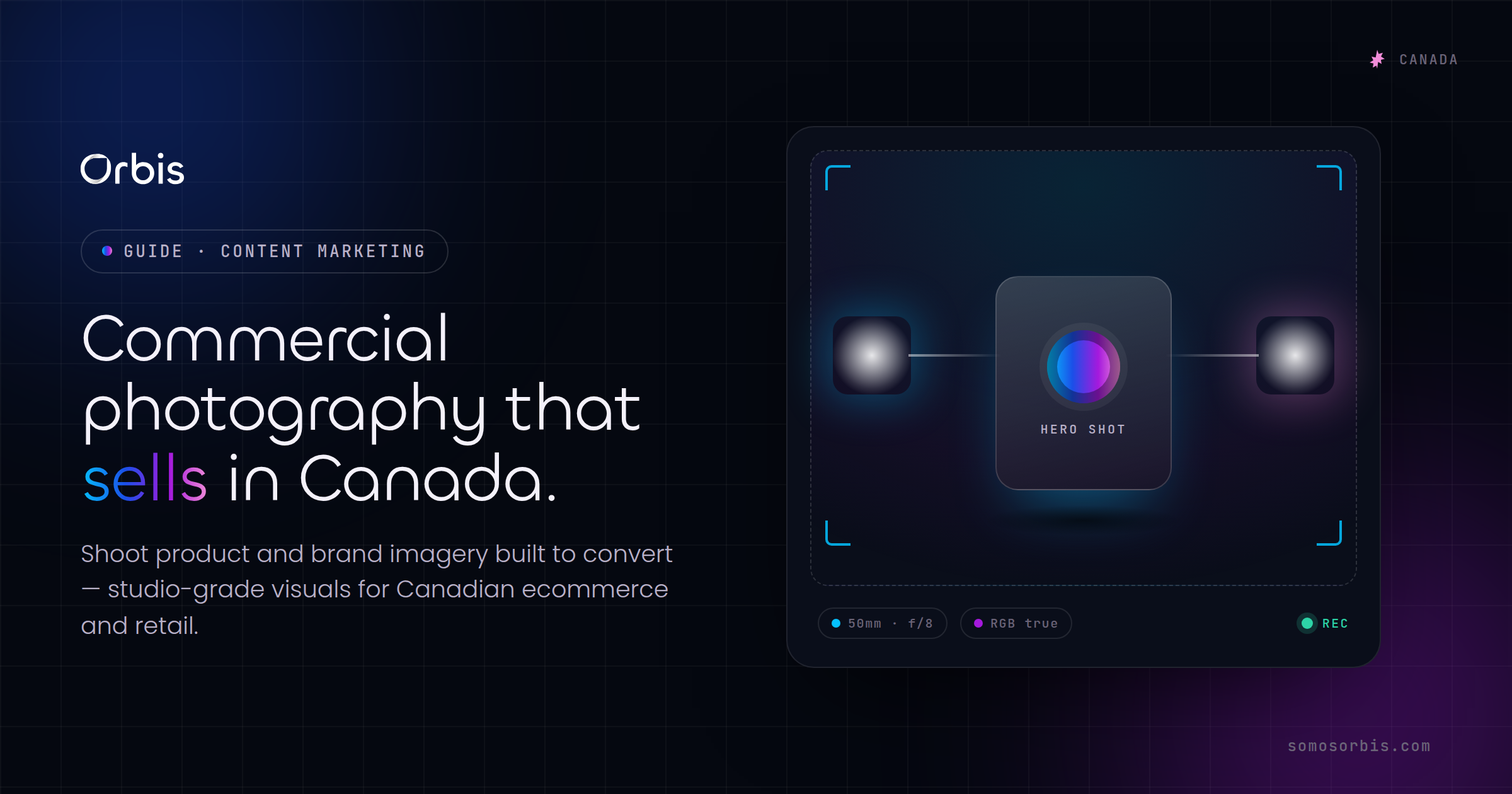
A commercial photo shoot is one of the few marketing investments that touches almost everything your brand does. The same set of frames can end up on your product detail pages, your paid social ads, your retail packaging, your wholesale line sheets, and the email you send on Boxing Day. When the photography is sharp, consistent, and planned for that range of uses, it quietly lifts conversion across every channel. When it's an afterthought — shot in a hurry, lit badly, or framed for the wrong placements — it drags everything down. This guide walks through what actually goes into commercial photography for Canadian brands, and how to plan a shoot so the images earn their keep across the full marketing mix.
If you're building out your full content program, photography is one pillar among several. It's worth reading this alongside our complete guide to content creation in Canada, which frames how photography, video, and creator content work together as a system rather than as one-off projects.
What "commercial photography" actually covers
Commercial photography is a broad umbrella, and the first planning conversation is usually about scope. Different shoot types have different setups, budgets, and crews, so naming what you need keeps the project honest. The most common categories Canadian brands ask for are:
- Product photography — clean, accurate images of the product itself, usually on white or a controlled background, for catalogues, marketplaces, and product pages.
- Lifestyle photography — the product in use, in a real or styled environment, with or without people, built to sell a feeling as much as a feature.
- Brand and editorial photography — imagery that communicates who you are: your space, your team, your craft, your customers.
- Packaging and detail photography — macro and texture work that shows materials, finishes, and the small details that justify a premium price.
- E-commerce flat lays and 360° sets — structured, repeatable formats designed for marketplace requirements and conversion.
Most brands need a blend. A skincare company launching in Canada might need clean product shots for Amazon and Shoppers Drug Mart listings, lifestyle imagery for Instagram and Meta ads, and detail shots of the packaging for their own site. Naming the mix up front is what lets you shoot it all efficiently in one production block instead of paying for three separate shoots.
Plan for multi-channel use before you book the studio
The single biggest mistake we see is planning a shoot around one channel — usually the website — and then scrambling to retrofit those images for everything else. Paid social, retail, email, and marketplaces all have different aspect ratios, safe zones, and content rules. If you shoot tight to a 1:1 crop, you have nothing left for a vertical 9:16 Reel or a wide hero banner.
The fix is to build a channel map before the shoot and bring it to the photographer. For each frame you want, decide where it will live and what crops it needs to survive. A practical channel map for a Canadian brand usually includes:
- Owned site — product pages, category headers, homepage hero (typically 1:1 and 16:9).
- Marketplaces — Amazon.ca, Walmart Canada, Best Buy Marketplace, each with their own pixel and background requirements.
- Paid social — Meta, Pinterest, and increasingly TikTok placements that demand 4:5 and 9:16 verticals with room for text overlays and CTAs.
- Email and CRM — banner-friendly horizontals for campaign sends and seasonal promotions.
- Retail and wholesale — clean, high-resolution files for line sheets, in-store screens, and partner co-marketing.
When you frame for the widest use up front — shooting a little loose so you can crop in multiple directions — one capture serves five channels. That's the difference between a shoot that produces 40 deliverables and one that produces 400. Our commercial photography service is built around this multi-channel planning so the asset library you walk away with is genuinely reusable.
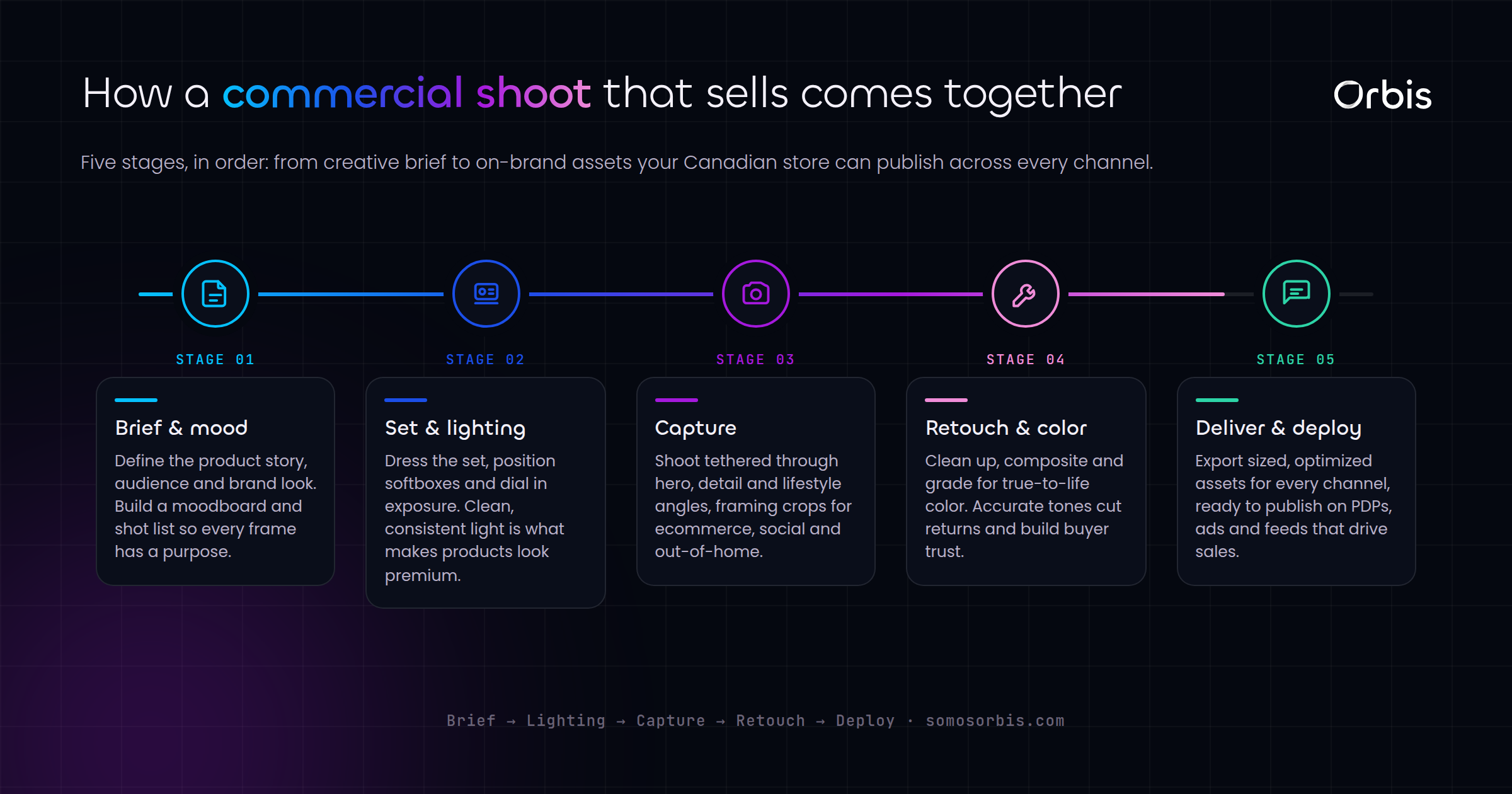
The anatomy of a commercial shoot
A well-run commercial shoot has a predictable shape. Understanding the phases helps you budget realistically and know what you're paying for.
Pre-production
This is where shoots are won or lost. Pre-production covers the creative brief, the shot list, mood boards, prop and set sourcing, model casting if people are involved, location scouting, and the production schedule. For Canadian brands shooting bilingual campaigns, this is also where you flag any frames that need to leave room for French copy — French text typically runs 15–20% longer than English, so your packshots and lifestyle frames need negative space that accommodates both EN and FR overlays.
Styling and set
Styling is the discipline that separates amateur product photos from images that sell. A food stylist, prop stylist, or set designer makes the product look its best and keeps it consistent across hundreds of frames. For lifestyle work, wardrobe, location dressing, and the small choices — a coffee cup, the right hands, a seasonal prop — do the storytelling.
Lighting and capture
Lighting is the technical core. Clean e-commerce product shots usually need soft, even, shadow-controlled lighting so the product reads true on a marketplace listing. Lifestyle and brand work leans on directional light and mood. A good photographer shoots tethered to a monitor so the team can approve framing, focus, and exposure in real time, which dramatically reduces costly reshoots.
Selects and post-production
After the shoot, you cull the raw captures down to selects, then retouch. Retouching for commercial work means colour accuracy (critical — your product needs to look the same on screen as it does in the customer's hands), clipping paths for clean backgrounds, blemish and dust removal, and final crops to channel specs. Colour accuracy matters even more for Canadian brands selling regulated categories like cosmetics or supplements, where misleading imagery creates real compliance exposure.
Product photography that converts on marketplaces
If you sell on Amazon.ca, Walmart Canada, or Best Buy Marketplace, your photography is doing direct conversion work, and the platforms have rules. The main image almost always has to be the product on pure white with no props, text, or logos, filling most of the frame. Get the main image wrong and the listing underperforms no matter how good your copy is.
Where you win is in the supporting gallery images. The frames after the main shot are your sales pitch:
- Scale and dimension shots — show the product in hand or next to a familiar reference so shoppers understand size.
- Feature callouts — annotated images that highlight what matters, with room for bilingual labels if you're selling nationally.
- In-use lifestyle frames — the product solving the problem, ideally in a recognizably Canadian context.
- What's-in-the-box and detail macros — reduce uncertainty and returns.
Plan these gallery frames as deliberately as the hero. They're where considered purchases actually get made.
Lifestyle and brand imagery that feels Canadian
Generic stock-looking imagery is easy to scroll past. Imagery that feels grounded in your customer's world earns attention. For Canadian brands, "feels Canadian" rarely means leaning on clichés — it means the seasonal, environmental, and cultural cues that read as real to a Toronto, Vancouver, Montreal, or Calgary audience.
Practical ways to build that in:
- Shoot for Canadian seasonality. Plan your imagery against the calendar your customers live by — back-to-school in late summer, the long holiday and Boxing Day run, and the genuinely cold-weather window that shapes everything from apparel to comfort products. Shoot seasonal sets in advance so you're never publishing summer imagery in a campaign that lands in February.
- Reflect the audience. Casting and styling that reflect the diversity of Canadian cities reads as authentic rather than performative, and it broadens the range of customers who see themselves in your brand.
- Plan bilingual from the frame. If you market in Quebec, leaving compositional room for French copy in the original capture is far cheaper than recropping a full library later.
Lifestyle photography also feeds directly into your video and short-form content. If you're capturing stills and motion in the same production block, you get enormous efficiency — see our breakdown of video production for Canadian brands for how to structure a combined photo-and-video shoot day so one crew, one location, and one set delivers both.
How commercial photography works with creator content
Polished commercial photography and raw creator content aren't competitors — they're a portfolio. Your owned channels and marketplace listings need the controlled, on-brand precision of a professional shoot. Your paid social and community feeds often perform better with the authentic, native-feeling texture of creator and user-generated content. The strongest brands run both and know which to deploy where.
A common pattern: use commercial photography for the hero placements where trust and clarity drive the sale, and layer in creator content for top-of-funnel reach and social proof. If that mix is new to you, our guide to UGC content for Canadian brands explains how to source, brief, and use creator imagery alongside your produced assets without diluting the brand.
Budgeting and rights: the parts brands forget
Two things derail photography budgets more than the shoot itself: scope creep and usage rights.
On scope, the cost driver is rarely the camera — it's the number of unique setups, the styling complexity, and the volume of post-production. A shoot of 12 products on white is fast and predictable. The same 12 products in styled lifestyle scenes with models is a different production entirely. Be explicit about deliverable counts and setups so the quote matches reality.
On rights, make sure your agreements cover everything you actually plan to do with the images. Watch for:
- Usage scope — organic social only, or paid advertising too? Paid usage typically costs more and needs to be agreed up front.
- Talent releases — if there are people in frame, you need signed model releases covering the channels and duration you'll use the images.
- Term and territory — how long you can use the images and where. National Canadian campaigns and bilingual rollouts should be specified.
- Music and props — if any licensed elements appear, confirm they're cleared for your intended use.
Getting rights right is part of running marketing as documented, defensible process rather than a series of one-off favours — the difference between a brand that scales cleanly and one that hits legal snags the moment a campaign succeeds.
A simple pre-shoot checklist
Before you confirm any commercial shoot, run through this:
- Defined shot list mapped to every channel that will use the images.
- Aspect ratios and safe zones noted for each placement (1:1, 4:5, 9:16, 16:9).
- Bilingual copy space accounted for in compositions, if marketing in Quebec.
- Seasonal sets planned against the Canadian calendar and shot in advance.
- Styling, props, casting, and location locked before the day.
- Tethered capture and on-set approval workflow agreed.
- Post-production scope — selects, retouching, colour accuracy, clipping paths, crops — clearly quoted.
- Usage rights, talent releases, term, and territory documented.
If you can tick all eight, you'll walk away with an asset library that works everywhere, not a folder of pretty pictures you can only use once.
Ready to plan a shoot that sells across every channel?
Commercial photography is most valuable when it's planned as a multi-channel asset library from the first conversation — framed for your site, your marketplaces, your paid social, your retail partners, and your seasonal Canadian calendar all at once. That's how a single production block delivers months of high-performing imagery instead of a handful of one-off shots.
If you're ready to brief a shoot built around how Canadian customers actually buy, explore our commercial photography service and let's plan imagery that earns its place on every page, feed, and listing where your brand shows up.