
Canada's B2B market is small, concentrated, and unforgiving of waste. A handful of cities — Toronto, Vancouver, Montreal, and Calgary — hold most of the decision-makers worth reaching, and those buyers move in tight professional circles where reputation travels fast. LinkedIn is the one channel where you can target those people by the exact attributes that define a B2B buyer: job title, seniority, company size, industry, and skills. The trade-off is cost. LinkedIn is the most expensive social platform in Canada on a per-click basis, and the audience pools are thin. That combination rewards discipline and punishes spray-and-pray. This guide covers how to target, structure, format, and budget LinkedIn Ads campaigns built specifically for Canadian B2B buyers, so every dollar lands in front of someone who can actually sign.
If you are still deciding where LinkedIn fits alongside Meta, TikTok, and other paid social channels, start with our complete guide to social media advertising in Canada, which maps the full landscape. This post goes deep on LinkedIn specifically.
Why LinkedIn Works for Canadian B2B — and Where It Doesn't
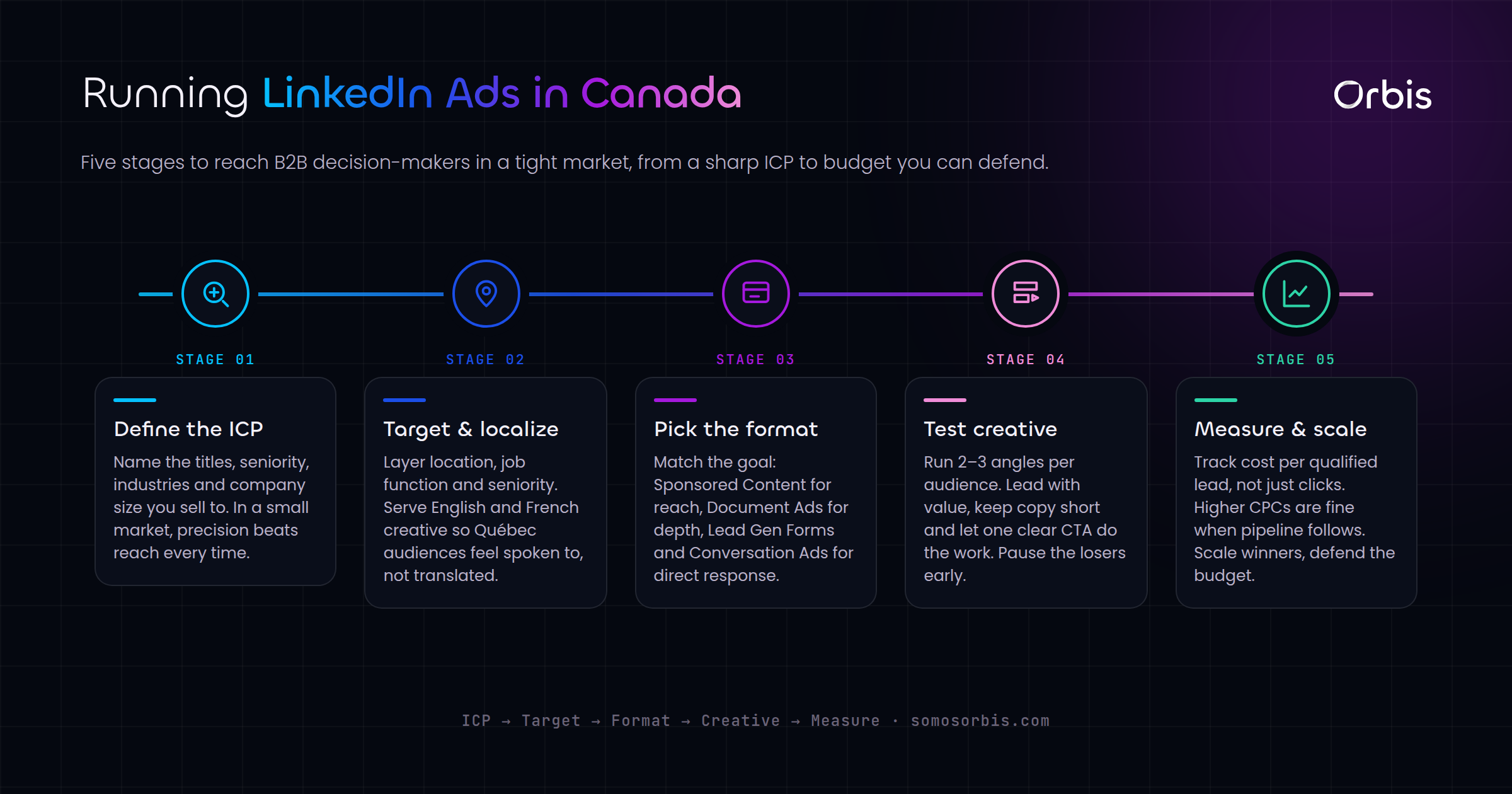
LinkedIn's value in Canada comes down to one thing: it is the only major platform where users tell you, voluntarily and continuously, what they do for a living and who they work for. That makes professional targeting possible at a precision no other channel can match. For a company selling accounting software to mid-market manufacturers in Ontario, or compliance services to credit unions in the Prairies, that precision is the whole point.
But LinkedIn is not a fit for every B2B offer. It works best when:
- Your buyer is identifiable by professional attributes. If the person who signs off on your product has a title like "VP Finance," "Director of Operations," or "Head of Procurement," LinkedIn can find them. If your buyer is a small-business owner who never updates their profile, reach gets thin.
- Your deal size justifies the cost. With cost-per-click frequently landing in the $7–$15 CAD range and cost-per-lead often $80–$200+ CAD, LinkedIn rarely makes sense for products with low contract values. A $400/month SaaS tool can work; a $20/month one usually can't.
- You have a considered sales cycle. LinkedIn shines for offers that require education and trust over weeks or months, not impulse purchases.
If your offer doesn't meet those conditions, you may get better B2B traction from broader social channels. Some Canadian B2B brands have found success with visually driven storytelling on other platforms — our breakdown of Instagram Ads for Canadian brands covers how brand-led formats can warm up an audience before a LinkedIn retargeting push. And for top-of-funnel awareness in professional contexts, audio has a role too; see how Spotify Ads work in the Canadian market for reaching commuters and remote workers during the workday.
Targeting Canadian Decision-Makers Without Burning Budget
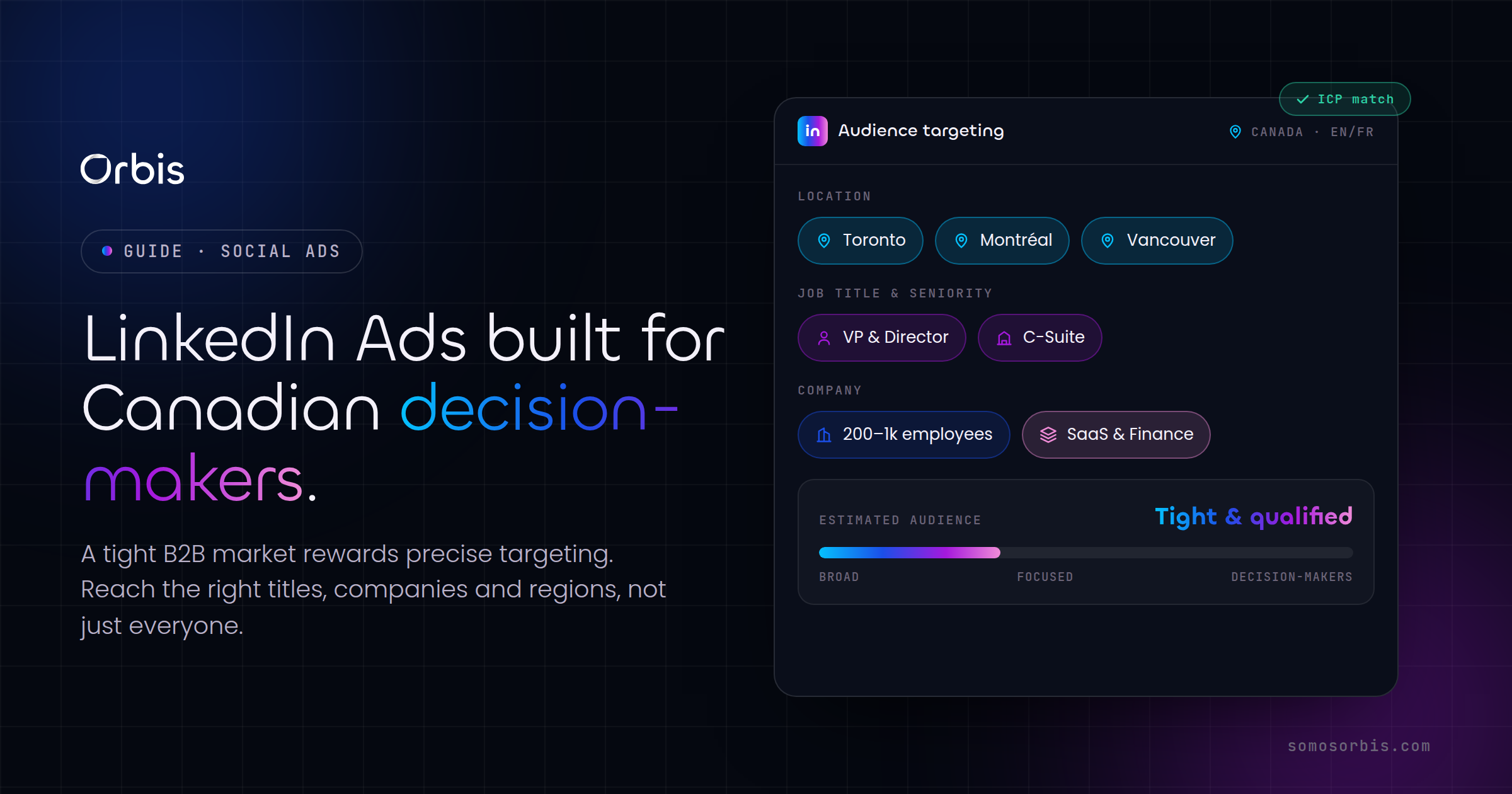
The single biggest mistake Canadian advertisers make on LinkedIn is layering too many filters onto an already small market. Canada has roughly a tenth of the U.S. population, and English-Canadian and French-Canadian audiences are distinct. Stack "Toronto + VP-level + 200–500 employees + SaaS industry + 5 specific skills" and you can shrink an audience to a few thousand people — too small to optimize, too expensive to convert.
Build From the Buyer, Not the Filters
Start by writing down who actually approves your purchase, then choose the one or two targeting dimensions that identify them most reliably. For most Canadian B2B campaigns, the strongest combinations are:
- Job Title + Company Size. The cleanest signal. "Director of Marketing" at companies with 50–1,000 employees is a tighter, more reliable audience than skills-based guessing.
- Job Function + Seniority. Useful when titles vary too much. Targeting the "Finance" function at "Director" and "VP" seniority captures controllers, finance directors, and VPs Finance in one pool.
- Industry + Seniority. Best when your product is industry-specific — for example, reaching senior staff across Canadian credit unions, logistics firms, or healthcare providers.
Avoid stacking skills, groups, and interests on top of these. Each added filter narrows reach and raises cost. Use one primary identifier plus, at most, one secondary refinement.
Geography: Match the Market's Real Shape
Canada's B2B economy is regional. Financial services and tech cluster in Toronto; energy and resources in Calgary and Edmonton; tech and trade in Vancouver; and a large French-first market in Montreal and across Quebec. Three practical rules:
- Don't default to "Canada" nationally if your sales team only covers certain provinces. Target the regions you can actually service.
- Treat Quebec as its own campaign. Run French-language creative for Quebec audiences. A franco buyer scrolling past English-only ads is a wasted impression — and in some sectors, French-first communication is also a compliance expectation, not just a courtesy.
- Use "permanent location," not "recent," for B2B. You want people who live and work in your service area, not visitors.
Matched Audiences and Retargeting
The highest-ROI targeting on LinkedIn in a small market is almost always your own data:
- Contact list uploads. Upload your CRM list of target accounts or known contacts. In a market the size of Canada, a well-built account list can cover a meaningful share of your total addressable market.
- Company list (Account-Based Marketing). Upload named target accounts and serve ads only to people at those companies. This is the most efficient use of LinkedIn for Canadian enterprise sales.
- Website retargeting. Install the LinkedIn Insight Tag and re-engage visitors who didn't convert. Given how expensive cold LinkedIn traffic is, retargeting warm visitors is one of the few ways to keep blended cost-per-lead reasonable.
- Engagement retargeting. Re-target people who watched your video or interacted with a Lead Gen Form. These warm audiences convert far better than cold prospecting.
Choosing the Right Ad Formats
LinkedIn offers several formats, and the right choice depends on where the buyer sits in your funnel. Spreading budget evenly across all of them is a common waste; instead, match format to objective.
Single Image Sponsored Content
The workhorse. It appears natively in the feed, supports a clear headline and call-to-action, and is the easiest format to test quickly. Use it for both awareness and conversion. Keep the visual clean and the value proposition legible on mobile, where most Canadian professionals scroll.
Document Ads
One of the strongest formats for Canadian B2B right now. You promote a multi-page PDF — a guide, checklist, or report — directly in the feed, and users swipe through it without leaving LinkedIn. Pair it with a Lead Gen Form to capture contacts who download the full asset. Document Ads tend to deliver strong engagement and lower cost-per-lead because they give value before asking for anything.
Video Ads
Best for awareness and for warming audiences you'll later retarget with a conversion offer. Keep videos short — 15 to 30 seconds — and design them to communicate with the sound off, since most feed views are muted. Captions are essential, and in Quebec, French captions are non-negotiable.
Lead Gen Forms
LinkedIn's Lead Gen Forms pre-fill a user's professional details from their profile, dramatically reducing friction. For a Canadian market where every click is expensive, removing form friction directly protects your cost-per-lead. Use them with Document Ads and Single Image Ads for demo requests, guide downloads, and webinar registrations. Always connect the form to your CRM so leads route to sales immediately rather than sitting in LinkedIn's interface.
Conversation and Message Ads
These land in the LinkedIn inbox and can drive high response rates, but use them carefully. Canadian professionals are protective of their inboxes, and a clumsy message reads as spam. Reserve message formats for high-value, clearly relevant offers — an executive roundtable invitation, a tailored assessment — and never for generic pitches.
Budgeting and Bidding in a High-Cost, Low-Volume Market
LinkedIn enforces minimum daily budgets (around $10 USD per campaign), but realistic testing requires more. Because clicks are expensive and audiences are small, you need enough spend to gather signal without exhausting your audience too fast.
Set Expectations on Cost
Plan around Canadian benchmarks, not consumer-platform numbers:
- CPC: commonly $7–$15 CAD, higher for senior decision-makers in finance, legal, and tech.
- CPM: often $30–$60 CAD for tightly targeted audiences.
- Cost-per-lead: frequently $80–$200+ CAD, depending on offer quality and friction.
These numbers look alarming next to Meta, but the comparison is misleading. A LinkedIn lead is a named professional at a known company with a verified title. The right metric is cost per qualified opportunity and, ultimately, customer acquisition cost against deal value — not cost per click.
A Practical Budget Structure
- Start with one tightly defined audience and one offer. Don't fragment a small Canadian audience across ten campaigns. Concentrate spend so the algorithm and your data both get enough signal.
- Use manual or maximum-delivery bidding while learning. Automated bidding can overspend fast on thin audiences. Cap your bids until you understand your true cost-per-result.
- Budget for a full sales cycle, not a week. B2B buyers don't convert on first touch. Plan a minimum 8–12 week run so retargeting and frequency can do their work.
- Allocate roughly 60% to prospecting and 40% to retargeting once you have warm audiences built. The retargeting layer is where a high-cost channel becomes efficient.
Watch Frequency in a Small Market
Because Canadian audiences are small, you'll hit high frequency faster than U.S. advertisers do. Monitor frequency weekly. When the same buyers have seen an ad five or more times without converting, refresh the creative or rotate the offer rather than pushing more spend at a fatigued audience. Creative fatigue is the silent killer of LinkedIn performance in markets the size of Canada.
Measuring What Actually Matters
Vanity metrics — impressions, clicks, even raw lead counts — will mislead you on LinkedIn. Build measurement around the full revenue path:
- Lead quality, not just lead volume. Tag LinkedIn leads in your CRM and track how many become sales-qualified opportunities. A campaign with fewer, higher-quality leads usually wins.
- Pipeline contribution. Connect closed-won revenue back to LinkedIn campaigns. This is where the channel's high CPC justifies itself.
- Cost per opportunity and per customer. These are the only numbers that tell you whether to scale or pause.
This requires clean tracking from the LinkedIn Insight Tag through your CRM. Getting that plumbing right is part of running LinkedIn as a revenue engine rather than a brand-awareness expense. Documented processes for lead routing, attribution, and follow-up are what separate campaigns that report "leads" from campaigns that report closed deals — and in a market where each lead costs real money, that discipline pays for itself.
A Realistic 90-Day Plan for Canadian B2B Teams
- Weeks 1–2: Install the Insight Tag, build your matched audiences (CRM upload, target-account list), and define one primary prospecting audience by title or function plus company size.
- Weeks 3–6: Launch with two formats — a Document Ad with a Lead Gen Form for prospecting, and Single Image Ads for the same audience. Run English and French variants where Quebec is in scope. Keep creative variations limited so each gets enough budget.
- Weeks 7–9: Layer in website and engagement retargeting. Cut the weakest-performing creative and double down on what's producing qualified leads, not just cheap clicks.
- Weeks 10–12: Review pipeline contribution with your sales team, refine targeting based on which segments actually closed, and decide where to scale spend.
Make LinkedIn Pay Off in a Tight Market
LinkedIn rewards advertisers who treat Canada's small, high-value B2B market with precision: target by the attributes that define your buyer, respect the English/French divide, match formats to funnel stage, and measure against pipeline rather than clicks. Done well, it puts your offer in front of the exact people who can approve it — and that access is worth the premium price.
If you want a LinkedIn program built around your real buyers, your sales cycle, and proper CRM-connected measurement, explore our LinkedIn Ads management services for Canadian businesses. As a Google Partner with 15+ years and a 4.9-star rating across 58 reviews, our team builds campaigns engineered for revenue, with documented processes and compliance built in from day one — so your budget reaches decision-makers, not just impressions.