
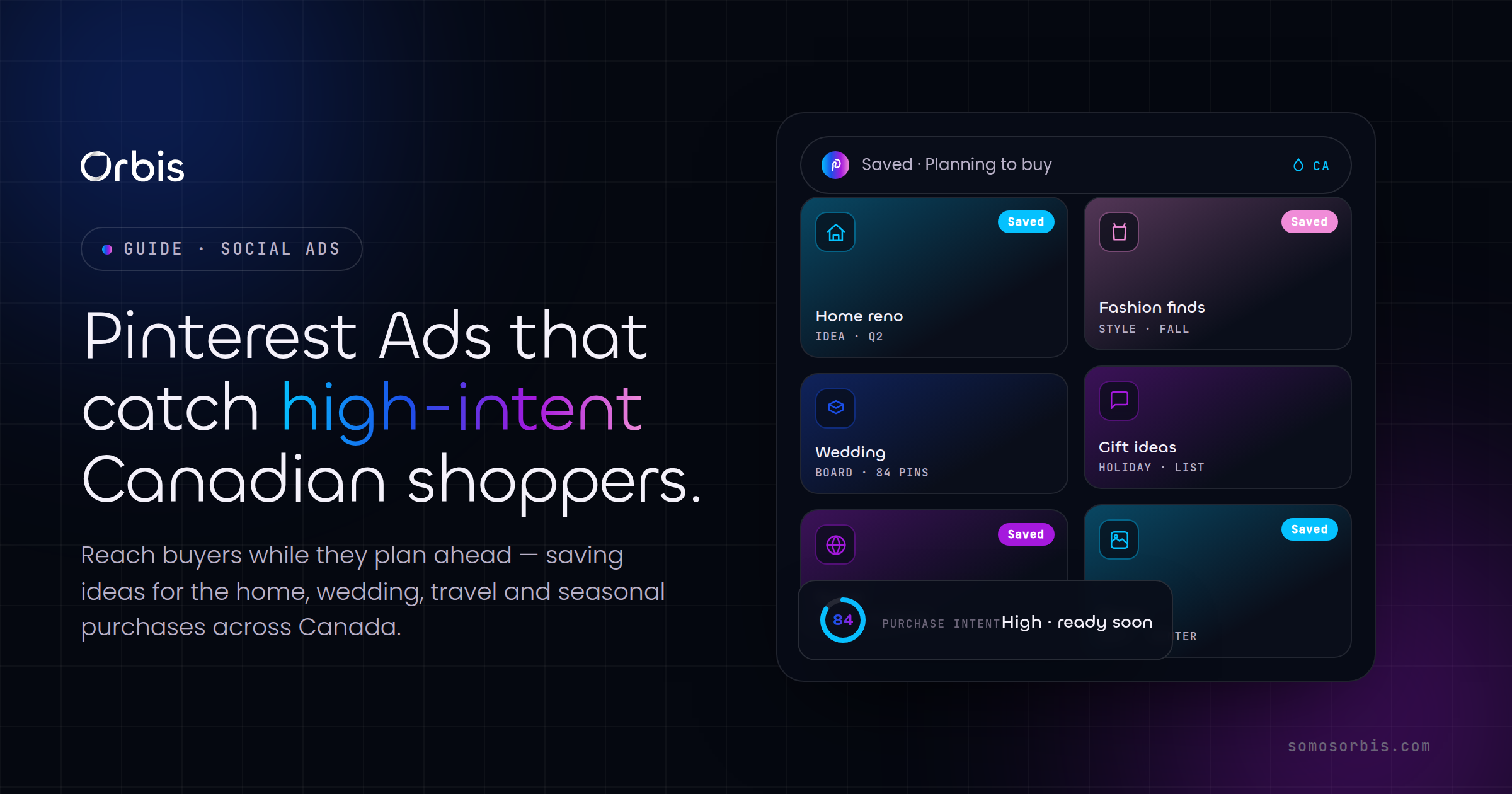
For Canadian retail and lifestyle brands, the hardest part of advertising is rarely the sale itself. It's reaching shoppers before they've decided what to buy, while they're still dreaming about a kitchen renovation, planning a Whistler ski trip, or quietly building a cart of back-to-school outfits for kids in Mississauga. That planning window is where Pinterest lives. Unlike feeds built for entertainment, Pinterest is a visual search and discovery engine where people actively save ideas for purchases they intend to make. For brands selling home goods, fashion, food, beauty, weddings, and travel to Canadian audiences, that high-intent, future-focused mindset is a genuine advantage you can advertise against. This guide breaks down how to use Pinterest Ads built for Canadian shoppers to reach planners at the exact moments they're deciding where their money goes.
Why Pinterest Works Differently for Canadian Brands
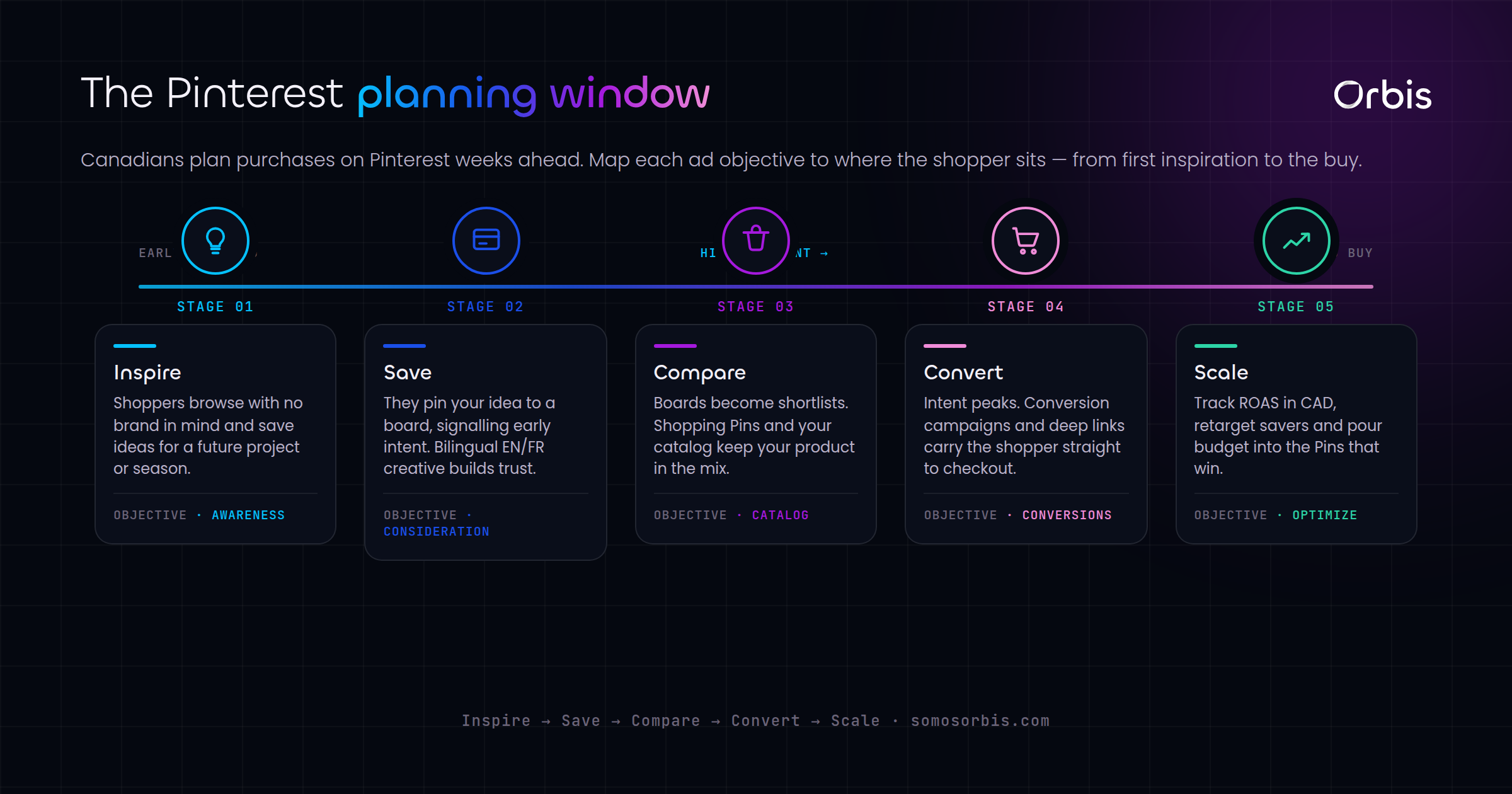
Most paid social platforms interrupt people who came to scroll, laugh, or watch. Pinterest is the opposite: users arrive with a goal. They're searching "small kitchen ideas," "Canadian winter capsule wardrobe," or "Thanksgiving dinner recipes" and saving the results to boards they'll act on weeks or months later. That changes everything about how you should plan, budget, and measure campaigns.
Three characteristics make Pinterest especially useful for Canadian retail and lifestyle advertisers:
- Intent over impulse. A pin saved in March for a summer cottage project is a purchase signal with a long fuse. You're not fighting for an impulse buy; you're getting your product into a consideration set early.
- Long content lifespan. A strong organic pin can keep driving saves and clicks for months, which lowers the effective cost of the creative you produce for ads. The same asset that performs as a paid Pin often keeps working organically afterward.
- Underused by competitors. Many Canadian brands pour everything into Meta and Google. That leaves Pinterest's planning-stage audience comparatively less contested, often with friendlier costs per click for the same retail categories.
If you're still mapping out where Pinterest fits alongside your other channels, start with our broader guide to social media advertising in Canada, which lays out how each platform earns its place in a Canadian media mix. Think of this post as the Pinterest-specific deep dive within that larger framework.
The Canadian Planner's Calendar: Timing Is Everything
Pinterest users plan ahead, and the data consistently shows that seasonal searches spike weeks earlier on Pinterest than the actual buying moment. For Canadian brands, that means you have to advertise to a calendar that runs slightly ahead of the one your customers feel. Here's how the key Canadian retail moments map to Pinterest planning behaviour.
Back-to-School (searches build in June and July)
Canadian parents start saving classroom outfits, dorm setups, lunch ideas, and study-space inspiration well before August. If you sell apparel, stationery, home organization, or food, your Pinterest spend should be live in early summer, not when the flyers hit in late August. Reaching planners in June lets you earn the save that becomes a September purchase.
Fall and Halloween (searches build in August and September)
Cozy home decor, costume DIY, and autumn recipes are perennial Pinterest categories. Lifestyle and food brands across Canada can ride this with seasonal collections, gift-able products, and "Canadian fall" content that feels regional rather than generic North American.
Holidays, Boxing Day, and Gifting (searches build September through November)
Gift planning on Pinterest starts shockingly early. Canadian shoppers are saving holiday tablescapes, gift guides, and decor in early autumn. Boxing Day and post-holiday sales are also planned in advance by deal-conscious shoppers. Brands that wait until December to advertise are arriving after the boards are already built. Get your gift-focused Pins and campaigns live by late September to early October.
Spring, Weddings, and Renovations (searches build January through March)
The Canadian winter is prime planning season for spring and summer projects. Wedding inspiration, patio and garden ideas, home renovations, and travel boards all surge in the cold months. If you sell anything tied to spring activity, your quietest sales months are your busiest advertising months.
Building Pinterest Ad Campaigns That Convert
Pinterest's ad structure rewards advertisers who match their objective to where the user is in the planning journey. A scattershot approach wastes budget. A staged approach respects how planners actually move from idea to purchase.
Match Your Campaign Objective to Intent
- Awareness and consideration. Early in a season, run campaigns optimized for saves, video views, and traffic. You're planting your product in boards and consideration sets. This is the work that pays off weeks later.
- Conversion. As the buying window approaches, shift budget to conversion campaigns optimized for checkout, add-to-cart, or lead actions. The planners you reached earlier are now ready to act, and you can retarget the users who saved or clicked.
- Catalogue and shopping. For retailers with a product feed, Shopping ads and dynamic retargeting turn browsing into purchases by showing the exact products a user engaged with.
Creative That Earns the Save
Pinterest is a visual platform first, and weak creative simply won't perform no matter how good your targeting is. A few principles consistently work for Canadian retail and lifestyle brands:
- Vertical, high-resolution imagery. A 2:3 aspect ratio is the standard. Bright, clean, lifestyle-driven photography outperforms flat product shots.
- Text overlays that promise value. "5 small-space storage ideas" or "Canadian winter outfits that actually keep you warm" tell the user exactly what they'll get.
- Idea Pins and video. Multi-frame and video formats earn more engagement and let you tell a richer story, from how-to sequences to seasonal lookbooks.
- Seasonally and regionally relevant scenes. Show the snowy porch, the cottage dock, the autumn maple street. Canadian shoppers respond to imagery that reflects their actual climate and lifestyle, not borrowed US summer scenes in November.
The creative discipline that wins on Pinterest carries over to other visual platforms. If you're producing seasonal lookbooks and lifestyle imagery, you can repurpose much of it for the channels covered in our breakdown of Instagram Ads for Canadian brands, where the same assets work in a more immediate, feed-driven context.
Targeting High-Intent Canadian Shoppers
Pinterest's targeting options let you reach planners with precision while still respecting the discovery nature of the platform. The strongest results usually come from combining a few approaches rather than relying on any single one.
- Keyword targeting. Bid on the search terms your customers use while planning. This is the closest Pinterest gets to search-engine intent, and it's where high-purchase-intent users surface.
- Interest targeting. Reach users engaged with categories like home decor, women's fashion, food and drink, or travel. Useful for top-of-funnel reach.
- Audience targeting. Upload customer lists, retarget site visitors via the Pinterest tag, and build actalike (lookalike) audiences from your best customers. For Canadian brands, layering geographic targeting on top keeps spend focused on provinces and cities you can actually serve and ship to.
- Bilingual considerations. If you serve Quebec or market nationally, consider French-language creative and keywords for francophone planners. A campaign that speaks to a Montreal shopper in French often outperforms an English-only equivalent in that market.
The audiences you build on Pinterest don't live in isolation. A planner who saves your products today may convert on Pinterest, search for you on Google next month, or encounter your retargeting on another channel. Treating Pinterest as one coordinated layer of a full-funnel program, rather than a standalone experiment, is what turns saves into measurable revenue.
Measuring What Matters: Beyond the Last Click
The biggest mistake brands make with Pinterest is judging it by last-click conversions alone. Because the platform's value is in the planning stage, much of its impact shows up later, on other channels, after the save. If you only credit Pinterest for purchases that happen in the same session, you'll systematically undervalue it and cut a channel that's actually feeding your funnel.
A more honest measurement approach includes:
- Install the Pinterest tag properly. Track saves, clicks, add-to-carts, and checkouts so you can see the full path, not just immediate sales.
- Watch assisted conversions. Use your analytics platform to see how often Pinterest appears as an early touchpoint in journeys that close elsewhere.
- Account for the planning lag. A March campaign for summer products should be evaluated against summer sales, not March sales. Build reporting windows that match the planning behaviour.
- Track saves as a leading indicator. A rising save rate today is a forecast of clicks and conversions in the weeks ahead.
This measurement discipline is part of what we call Business Assurance: documented processes and revenue engineering that connect each channel to outcomes you can actually see. Getting the tracking and attribution right before you scale spend is the difference between a Pinterest program you can defend in a budget meeting and one that gets cut on a hunch.
How Pinterest Fits With Your Other Paid Channels
Pinterest is rarely a brand's only paid channel, nor should it be. It works best as the planning-stage layer of a coordinated mix. Here's a simple way to think about the division of labour for a Canadian retail or lifestyle brand:
- Pinterest reaches planners early, during the dreaming and saving stage, and keeps your product in consideration sets through long content lifespan.
- Instagram drives immediate engagement and social proof in a fast-moving feed, ideal for launches and time-sensitive promotions.
- TikTok captures cultural momentum and trend-driven discovery, especially with younger Canadian audiences.
- Google Search catches the demand that all of the above created, when the planner finally types in a purchase-ready query.
If a younger, trend-led audience is part of your strategy, it's worth pairing your Pinterest planning campaigns with the tactics in our look at TikTok Ads and Canadian trends. Pinterest captures the deliberate planner; TikTok captures the spontaneous discoverer. Together they cover both halves of how Canadians actually find and decide on products.
A Practical First-90-Days Plan
If you're launching Pinterest Ads for the first time, resist the urge to go broad immediately. A disciplined ramp gives you cleaner data and a stronger foundation. Here's a sequence that works for most Canadian retail and lifestyle brands:
- Weeks 1 to 2: Foundation. Install and verify the Pinterest tag, connect your product catalogue, and confirm conversion events fire correctly. Audit your existing organic Pins to see what already resonates.
- Weeks 3 to 6: Test creative and keywords. Run consideration campaigns with several creative variations and keyword sets. Identify which imagery, text overlays, and search terms earn the most saves and clicks at the lowest cost.
- Weeks 7 to 10: Scale winners and add retargeting. Increase budget on the top performers, launch conversion campaigns, and turn on retargeting for users who saved or clicked.
- Weeks 11 to 13: Align with the next season. Look at the Canadian planning calendar and pre-build campaigns for the next seasonal window so you're advertising ahead of demand, not chasing it.
Throughout, document what works. The creative angles, keywords, and timing that perform for your category become a reusable playbook, which is exactly the kind of repeatable, process-driven growth that compounds over time.
Ready to Reach Canada's High-Intent Planners?
Pinterest rewards brands that understand its planning-stage mindset and advertise ahead of the Canadian seasonal calendar. Done well, it puts your products into consideration sets weeks before the purchase, at costs that are often friendlier than the more crowded platforms. The key is matching your campaigns to intent, building creative that earns the save, targeting the right Canadian audiences, and measuring beyond the last click.
If you'd like a team that builds Pinterest programs around real intent and documented, revenue-focused processes, explore our Pinterest Ads services for Canadian brands. As a Google Partner with more than 15 years of experience and 500-plus clients, Orbis helps Canadian retail and lifestyle brands turn planners into buyers, one well-timed Pin at a time.