
Aerial footage has gone from a novelty to a baseline expectation. A real estate listing in Mississauga, a tourism reel for the Sea-to-Sky corridor, or a brand film shot over a Calgary facility all read as more credible when the camera lifts off the ground. But in Canada, flying a drone for commercial work is not a hobby activity you can wing on a Saturday. Transport Canada regulates the airspace, the pilots, and increasingly the aircraft themselves, and the rules tightened again in 2025. If you are planning aerial content for Canadian audiences, the difference between a clean shoot and a grounded one comes down to planning the regulatory side as carefully as the creative side. This guide walks through both, with Canadian specifics you can act on.
If you are mapping out a broader visual program and want context on where drone work fits alongside video, photography and creator content, start with our complete guide to content creation in Canada, which frames the full production stack. This post zooms into the aerial piece.
Why aerial content earns its keep in Canada
Canada is a country built for the wide shot. Coastlines, prairie scale, mountain ranges, ravine-laced cities, lakefront cottage country, and dense urban cores all reward elevation. For the three sectors that commission the most drone work, the case is concrete:
- Real estate. Aerial establishes lot size, proximity to amenities, waterfront access, and neighbourhood context that ground photography cannot. For acreage outside Barrie, cottage properties in Muskoka, or new developments on the edge of Edmonton, the drone shot is often the deciding visual.
- Tourism and destination marketing. Provincial and municipal tourism boards lean on aerials to sell scale. A single sweeping pass over Peggy's Cove, Lake Louise, or the Cabot Trail does more than a paragraph of copy.
- Brand and corporate. Facility flyovers, event coverage, and recruitment films use aerials to signal size and ambition. A logistics company near the 401 corridor or a manufacturer in Winnipeg gains instant credibility from a clean overhead reveal.
The catch is that the visual payoff only lands if the footage is usable, and usability in Canada is gated by compliance. Footage shot illegally can expose your brand to fines, and a grounded crew on shoot day blows the budget regardless of how good the storyboard was.
Who regulates drones in Canada
Drones in Canada are governed by Transport Canada under the Canadian Aviation Regulations (CARs), Part IX. The rules apply to remotely piloted aircraft systems (RPAS) and have been evolving quickly. The headline points every commercial client should understand:
- Registration. Drones between 250 g and 25 kg must be registered with Transport Canada, and the registration number must be marked on the aircraft.
- Pilot certification. Operators need a valid pilot certificate. The category of certificate depends on where and how you fly.
- The 250 g threshold. Micro drones under 250 g (such as some sub-250 consumer models) are exempt from registration and certification requirements, but they are still subject to the general rule not to fly in a way that endangers aviation safety or people. For most professional cinematic work, the camera payload pushes you well over 250 g, so plan for the full regime.
The two certification levels that matter
Since the 2025 regulatory update, Transport Canada structures most commercial flying around these categories:
- Basic operations. Flying in uncontrolled airspace, more than 30 m horizontally from bystanders, and away from controlled airspace and people. This requires a Pilot Certificate for Basic Operations.
- Advanced operations. Flying in controlled airspace, near or over bystanders, or close to airports. This requires a Pilot Certificate for Advanced Operations, which involves a flight review with a qualified examiner, plus a drone that meets the relevant safety assurance declaration.
For commercial content, advanced certification is frequently the practical requirement, because the best shots tend to be in cities, near events, or over people. When you hire a production partner, confirm the assigned pilot holds the Advanced certificate and that the aircraft carries the manufacturer's safety assurance for the operation type. This is exactly the kind of compliance-by-design groundwork that separates a documented process from a gamble.
Controlled airspace, NAV CANADA, and the RPAS flight authorization
A huge share of Canada's commercially interesting locations sit inside controlled airspace. Downtown Toronto, much of Vancouver, the area around Montreal-Trudeau, and zones near regional airports all require authorization before a drone leaves the ground.
Authorization in controlled airspace runs through NAV CANADA's drone flight planning portal, which issues RPAS flight authorizations. The system tells you whether your intended flight is permitted, automatically approved, or requires manual review. Practical planning notes for a Canadian shoot:
- Check the airspace early. Use the NAV Drone tool during location scouting, not on shoot morning. A location that looks perfect on a map may sit in a no-fly zone or require lead time for approval.
- Build buffer for manual reviews. Some authorizations are instant; others take days. If your shoot is near a busy airport, assume the longer timeline.
- Respect aerodrome distances. There are minimum distances from airports and heliports. Hospitals with helipads in dense cities are an easy thing to overlook.
Restricted zones and temporary closures
Beyond permanent controlled airspace, watch for temporary restrictions. Forest fire zones in BC and Alberta during summer, major sporting events, and government sites can all trigger no-fly conditions. During wildfire season, flying a drone near active firefighting operations is both illegal and dangerous, and Transport Canada treats it seriously. Bake a final airspace check into your day-of checklist.
Privacy, property, and provincial considerations
Compliance is not only about aviation rules. Aerial cameras raise privacy questions, and Canada's privacy landscape is layered across federal and provincial law.
- Privacy expectations. Avoid capturing identifiable individuals on private property without a basis to do so. For real estate, frame the subject property and avoid lingering over neighbours' yards, pools, or windows.
- Provincial nuance. Quebec, British Columbia, and Alberta have their own private-sector privacy statutes that can apply alongside federal law. If your footage features people, get the location and talent releases sorted in advance.
- Property and trespass. You generally need permission to take off and land from private property. Securing launch sites in writing avoids day-of friction with property managers or condo boards.
None of this should scare you off aerial work. It simply means the legal and creative briefs need to travel together. When privacy and releases are handled upstream, the edit is clean and the asset is safe to run across paid and organic channels.
Planning a compliant, high-impact shoot
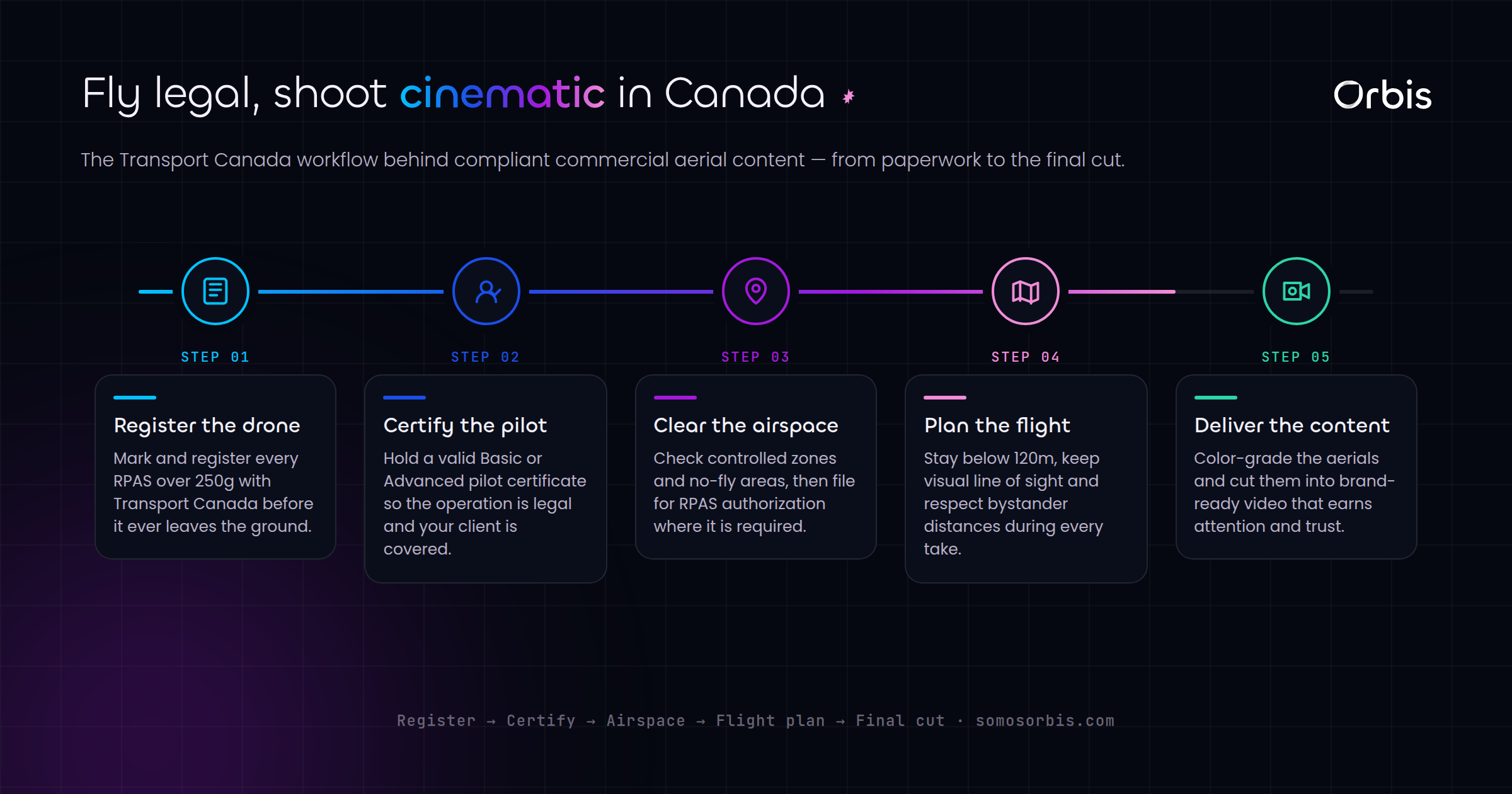
Here is a practical sequence that keeps a Canadian aerial shoot both legal and creatively strong. Treat it as a documented checklist your team reuses on every project.
- Define the shot list against the story. Decide what the aerials need to communicate: scale, context, motion, reveal. A real estate flyover and a tourism hero shot have different grammars.
- Scout the airspace, not just the view. Pull the location into the NAV Drone tool. Confirm whether it is uncontrolled, controlled, or restricted, and what certification level the flight demands.
- Match the pilot and aircraft to the operation. Confirm Advanced certification where required, registration markings, and the safety assurance declaration for the drone.
- Secure permissions. Launch and landing site permission, any required flight authorization, and talent or property releases.
- Plan for weather and season. Wind, cold, and precipitation all affect flight. Canadian winters limit battery performance, and high winds over open water or near tall buildings can ground a shoot. Build a backup date.
- Shoot redundantly. Capture safe coverage first, then push for the ambitious moves. Battery swaps, multiple passes, and varied altitudes give the editor options.
- Log the flight. Keep records of authorizations and flights. Documentation protects the client and supports any audit.
Seasonality is a Canadian creative lever
The calendar is a feature, not a constraint. Fall colour over Gatineau Park, fresh snow on a ski resort for a holiday campaign, spring melt on a riverfront, or summer patio season in a downtown core each give an aerial a time-stamped energy. Plan tourism and brand aerials around the season you want to sell, and book early, because the best light windows are short and the weather is unforgiving.
How aerial fits into a complete content system
Drone footage rarely stands alone. It is one layer in a content package that usually includes ground video, stills, and platform-specific edits. The strongest Canadian campaigns treat aerial as the opening or the punctuation, not the whole sentence.
- Pair aerials with strong video production for Canadian brands so the flyover hands off smoothly into ground-level storytelling and interviews.
- Combine drone reveals with commercial photography in Canada for the detail shots, interiors, and product stills that aerials cannot capture.
- Cut platform-native versions: a vertical 9:16 reveal for Reels and TikTok, a 16:9 hero for YouTube and the website, and tightened cuts for paid social where the first second has to land.
When these elements are produced as one system rather than separate buys, the brand language stays consistent and the production budget goes further. That is the difference between a one-off drone clip and a content engine that keeps feeding your channels.
Common mistakes to avoid
- Assuming a hobby drone equals a commercial shoot. Consumer footage is fine for fun; commercial use demands certified pilots and proper authorizations.
- Booking the location before checking the airspace. A stunning rooftop near an airport may simply not be flyable on your timeline.
- Ignoring season and weather. A grey, windy day over a lake produces flat, shaky footage. Build flexibility into the schedule.
- Skipping releases and permissions. Unusable footage is the most expensive footage. Clear the rights before you fly.
- Treating aerial as the whole deliverable. The flyover sells the scale; the rest of the package sells the story.
Bring your aerial vision to the ground, legally
Commercial drone video in Canada rewards the teams that plan compliance and creativity together. The Transport Canada rules, NAV CANADA authorizations, privacy considerations, and Canadian seasonality are all manageable when they are built into the brief from the start. Handled well, aerial content gives Canadian real estate, tourism, and brand work a credibility and scale that ground footage cannot match.
If you want a partner who handles the certification, the airspace authorizations, and the storytelling as one documented process, explore our commercial drone video services in Canada. We plan the compliant shoot, fly it with certified pilots, and deliver footage cut for every channel your brand runs.