
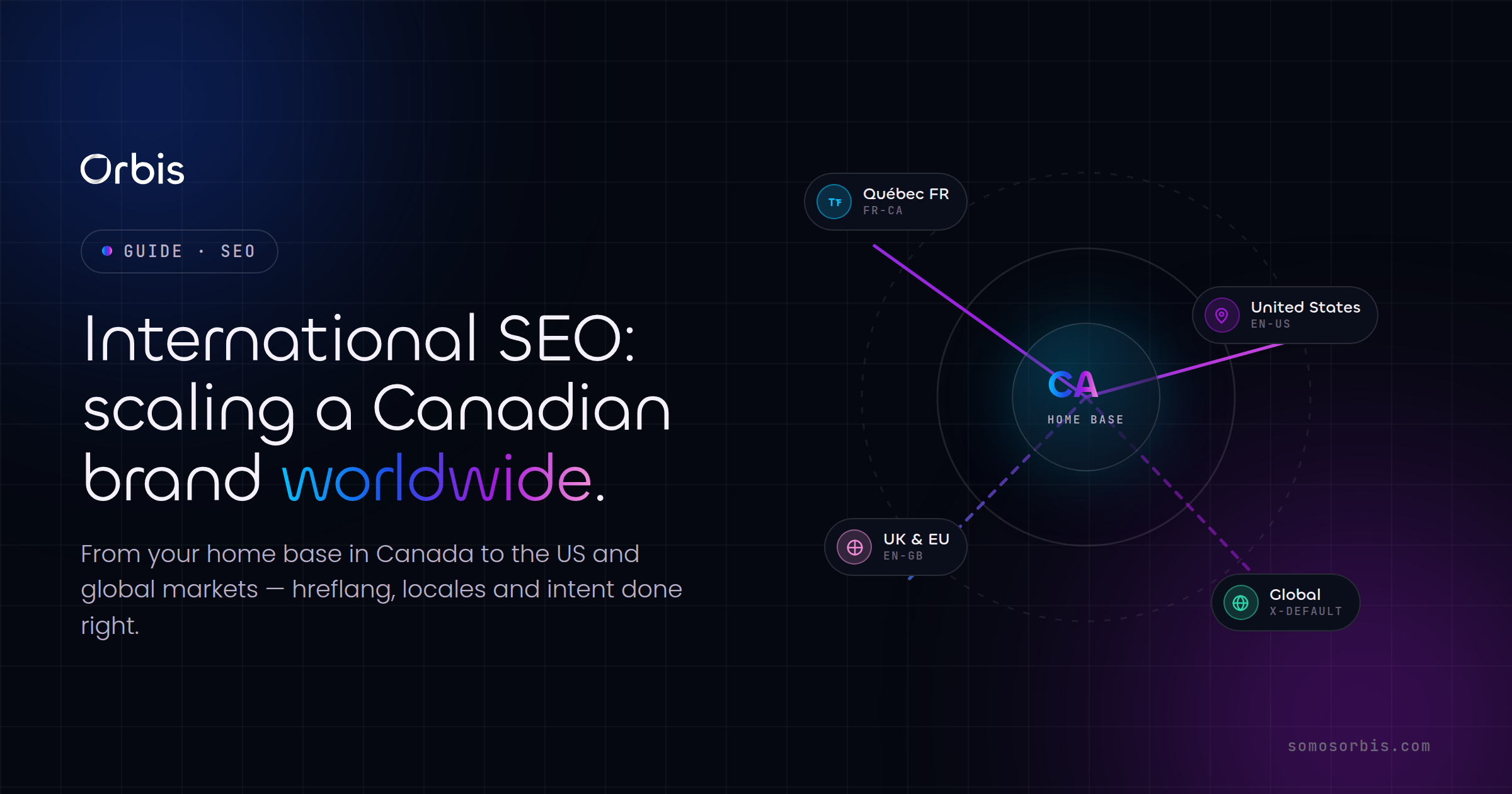
Your Canadian business is growing. Sales are steady in Toronto, Vancouver and Montreal, your organic traffic is healthy, and you are starting to notice something interesting in your analytics: orders, enquiries and demo requests arriving from the United States, the United Kingdom, and sometimes further afield. That is the moment most Canadian founders and marketing leads start asking the same question — how do we deliberately expand search visibility beyond our home market without breaking the rankings we have worked so hard to build at home?
International SEO is the discipline that answers that question. It is the set of technical, structural and content decisions that tell search engines which version of your site to show to which audience, in which language, in which country. Done well, it lets a Canadian brand show up in US search results without cannibalising its Canadian rankings, serve French content to Quebec and France appropriately, and price in the right currency for each market. Done badly, it produces duplicate-content confusion, the wrong currency in front of the wrong buyer, and a US homepage outranking your Canadian one for your own brand name. This guide walks through the decisions that matter, with examples grounded in the realities of scaling a Canadian company outward.
Start with the strategic question, not the technical one
Before touching a single hreflang tag, get honest about why you are expanding and how committed you are. International SEO rewards focus, and the most common failure we see is a Canadian company that "goes global" by switching on twelve country targets at once, then spreads its content and link-building budget so thin that nothing ranks anywhere.
Ask three questions first:
- Where is demand already proving itself? Look at your existing analytics, your sales pipeline and your support inbox. If a quarter of your inbound demos already come from US prospects, the US is not a hypothesis — it is a market waiting to be served properly.
- Can you actually fulfil and support that market? Shipping logistics, currency, payment processors, tax, returns, time-zone support, legal terms. SEO will bring the visitors; an operation that cannot serve them will waste that visibility.
- Is it a language expansion, a country expansion, or both? Serving English-French audiences inside Canada is a different problem from serving the United States, which is a different problem again from entering France or Australia. Each combination changes your technical setup.
If you have not yet locked down your home-market fundamentals, do that first. A brand that has not nailed the basics of our complete guide to SEO in Canada is not ready to multiply the same gaps across three more markets. International SEO amplifies whatever foundation you already have — strong or weak.
Choosing your domain structure: ccTLD, subdomain or subdirectory
This is the single most consequential decision in international SEO, because it is the hardest to reverse. There are three mainstream approaches, each with real trade-offs for a Canadian company.
1. Country-code top-level domains (ccTLDs)
This means running separate domains per country: yourbrand.ca for Canada, yourbrand.com or yourbrand.us for the United States, yourbrand.co.uk for Britain, and so on.
- Strengths: the clearest possible geo-targeting signal to both users and search engines. A .ca domain tells a Canadian buyer instantly that this is built for them, and the same is true of .co.uk for British buyers. Trust and click-through often improve in-market.
- Weaknesses: each domain starts its authority almost from zero. The backlinks, brand signals and ranking history you built on yourbrand.ca do not transfer to a brand-new .com. You are effectively running several SEO programs in parallel, each needing its own link-building and content investment. For most growing Canadian companies, that is expensive.
ccTLDs make sense when you have the resources to genuinely operate as a local brand in each market, or where local trust is decisive — regulated industries, financial services, or anywhere buyers strongly prefer a domestic supplier.
2. Subdirectories (subfolders) on one domain
This means keeping a single strong domain and segmenting by folder: yourbrand.com/ca/, yourbrand.com/us/, yourbrand.com/uk/. This is the structure many scaling companies choose, and the one Orbis generally recommends for Canadian brands expanding for the first time.
- Strengths: every market inherits the domain authority of the whole site. A backlink earned by your US content strengthens your Canadian rankings too. You maintain one technical setup, one analytics property, one place to manage SEO. It is the most cost-efficient way to add markets.
- Weaknesses: the geo-targeting signal is softer than a ccTLD, so you lean harder on hreflang and clean folder structure to keep things clear. You also need disciplined internal linking so that authority flows to the right regional sections.
3. Subdomains
This means ca.yourbrand.com, us.yourbrand.com, and so on. Subdomains sit between the other two options. Search engines treat them as somewhat separate from the root domain, so authority sharing is weaker than with subdirectories but stronger than fully separate ccTLDs. They can be useful when different markets are managed by different teams or on different platforms, but for most Canadian companies the subdirectory approach delivers better consolidated authority with less complexity.
For a Canadian company expanding into the US for the first time, a subdirectory structure on a single strong domain is usually the best balance of cost, consolidated authority and control. Reserve ccTLDs for markets where you are committing to operate as a genuine local brand.
Hreflang: telling Google who each page is for
Hreflang is the mechanism that prevents your biggest international SEO headache: the wrong regional version of a page outranking the right one. Without it, Google may serve your US pricing page to a Toronto buyer, or treat your Canadian and US pages as duplicates and pick one more or less at random.
An hreflang annotation tells search engines: "this page is the English version for Canada, that page is the English version for the US, and this third page is the French version for Canada." Each set of equivalent pages references every alternate, including itself.
A correct set for a Canadian brand serving Canada (English and French) and the US might look like this:
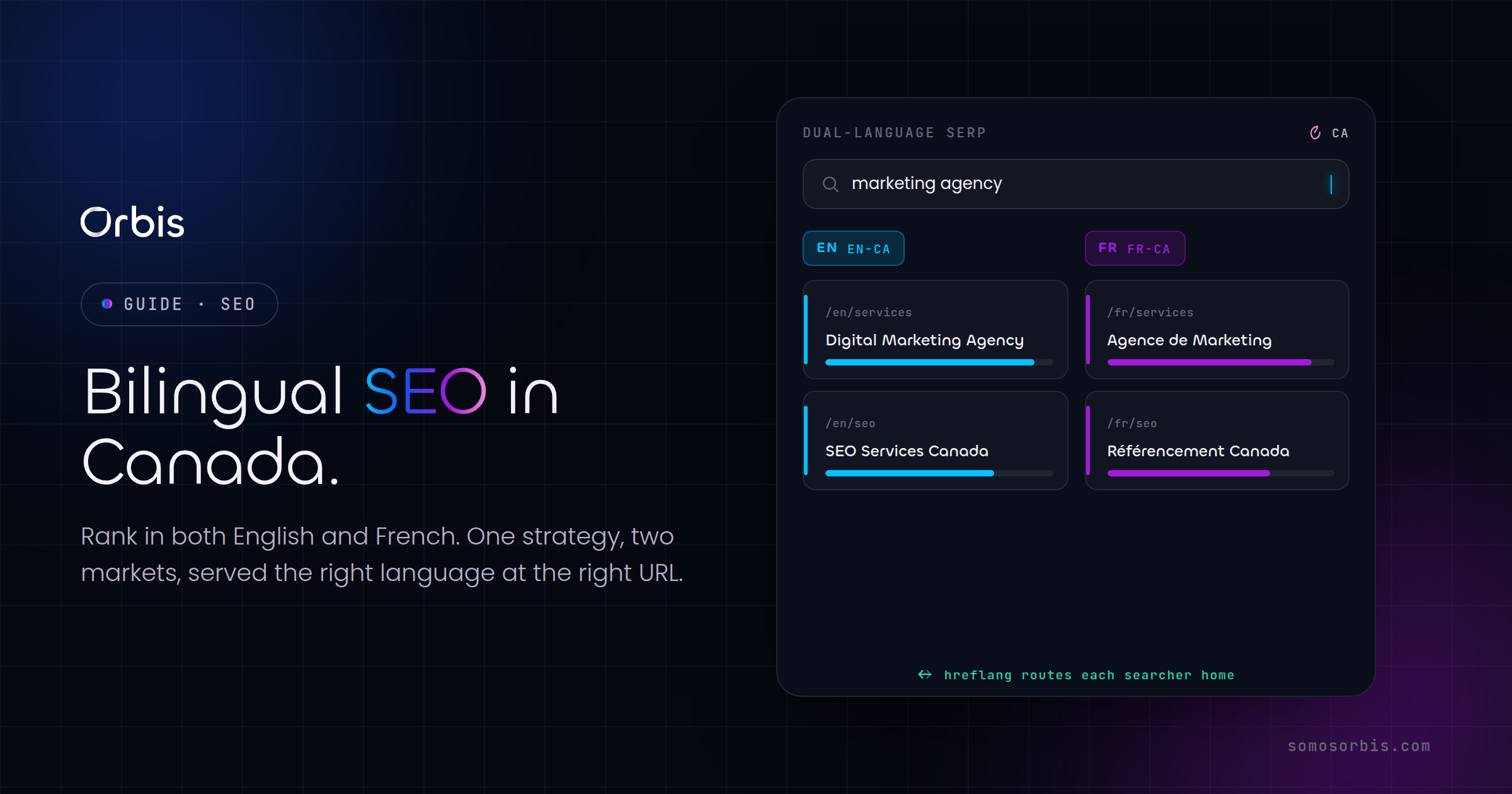
hreflang="en-ca"— English, Canadahreflang="fr-ca"— French, Canadahreflang="en-us"— English, United Stateshreflang="x-default"— the fallback for users who match no specific target
The rules that trip teams up most often:
- Annotations must be reciprocal. If your Canadian page points to the US page, the US page must point back. One-directional hreflang is ignored.
- Use the right codes. Language is ISO 639-1 (en, fr), region is ISO 3166-1 (CA, US, GB). A common error is using en-uk — the correct code is en-gb.
- Always include an x-default. This catches everyone who is not explicitly targeted and points them to a sensible default, usually your primary English or a market-selector page.
- Every URL must be self-canonical. Do not point a US page's canonical tag at the Canadian version. Hreflang and canonical have to agree, or Google deduplicates your regional pages and your targeting collapses.
The English-French dimension deserves special attention because it is uniquely Canadian. Serving Quebec and the rest of Canada properly is its own discipline, and we cover it in depth in our guide to bilingual SEO for English and French in Canada. When you then add the US, your hreflang matrix has to hold all of those variants together cleanly — which is exactly why getting the bilingual foundation right before going international saves you from compounding errors.
Geo-targeting signals beyond hreflang
Hreflang handles which version to show, but several other signals reinforce where each section of your site belongs.
- Google Search Console targeting: with a subdirectory structure you can register each folder (/ca/, /us/) as a separate property and, where applicable, set an international targeting preference. This gives Google an explicit hint.
- Server and CDN location: a minor signal today, but hosting that serves Canadian and US users quickly still matters for the Core Web Vitals that affect rankings in both markets.
- Local signals on the page: currency (CAD vs USD), local phone formats, addresses, and references to local context all reinforce relevance. A US visitor seeing prices in CAD with a Canadian toll-free number will bounce, and bounce signals do not help you.
- Local backlinks: links from US publications and directories tell Google your US content is relevant to US audiences. This is why ccTLDs are expensive — they need this link equity built market by market.
One practical warning: avoid automatic IP-based redirects that force users into a regional version. They block search engine crawlers (which often crawl from US data centres) from seeing your other regional pages, and they frustrate users who deliberately want a different version. Offer a clear, dismissible banner suggesting the local version instead, and let the user choose.
Content: translate intent, not just words
The fastest way to waste an international SEO budget is to run your Canadian pages through machine translation, publish them under a new folder, and call it localisation. Search behaviour differs by market in ways that go well beyond language.
- Keywords differ even within the same language. Canadians search "mobile plans" while Americans may lean toward "cell phone plans"; spelling diverges (colour vs color, cheque vs check); and entire product categories carry different names across the border. Do fresh keyword research per market rather than assuming your Canadian terms travel.
- Seasonality and context differ. Boxing Day and back-to-school timing, statutory holidays, and even tax-year references are Canadian context that will read as off-key to a US or UK audience. Localise the calendar, not just the copy.
- Proof and compliance differ. Pricing, currency, guarantees and the regulatory language you use should reflect each market's current regulations and expectations. What reassures a Canadian buyer is not always what a US buyer needs to see.
- French is not a copy-paste of English. Quebec French has its own search vocabulary and its own regulatory expectations around French-language content. Treat it as a first-class market, not a translation afterthought.
For B2B brands in particular, the structure of buyer intent — the questions decision-makers ask, the comparison content they want, the lead-capture flow that converts them — needs to be rebuilt per market rather than assumed. If lead generation is your goal in these new markets, pair this work with the principles in our guide to B2B SEO and lead generation in Canada, then adapt the intent mapping to each country you enter.
A practical rollout sequence for a Canadian brand
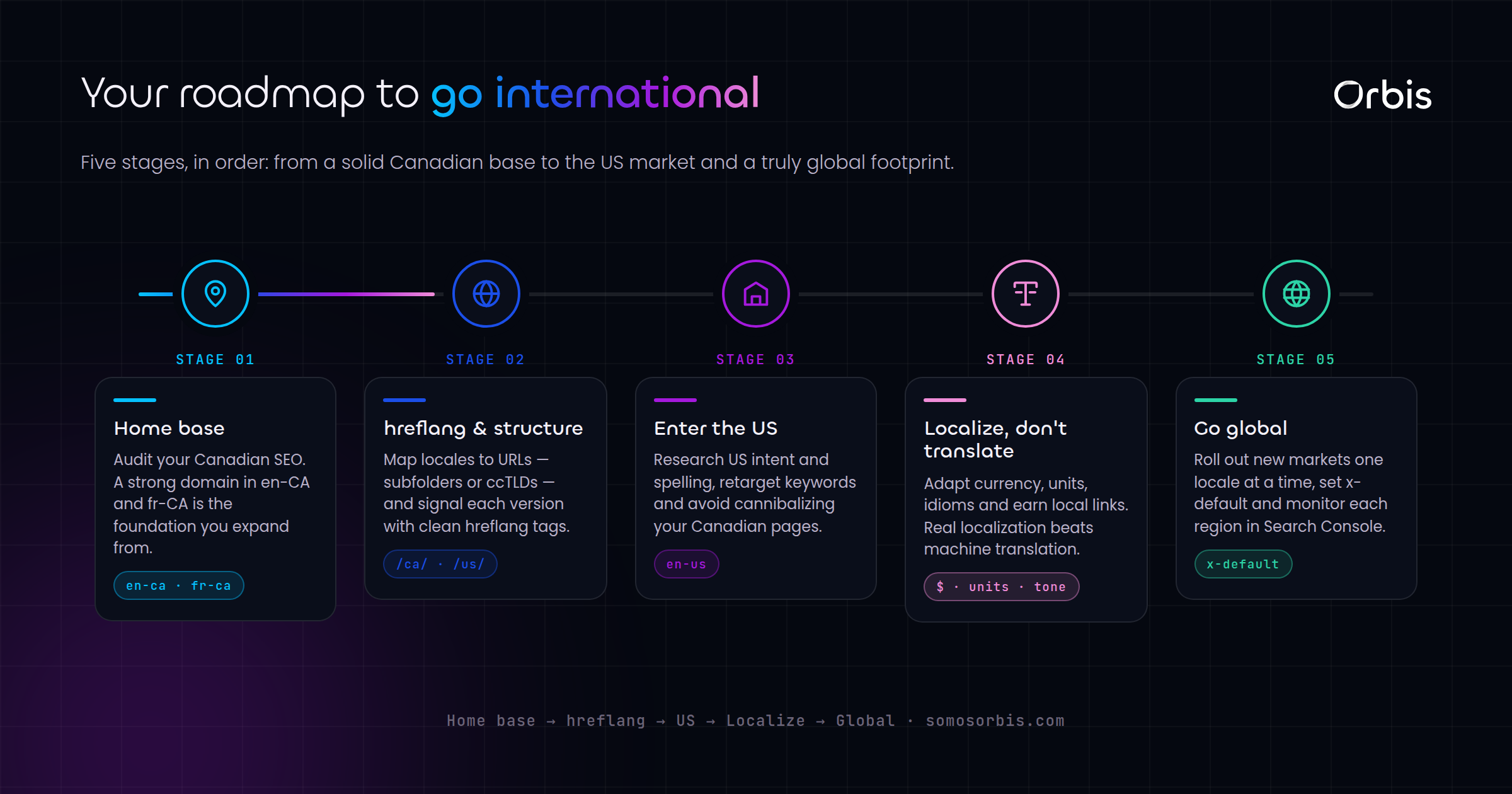
Here is the order Orbis recommends when taking a Canadian site international, designed to protect your existing rankings at every step:
- Audit and stabilise the home market. Confirm your Canadian SEO foundation is solid before you multiply it. Fix crawl, indexation and Core Web Vitals issues now, not after you have copied them three times.
- Decide the domain structure. For most first-time expansions, move to a subdirectory model on your strongest domain. Plan the migration carefully and map every redirect.
- Build the regional URL architecture. Create clean, consistent folders (/ca/, /us/) with parallel structures so equivalent pages map one-to-one — a requirement for clean hreflang.
- Implement hreflang and self-canonicals. Roll out reciprocal annotations across every equivalent set, include x-default, and validate with a crawler before launch.
- Localise content per market. Fresh keyword research, market-appropriate spelling and terminology, local currency and proof, and properly localised French where it applies.
- Set geo-targeting signals. Configure Search Console properties, align on-page local signals, and begin earning in-market backlinks.
- Monitor and iterate. Watch each market's rankings, indexation and conversions separately. Expect the new markets to ramp over months, not weeks, and protect home-market performance throughout.
Common mistakes that quietly sink international expansions
- Switching on too many markets at once and starving each of content and links.
- Conflicting hreflang and canonical tags that cause Google to deduplicate regional pages.
- Forced IP redirects that hide regional pages from crawlers.
- Machine-translated content with no local keyword research behind it.
- Showing the wrong currency, phone format or seasonal reference to the wrong market.
- Treating French as an afterthought rather than a first-class Canadian market.
- Neglecting the home market while chasing new ones — the rankings that fund the expansion.
Where to go from here
International SEO is one of the highest-leverage moves a growing Canadian brand can make, but it is also one of the easiest to get wrong in ways that take months to diagnose. The structural decisions — domain architecture, hreflang, geo-targeting — are documented processes that, done right, compound in your favour and protect the rankings you already have at home. Done casually, they introduce confusion that quietly caps your growth in every market.
If you are ready to expand a Canadian brand into the US and beyond, our international SEO services for Canadian companies cover the full programme: domain strategy, hreflang implementation, geo-targeting, per-market keyword research and localisation, and the ongoing monitoring that keeps each market healthy without sacrificing the others. Start with a solid home-market foundation, expand deliberately, and let revenue from each new market fund the next. That is how Canadian brands scale beyond their borders — one well-structured market at a time.