
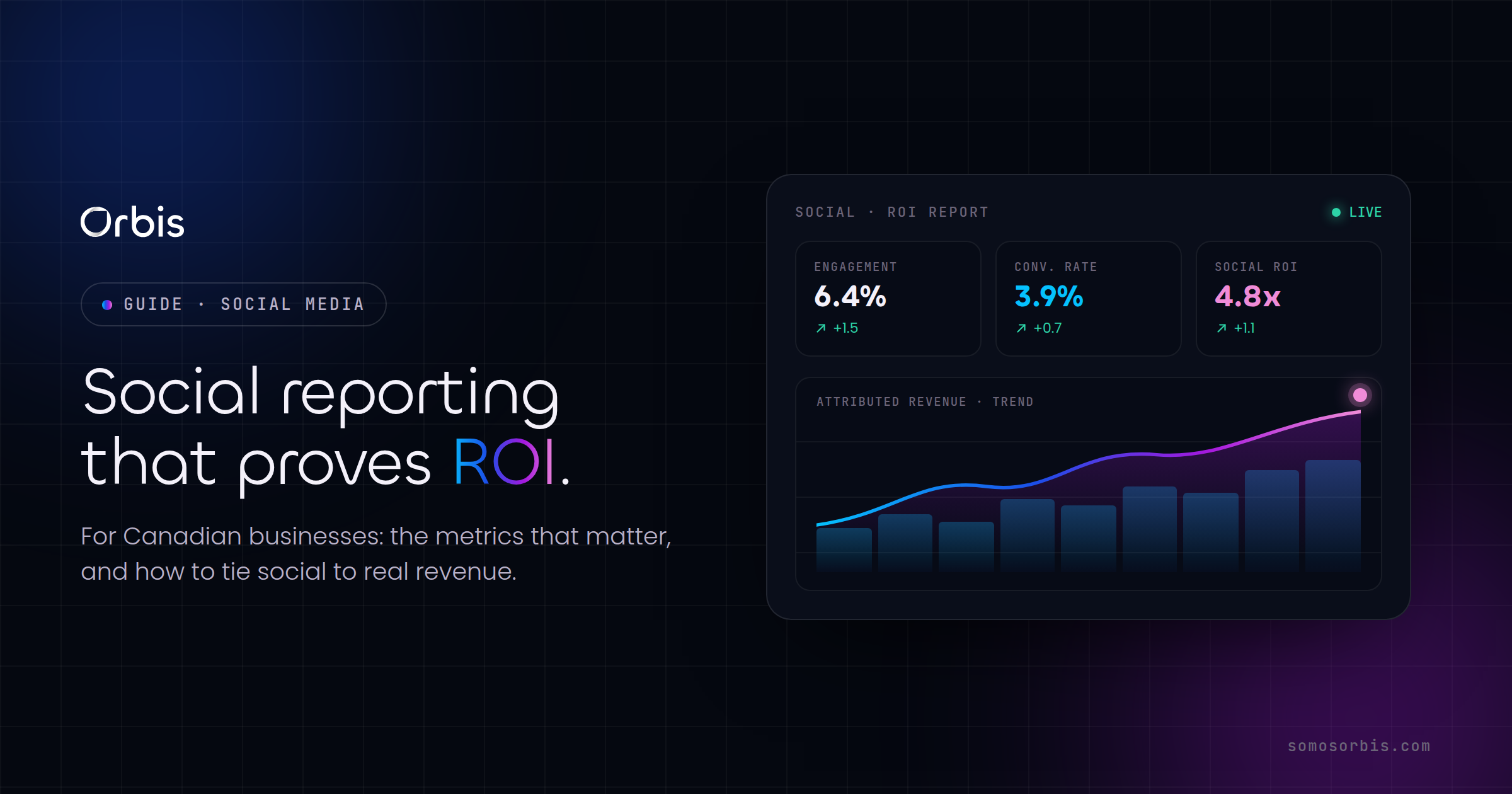
Most Canadian businesses are collecting more social media data than they will ever use, and reporting on far less than they should. The result is a familiar standoff: marketing teams send a monthly deck full of likes, reach and follower counts, while finance and leadership keep asking a much simpler question that the deck never answers. Did this make us any money? Closing that gap is the entire job of good social media reporting. This guide walks Canadian decision-makers through the metrics that actually matter, how to connect social performance to revenue, and how to build a reporting rhythm that earns budget instead of begging for it.
If you are still standing up your channels or rethinking how they are run, start with our complete guide to social media management in Canada, which sets the strategic foundation this article builds on. Reporting is where strategy proves itself, so it pays to have both in place.
Why vanity metrics quietly drain Canadian marketing budgets
Vanity metrics are the numbers that go up reliably and mean almost nothing on their own. Follower counts, total impressions, and raw like totals all fall into this bucket. They feel good in a report, but they do not tell a Toronto retailer whether their Boxing Day campaign drove store traffic, and they do not tell a Vancouver SaaS company whether LinkedIn is filling the pipeline.
The problem is not that these numbers are useless. The problem is that they are presented as outcomes when they are, at best, early indicators. A post that reached 40,000 people in Calgary is interesting only if you know what those people did next. Without that next step, you are reporting motion, not progress.
For Canadian businesses specifically, vanity metrics also hide some structural realities worth tracking honestly:
- Bilingual reach is not the same as bilingual engagement. A campaign can reach a large Quebec audience while underperforming in French because the creative was translated rather than written for that market.
- National reach can mask regional weakness. Strong numbers in Ontario can paper over flat performance in Atlantic Canada or the Prairies.
- Seasonality distorts month-over-month vanity numbers. Reach naturally spikes around back-to-school and the holidays, so a December lift in impressions is not proof your strategy improved.
The fix is not to stop measuring these things. It is to demote them. Treat reach and impressions as context, then build your report around metrics that connect to business outcomes.
The metrics that actually matter, organized by funnel stage
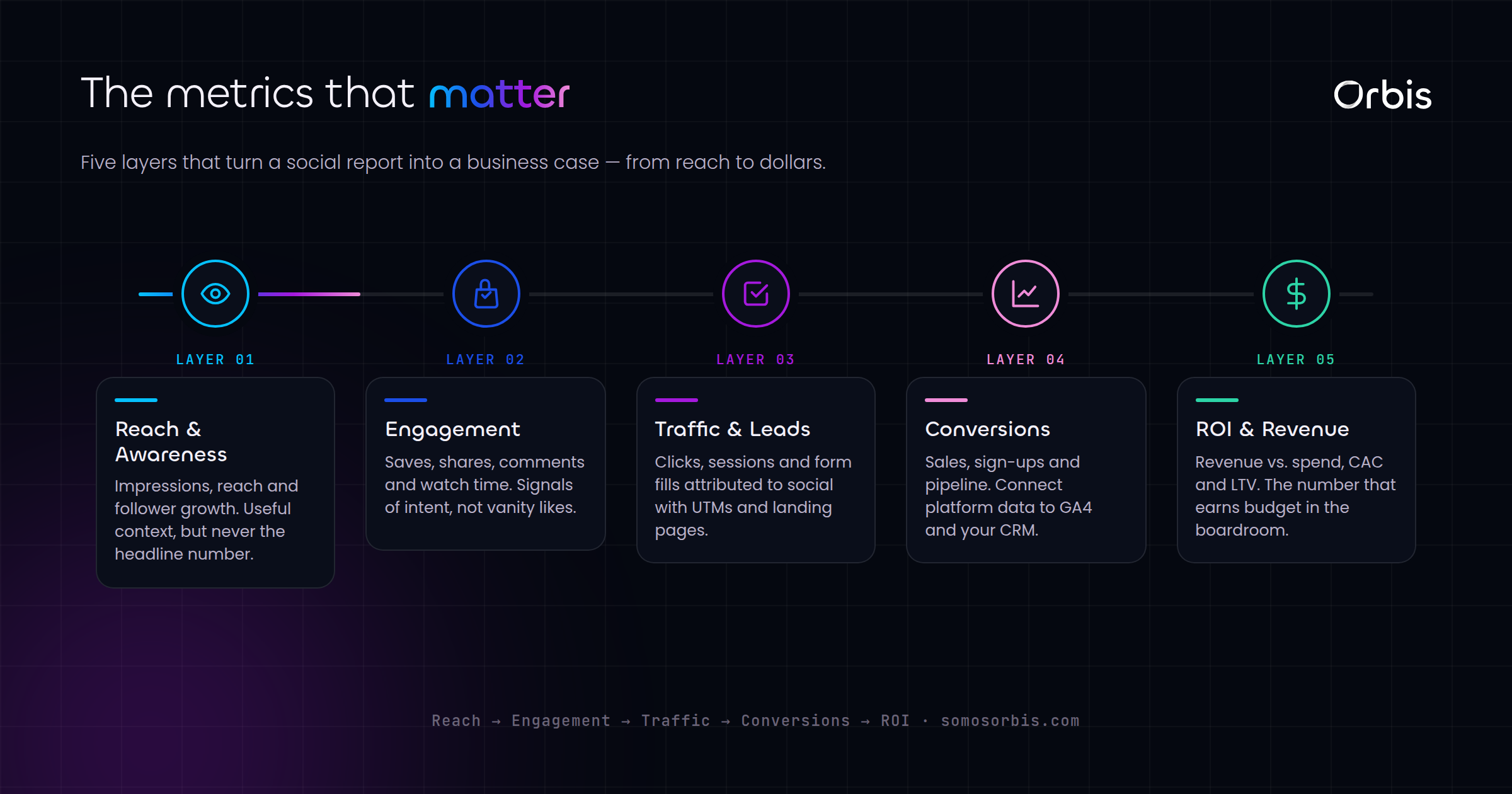
A report that tells a story moves from awareness to revenue in a logical line. Organizing your KPIs by funnel stage keeps the conversation honest, because each stage is supposed to feed the next. If awareness is healthy but conversions are flat, the report itself points to where the problem lives.
Awareness metrics (use as context, not as wins)
- Reach and impressions by region and language, so you can see whether you are actually showing up in the markets you care about.
- Share of voice against Canadian competitors, which matters far more than your absolute follower count.
- Audience growth rate rather than total followers, since a small account growing 8% a month is healthier than a large one that has stalled.
Engagement metrics (the quality signal)
- Engagement rate by reach, which normalizes for audience size and lets you compare a niche B2B account in Montreal against a consumer brand in Toronto fairly.
- Saves and shares, which signal genuine value far more reliably than likes. A saved post is a small commitment.
- Comment sentiment, not just comment volume. Ten thoughtful questions beat a hundred emojis when you are trying to gauge buying intent.
Conversion and revenue metrics (the ones leadership cares about)
- Click-through rate from social to your site or landing pages.
- Conversion rate of social traffic, segmented by platform and campaign.
- Cost per lead and cost per acquisition, reported in CAD so nobody has to do mental currency math.
- Revenue attributed to social, both first-touch and last-touch, so you can show the channel's role at the start and the close of the journey.
- Return on ad spend (ROAS) for paid social, and a blended ROI figure that folds in organic effort and content costs.
You do not need every metric on this list in every report. You need the handful that map to the specific outcome a campaign was built to produce. A brand-awareness push and a lead-generation campaign should be judged by different scorecards, and saying so up front prevents a lot of unfair comparisons later.
How to tie social performance to revenue
This is the part most reports skip, and it is the part that wins budget. Connecting social activity to dollars is not magic; it is a measurement chain that you set up once and maintain.
1. Get your tracking foundation right
Before any report can be trusted, the plumbing has to work. That means consistent UTM tagging on every link, a properly configured analytics setup, and conversion events defined for the actions that matter to your business, whether that is a purchase, a booked demo, a quote request, or a newsletter signup. If your tracking is inconsistent, your ROI numbers are fiction, no matter how confident the dashboard looks.
2. Choose an attribution model and state it plainly
Social media rarely gets sole credit for a sale. A prospect in Ottawa might discover you on Instagram, return three weeks later through a Google search, and convert after a remarketing ad. Single-touch attribution will either over-credit or under-credit social depending on which touch you measure. For most Canadian SMBs, a position-based or data-driven model gives a fairer picture, but the specific model matters less than consistency and transparency. Pick one, write it into your reporting notes, and stick with it so trends stay comparable.
3. Calculate true ROI, not just ROAS
ROAS divides revenue by ad spend, which is useful but incomplete because it ignores the cost of content production, management time, and tools. A more honest ROI calculation looks like this:
ROI = (Revenue attributed to social − Total social investment) ÷ Total social investment, where total investment includes ad spend, content costs, and the time your team or agency spends managing channels.
When you report ROI this way, leadership trusts the number, because it does not pretend social media is free to run. That trust is what gets the next budget approved.
4. Layer in lifetime value for the full picture
Cost per acquisition only tells half the story if your customers stick around. A Canadian subscription business might pay $60 CAD to acquire a customer through social who goes on to generate $900 in lifetime value. Reporting CAC against LTV reframes social from a cost centre into a growth engine, and it is one of the most persuasive numbers you can put in front of a CFO.
Building a reporting cadence that fits Canadian business rhythms
Reporting frequency should match the decision it informs. Dumping everything into one monthly mega-report buries the signals that need fast action and over-reports the trends that move slowly.
- Weekly pulse check for active campaigns. A short scan of spend, CPA, and conversion rate so you can adjust before a Boxing Day or back-to-school window closes. These are the moments where a two-day delay costs real money.
- Monthly performance report tying activity to leads, sales, and ROI, with regional and language breakdowns where they are relevant.
- Quarterly strategic review that zooms out to share of voice, audience growth quality, and channel-level ROI, and feeds directly into the next quarter's plan and budget.
Canada's seasonality makes this cadence especially valuable. The stretch from back-to-school through Boxing Day and the holidays is when many businesses earn the bulk of their revenue, and a weekly pulse during those weeks is the difference between catching an underperforming ad early and discovering it in a post-mortem.
What a report should actually say
A good social media report is not a data dump. It is an argument supported by evidence. Every report you send should answer three questions clearly:
- What happened? The headline numbers, framed against goals rather than against last month in isolation.
- So what? The interpretation. Why did conversions rise, and is that repeatable, or was it a one-time seasonal lift?
- Now what? The recommendation. The specific next action, the budget shift, or the creative test you propose based on what the data showed.
If your current reporting stops at "what happened," you are leaving the most valuable part on the table. The "so what" and "now what" are where reporting turns into strategy, and where ongoing measurement and refinement compound into results. That is the core idea behind treating social media reporting and optimization as a continuous loop rather than a monthly chore.
Common reporting mistakes to avoid
- Comparing across platforms as if they were equal. A LinkedIn lead and an Instagram follower are not interchangeable. Report each platform against its own purpose.
- Ignoring organic when calculating ROI. Organic content has real costs and real returns. Leaving it out makes paid look more efficient than it is and starves your organic strategy of credit.
- Reporting in mixed currencies or vague ranges. Keep everything in CAD and be specific. Precision builds trust.
- Skipping the baseline audit. You cannot measure improvement without a starting point. If you have never benchmarked your channels, our social media audit guide walks through how to establish one before you commit to reporting targets.
- Treating sentiment as optional. Numbers tell you what is happening; sentiment tells you why. Pairing performance data with social listening and reputation monitoring gives your reports the context that raw metrics miss, especially when a campaign performs strangely for reasons the dashboard will never explain.
From reporting to revenue: the next step
Reporting is only worth the effort if it changes what you do next. The businesses that get the most from social media are the ones that close the loop: measure honestly, interpret carefully, act decisively, and then measure again. Done well, that loop turns social media from a line item that has to justify itself every quarter into a predictable, accountable contributor to revenue.
If your reports are still long on activity and short on answers, that is a fixable problem, and it is exactly where the right measurement framework pays for itself. Our team helps Canadian businesses build reporting that ties social performance to revenue and uses it to drive continuous improvement. Explore our approach to social media reporting and optimization, and let's turn your data into decisions that move the number that matters most.