
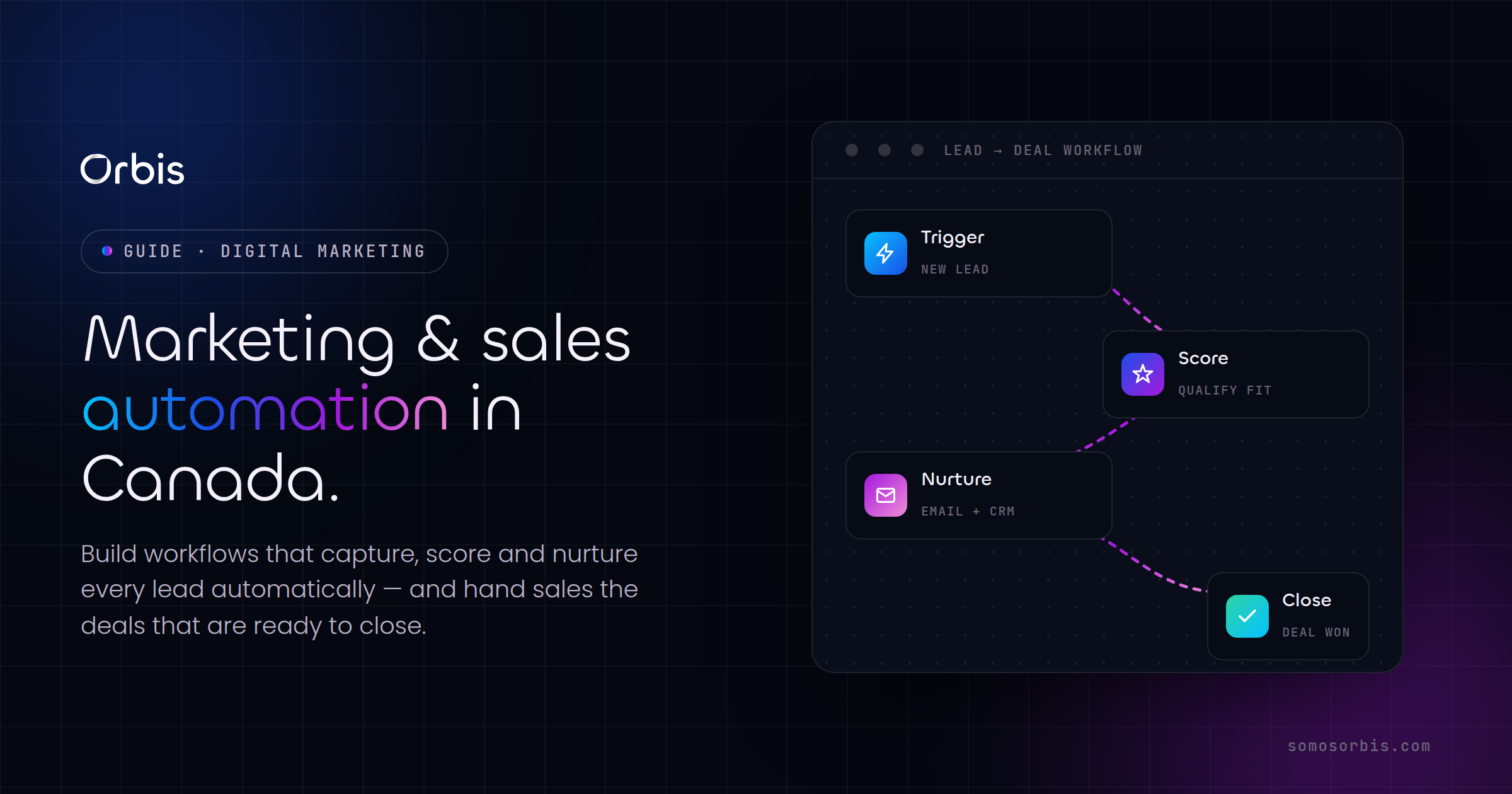
Most Canadian companies do not have a lead problem. They have a follow-up problem. Leads come in from a Meta campaign, a Google search, a referral, or a Boxing Day promo, and then they sit. A rep gets to them three days later, the prospect has already booked with someone else, and the marketing budget that generated the lead is quietly wasted. Marketing and sales automation fixes the gap between "we got a lead" and "we closed the deal" by building repeatable workflows that nurture, score, route, and hand off prospects without anyone having to remember to do it. For a fuller foundation on the tooling side, our complete guide to marketing automation and CRM implementation in Canada is the place to start; this article focuses on the workflows themselves, the ones that actually move revenue.
The promise of automation is not "fire your sales team." It is "let a small team behave like a large one." Done properly, automation lets a five-person company in Calgary respond to every inbound lead within minutes, nurture the 80% who are not ready to buy today, and surface the 20% who are, so your reps spend their hours on conversations that close. Below is how to build that, step by step, with the Canadian market in mind.
Start With the Revenue Math, Not the Tool
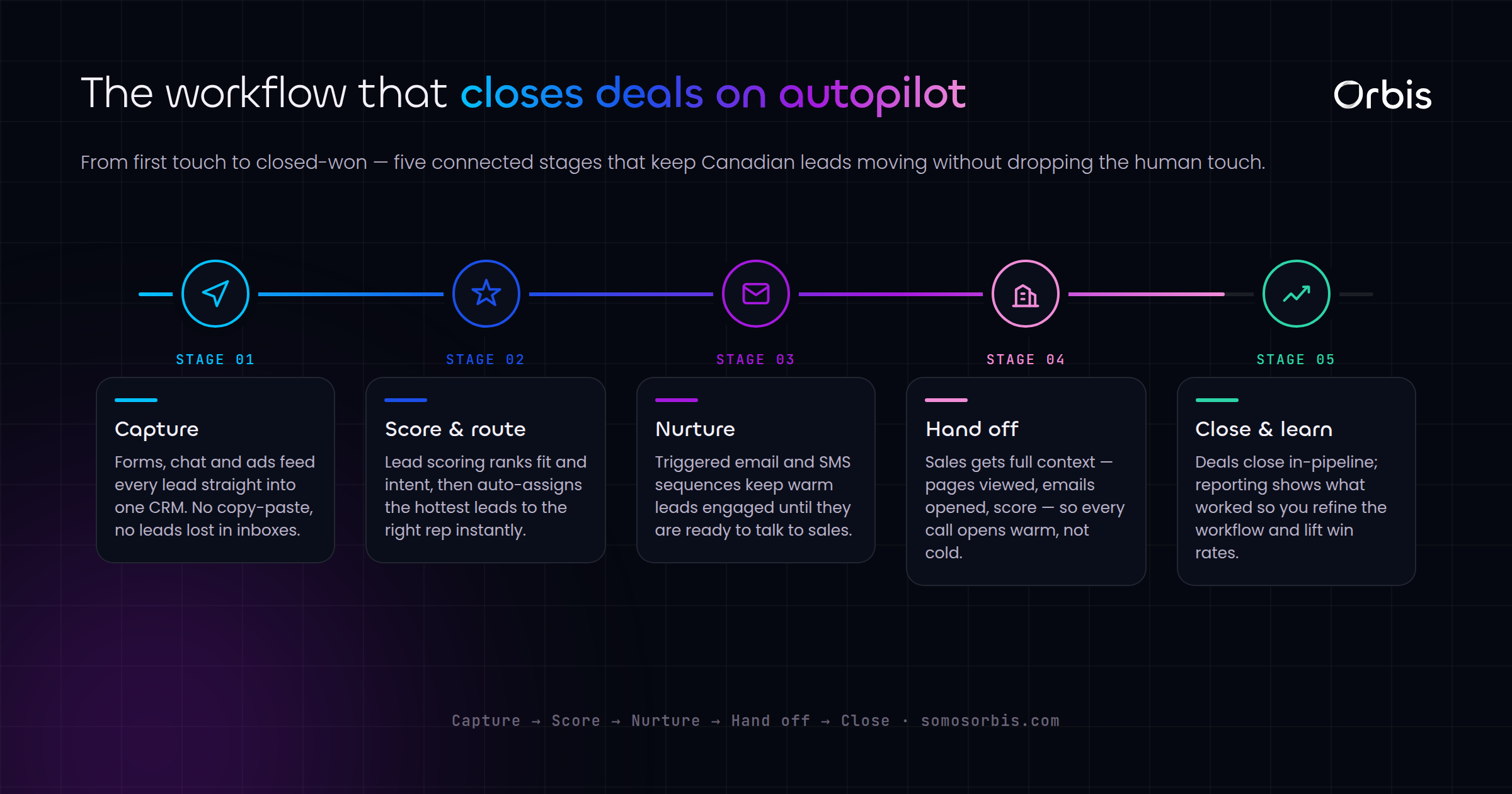
Before you automate anything, map the path a dollar takes through your business. A workflow that does not connect to revenue is just busywork with a trigger. For most Canadian B2B and B2C companies the path looks like this:
- Capture — a lead fills a form, messages on WhatsApp, books a call, or abandons a cart.
- Qualify — you decide whether this person is a fit and how ready they are to buy.
- Nurture — you stay useful and present until the timing is right.
- Hand off — a qualified lead reaches a human at the right moment with full context.
- Close and expand — the deal is won, and the relationship is set up for renewal or referral.
Automation should attach to each of these stages. If you cannot say which stage a workflow serves and what revenue outcome it protects, do not build it yet. This discipline is the difference between an automation program that pays for itself and a pile of disconnected Zaps nobody trusts.
Lead Capture: Speed Is the Whole Game
The single highest-leverage automation in any Canadian business is instant lead response. Research across markets consistently shows that the odds of qualifying a lead drop sharply after the first five minutes. Yet most companies measure response time in hours or days.
Build a capture layer that does three things automatically the moment a lead arrives:
- Acknowledge instantly. Trigger an email or SMS within seconds confirming you received the inquiry and setting expectations. In a bilingual market, detect language from the form or page and reply in English or French accordingly — a Montreal prospect who submits a French form should never get an English auto-reply.
- Enrich and route. Append company size, region, and source so the lead lands with the right rep or queue. A Vancouver enterprise lead and a small Toronto retailer should not follow the same path.
- Create the record. Push a clean contact into your CRM with the source, campaign, and consent status attached. Under Canadian anti-spam rules, capturing how and when you obtained consent is not optional — bake it into the workflow so compliance is a byproduct of the system, not a separate chore.
Conversational capture deserves special attention here. A well-built chatbot can qualify and book a meeting before a human ever touches the lead, which is why we treat it as part of the automation stack rather than a gimmick — our piece on chatbots for Canadian businesses goes deep on where they earn their keep and where they do not.
Lead Scoring: Decide Who Gets Your Reps' Time
Once leads are flowing, the next workflow answers a simple question: who is worth a phone call today? Lead scoring assigns points based on two dimensions.
Fit Score (Who They Are)
This is static demographic and firmographic data: industry, company size, region, job title, budget signals. A national logistics firm in Mississauga scores higher than a one-person side project if your product is enterprise-grade. Assign points to the attributes that historically correlate with closed deals — and if you do not know what those are yet, ask your sales team which three traits the best customers share. That conversation alone will tighten your scoring model.
Engagement Score (What They Do)
This is behavioural and decays over time. Opening emails, visiting the pricing page twice, downloading a comparison sheet, replying to a nurture message — each adds points. Going quiet for three weeks subtracts them. The decay matters: a lead who was hot in March but silent since is not a hot lead in May, and your scoring should reflect that so reps are not chasing ghosts.
Combine the two into a simple grid. High fit plus high engagement is a sales-ready lead that should trigger an immediate handoff. High fit plus low engagement belongs in nurture. Low fit, regardless of engagement, gets a lighter-touch automated track so your team's hours go where the revenue is. Keep the model simple enough that a new rep can explain it in one sentence; over-engineered scoring models are abandoned models.
Nurture Workflows: Stay Useful Until the Timing Is Right
The majority of leads are not ready to buy the day they find you. Nurture workflows keep you present and credible without burning out your sales team. The mistake most Canadian companies make is treating nurture as a newsletter — generic blasts that get ignored. Effective nurture is triggered, segmented, and tied to behaviour.
- Welcome and orient. The first few touches teach the prospect what you do and how you are different. For Orbis-style positioning, this is where you establish that you bring documented, repeatable processes rather than improvised one-off campaigns.
- Educate by problem, not by feature. Send content mapped to the problem the lead signalled. Someone who downloaded a guide on revenue operations gets a different track than someone who asked about a chatbot build.
- Respect Canadian seasonality. Time campaigns to the rhythm of the market — back-to-school in late August, the long Black Friday-to-Boxing-Day retail window, the slow holiday stretch when B2B buyers go quiet, and the January budget-reset when they come back ready to act. A nurture calendar that ignores this rhythm sends "buy now" messages while half the country is on holiday.
- Re-engage the dormant. When an engagement score decays past a threshold, trigger a win-back sequence rather than letting the lead die silently. A single well-timed "still thinking about this?" message recovers more pipeline than most new campaigns.
Every nurture track should have an exit ramp. The moment a nurtured lead takes a high-intent action — books a call, requests a quote, returns to pricing — they should leave the nurture flow and trigger a handoff. Leaving sales-ready leads stuck in an educational drip is one of the most common and most expensive automation mistakes.
The Handoff: Where Most Automation Programs Break
The handoff from marketing automation to a human seller is the seam where revenue leaks. A lead can be perfectly nurtured and scored, and still go cold because the rep got a bare notification with no context, or because nobody owned the follow-up.
Build the handoff as an explicit workflow, not an afterthought:
- Trigger on a clear signal. Define exactly what makes a lead sales-ready — a score threshold, a booked meeting, a pricing request — and automate the handoff the instant it fires.
- Pass the full story. The rep should see the lead's source, every page they viewed, what they downloaded, the language they prefer, and the consent record. Context turns a cold call into a warm conversation.
- Assign an owner and a deadline. Round-robin or territory-based assignment, plus an automated task with an SLA. If the lead is not contacted within the window, escalate. "Everybody's job" becomes nobody's job without enforced ownership.
- Close the loop back to marketing. When the rep marks a lead as won, lost, or not-yet, that outcome should flow back to refine scoring. A handoff that does not feed learning back upstream is a one-way street.
The goal of automation is not to remove humans from the sale. It is to make sure that when a human does step in, they arrive at the perfect moment with everything they need to win.
Choosing and Connecting the Stack
Workflows live inside tools, and in Canada the practical question is usually how to connect what you already run — a CRM, an email platform, ad accounts, a chat tool — rather than ripping everything out. The connective tissue is where automation succeeds or fails. A platform like Bitrix24 is popular with Canadian SMBs precisely because it folds CRM, automation, and communication into one place; if that is your direction, our walkthrough on Bitrix24 implementation in Canada covers the setup decisions that matter.
Whatever stack you land on, hold it to a few standards:
- One source of truth. Your CRM is the system of record. Every workflow reads from and writes to it, so reps never wonder which screen has the real data.
- Consent and data residency built in. Track consent at the field level and know where your customer data physically lives. For Canadian customers this is a trust and compliance requirement, not a nice-to-have — design it in from day one rather than retrofitting it after an audit.
- Bilingual by default. Templates, scoring, and routing should all handle English and French as first-class citizens, not as a translation bolted on at the end.
- Observable. You should be able to see, for any workflow, how many leads entered, where they dropped, and what it produced. Automation you cannot measure is automation you cannot trust.
Common Pitfalls and How to Avoid Them
- Automating a broken process. If your manual follow-up is chaotic, automating it just makes the chaos faster. Document the process by hand first, then automate the version that works.
- Over-messaging. More emails is not more nurture. Cap frequency, honour unsubscribes instantly, and let behaviour — not a fixed calendar — pace the touches.
- Scoring everything. A model with forty rules nobody understands is worse than five rules everyone trusts. Start simple and add only what proves out.
- No human review. Schedule a monthly look at what your workflows are doing. Automations drift; lists go stale; a trigger someone changed six weeks ago is quietly misrouting leads. Treat the system as something you maintain, not something you set and forget.
A 90-Day Path to Get There
- Days 1–30: Map the revenue path, clean the CRM, and ship instant lead-response and a single welcome nurture track. Get consent capture right from the first day.
- Days 31–60: Add lead scoring with fit and engagement, build the sales handoff workflow with ownership and SLAs, and segment nurture by problem.
- Days 61–90: Layer in re-engagement, seasonal campaigns tuned to the Canadian calendar, and a reporting loop that feeds outcomes back into scoring.
By the end of a quarter you have a system where leads are answered in minutes, nurtured by behaviour, scored honestly, and handed to reps with context — without adding a single headcount.
Where Orbis Comes In
Building workflows that actually close deals is part engineering, part process design, and part discipline. As a Google Partner with more than 15 years and over 500 clients behind us, we design automation around documented processes and measurable revenue outcomes rather than tool hype. If you want a team to map your revenue path, connect your stack, and ship workflows that grow revenue without growing headcount, explore our marketing and sales automation implementation services in Canada and let's build a system your sales team will actually trust.