
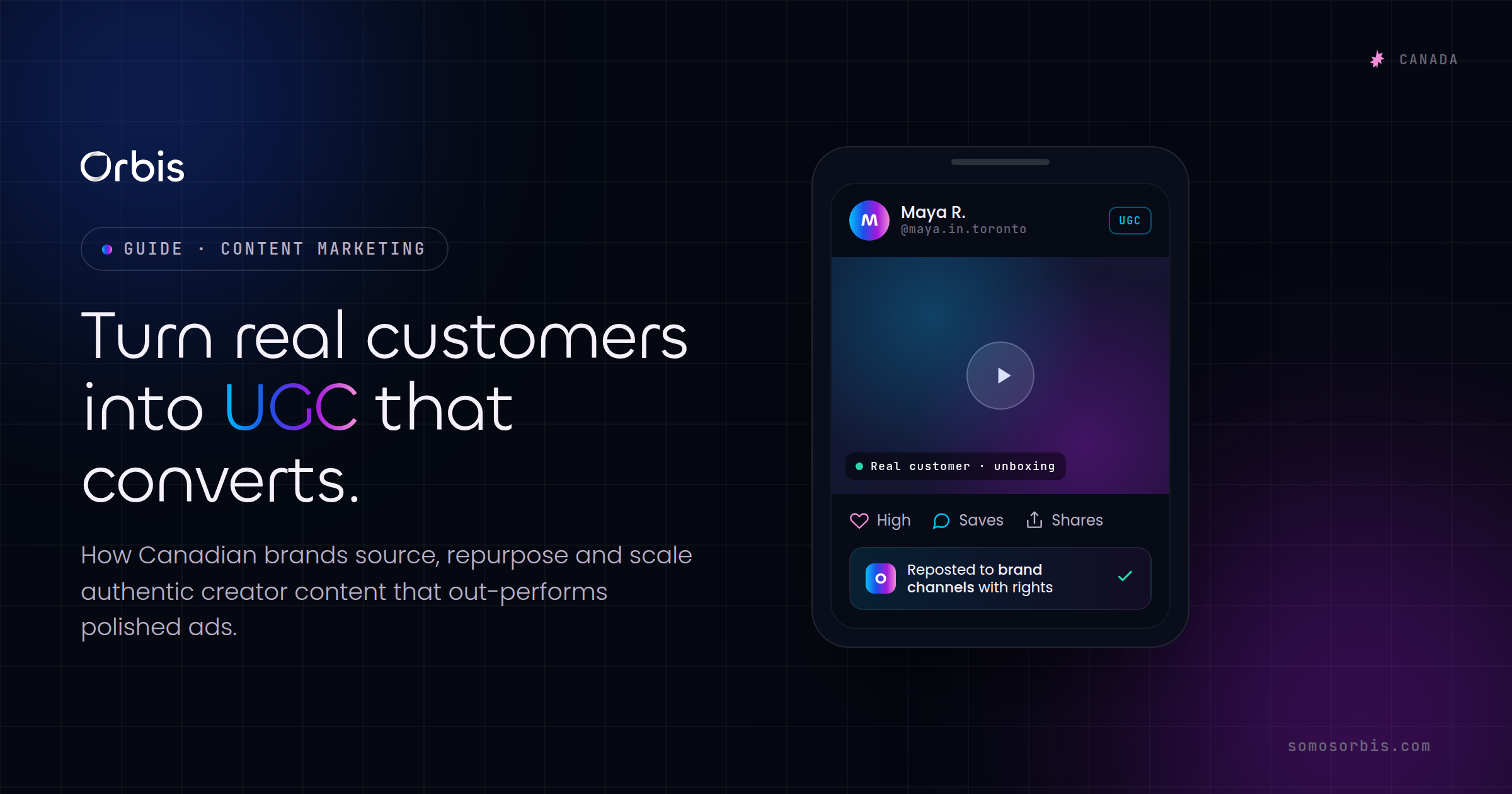
User-generated content has quietly become the most cost-effective creative engine for Canadian brands. While production budgets tighten and audiences grow more skeptical of polished advertising, content made by real customers keeps outperforming studio work on the metrics that matter: thumb-stop rate, click-through, and cost per acquisition. The challenge for most marketing teams in Toronto, Vancouver, Montreal, and Calgary is not whether UGC works. It is how to source it reliably, produce it at a quality bar that fits the brand, and feed it into paid and organic social without the whole thing collapsing into a one-off campaign that never repeats.
This guide walks through how Canadian brands actually build a UGC engine that produces creative that converts. We will cover where the content comes from, how to brief creators, the legal and bilingual realities of operating in Canada, and how to turn a pile of raw clips into ad creative that lowers your acquisition cost. If you want the wider strategic picture first, our complete guide to content creation in Canada sets the context for where UGC fits alongside video, photography, and creator partnerships.
What UGC actually means for a brand in 2026
There is a useful distinction that gets lost in most conversations. "Organic UGC" is content your customers create and post on their own, without being asked or paid. A customer films themselves unboxing your product in their Mississauga kitchen and tags you. "Commissioned UGC," by contrast, is content you pay a creator to make in the authentic, native style of a real customer, with the explicit intent of using it in your ads and channels. Both are valuable. They solve different problems.
Organic UGC builds trust and gives you proof. Commissioned UGC gives you volume, control, and usage rights. Most brands that scale UGC well run both streams at once: they capture and amplify the organic content that already exists, and they commission a steady pipeline of creator content to keep their ad accounts fed with fresh creative. The reason this matters is simple. Paid social platforms reward creative variety. The moment a winning ad fatigues, you need the next one ready, and a single agency video shoot every quarter cannot keep that pace.
Why UGC converts better than studio creative
The performance advantage of UGC is not magic. It comes down to a few concrete mechanisms:
- It looks native to the feed. A vertical, slightly imperfect, handheld clip blends into the organic content people came to see. Polished brand films announce themselves as ads, and audiences scroll past ads.
- It carries social proof. Seeing a person who looks like your customer use and react to a product lowers the perceived risk of buying. This is the same instinct that drives people to read reviews before purchasing.
- It is cheap to test. When a single creator can deliver three to five variations for the cost of a fraction of a studio day, you can test more hooks, more angles, and more formats. More tests means more winners.
- It refreshes fast. Creative fatigue is the silent killer of paid performance. A UGC pipeline lets you swap in new hooks weekly instead of quarterly.
None of this replaces high-end production. There is a clear role for a polished brand film or a clean studio photo, and our perspective on that lives in our piece on commercial photography for Canadian brands. The point is that UGC and studio work are complementary, not competing. UGC wins on volume, velocity, and feed-native authenticity. Studio wins on brand-defining hero moments.
Where Canadian brands source UGC
Sourcing is where most UGC programs stall. Here are the practical channels Canadian brands use, roughly in order of cost.
1. Mine the content you already have
Before you spend a dollar, audit what customers have already posted. Search your branded hashtags, your tagged mentions, and your product reviews for video and photo content. A surprising amount of usable UGC is sitting in your notifications right now. The catch is rights: a customer posting a clip on their own account has not granted you permission to run it as a paid ad. You need to ask, and you need that permission in writing.
2. Activate your existing customers
Your best UGC creators are often people who already love the product. A short post-purchase email or in-app prompt inviting customers to share a video in exchange for a discount, loyalty points, or a feature on your channel can produce a steady trickle of content. This works especially well for Canadian DTC brands with strong repeat-purchase cohorts. Frame the ask around moments that matter to your audience: a back-to-school routine, a holiday gift haul, a Boxing Day find.
3. Commission dedicated UGC creators
This is the backbone of a serious program. UGC creators are not the same as influencers. An influencer is paid partly for their audience and reach; a UGC creator is paid to produce content you own and distribute yourself. Many creators do both, which is why the line blurs. If your goal is reach and credibility through someone else's following, that is a different motion, and our guide to influencer marketing in Canada covers how to run those partnerships properly. If your goal is a library of ad-ready clips you control, you want commissioned UGC.
Canada has a deep pool of UGC creators across both official languages. For brands selling nationally, sourcing a mix of English and French creators is not a nice-to-have. Quebec audiences respond far better to content made by francophone creators in natural Québécois French than to dubbed or subtitled English clips. Build that into your sourcing from day one.
4. Build a managed creator roster
Once you find creators who consistently deliver, keep them. A standing roster of five to ten reliable creators across regions and languages removes the recurring friction of re-sourcing every month. This is exactly the kind of ongoing pipeline our team runs through our UGC content creation service, where the goal is a predictable monthly volume of on-brand, rights-cleared creative rather than scattered one-off shoots.
How to brief a UGC creator so the content actually performs
The single biggest reason commissioned UGC underperforms is a vague brief. "Make a video about our product" gets you a generic clip nobody stops for. A strong brief is specific about the hook, the structure, and the conversion goal, while leaving room for the creator's natural voice.
A useful brief includes:
- The hook. Specify the first three seconds. This is where the ad is won or lost. Give the creator two or three hook options to film so you can test them: a problem-first hook, a result-first hook, and a curiosity hook.
- The core message. One single idea per video. Trying to cram three benefits into one clip dilutes all of them.
- The format and aspect ratio. Vertical 9:16 for Reels, TikTok, and Stories. Specify it explicitly so you do not receive landscape footage you have to crop.
- The call to action. Tell the creator exactly what action you want the viewer to take and have them say it naturally.
- What to avoid. Brand-safety guardrails, claims they must not make, and any compliance-sensitive language. In Canada this matters: advertising standards require that claims be truthful and substantiated, and creators need to disclose paid relationships clearly.
The brands that win with UGC treat the brief as a creative spec, not a script. You are defining the boundaries of the sandbox, then trusting the creator to play inside it in their own voice.
The Canadian realities: bilingual content, disclosure, and rights
Operating a UGC program in Canada comes with specific requirements that brands from single-market geographies often miss.
Bilingual by design
If you sell across Canada, you need French content, not translated content. The most efficient approach is to commission parallel briefs: the same creative concept executed by an English creator and a French creator, each in their own natural register. This produces two native-feeling assets instead of one awkward bilingual compromise. For national campaigns and anything touching Quebec, plan French creative into the budget from the start rather than bolting it on later.
Disclosure and advertising standards
Canadian advertising rules require that material connections between a brand and a creator be disclosed clearly and prominently. A paid UGC creator must signal that the content is an ad. Build disclosure language into every brief, and confirm it appears in the post and the caption, not buried three lines down. Following current regulations and disclosure norms is not just compliance hygiene; clear disclosure has been shown to preserve, not damage, audience trust.
Usage rights and licensing
This is where programs get burned. Before any content runs as a paid ad, you need explicit, written usage rights covering the platforms, the duration, and whether you can edit and remix the footage. Standard practice is to license content for paid usage for a defined term, often six or twelve months, with the option to renew. Never assume that paying for a video means you own it forever and everywhere. Spell it out in the agreement.
Turning raw UGC into ad creative that converts
Raw clips are raw material. The conversion happens in how you assemble, test, and iterate them. Here is the workflow Canadian performance teams use.
Edit for the platform, not the brand reel
Each platform has its own grammar. A TikTok edit moves faster and leans into trends; a Meta Reels edit can sustain a slightly longer narrative; a Pinterest video rewards clear, calm demonstration. Cut platform-specific versions rather than posting one master edit everywhere.
Build a hook library
Because the first three seconds determine performance, the highest-leverage thing you can test is the hook. Take one strong UGC body and pair it with five different opening hooks. Run them as separate ads. The winning hook often outperforms the others by a wide margin, and you can then apply that hook pattern to future content.
Test systematically, then scale the winners
- Launch a batch of UGC variations with small, equal budgets.
- Let the platform gather enough data to identify the top performers on cost per result.
- Cut the losers, scale spend behind the winners, and feed the learnings into your next creator brief.
- Refresh before fatigue sets in. When a winning ad's frequency climbs and its cost per result starts to drift up, you should already have the next batch in production.
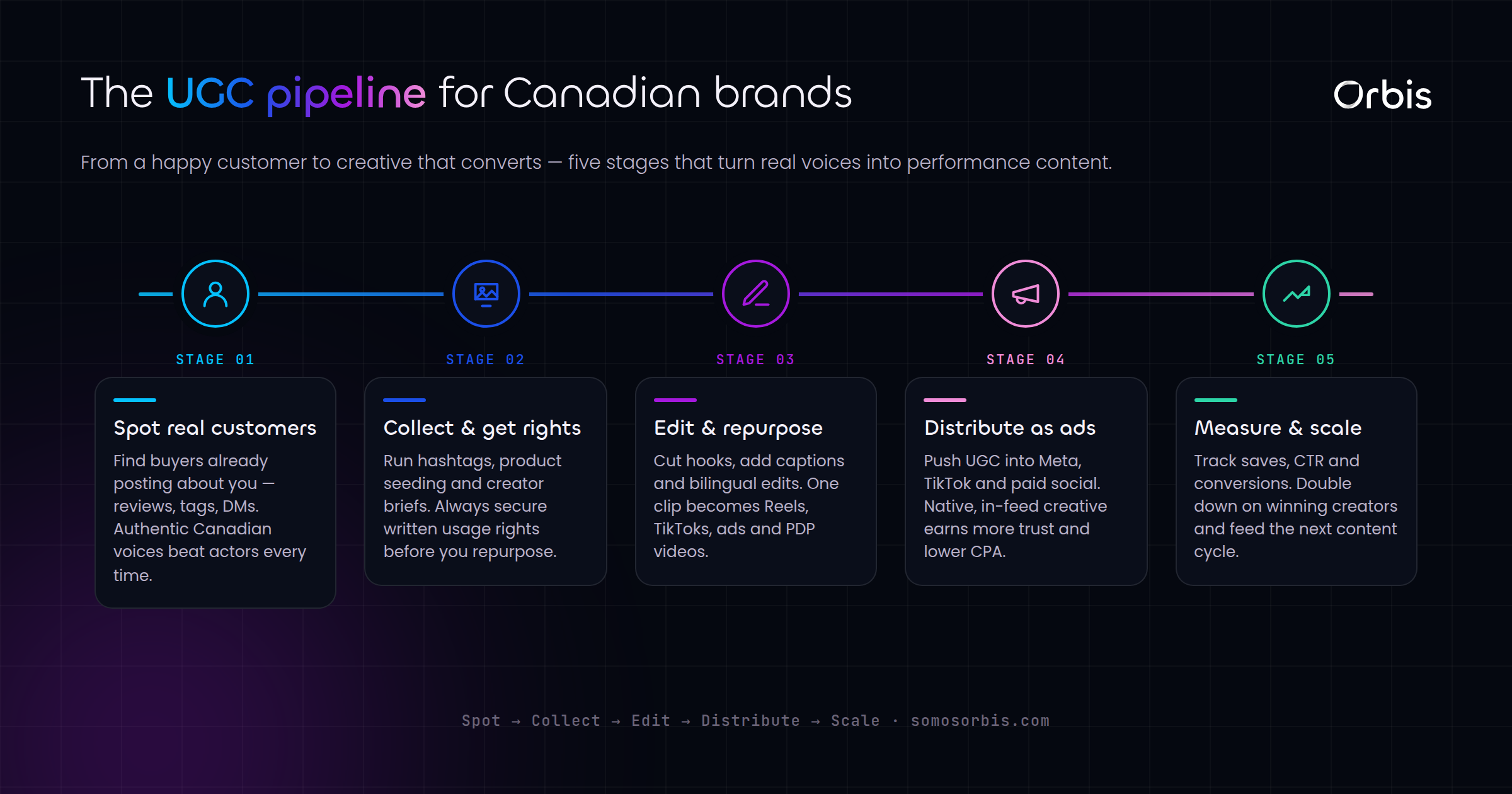
This is the loop that makes UGC an engine rather than a campaign. Source, brief, produce, edit, test, scale, refresh. Each cycle teaches you what your specific audience responds to, and the cost per acquisition trends down as your creative gets sharper.
Feeding both paid and organic
A well-run UGC pipeline serves two channels at once. The same creator content that powers your paid social can anchor your organic feed, where it builds the social proof that makes your next paid push more effective. Organic UGC reposts signal to your audience that real people use and like the product; paid UGC takes the best of that signal and puts media behind it. Treat them as one system. The organic feed becomes a testing ground for hooks and concepts, and the winners graduate to paid.
A practical 90-day rollout for Canadian brands
- Days 1 to 30: Audit existing organic UGC and secure rights to the best of it. Define your brand's UGC guardrails, compliance language, and bilingual requirements. Source an initial roster of three to five creators across English and French.
- Days 31 to 60: Run your first commissioned batch with structured hook testing. Launch into paid with small, equal budgets. Begin reposting rights-cleared organic UGC to your feed.
- Days 61 to 90: Identify winning hooks and creators. Scale spend behind proven creative, expand the roster to cover regional and seasonal needs, and lock in a monthly production cadence so the pipeline never runs dry.
Make UGC a system, not a scramble
The brands that get real, compounding returns from user-generated content are the ones that stop treating it as a series of one-off favours from happy customers and start running it as a managed, rights-cleared, bilingual production pipeline. Sourcing, briefing, licensing, editing, and testing are each small disciplines that, stacked together, produce a steady stream of creative that lowers acquisition cost month over month.
If you would rather plug into a pipeline that already handles creator sourcing, bilingual production, rights management, and ad-ready editing, our UGC content creation service is built for exactly that. We help Canadian brands turn real customers into creative that converts, and keep the well full so your ad account never goes thirsty. Reach out and we will map a UGC plan to your channels, your audience, and your goals.