
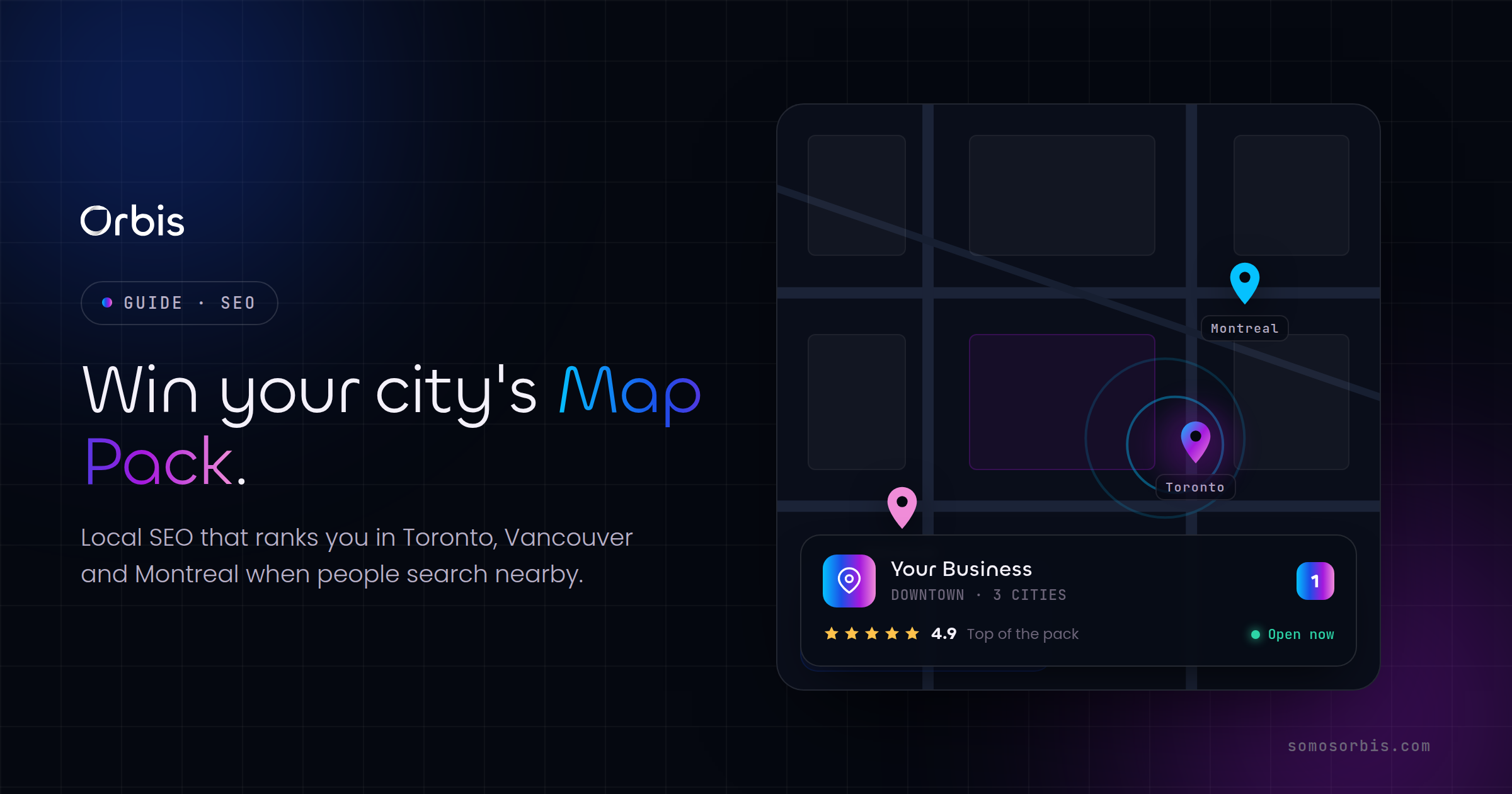
If your business serves customers in Toronto, Vancouver or Montreal, the single most valuable piece of digital real estate you can own isn't your homepage — it's a spot in the Google Map Pack. That three-result block at the top of local searches captures the lion's share of clicks for "near me" and city-specific queries, and it sits above the traditional organic results. Winning it is the difference between a phone that rings and a storefront that stays quiet. This is a city-by-city playbook for ranking in the Map Pack across Canada's three largest metros, built for businesses that want practical steps rather than theory.
Local search behaves differently from national SEO. Google weighs three signals heavily — relevance, distance and prominence — and each of Canada's big cities introduces quirks that change how you should approach all three. Below we break down what works in each metro, then walk through the universal fundamentals that earn and defend a Map Pack position. If you want the broader strategic context first, start with our complete guide to SEO in Canada, which frames how local fits into a full search program.
Why the Map Pack matters more in Canadian cities
Canada's urban population is concentrated and mobile. In Toronto, Vancouver and Montreal, a huge share of local discovery happens on phones, often while people are commuting, walking, or sitting on transit. The Map Pack is the format Google serves most aggressively on mobile, which means a top-three local position frequently gets seen before a single organic blue link.
There's also a density factor. In dense neighbourhoods — think Toronto's King West, Vancouver's Mount Pleasant, or Montreal's Plateau — there may be a dozen competitors within a few hundred metres. Distance alone won't separate you from the pack, so prominence and relevance signals do the heavy lifting. That's good news: it means disciplined work on your profile, reviews and on-page content can move you ahead of a closer but lazier competitor.
- High intent. Local searches like "emergency plumber Scarborough" or "comptable Plateau" carry strong purchase intent. The searcher wants to act now.
- Limited slots. Only three businesses appear by default. Position one to three is the entire game; fourth place lives below the fold.
- Trust transfer. Reviews, photos and accurate hours displayed right in the pack pre-qualify you before a click.
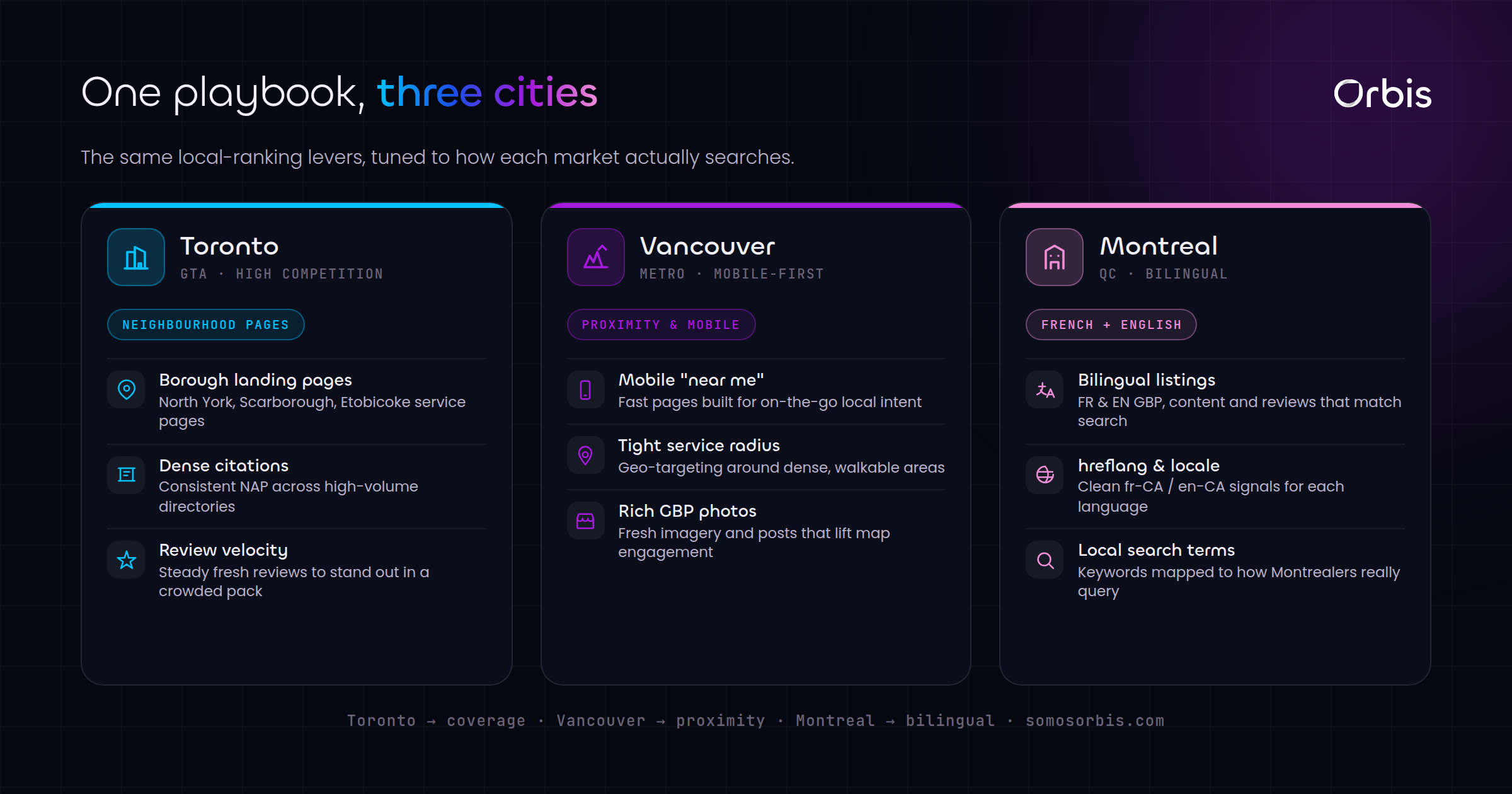
Toronto: winning in a fragmented, multi-neighbourhood market
Toronto isn't one market — it's dozens. The City of Toronto plus the broader GTA (Mississauga, Brampton, Markham, Vaughan, Scarborough, North York and beyond) means a single "Toronto" keyword strategy will leave you invisible in the neighbourhoods where your customers actually live.
Build for neighbourhoods, not just the city name
If you serve multiple parts of the GTA, create dedicated location pages for the areas you genuinely cover — not thin, copy-pasted doorway pages, but real pages with local context: the neighbourhoods you serve, parking and transit notes, local landmarks, and answers to questions specific to that area. A clinic that lists "Liberty Village, Leslieville and the Beaches" with substantive, distinct content for each will outrank one that only targets "Toronto."
- Anchor each page to a real service area and reference TTC lines, major intersections, or local landmarks customers recognize.
- Use schema markup so Google can clearly read your service areas and business category.
- Keep your Google Business Profile category tightly matched to the intent you want — the primary category is one of the strongest relevance levers you have.
Compete on reviews velocity
Toronto categories are crowded, and review count plus recency strongly influence prominence. A steady stream of recent reviews beats a large but stale pile. Build a simple, repeatable ask into your customer journey — after a completed job, at checkout, or in a follow-up email — so reviews arrive consistently rather than in one short-lived burst.
Vancouver: geography, competition and a mobile-first audience
Vancouver's physical geography shapes its search behaviour. The city is hemmed in by water and mountains, neighbourhoods are compact, and the broader Metro Vancouver region (Burnaby, Surrey, Richmond, North Vancouver, Coquitlam) sprawls outward. Distance signals matter intensely here because a searcher in Kitsilano and one in Surrey are effectively in different markets even though both might type "Vancouver."
Nail your service-area definition
If you're a service-area business (you go to the customer rather than the reverse), be precise and honest about the municipalities you cover in your Google Business Profile. Overreaching — claiming all of Metro Vancouver when you really serve the North Shore — dilutes your relevance and can hurt you in the neighbourhoods where you're strongest. Tighter, truthful service areas usually rank better.
Optimize for mobile and "near me"
Vancouver's outdoor, transit-and-walking culture means an outsized share of searches happen on the move. Make sure your profile and site deliver instantly on mobile:
- Accurate, current hours — including stat holidays and seasonal changes.
- A tappable phone number and one-tap directions.
- Fast-loading pages; slow mobile load is a silent killer of local conversions.
- Fresh photos that reflect the actual location, which Google increasingly uses as a quality and freshness signal.
Montreal: bilingual search is non-negotiable
Montreal is where many out-of-province strategies fall apart. A large portion of the market searches in French, and a meaningful share switches between English and French depending on the query. If your local presence is English-only, you're invisible to a huge segment of Montrealers — and you're handing the Map Pack to competitors who got their French right.
Serve both languages properly
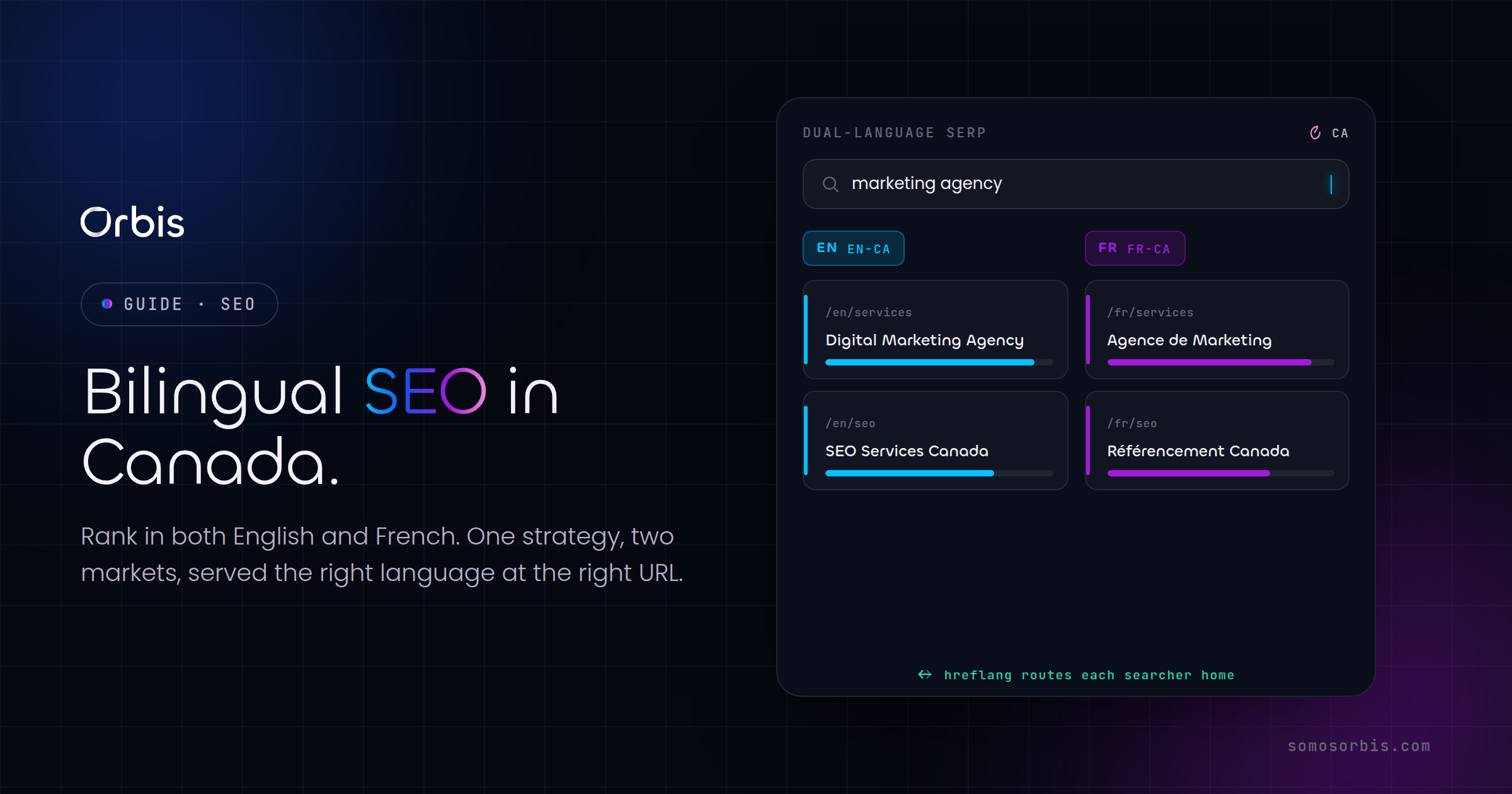
Bilingual local SEO is more than running your copy through a translator. Quebec French has its own phrasing, and the search terms people actually use ("dentiste près de moi," "plombier urgence Montréal") differ from a literal translation. Your Google Business Profile, location pages and reviews strategy all need to reflect both languages authentically. We cover the full approach in our guide to bilingual SEO for English and French in Canada, which is essential reading before you target the Quebec market.
Respect language laws and local expectations
Quebec has clear expectations around French-language commercial communication. Beyond compliance with current regulations, leading with French simply reflects how a large part of the city prefers to be addressed. Build your primary local content in French where your audience is francophone, with English as a properly structured parallel — not an afterthought.
In Montreal, the business that ranks isn't necessarily the closest one. It's the one that shows up correctly in the language the searcher is using.
The universal Map Pack fundamentals
City quirks aside, every Map Pack ranking rests on the same foundation. Get these right in all three metros and you give yourself a fighting chance regardless of how competitive the category is.
1. Claim and fully complete your Google Business Profile
An incomplete profile cannot rank well. Fill out every field: primary and secondary categories, services, attributes, hours, service areas, description, and a complete set of real photos. Profiles that are 100% complete consistently outperform half-finished ones.
- Choose the most specific primary category that matches your core service.
- Add relevant secondary categories without keyword-stuffing.
- Write a clear, benefit-led business description that reads naturally.
- Upload genuine photos and refresh them periodically.
2. Keep your NAP consistent everywhere
Your Name, Address and Phone number must match exactly across your website, Google Business Profile, and every directory and citation. Inconsistencies — an old suite number here, a different phone format there — confuse Google and erode prominence. Audit your citations and fix mismatches; consistency is one of the cheapest local SEO wins available.
3. Earn reviews, and respond to them
Reviews influence both ranking and click-through. Volume, recency, rating and even the keywords customers naturally use all feed the algorithm. Just as important: respond to every review, positive or negative, in a professional, on-brand voice. Responses signal an active, trustworthy business — to both Google and prospective customers reading them.
4. Build local relevance with on-page content
Your website still matters for the Map Pack. Pages that clearly establish what you do and where you do it strengthen the relevance signal. Embed a map, reference your service areas, publish locally relevant content, and ensure your contact details are crawlable text — not buried in an image.
5. Earn local links and citations
Prominence is partly a function of how the wider web references you. Local backlinks — from a neighbourhood business association, a regional publication, a local supplier or a community sponsorship — carry strong geographic relevance. For a deeper playbook on earning these, see our guide to link building for Canadian websites, which pairs naturally with a local SEO push.
A 30-day action plan to move up the Map Pack
Don't try to do everything at once. This sequence delivers the fastest realistic gains:
- Week 1 — Foundation. Fully complete your Google Business Profile, lock in the right primary category, and audit your NAP consistency across the top directories.
- Week 2 — Content. Build or improve your core location and service pages with genuine local detail; add schema markup; in Montreal, ship proper French versions.
- Week 3 — Reviews. Stand up a repeatable review-request process and respond to every existing review you've ignored.
- Week 4 — Authority. Pursue two or three local citations or backlinks and add fresh, real photos to your profile.
Then measure. Track your ranking for your priority keywords from the actual neighbourhoods you serve — local results are personalized by location, so test from where your customers are, not just from your office.
Common mistakes that keep Canadian businesses out of the pack
- Targeting only the city name. In all three metros, neighbourhood-level intent is where the volume and the wins are.
- Ignoring French in Montreal. English-only presence forfeits a huge share of the market.
- Stale profiles. Outdated hours, old photos and unanswered reviews quietly drag prominence down.
- Inconsistent NAP. Mismatched details across the web confuse Google and dilute trust.
- Overreaching service areas. Claiming territory you don't truly serve weakens relevance everywhere.
Turn local visibility into a steady stream of customers
Ranking in the Map Pack across Toronto, Vancouver and Montreal isn't luck — it's the result of a complete, consistent profile, a genuine commitment to reviews, locally relevant content (in both languages where it counts), and the local authority that links and citations provide. Do the fundamentals well and tailor them to each city's reality, and you'll show up at the exact moment a nearby customer is ready to act.
If you'd rather have an experienced team build and manage this for you, Orbis offers dedicated local SEO services for Canadian businesses — from Google Business Profile optimization and citation cleanup to review systems and city-by-city content. As a Google Partner with a 4.9-star rating across 58 reviews and more than 500 clients served over 15-plus years, we build local search programs designed to put your business in the pack and keep it there. Reach out and let's map your path to the top three in your city.