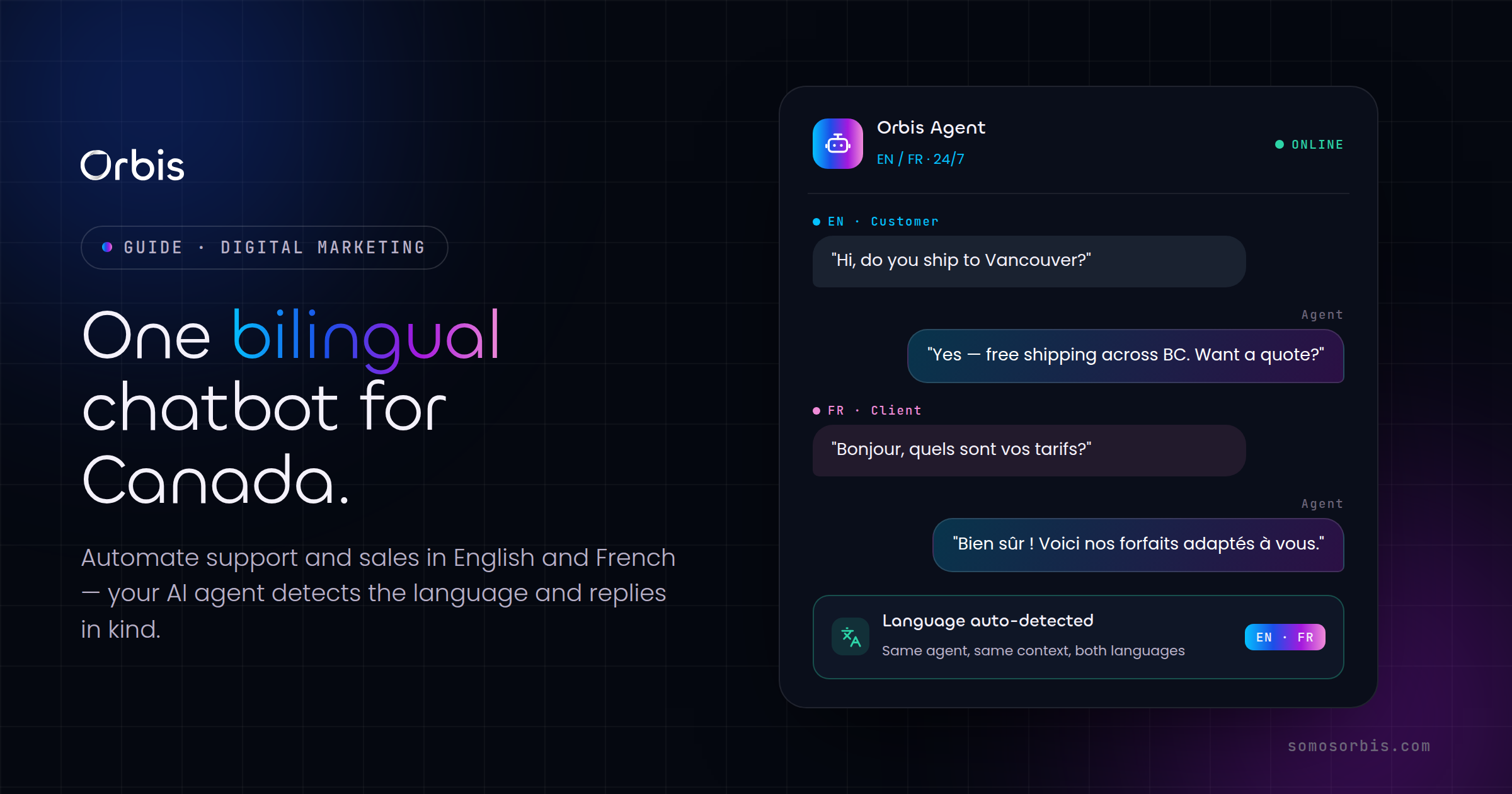
For Canadian businesses, the support inbox never really closes. A customer in Halifax is browsing your store at 9 p.m. Atlantic time while your team in Vancouver has just wrapped up the morning. A French-speaking lead in Montreal expects to be answered in French, and an English-speaking buyer in Calgary expects the same speed in English. Hiring around the clock in both official languages is expensive and hard to staff. A well-built chatbot closes that gap: it qualifies leads, answers repetitive questions, and routes the conversations that genuinely need a human, in EN and FR, every hour of the day.
This guide walks through how to deploy bilingual chatbots that actually move revenue and reduce support load, not the gimmicky pop-ups that frustrate people. It is written for the Canadian market, where bilingual service is often a customer expectation and sometimes a regulatory one, and where seasonal demand spikes around Boxing Day, back-to-school, and the holidays put real pressure on small support teams.
Why Canadian businesses need bilingual chatbots specifically
Plenty of generic advice about chatbots ignores the realities of operating in Canada. Two factors change the calculation here.
First, language. A meaningful share of your audience expects service in French, and not just in Quebec. Treating French as an afterthought, a half-translated menu and an English fallback when the conversation gets complicated, reads as careless. A chatbot that detects language, holds the full conversation in French, and hands off to a French-speaking agent when needed signals that you take the customer seriously.
Second, seasonality and time zones. Canada spans six time zones. When your support team logs off in one province, customers in another are still shopping. Layer on the demand spikes of the Canadian retail calendar, the rush before the holidays, the Boxing Day surge, the back-to-school window, and you get periods where human-only support simply cannot keep up. A chatbot absorbs the predictable, repetitive volume so your team can focus on the conversations that need judgment.
The point is not to replace people. It is to let people spend their time where they add the most value, and to make sure no qualified lead or paying customer is left waiting because of the clock or the language they speak.
What a chatbot should actually do for you
A useful business chatbot earns its place by doing a small number of jobs well. Trying to make it do everything is how you end up with a frustrating maze. Focus on these roles.
1. Qualify and capture leads
The highest-value job for most businesses is lead qualification. Instead of a static contact form, a chatbot can ask a short, natural sequence of questions, what are you looking for, what is your timeline, what is your budget range, and decide whether the visitor is a fit. Qualified leads get fast-tracked to a salesperson or booked straight into a calendar. Unqualified ones still get a helpful answer and a resource, so the interaction stays positive.
This works best when the chatbot is wired into your CRM so every conversation becomes a contact record with context attached. That connection between conversation and pipeline is the same discipline we cover in our pillar guide on marketing automation and CRM for Canadian businesses, which is worth reading alongside this one if you want the full picture of how automated touchpoints feed a sales pipeline.
2. Answer the repetitive questions
Look at your support tickets and live chat logs from the last 90 days. You will almost certainly find that a small set of questions accounts for a large share of volume: shipping times within Canada, return policy, hours, pricing tiers, whether you serve a particular province, how to reset a password. These are perfect for automation. Answering them instantly, in either language, frees your team and gives customers a faster experience than waiting in a queue.
3. Route and escalate cleanly
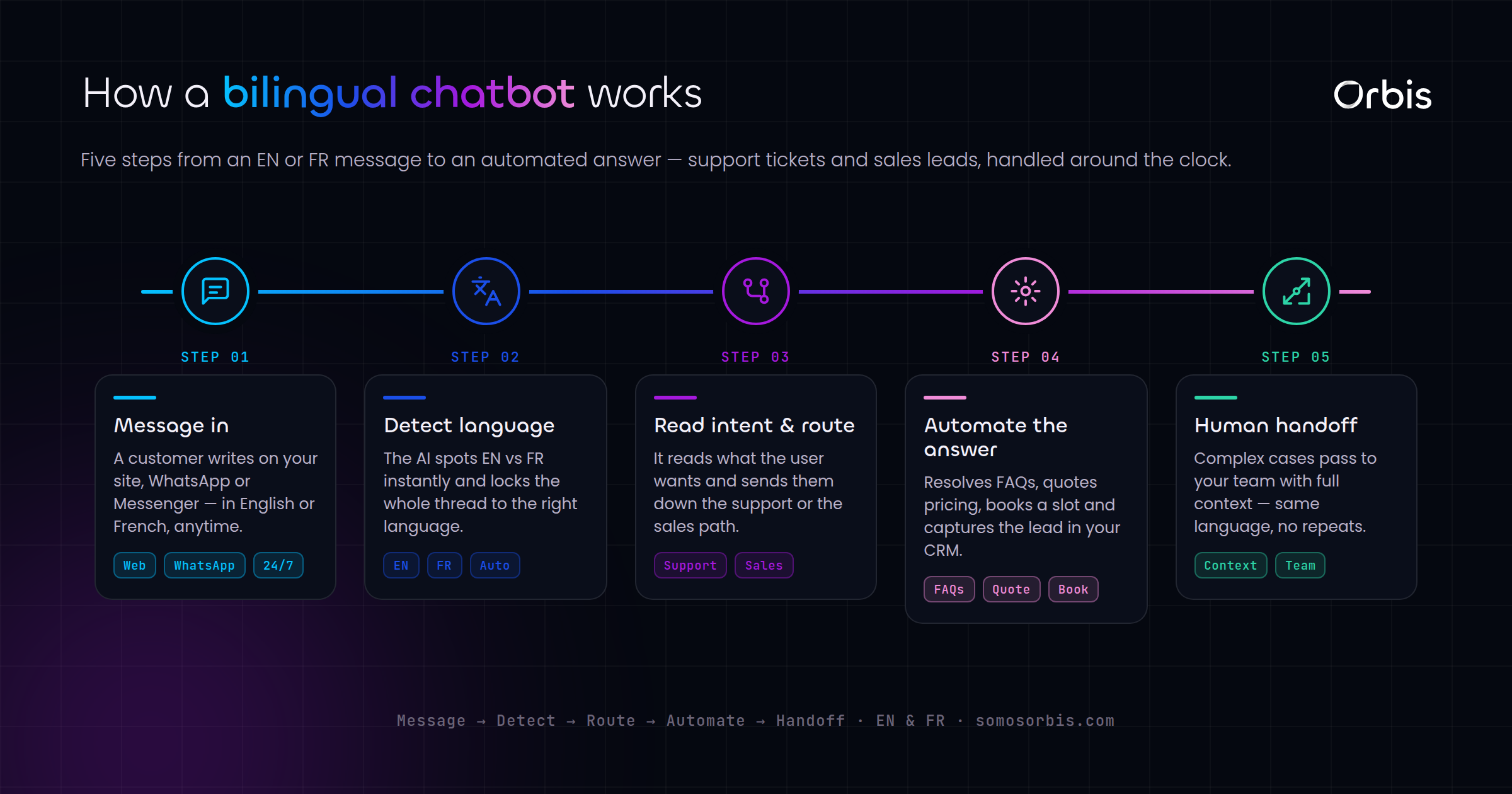
A chatbot should know its limits. When a question is complex, emotional, or high-value, the bot should hand off to a human without making the customer repeat themselves. Good routing passes the full transcript, the detected language, and any captured details to the right agent or team. The handoff should feel seamless, not like starting over.
4. Support and onboard existing customers
Chatbots are not only for new leads. They can help current customers check order status, find documentation, book a service appointment, or troubleshoot common issues. For subscription and service businesses, this reduces churn-driving frustration and keeps simple requests from clogging the support queue.
EN and FR: building genuinely bilingual experiences
Bilingual is the part most teams get wrong, so it deserves its own section. A few principles keep a French experience from feeling like a second-class translation.
- Detect, do not assume. Let the chatbot detect the customer's language from their first message or from a clear language toggle, rather than defaulting everyone to English and offering French only as an escape hatch.
- Translate intent, not just words. Use native French copy reviewed by a French speaker, not machine output dropped in unedited. Tone, formality, and common phrasing differ, and customers notice.
- Keep the whole journey in one language. If a conversation starts in French, the confirmation emails, the booking page, and the human agent it escalates to should all be French. A language switch mid-journey breaks trust.
- Match your human coverage. Only promise live French escalation during hours when a French-speaking agent is available. Outside those hours, the bot should set expectations honestly and capture the request for follow-up.
Done well, a bilingual chatbot is a competitive advantage. Many smaller Canadian competitors still offer English-only automation, so a polished French experience is a way to stand out with the large French-speaking market.
How to deploy a chatbot: a practical sequence
Skip the temptation to launch a giant bot that tries to handle everything on day one. A staged rollout produces better results and fewer embarrassing failures.
- Audit your real questions. Pull the last quarter of support tickets and chat logs. Cluster them into themes. The biggest clusters are your first automation targets.
- Map the high-value paths. Identify the two or three conversations that most directly drive revenue, usually lead qualification and booking, and design those flows carefully.
- Write the copy in both languages. Draft every prompt, answer, and fallback in EN and FR. Have a native French speaker review the French.
- Connect the back end. Wire the chatbot into your CRM, your calendar, and your help desk so conversations create records and bookings, not dead ends. The quality of these connections, what we call clean API integrations for Canadian businesses, is what separates a chatbot that drives pipeline from one that just collects unread messages.
- Set escalation rules. Define exactly when the bot hands off to a human and what context travels with the handoff.
- Launch narrow, then expand. Start with one or two flows on one page. Watch real conversations, fix the confusing spots, then widen coverage.
The fastest way to lose trust in a chatbot is to launch it everywhere at once with flows nobody tested. Start small, read the transcripts every week, and expand only what you can see is working.
Connecting chatbots to the rest of your automation
A chatbot is one node in a larger system. On its own it answers questions; connected to your wider stack, it becomes a revenue engine. When a chatbot qualifies a lead, that should trigger a nurture sequence, notify a salesperson, and create a follow-up task automatically. When it books an appointment, that should sync to the right calendar and send a bilingual confirmation.
This is where chatbots overlap with broader workflow automation. If you are thinking about how conversations feed into longer sales and marketing sequences, our overview of marketing and sales automation in Canada is a natural next read, it covers how the touchpoints downstream of a chatbot conversation should fire.
The underlying principle is what we call Business Assurance: documented processes, revenue engineering, and compliance by design. A chatbot built this way is not an isolated toy. It follows a repeatable, documented flow, it is engineered to move a lead toward a sale, and it respects the language expectations and quality processes your customers and current regulations require, including how you handle and store the personal information a conversation collects.
Measuring whether your chatbot is working
If you cannot measure it, you cannot improve it. Track a focused set of metrics from week one.
- Containment rate — the share of conversations the bot resolves without human help. Rising containment means real load reduction.
- Qualified leads captured — how many sales-ready contacts the bot hands to your team, broken out by language.
- Handoff quality — how often escalations arrive with full context versus customers having to repeat themselves.
- Resolution time — for automated paths, near-instant; compare against your human baseline.
- Language split — the EN/FR ratio of conversations, which tells you where to invest in better coverage.
- Drop-off points — where people abandon a flow. Each drop-off is a flow to rewrite.
Read the actual transcripts, not just the dashboard. The fastest improvements come from seeing exactly where a real customer got stuck and fixing that one prompt.
Common mistakes to avoid
- Hiding the human option. Always make it easy to reach a person. Trapping people with a bot creates resentment.
- French as an afterthought. Half-translated French is worse than no French. Commit to a full bilingual experience or be clear about your coverage.
- No CRM connection. A chatbot that captures leads into a void wastes its best feature. Connect it to your pipeline.
- Set and forget. Customer questions evolve. Review transcripts monthly and keep the flows current.
- Overpromising scope. A focused bot that does five things well beats one that does fifty things poorly.
Get a bilingual chatbot built for the Canadian market
A chatbot that qualifies leads, answers customers in English and French around the clock, and feeds clean data into your CRM is one of the highest-leverage automations a Canadian business can deploy. Built properly, it pays for itself in saved support hours and captured leads, especially through the Boxing Day, back-to-school, and holiday spikes when human-only support strains.
At Orbis, we design and deploy bilingual chatbot implementations for Canadian businesses that are wired into your real sales and support processes, not bolted on as an afterthought. As a Google Partner with more than 15 years and over 500 clients behind us, we build automation that follows documented processes and is engineered to drive revenue. If you are ready to automate support and sales in EN and FR, let's map out the flows that will make the biggest difference for your business.