
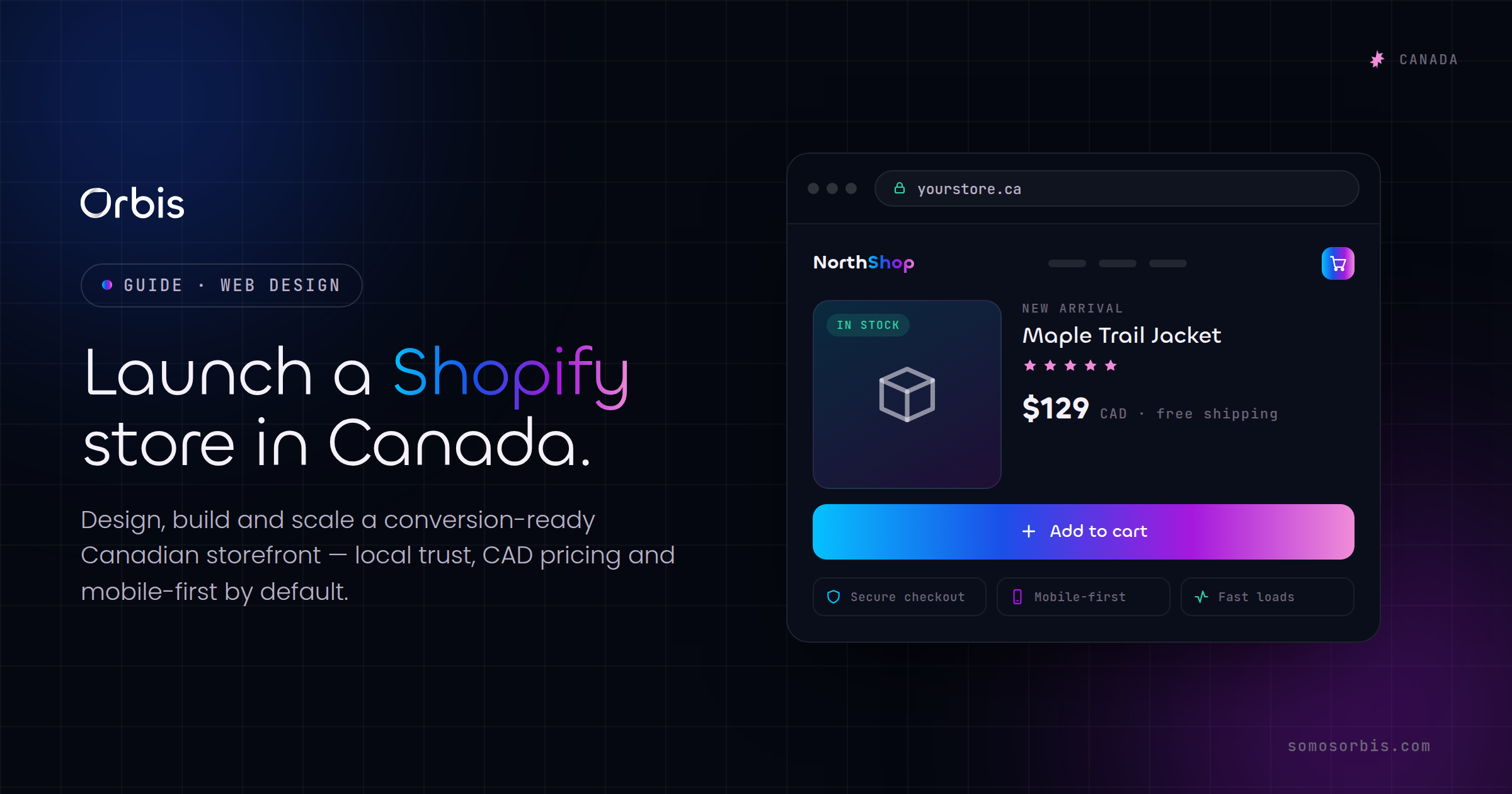
For Canadian merchants, a Shopify store is more than a storefront — it's a revenue engine that has to handle CAD pricing, GST/HST/PST that varies by province, shipping across one of the largest land masses on earth, and demand that spikes hard around Boxing Day, back-to-school and the December holidays. A store designed for a generic "North American" audience leaves money on the table. This guide walks through how to design, launch and scale a Shopify store built specifically for the Canadian market, with practical decisions you can act on this week.
If you're earlier in your journey and still weighing platforms, layouts and budgets, start with our complete guide to web design in Canada — it's the pillar that frames everything below. This article is the Shopify-specific deep dive within that cluster.
Why Shopify Works Well for Canadian Merchants
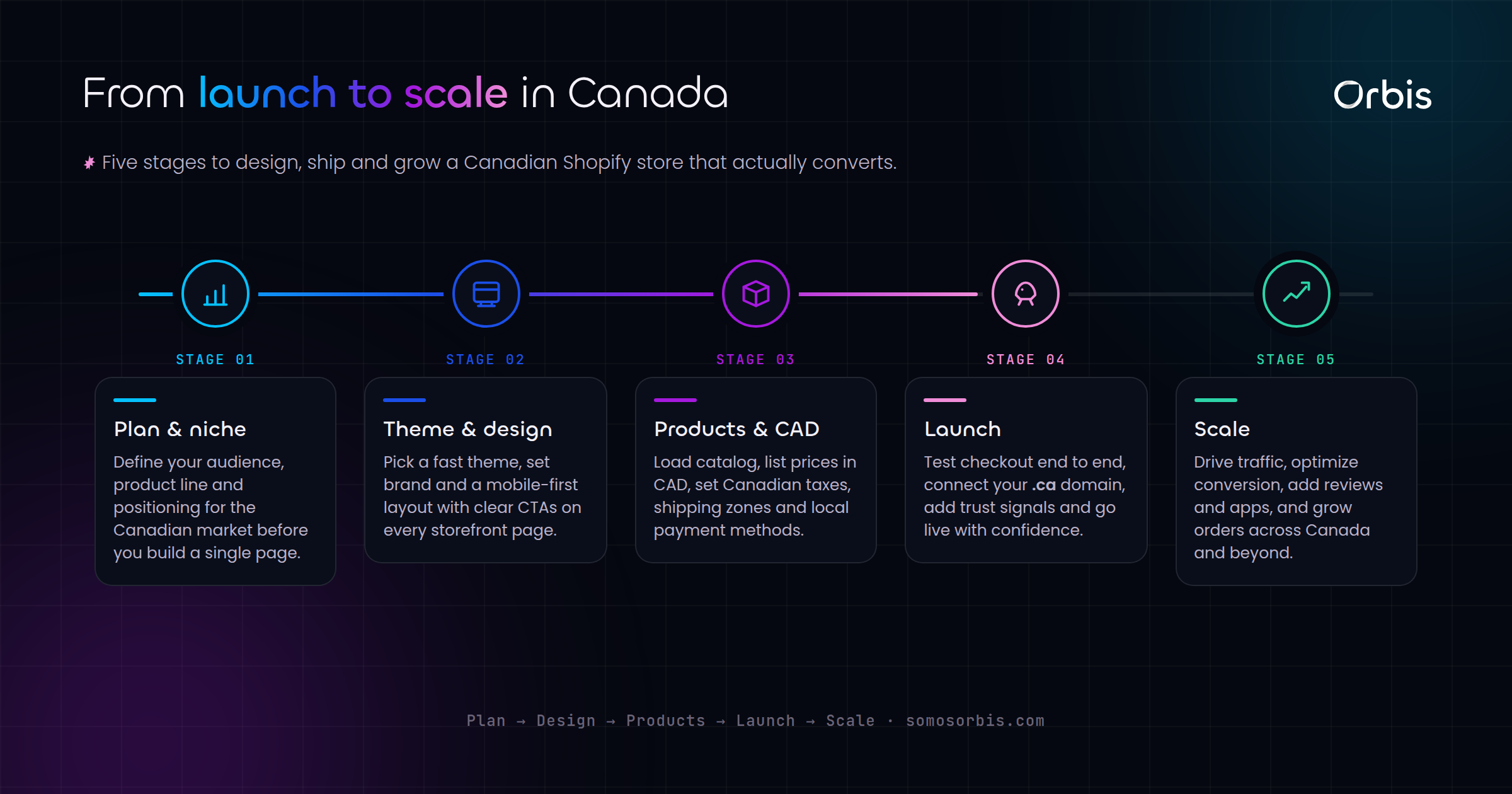
Shopify is a Canadian company (headquartered in Ottawa), and that shows up in features Canadian sellers actually need. Out of the box you get multi-currency selling, native CAD support, Shopify Payments with Canadian banking, and Shopify Tax that understands provincial rules. For most small and mid-sized merchants, it removes a long list of integration headaches you'd otherwise have to engineer yourself.
That said, "it works out of the box" is not the same as "it converts." The default theme is a starting point, not a finished store. The merchants who win treat design, tax logic, shipping and seasonal planning as deliberate decisions rather than defaults they inherited.
- Native CAD and multi-currency — sell to Canadian shoppers in dollars they recognize, and to U.S. or international buyers in their own currency without a third-party plugin.
- Shopify Tax — automatic calculation of GST, HST and PST based on the customer's province and your nexus.
- Bilingual capability — critical if you ship to Quebec, where French-language commerce is both expected and, in many cases, legally required.
- Canadian shipping integrations — Canada Post, along with carriers like Purolator, FedEx and UPS, plug in directly for live rates.
Designing for the Canadian Shopper
Good Shopify store design in Canada starts with the assumption that your visitor is comparing you to Amazon.ca and to a U.S. competitor whose prices look cheaper until duties and exchange rates are added. Your design job is to remove every doubt before it forms.
Show Prices in CAD — Clearly and Honestly
Nothing erodes trust faster than a shopper discovering at checkout that prices were in USD. Set CAD as your store currency, display the currency code explicitly (e.g., "$49.00 CAD"), and if you sell cross-border, use Shopify Markets to localize pricing per region. Canadian shoppers have been burned by surprise conversion fees and customs charges — transparency is a conversion lever, not a nicety.
Make Shipping Costs and Timelines Obvious
Shipping is the single biggest friction point in Canadian e-commerce. A parcel from Toronto to a rural address in the territories can cost more and take far longer than the same parcel crossing a U.S. state. Design your product and cart pages to surface shipping reality early:
- Display a free-shipping threshold prominently (e.g., "Free shipping on orders over $75 CAD") — it lifts average order value and reduces cart abandonment.
- Offer a shipping estimator on the product page so a shopper in Calgary or Halifax sees their real cost before they commit emotionally.
- Be explicit about delivery windows to remote and northern regions; under-promising and over-delivering beats a surprise at checkout.
Build for Mobile and Slower Connections
A large share of Canadian e-commerce traffic is mobile, and connection quality outside major metros is uneven. A heavy, image-bloated theme that feels fine on office fibre in downtown Vancouver can crawl on a phone in a smaller community. Compress images, lazy-load below-the-fold content, and keep your hero section lean so the page is interactive in seconds, not after a spinner.
Handling CAD, Taxes and Compliance
Tax is where Canadian Shopify stores most often get configured wrong — and where getting it right is part of running a clean, compliant operation. Canada's sales tax landscape isn't one rate; it's a patchwork.
- GST applies federally at a flat rate.
- HST combines federal and provincial tax in provinces like Ontario, Nova Scotia and New Brunswick.
- PST/QST applies separately in provinces such as British Columbia, Saskatchewan, Manitoba and Quebec.
Shopify Tax handles the calculation, but you still need to register for the right tax accounts, set your nexus correctly, and decide whether prices display tax-inclusive or tax-exclusive. We design stores with these quality processes documented from day one, so finance and fulfilment aren't reverse-engineering your settings six months later. Building compliance into the store design — rather than bolting it on after a problem appears — is a core part of how we approach revenue-critical builds.
For Quebec specifically, plan for French. Depending on your situation, current regulations may require French-language product information and checkout. Shopify supports multilingual stores, so build the French experience as a first-class version, not a machine-translated afterthought.
Designing for Canadian Seasonal Demand
Canadian retail runs on a distinct calendar, and your store design should flex with it. The merchants who scale plan their store for these peaks months in advance rather than scrambling the week before.
- Back-to-school (August–September) — a major spending window for apparel, electronics and home goods. Build collection pages and bundles ahead of time.
- Holiday and Black Friday (late November) — the heaviest traffic of the year. Pressure-test your theme, apps and checkout under load before the rush.
- Boxing Day and Boxing Week (December 26 onward) — a uniquely strong Canadian event. Many merchants see Boxing Week rival or exceed Black Friday, so design a dedicated sale experience for it.
- Winter logistics — factor weather-related shipping delays into your messaging and set customer expectations honestly.
Prepare the Store, Not Just the Promotion
Seasonal readiness is a design and engineering exercise, not only a marketing one. Before a peak:
- Audit your theme and apps for speed — every extra script is a tax on conversion when traffic surges.
- Pre-build sale collections, banners and countdown elements so launch day is a toggle, not a rebuild.
- Confirm inventory sync and shipping rates hold up under volume.
- Set up clear post-purchase communication so support isn't buried in "where's my order" tickets.
Apps and Integrations Worth Designing Around
Shopify's strength is its ecosystem, but every app you install adds weight and potential failure points. Choose deliberately. For Canadian merchants, the integrations that tend to earn their place are:
- Shipping — Canada Post and multi-carrier apps that surface live rates and print labels.
- Reviews and social proof — local reviews carry weight; surface them on product pages.
- Email and SMS — for abandoned-cart recovery and seasonal campaigns, where the real margin often lives.
- Loyalty — repeat purchase programs that suit your category and margins.
The principle is the same one we apply to every build: each integration must justify its performance cost. A lean, fast store with five well-chosen apps will outconvert a bloated one running twenty.
Shopify vs. Other Platforms for Canadian Stores
Shopify isn't the only path. If you're running content-heavy commerce or already live on a WordPress site, a WooCommerce setup can make sense — we cover the trade-offs in our guide to building a WordPress website in Canada. And if you're weighing the broader question of platform, structure and conversion strategy before committing, our overview of e-commerce website design in Canada compares the options side by side.
For most Canadian merchants who want to launch quickly, sell across provinces without wrestling tax logic, and scale into peak seasons without re-platforming, Shopify is the pragmatic choice. The differentiator isn't the platform — it's how deliberately the store is designed on top of it.
A Practical Launch Checklist
Before you flip your Shopify store live, run through this Canada-specific checklist:
- Store currency set to CAD with currency code visible on prices.
- Shopify Tax configured for your provinces and nexus, with the right tax registrations in place.
- Shipping zones and live rates set for every province and territory, plus a clear free-shipping threshold.
- French-language experience built where required for Quebec.
- Mobile performance tested on a real phone and a slower connection.
- Seasonal collections and sale templates pre-built for Boxing Week and the holidays.
- Abandoned-cart and post-purchase flows live before your first campaign.
- Analytics and conversion tracking confirmed so you can measure what's working.
Launch and Scale With a Team That Knows the Canadian Market
A Shopify store designed for Canada — CAD-native, tax-correct, shipping-honest and built to survive Boxing Week — is the difference between a storefront that exists and one that compounds revenue. Getting there takes more than installing a theme; it takes deliberate design, clean processes and an eye on every conversion-killing detail.
That's exactly what we build. If you're ready to launch or rebuild, explore our Shopify store design and development services in Canada — a Google Partner team with 15+ years of experience, 4.9 stars across 58 reviews, and more than 500 clients served. Let's design a store that's ready for the way Canadians actually shop.