
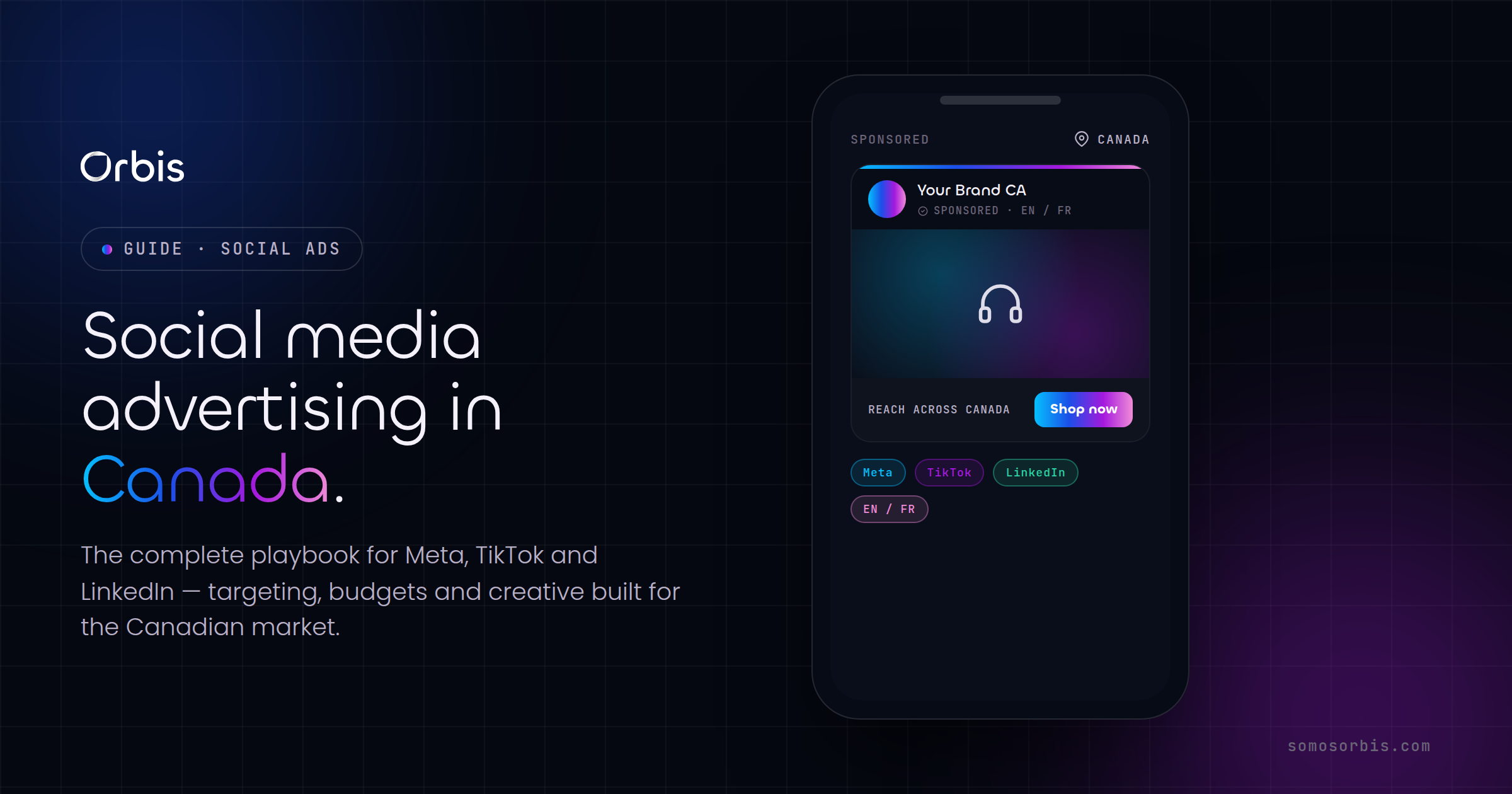
Paid social is where most Canadian brands now spend their first marketing dollar — and where many of them waste it. The platforms make it easy to launch a campaign in minutes, but easy launches rarely produce profitable results. Between Meta's two-app ecosystem, TikTok's discovery engine, LinkedIn's expensive B2B audiences, Pinterest's planning-stage shoppers and Spotify's audio inventory, the question is no longer "should we run social ads?" It is "which platforms deserve our CAD budget, and how do we run them so the spend pays for itself?"
This guide is written for marketers and owners running paid social in Canada: a bilingual market with English and French audiences, CAD budgets, distinct seasonality (Boxing Day, back-to-school, the long holiday run-up), and provincial nuances from Vancouver to Montreal. We'll cover how to choose platforms, set realistic budgets, structure campaigns, build creative that performs, measure honestly, and stay compliant with current regulations. It's a long read on purpose — treat it as a reference you come back to, not a one-time skim.
Why social advertising works differently in Canada
The mechanics of the ad platforms are the same in Toronto as they are in Texas, but the conditions around them are not. Three factors change how Canadian campaigns should be built.
Bilingualism is not optional. Roughly a fifth of the country speaks French as a first language, concentrated in Quebec but present across New Brunswick, eastern Ontario and pockets nationwide. Running English-only creative into Montreal or Quebec City leaves performance — and goodwill — on the table. The cheap mistake is to machine-translate ad copy; the expensive mistake is to ignore French entirely. Build separate ad sets for EN and FR audiences so you can budget, bid and measure them independently rather than averaging two very different markets into one blurry number.
Seasonality follows a Canadian calendar. Boxing Day and Boxing Week drive a retail spike that rivals Black Friday. Back-to-school ramps through August into early September. The winter holidays compress demand into a short, expensive window where auction costs climb sharply. Summer brings cottage season and a slowdown in some B2B verticals. Plan budgets against this calendar, not a generic US one, and pull spend forward before auction prices peak.
Audience size and cost. Canada is a smaller market than the US, which means narrow targeting can exhaust an audience quickly and drive up frequency. Broad-but-relevant targeting, supported by strong creative, usually outperforms hyper-narrow stacks of interests here. It also means you should expect CPMs to behave differently across provinces — the GTA, Metro Vancouver and Greater Montreal carry the most competition.
Choosing the right platforms for your business
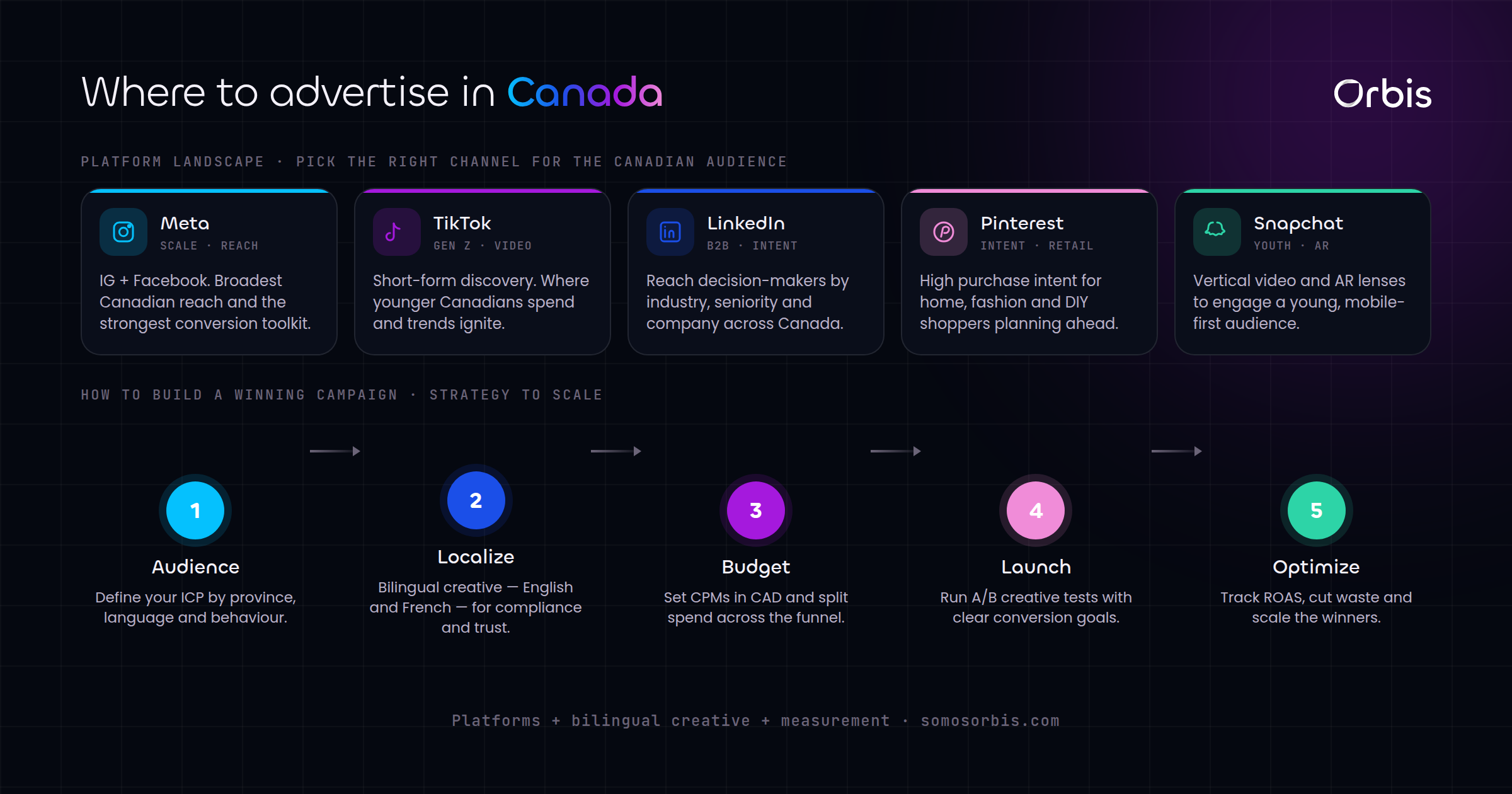
The biggest budget decision is allocation, not optimization. A perfectly tuned campaign on the wrong platform still loses. Start by matching the platform to where your buyer actually makes the decision.
Meta (Facebook and Instagram)
Meta remains the default workhorse for most Canadian advertisers, and for good reason: enormous reach across age groups, mature commerce features, and the most forgiving learning curve for direct-response. For ecommerce, local services, lead generation and app installs, it is usually the first platform to test and the last to cut. Facebook still skews older and is strong for local and service businesses; Instagram skews younger and visual, ideal for lifestyle, fashion, food and beauty. Because they share an ad system, you can run both from one campaign and let placement optimization find efficiency — though we generally recommend testing feed and Reels placements deliberately rather than trusting "Advantage+ placements" blindly on day one.
If Meta is your primary channel, it's worth going deep on the platform's structure and bidding rather than treating it as a boost button. Our breakdown of how Canadian brands run Meta and Facebook ads covers campaign architecture and budget pacing in detail, and the Instagram ads playbook for Canadian brands goes deeper on visual-first creative and Reels.
TikTok
TikTok has moved from "experimental" to "core" for many Canadian DTC and consumer brands. Its strength is discovery: the algorithm surfaces products to people who weren't searching for them, which makes it powerful for top-of-funnel demand generation and for brands with a strong visual or entertaining hook. It skews younger but the audience is aging up fast, and the platform's commerce features keep expanding. The catch is that TikTok rewards native, creator-style content and punishes repurposed TV-style ads. If your team can produce a steady stream of authentic, fast-paced video, TikTok can deliver some of the cheapest reach in the market. If it can't, the channel will frustrate you. See our look at TikTok ads trends in Canada for what's actually converting.
LinkedIn is the most expensive social platform per click in Canada — and frequently the most profitable for B2B. If you sell to businesses, professionals or specific job functions, no other platform lets you target by company, seniority, industry and role with comparable precision. Expect high CPCs and modest volume; the math works because a single closed deal can dwarf the ad cost. LinkedIn is best for lead generation, content distribution to decision-makers, and account-based programs aimed at Canadian enterprises. It is rarely the right home for impulse consumer products. Our guide to LinkedIn ads for Canadian B2B walks through targeting and lead-gen forms.
Pinterest catches people in planning mode — weddings, renovations, recipes, travel, seasonal shopping, home decor. That intent makes it quietly effective for retail, home, food and DIY brands, often at a lower CPM than Meta. Canadian seasonal planning (cottage season, winter holidays, back-to-school) maps neatly onto how people use the platform. It rewards clean, vertical, "save-worthy" imagery and a long content shelf life — a strong Pin can drive traffic for months. Read more in our piece on Pinterest ads and Canadian shoppers.
Spotify and audio
Audio is the channel most Canadian advertisers underuse. Spotify reaches commuters, gym-goers and at-home listeners in moments when screens are unavailable, which makes it a strong awareness and brand-recall complement to your visual channels. It's also useful for reaching specific audiences by playlist, genre and daypart. Audio creative is a different craft — your hook lives in the first few seconds and your call to action has to be memorable without a clickable button — but for brand-building on a Canadian budget it deserves a test. We cover the format in Spotify ads and audio advertising in Canada.
Setting CAD budgets that make sense
There is no universal "right" budget, but there is a reliable way to reason about it. Budget should be a function of your goal, your unit economics and the learning the platform needs — not a number you picked because it felt comfortable.
Start from your economics, not the platform's minimums
Work backwards from what a customer is worth. If your average order value is $120 CAD and your gross margin is 40%, you can afford roughly $48 in variable cost per order before you stop making money on the first purchase — and more if repeat purchases are likely. That ceiling, not the platform's suggested daily budget, tells you whether a campaign is viable. For lead generation, do the same math on your lead-to-close rate and average deal value. Decide your target cost per acquisition before you spend a dollar.
Give the algorithm enough data to learn
Every major platform optimizes against a conversion event, and it needs a minimum volume of those events per week to exit the "learning phase" and stabilize. As a rule of thumb on Meta, an ad set wants to see in the neighbourhood of dozens of conversions per week to optimize well. If your budget is so thin that you generate only a handful of conversions, the system never learns and performance stays erratic. The practical implication: don't spread a small budget across ten ad sets. Concentrate it so at least one ad set can actually learn.
A simple allocation framework
- Testing budget (10–20%): always-on spend dedicated to new creative, audiences and placements. This is your pipeline of future winners.
- Scaling budget (60–70%): goes behind proven winners. Scale by raising budgets gradually — large overnight jumps reset the learning phase.
- Retargeting budget (15–25%): warm audiences (site visitors, video viewers, cart abandoners, engaged accounts) almost always deliver your cheapest conversions. Don't starve this just because the volume looks small.
Budget against the Canadian calendar
Pull budget forward ahead of Boxing Week and the holiday window, when auction prices climb and last-minute spend gets expensive. Ramp gradually into back-to-school. Use the quieter summer stretch to test creative cheaply so you enter Q4 with proven assets rather than guesses. Keep a contingency line so you can lean into a campaign that's clearly working without cannibalizing your baseline.
Campaign structure and targeting
Most underperforming accounts share the same problem: too many ad sets, each starved of data, all competing against each other in the auction. A clean structure fixes more problems than any single bid tweak.
Keep the account simple
A workable default is one campaign per objective (for example, one for prospecting and one for retargeting), a small number of ad sets within each, and several creative variations per ad set. Resist the urge to build a separate ad set for every interest you can think of — in a market the size of Canada, that fragments your audience and your data. Let the platform's broad targeting and your creative do the heavy lifting, and reserve manual segmentation for genuinely different audiences (EN vs FR, prospecting vs retargeting, dramatically different value propositions).
Build your audience layers
- Cold / prospecting: broad or lightly-targeted audiences, often supported by lookalikes built from your best customers. This is where most of your reach budget lives.
- Warm / engagement: people who watched your video, visited your site, or engaged with your profile but haven't converted. Cheaper and more responsive than cold.
- Hot / retargeting: cart abandoners, pricing-page visitors, past purchasers. Small audiences, but your highest return per dollar.
First-party data is now the foundation
As browser-level tracking has tightened, the advertisers winning in Canada are the ones feeding the platforms clean first-party signals: server-side conversion tracking, hashed customer lists for matching, and well-defined conversion events. This isn't a nice-to-have anymore — it's the difference between an optimizer that can find your buyers and one that's guessing. It also keeps you on the right side of current privacy regulations, because you're working from data customers have actually given you. Getting this plumbing right is a core part of how our paid social team sets up accounts before spending a dollar on media.
Creative: the real performance lever
Once your tracking and structure are sound, creative is what actually moves the numbers. On modern social platforms the algorithm is so good at finding the right person that the ad itself — the hook, the message, the format — accounts for the majority of performance differences between campaigns. Spend your energy here.
Match the creative to the platform's native language
The single most common waste is running the same asset everywhere. A polished brand film that works on Instagram feed will die on TikTok, where viewers expect raw, fast, creator-style video. A Pinterest Pin needs clean vertical imagery and text that helps someone plan. A LinkedIn ad needs to respect a professional's time and lead with a clear business outcome. A Spotify spot has to land its message in audio alone. Produce platform-native variations rather than one master asset stretched to fit.
Lead with the hook
On every social platform you have one to three seconds before the thumb moves. Front-load the value: open on the problem, the payoff, or a pattern interrupt — never a slow logo animation. Put your strongest message and any text overlay in the first frame. For video, design for sound-off viewing on Meta (captions, on-screen text) and sound-on for TikTok and Spotify.
Produce volume, then double down
Creative fatigues — frequency climbs, results decay, and a winning ad's performance erodes over a few weeks. The fix is a steady pipeline of new concepts, not a single hero ad you defend forever. Build in batches, test cheaply, kill losers quickly, and reinvest behind the two or three concepts that break out. Vary the angle, not just the colour: different hooks, different value propositions, different formats. For brands running Meta as their primary channel, our Meta and Facebook ads service includes a structured creative-testing cadence so you're never relying on a single tired asset.
Localize, don't just translate
For French-Canadian audiences, write the creative in French rather than translating from English — idioms, humour and cultural references rarely survive a literal swap. The same applies to imagery and seasonal cues: a Quebec winter campaign should feel like it was made for Quebec, not adapted from a generic North American template.
Measurement and attribution
You can't scale what you can't measure honestly, and honest measurement is harder than the dashboards make it look. Platform-reported numbers are useful but self-interested — each network claims credit generously. Treat them as directional and anchor your real decisions to business outcomes.
Define success before you launch
Decide your primary metric per objective up front: cost per acquisition and return on ad spend for direct response; cost per qualified lead for B2B; reach, frequency and brand lift for awareness. Write down the threshold that makes a campaign a keeper versus a cut. This prevents the all-too-common pattern of moving the goalposts to justify a campaign that isn't working.
Triangulate your data sources
- Platform dashboards tell you relative performance within a channel — which ad and audience are winning.
- Your analytics platform (GA4 or similar) gives a more neutral cross-channel view of traffic and conversions.
- Your CRM or order data is the source of truth — it knows what actually closed and what it was worth.
When these three disagree — and they will — trust the one closest to revenue. A common Canadian wrinkle: with smaller audiences and bilingual splits, conversion volumes per segment can be low, which makes day-to-day numbers noisy. Make decisions on rolling windows, not single days, and don't kill an ad set on one bad afternoon.
Incrementality beats last-click
The most valuable question isn't "which click did the platform claim?" but "did this spend generate sales we wouldn't have gotten anyway?" Geo holdout tests, lift studies and simple before/after analysis around budget changes get you closer to that truth than any attribution model. You don't need a data-science team to start — even disciplined pause-and-observe tests on a single channel will teach you which spend is genuinely incremental.
Compliance and brand safety in Canada
Paid social in Canada operates under real rules, and ignoring them is a fast way to get accounts disabled or land in regulatory trouble. Build compliance into your process rather than bolting it on after a complaint.
- Privacy and consent: when you upload customer lists or use first-party data for matching, make sure you have the consent and the privacy disclosures that current regulations require. Server-side tracking should be configured with privacy in mind, not as a workaround.
- Truth in advertising: claims must be accurate and substantiated. Avoid unverifiable superlatives and misleading price or savings claims — Canadian advertising standards take these seriously.
- French-language requirements: advertising directed at Quebec audiences carries specific French-language expectations. Plan French creative as a requirement, not an afterthought.
- Regulated categories: finance, health, alcohol and similar verticals face extra restrictions on both the platforms and under current regulations. Know your category's rules before you write the creative.
This is exactly where a Business Assurance mindset pays off: documented processes for how consent, claims and creative approvals are handled, so growth doesn't come at the cost of a compliance fire later. Treating quality processes as part of the campaign — not an obstacle to it — is what lets you scale spend with confidence.
A practical 90-day rollout
If you're starting or rebuilding paid social, resist the urge to launch everything at once. A staged approach lets each channel prove itself before it competes for budget.
- Weeks 1–2 — Foundation. Install and verify conversion tracking (server-side where possible), define your conversion events, set your target CPA/ROAS, and build your audience lists. Pick one primary platform to start — for most Canadian brands that's Meta.
- Weeks 3–6 — Prove the primary channel. Launch prospecting and retargeting on your primary platform with several creative variations and a clean structure. Let ad sets exit the learning phase before judging them. Build EN and FR splits if you serve Quebec.
- Weeks 7–10 — Expand creative and add a channel. Scale your winners, refresh fatiguing creative, and add a second platform that matches your audience — TikTok for discovery, LinkedIn for B2B, Pinterest for planning-stage retail.
- Weeks 11–13 — Optimize and systematize. Run an incrementality check on your biggest spend, formalize your creative-testing cadence, and lock in the reporting that ties spend to revenue. You should now have a repeatable engine rather than a series of one-off campaigns.
Related guides in this series
This pillar gives you the strategy; the platform-specific guides below go deep on execution for each channel:
- Meta and Facebook ads in Canada — campaign architecture, bidding and budget pacing.
- Instagram ads for Canadian brands — visual-first creative and Reels.
- TikTok ads trends in Canada — native creative and discovery-driven growth.
- LinkedIn ads for Canadian B2B — precise targeting and lead-gen forms.
- Pinterest ads and Canadian shoppers — planning-stage intent and seasonal Pins.
- Spotify ads and audio advertising in Canada — audio creative and brand recall.
And if you'd rather have the platform-level work done for you, our TikTok ads service and Meta and Facebook ads service plug straight into the strategy above.
The bottom line
Social advertising rewards discipline far more than it rewards spend. The Canadian brands that win paid social aren't the ones with the biggest budgets — they're the ones that choose the right platforms for their buyer, set CAD budgets grounded in real unit economics, feed the algorithms clean first-party data, ship a steady stream of platform-native creative, measure against revenue instead of vanity metrics, and build compliance in from the start. Do those six things consistently and paid social stops being a cost centre and starts being a growth engine.
If you want a team that runs all of this for you — strategy, creative, measurement and compliance across Meta, TikTok, LinkedIn, Pinterest and Spotify — explore our social media advertising services for Canada. With Google Partner status, a 4.9-star rating across 58 reviews, more than 500 clients and over 15 years of building revenue engines, we'll help you turn paid social into a channel you can scale with confidence. Book a conversation with our paid social team and let's map your first 90 days.