
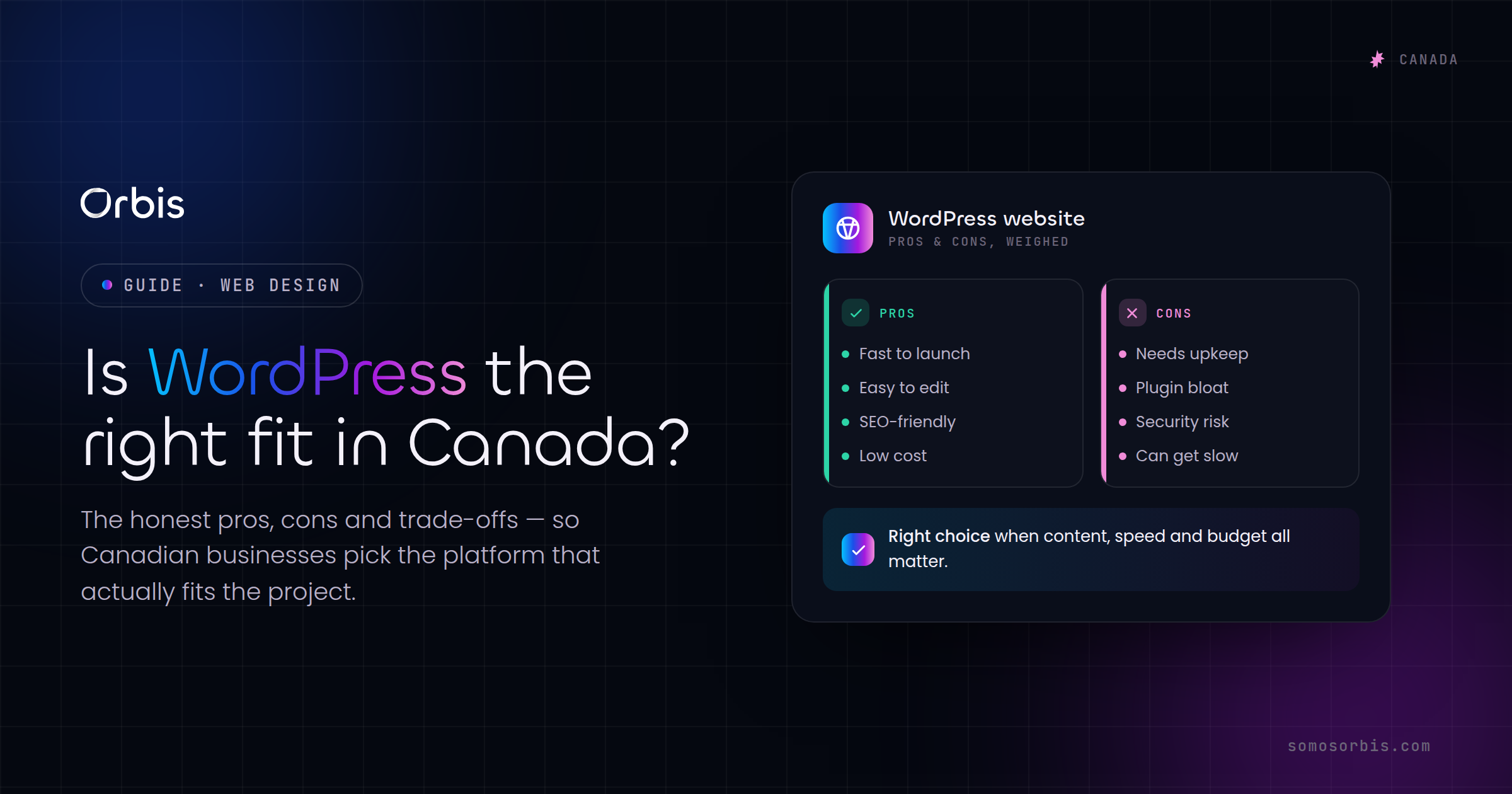
WordPress runs a large share of the web, and for good reason. For many Canadian businesses, it remains a sensible, cost-effective foundation for a marketing website, blog, or content-heavy site. But "popular" is not the same as "right for you." Before you commit your budget and your team's time, it's worth understanding exactly what WordPress does well, where it creates friction, and the specific scenarios where a Toronto retailer, a Vancouver professional services firm, or a Calgary manufacturer is genuinely better served by it. This guide gives you a clear-eyed view, grounded in the realities of hosting, security, maintenance, and compliance in the Canadian market.
If you're still mapping out your broader approach before picking a platform, start with our complete guide to web design in Canada, which covers strategy, budgets, and timelines end to end. This post zooms in on one decision inside that larger picture: should WordPress be your platform?
What WordPress actually is (and what it isn't)
There are two things people call "WordPress," and confusing them leads to bad decisions. The first is WordPress.com, a hosted service where someone else manages the infrastructure. The second, and the one most agencies mean, is the open-source WordPress software you install on your own hosting (often called self-hosted WordPress or WordPress.org). The self-hosted version is the flexible, extensible platform that powers everything from a local bakery's site to large publishing operations.
At its core, WordPress is a content management system: a structured way to create, organize, and publish pages and posts without touching code. Its real power comes from themes (which control design) and plugins (which add functionality, from contact forms to bookings to multilingual support). That plugin ecosystem is both its greatest strength and the source of most of its headaches, as we'll see.
The pros: why WordPress still wins for many Canadian businesses
1. Lower upfront cost and a large talent pool
Because WordPress is open source, there are no licensing fees for the core software. For a small or mid-sized Canadian business watching cash flow in CAD, that matters. Just as important, there is a deep pool of developers, freelancers, and agencies across Canada who know the platform. You are not locked into a single vendor; if a relationship doesn't work out, you can find someone else to take over without rebuilding from scratch.
2. You own your content and you can move
With self-hosted WordPress, your content lives in a database you control, on hosting you choose. If you want to keep your data on Canadian servers for performance or data-residency reasons, you can select a host with data centres in Toronto, Montreal, or Vancouver. That portability is a meaningful contrast to fully closed platforms where exporting your content cleanly can be painful.
3. Excellent for content marketing and SEO
WordPress was born as a blogging platform, and it shows. Publishing articles, structuring categories, and managing a content calendar is straightforward. Combined with mature SEO plugins, it gives marketing teams strong control over titles, meta descriptions, redirects, and structured data, the foundations of organic visibility. If part of your growth plan is ranking for what Canadian customers search, that's a genuine advantage.
4. Bilingual and multi-region friendly
Operating in Canada often means serving customers in both English and French, especially if you sell into Quebec or run national campaigns. WordPress has well-established multilingual plugins that let you maintain EN/FR versions of your pages, manage translations, and serve the right language to the right visitor. It also handles regional content well if you run separate pages for, say, back-to-school promotions in Ontario versus Boxing Day campaigns nationally.
5. Extensible without reinventing the wheel
Need event registration, a member area, a job board, lead-capture forms, or a booking calendar? There is almost certainly a mature plugin for it. This lets you launch faster and test ideas before investing in custom development. For a growing business, that speed-to-market is real money saved.
The cons: where WordPress creates work and risk
1. Security is your responsibility
WordPress's popularity makes it a frequent target. The core software itself is reasonably secure when kept current, but most breaches come through outdated plugins, weak passwords, or abandoned themes. If no one is actively patching and monitoring the site, vulnerabilities accumulate. For a Canadian business handling customer enquiries or, worse, personal data, a compromised site is both a reputational and a privacy problem. This is exactly why we treat security as part of our process rather than an afterthought, building in maintenance and monitoring from day one.
2. Maintenance never stops
A WordPress site is not "set and forget." Core, themes, and plugins all receive updates, and skipping them is how sites break or get hacked. But applying updates blindly can also break things, especially when plugins conflict. Responsible maintenance means staging changes, testing, and then deploying, on a regular cadence. Budget for this. A site that looks cheap to build can become expensive to neglect.
3. Plugin bloat and performance
The ease of adding plugins is a trap. Stack fifteen of them and your site slows down, your attack surface grows, and conflicts multiply. Slow load times hurt both conversions and search rankings, and Canadian shoppers comparing options on mobile during a commute will leave a sluggish site. Disciplined plugin choices and proper hosting are what keep WordPress fast.
4. Hosting quality makes or breaks it
Cheap shared hosting is where good WordPress projects go to die. Underpowered servers, no caching, and no staging environment lead to slow, fragile sites. Managed WordPress hosting, ideally with servers or a CDN edge close to your Canadian audience, costs more but pays for itself in speed, uptime, and fewer emergencies.
5. It can become a Swiss Army knife when you need a scalpel
WordPress can do almost anything, but "can" and "should" diverge. For high-volume online stores or complex applications, purpose-built platforms often serve you better. If your core business is selling products online at scale, a dedicated commerce platform is usually the stronger choice, which is why many Canadian retailers we work with land on a Shopify store built for the Canadian market rather than a WooCommerce setup.
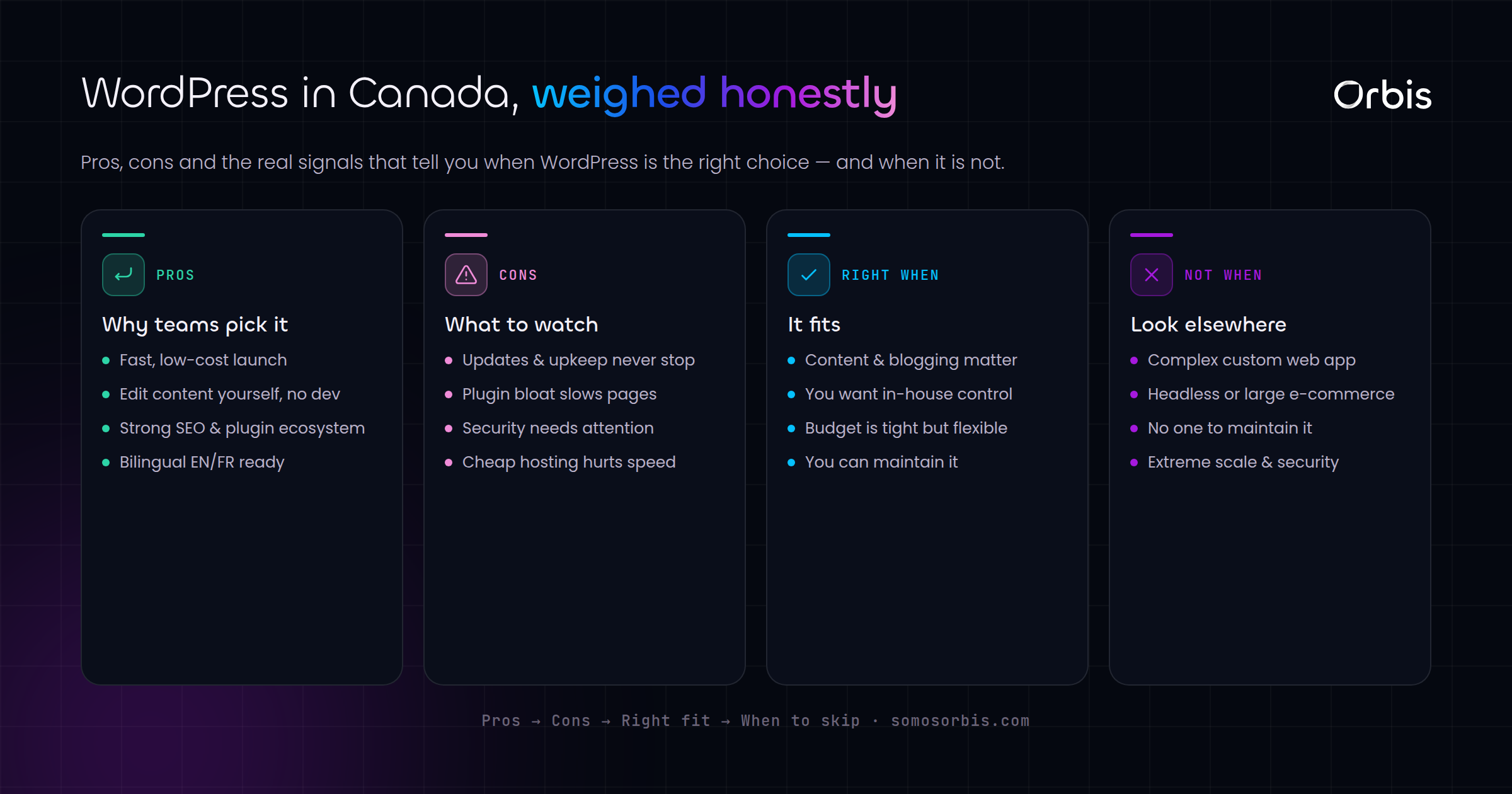
When WordPress is the right choice
WordPress is an excellent fit when your priorities line up with its strengths. Consider it your default option if most of the following describe you:
- You publish content regularly, a blog, resources, news, or thought leadership, and SEO is part of your growth plan.
- You need a flexible marketing site with pages like services, about, careers, and contact, plus the ability to add features over time.
- You want your team to update content themselves without calling a developer for every change.
- You need bilingual EN/FR content and regional landing pages for Canadian campaigns.
- You want to avoid vendor lock-in and keep the freedom to switch developers or hosts.
- Your budget favours a strong launch now with the option to invest in custom features later.
When to look elsewhere
Be honest about the cases where another platform serves you better:
- High-volume ecommerce: If selling online is your core business, a dedicated commerce platform handles inventory, payments, shipping, and Canadian tax rules with less friction.
- Complex web applications: Customer portals, dashboards, or heavily transactional tools often warrant custom development.
- Single high-intent campaign pages: If your immediate goal is one conversion-focused page for an ad campaign, you may not need a full CMS at all. A purpose-built page, designed around a single action, frequently outperforms a generic template, which is the focus of our guide to landing page design that converts.
- Strict performance or security constraints: If you cannot commit to ongoing maintenance, a lower-maintenance hosted platform may reduce risk.
A practical checklist before you build on WordPress
If you've decided WordPress is the right call, set yourself up properly from the start. Work through this list with your developer or agency:
- Choose quality hosting first. Managed WordPress hosting with caching, staging, daily backups, and infrastructure close to your Canadian users.
- Plan for maintenance. Agree on a monthly cadence for updates, monitoring, and backups before launch, not after the first incident.
- Keep plugins lean. Every plugin should earn its place. Prefer well-maintained, reputable ones and remove anything unused.
- Build security in. Strong credentials, limited admin access, an SSL certificate, and a firewall or security layer from day one.
- Handle privacy correctly. Map what personal data you collect through forms and analytics, and align your cookie and privacy notices with current regulations that apply to Canadian businesses.
- Design for performance and mobile. Optimize images, enable caching, and test on the devices your customers actually use.
- Set up measurement. Analytics and goal tracking so you know whether the site is driving enquiries and revenue, not just traffic.
The bottom line for Canadian businesses
WordPress is not the right answer for every project, but it remains the right answer for a great many of them. It rewards businesses that value content, flexibility, ownership, and a wide talent pool, and it punishes those who treat a website as a one-time purchase rather than a living asset. The difference between a WordPress site that drives leads for years and one that becomes a liability usually comes down to two things: the quality of the build and the discipline of the ongoing maintenance behind it.
That's where having an experienced partner matters. As a Google Partner with more than 15 years and over 500 clients, we approach WordPress with documented processes and built-in maintenance, so your site stays fast, secure, and aligned with current regulations as your business grows. If you're weighing your options or ready to build, explore our WordPress web design services for Canadian businesses and let's figure out, honestly, whether it's the right platform for where you're headed.