
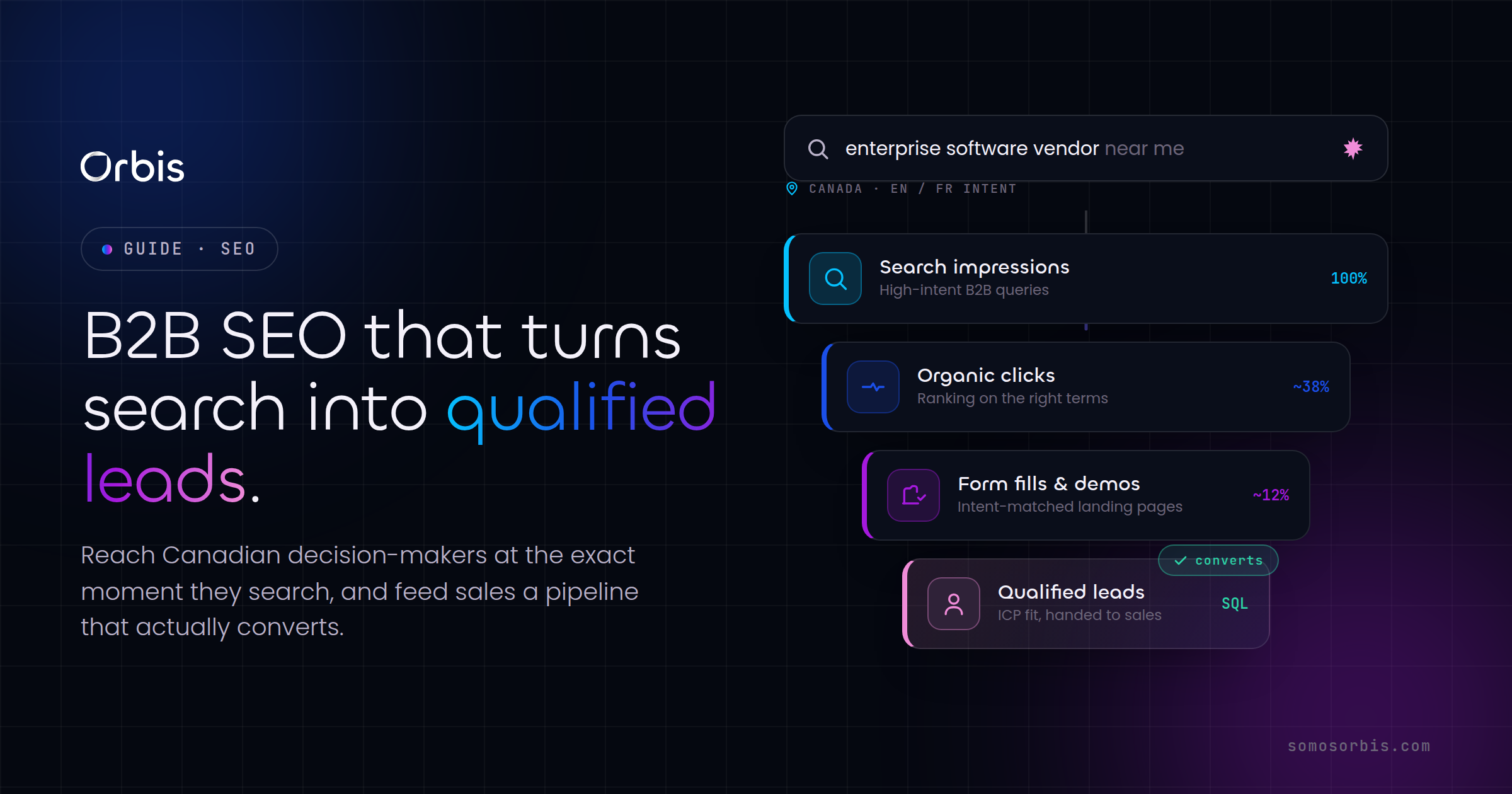
Most Canadian B2B companies treat SEO like a brand awareness exercise: publish a few blog posts, chase a handful of high-volume keywords, and hope something sticks. The result is traffic that looks good in a monthly report but never shows up in the sales pipeline. If your buyers are procurement leads in Toronto, operations directors in Calgary, or finance teams in Montreal, vanity traffic does nothing for you. What you need is bottom-of-funnel SEO engineered to turn search intent into qualified conversations.
This guide breaks down how Canadian B2B firms build search programs that generate real pipeline, not just sessions. It is the practical, revenue-focused companion to our broader complete guide to SEO in Canada, narrowed specifically to the B2B buying cycle and the long, multi-stakeholder deals that define it.
Why B2B SEO in Canada Is a Different Game
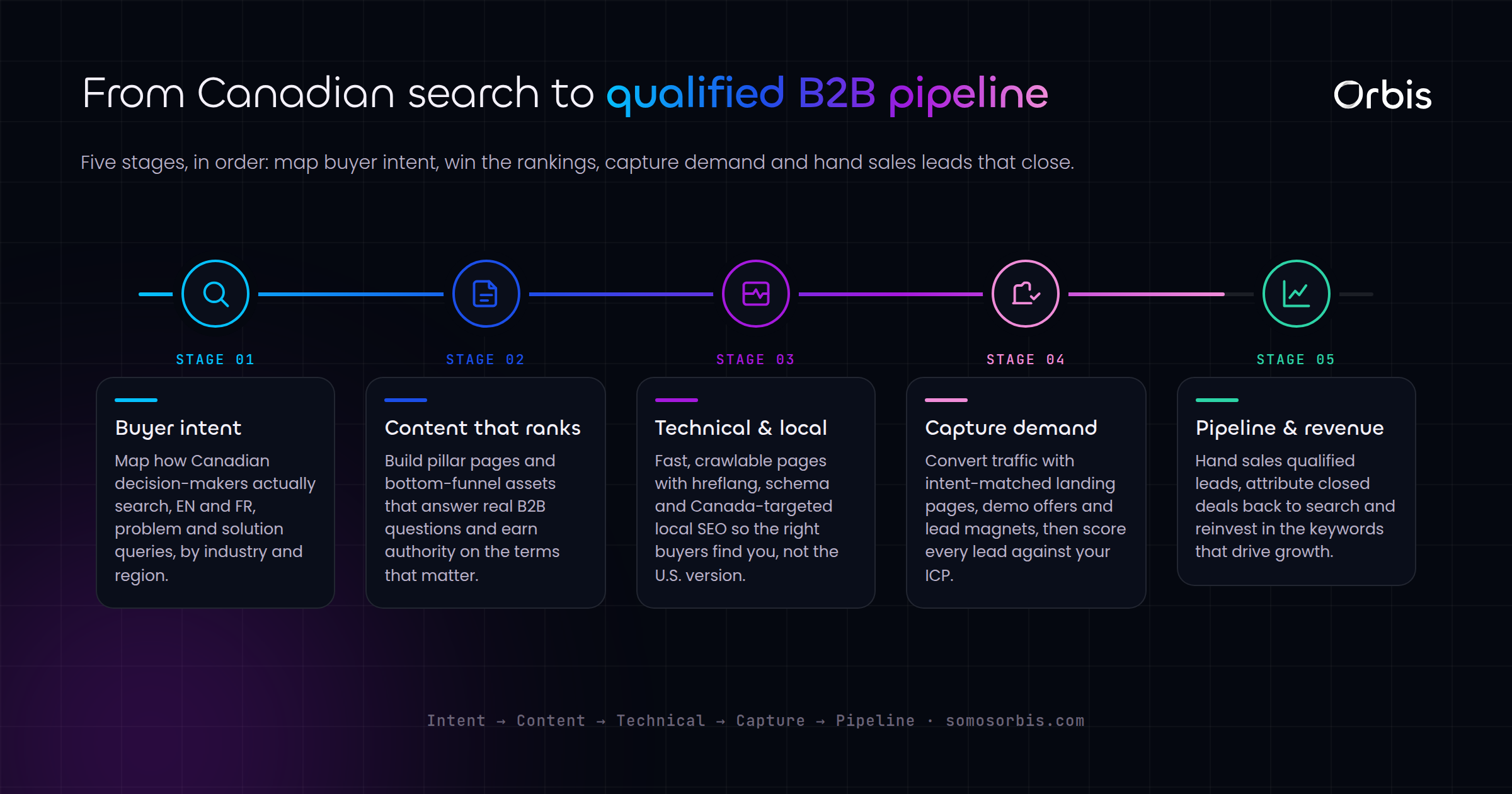
B2B search behaviour in Canada differs from B2C in three ways that change how you build your entire program.
- Lower volume, higher value. A query like "managed cybersecurity provider Ontario" might get 90 searches a month. That feels small until you realize a single signed contract could be worth six figures over its lifetime. In B2B, ranking for the right 200-search keyword beats ranking for the wrong 20,000-search one.
- Long, committee-driven buying cycles. Canadian B2B purchases routinely involve three to seven stakeholders, RFP processes, and procurement gates. A buyer might research for months before talking to sales. Your content has to serve every stage of that journey, not just the first click.
- Regional and bilingual nuance. Serving Quebec means French-language search matters, and not as an afterthought. A prospect in Montreal searching "logiciel de gestion d'inventaire" will not be served by an English-only page. Provincial regulations, tax considerations, and even procurement preferences vary across the country, and your content should reflect that you understand them.
Because the deal values are high and the volumes are low, precision matters more than reach. You are not trying to win the internet. You are trying to be the obvious answer when a qualified buyer searches a phrase that signals real intent.
Start With Bottom-of-Funnel Keywords, Not Top-of-Funnel Volume
The single most common mistake in Canadian B2B SEO is starting with awareness content. Teams write "what is supply chain management" articles, rank for them eventually, and then wonder why none of that traffic books a demo. The people searching definitional queries are often students, junior staff, or competitors, not buyers with budget.
Flip the funnel. Build your foundation on commercial and transactional intent first, then layer awareness content on top once the money pages are converting.
The Four Intent Tiers That Actually Generate Pipeline
- Solution-aware queries. "Payroll software for Canadian small business," "freight brokerage Vancouver," "ISO-ready document management platform." These searchers know they need a solution and are evaluating options. This is where your money is.
- Comparison and alternative queries. "[Competitor] alternative," "best CRM for manufacturing Canada," "[Tool A] vs [Tool B]." Buyers in active evaluation use these. A well-built comparison page can convert at several times the rate of a blog post.
- Pricing and cost queries. "How much does fleet tracking cost in Canada," "ERP implementation pricing." B2B buyers hate that vendors hide pricing. Even a transparent "how pricing works" page captures high-intent demand most competitors ignore.
- Geo-modified service queries. "B2B marketing agency Toronto," "industrial equipment supplier Alberta." Local intent in B2B is real, especially for services and anything requiring on-site delivery, support, or compliance with provincial rules.
Map every one of these to a dedicated, conversion-built page. Do not bury a "freight brokerage Vancouver" target inside a 2,000-word thought leadership essay. Give it its own page with a clear value proposition, proof points, and a single obvious next step.
Build Pages That Match Both Intent and the Buying Committee
Ranking is necessary but not sufficient. A page that ranks first and converts no one is a failure. In B2B, the page has to speak to multiple readers at once, because the person who finds you on Google is rarely the person who signs the contract.
A strong B2B landing page in the Canadian market typically addresses:
- The economic buyer who needs ROI, payback period, and risk reduction framed clearly.
- The technical evaluator who wants specifications, integrations, and implementation detail.
- The end user who cares about ease of use and day-to-day workflow.
- Procurement and compliance who need to know you can meet current regulations, security requirements, and contract terms.
This is where Business Assurance becomes a search advantage, not just a sales talking point. When your pages document your processes, demonstrate revenue-focused thinking, and show compliance by design, you answer the questions a Canadian buying committee actually asks before they shortlist you. Pages that pre-empt procurement objections move further down the funnel before a human ever gets involved.
The goal of a B2B page is not to "get the lead." It is to get the lead that procurement will actually approve. Filtering for fit on the page itself is what separates SEO traffic from SEO pipeline.
Technical Foundations That Protect Your Rankings
None of your content strategy matters if Google cannot crawl, render, and trust your site. B2B sites are often the worst offenders here because they are frequently built on aging platforms, stitched together across multiple vendors, or weighed down by gated content that search engines never see.
Cover these fundamentals before you scale content:
- Site speed and Core Web Vitals. Decision-makers research on mobile between meetings. A slow page loses them and your ranking.
- Clean information architecture. Services, solutions, industries, and resources should each have a logical hub. Internal linking should reinforce which pages matter most.
- Structured data. Organization, Service, FAQ, and Breadcrumb schema help Google understand your offering and can win you richer results.
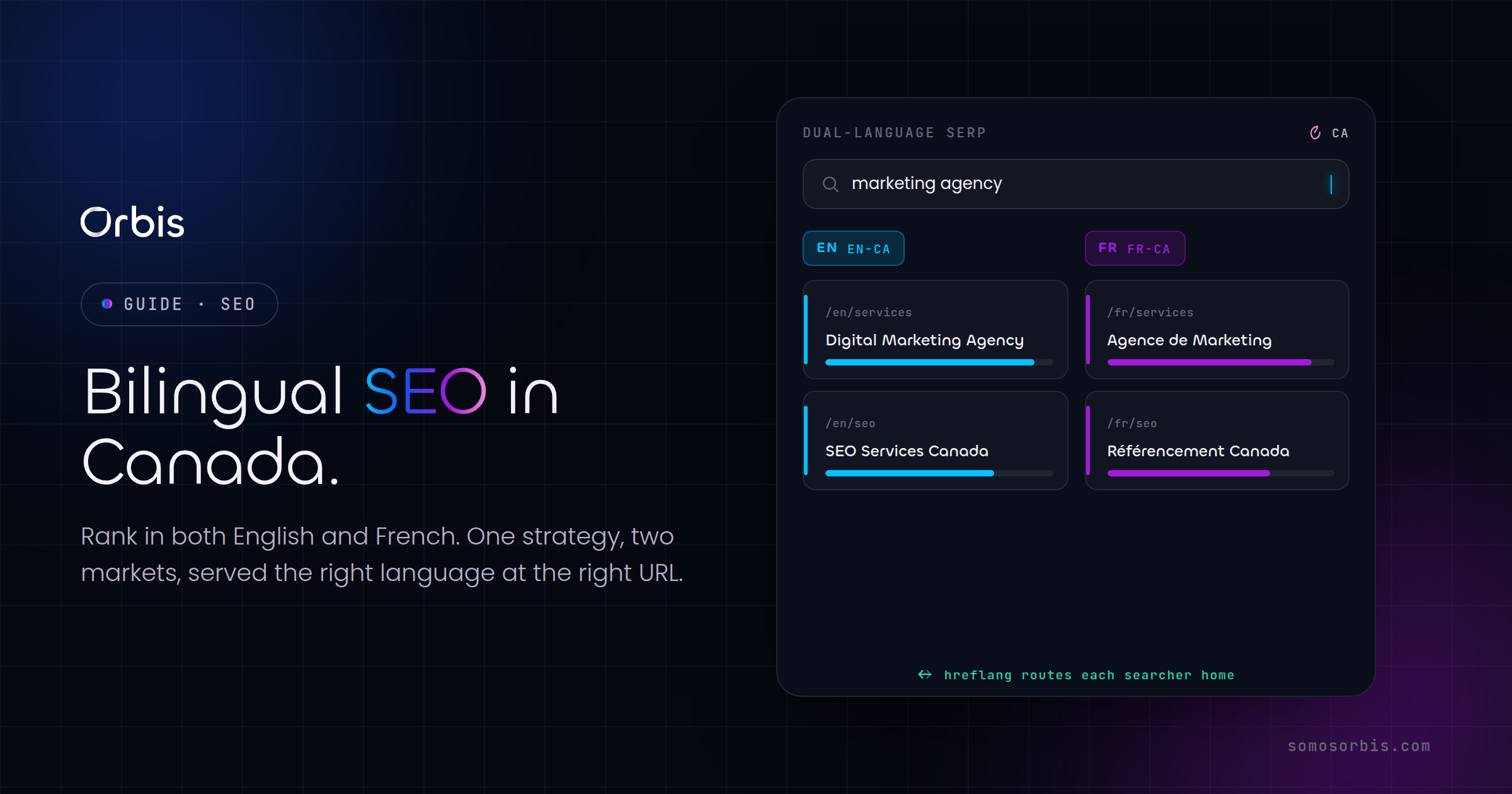
- Bilingual implementation done right. Use hreflang correctly for English and French Canadian pages so the right version surfaces for the right searcher. Half-built French sections hurt more than they help.
- Indexable proof. If your case studies, certifications, and methodology live behind forms or in PDFs Google ignores, you are hiding your strongest ranking and trust signals.
The same technical discipline that helps a retailer applies here. If you also run a storefront, the playbook in our breakdown of ecommerce SEO for Canadian stores covers crawl efficiency, structured data, and conversion-focused page builds that translate directly to B2B catalogues and product-led service pages.
Topic Clusters: Organize for Authority and Conversion
Search engines reward depth and topical authority. A single page on "warehouse automation" will struggle against competitors who have built an entire interconnected library on the subject. The fix is the topic cluster model: one comprehensive pillar page supported by a web of focused articles that each target a specific sub-query and link back to the hub.
For a Canadian B2B company, a cluster might look like this:
- Pillar: a definitive guide to your core category, built to rank for the broad term and to orient buyers.
- Commercial satellites: comparison pages, pricing explainers, and geo-targeted service pages that capture high-intent traffic.
- Educational satellites: how-to and best-practice articles that capture earlier-stage research and feed prospects toward your commercial pages through internal links.
The internal linking is what makes the cluster work. Every educational article should point readers toward the relevant commercial page using descriptive, natural anchor text. Every commercial page should reinforce the pillar. This structure tells Google you are an authority and guides human readers down the funnel at the same time.
Don't Ignore AI Search and Answer Engines
Canadian B2B buyers increasingly start their research inside AI assistants and Google's AI Overviews rather than a traditional results page. When a procurement researcher asks an AI tool "who are the leading managed IT providers for mid-market Canadian firms," you want to be in that answer. That requires a different optimization approach focused on clear, extractable, well-structured content that machines can quote with confidence.
This is its own discipline, and it is moving fast. We cover the specifics, from structured answers to entity clarity, in our guide to answer engine optimization and AI search in Canada. The short version: the same clarity that helps a buying committee skim your page also helps an AI engine cite it. Vague, padded content loses in both arenas.
Measure What Matters: Pipeline, Not Just Position
If your SEO reporting stops at rankings and traffic, you cannot tell whether the program is working. B2B SEO has to be measured against revenue outcomes, even though the path from click to closed deal is long and indirect.
Track these instead of, or alongside, vanity metrics:
- Qualified leads from organic. Tag form fills and demo requests by source so you can isolate organic-driven pipeline.
- Lead-to-opportunity rate by landing page. Which pages produce leads that sales actually accepts? Double down on those.
- Assisted conversions. A blog post rarely closes a deal directly, but it may be the first touch in a six-month journey. Multi-touch attribution shows you which content quietly does the heavy lifting.
- Pipeline value influenced by organic. The number that earns SEO a seat at the budget table.
Connect your analytics to your CRM. Without that link, you are flying blind and will inevitably optimize for the wrong things. The companies that win at B2B SEO in Canada are the ones that can draw a straight line from a search query to a signed contract.
A Practical 90-Day Starting Plan
If you are starting from scratch or rebuilding, here is a sequence that produces results without boiling the ocean:
- Weeks 1 to 2: Audit technical health and fix anything blocking crawling, indexing, or speed. Confirm bilingual setup if you serve Quebec.
- Weeks 3 to 5: Build or sharpen your highest-intent commercial pages first: comparison, pricing, and geo-targeted service pages.
- Weeks 6 to 9: Publish your pillar page and the first wave of supporting satellite articles, fully interlinked.
- Weeks 10 to 12: Wire up CRM-connected reporting, establish baselines, and identify the next cluster to build.
Resist the urge to publish twenty thin articles in month one. Three excellent, conversion-built pages will outperform a pile of generic posts every time in B2B.
Turn Search Into Pipeline
B2B SEO in Canada rewards precision, patience, and a relentless focus on the buyer rather than the algorithm. Target the queries that signal intent, build pages that satisfy an entire buying committee, organize everything into authoritative clusters, and measure against pipeline instead of position. Do that consistently and search becomes one of the most predictable, compounding lead sources your business has.
If you want a search program engineered to generate qualified pipeline rather than vanity traffic, explore how our B2B SEO services for Canadian companies turn bottom-of-funnel search demand into real, sales-ready conversations. We bring fifteen-plus years of experience, Google Partner status, and a Business Assurance approach that procurement teams trust.