
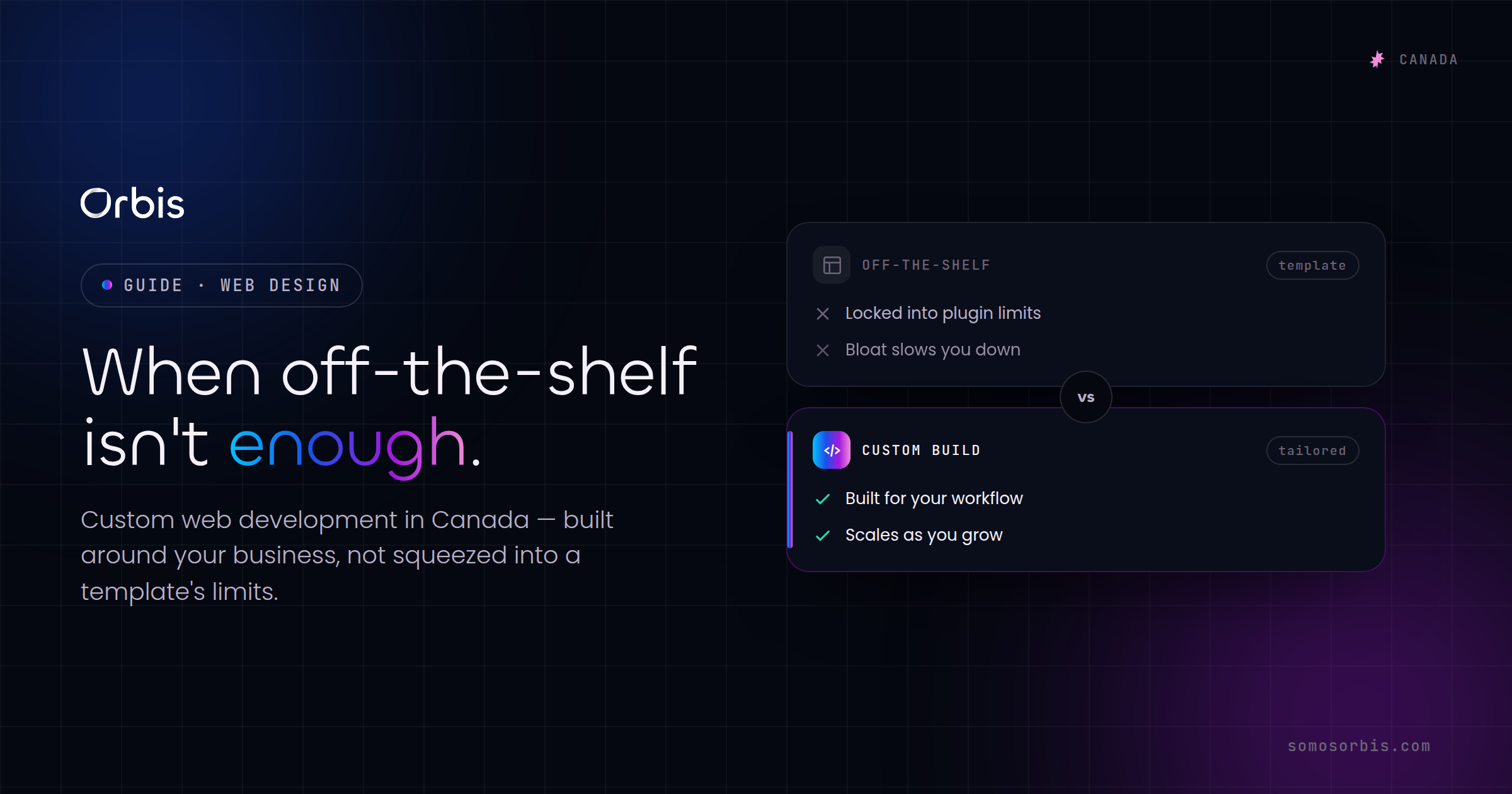
Every Canadian business eventually faces the same crossroads. You need a website, or you need to rebuild the one you have, and you're staring at two very different paths: grab a template and launch fast, or commission a custom build tailored to exactly how your business runs. For a lot of companies, a well-chosen template is genuinely the right call. But there's a point where off-the-shelf stops saving you money and starts quietly costing you customers, revenue, and weekends spent fighting your own platform. This guide is about recognizing that point, and knowing what custom development actually delivers when you cross it.
If you're earlier in the journey and still mapping out your options, start with our complete guide to web design in Canada, which covers strategy, budgets, and the full build-versus-buy landscape. This post goes one level deeper into the custom development decision specifically.
What "Off-the-Shelf" Actually Means
Off-the-shelf covers a broad range of solutions, and it helps to be precise about what you're comparing. In practice, Canadian businesses choosing the non-custom route are usually picking from:
- Theme-based CMS builds — a WordPress, Webflow, or similar theme that you configure and populate with your content.
- Hosted website builders — Squarespace, Wix, or GoDaddy, where the platform and the design templates are bundled together.
- Hosted commerce platforms — Shopify being the dominant choice for Canadian retailers, with a theme layered on top.
- SaaS app templates — pre-built dashboards or booking systems you brand and deploy.
The appeal is real. Templates are fast, predictable in cost, and battle-tested by thousands of other sites. If your needs map cleanly onto what the template was built for, you'd be wasting money going custom. The trouble starts when your business doesn't fit the mold the template assumes.
The Signs You've Outgrown a Template
Most companies don't decide to go custom out of ambition. They get pushed there by friction. Here are the signals we see most often with Canadian clients who arrive ready for a custom build.
You're paying for plugins to do one thing each
A template site that needs fifteen plugins to function is a maintenance liability waiting to happen. Each plugin is a separate vendor, a separate update cycle, a separate security surface, and a separate monthly fee. When one updates and breaks another, you're the one who finds out at the worst possible moment. Custom development folds that functionality into a single coherent codebase that one team owns end to end.
Your workflow doesn't match the platform's assumptions
Say you run a logistics company in Mississauga and your quoting process depends on dimensional weight, fuel surcharges, and customer-specific contract rates. No template has a form for that. You either bolt on a clumsy integration, force your staff to do calculations by hand after the lead comes in, or you build the logic into the site itself. The third option is custom development, and it's usually the one that pays for itself in saved hours.
You're losing deals at the point of conversion
This is the expensive one. If customers reach your site, want to buy or book, and then bounce because the checkout is clunky or the booking flow doesn't handle your real-world cases, the template is actively costing you revenue. We dig into this for retail specifically in our guide to ecommerce website design in Canada, but the principle applies to any conversion-driven site.
Bilingual and compliance requirements are fighting you
Canada adds a layer most template marketplaces simply weren't built for. If you sell into Quebec, you have real obligations around French-language content under current regulations, and a tacked-on translation plugin rarely handles structured data, metadata, and URL structure cleanly. Serving customers in both official languages properly, with the right language defaulting, hreflang setup, and parallel content management, is something custom development handles natively instead of as an afterthought.
What Custom Development Actually Delivers
When you commission a custom web development build, you're not just buying a nicer-looking site. You're buying a set of structural advantages that compound over time.
1. A site shaped around your actual business
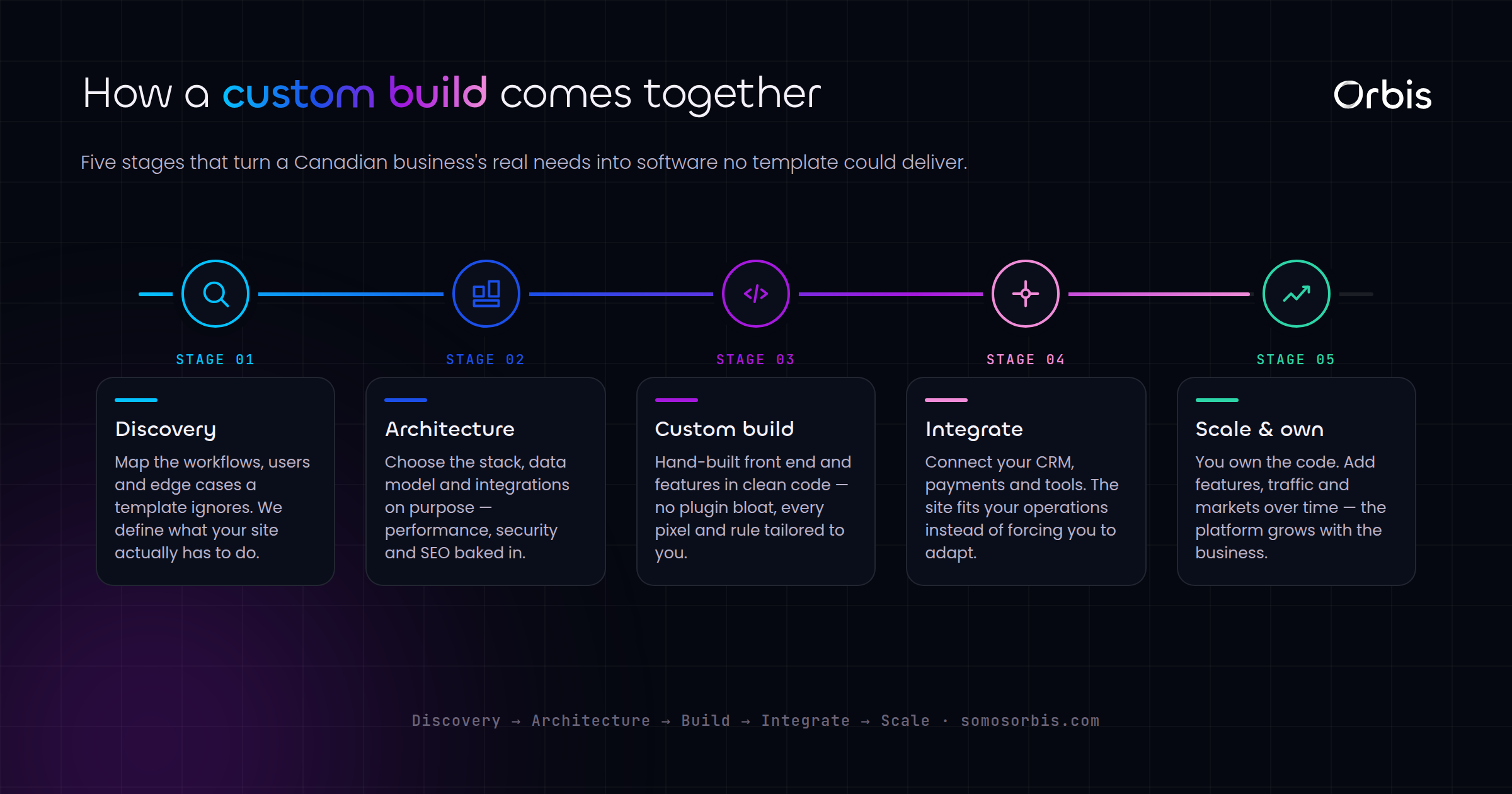
The biggest difference is that a custom build starts from your processes, not from a generic layout someone designed for an imaginary average company. Your quoting logic, your inventory rules, your approval workflows, your reporting needs — these become first-class features instead of workarounds. For a Calgary equipment supplier, that might mean real-time availability tied to a warehouse system. For a Vancouver clinic, it might mean a booking flow that respects practitioner schedules and provincial billing rules. The site does what your business actually does.
2. Performance you control
Template sites carry weight. They ship code for features you'll never use, and that bloat shows up in load times, which Google reads as a ranking and conversion signal. A custom build only loads what it needs. For Canadian retailers bracing for traffic spikes around Boxing Day, back-to-school, or the December holidays, the difference between a site that holds up under load and one that buckles is often the difference between a record day and a refund-and-apology day.
3. Integrations that aren't an afterthought
Most Canadian businesses run on a stack: a CRM, accounting software, an email platform, maybe an ERP or a point-of-sale system. Custom development lets you wire the website directly into that stack so data flows automatically. A lead fills out a form and lands in your CRM with the right tags. An order syncs to your accounting system. A booking blocks the calendar and triggers a confirmation. No copy-paste, no nightly export, no human error.
4. Ownership and a clear upgrade path
With a template, you rent your capabilities from whoever maintains the theme and the plugins. When they sunset a feature or jack up pricing, you absorb it. A custom codebase is an asset you own. You decide what changes, when, and how — and you can keep building on it for years instead of replatforming every time your needs shift.
5. Security and compliance built in by design
Custom builds let you handle data with intention. You decide where customer information lives, how it's stored, who can access it, and how it moves between systems. For businesses handling sensitive data or operating under current Canadian privacy regulations, that control matters far more than any template's generic security promise.
Custom Doesn't Always Mean "Build Everything From Scratch"
One misconception worth clearing up: going custom is not an all-or-nothing decision. The smartest builds are usually hybrids. You might run on a proven foundation like a headless CMS or a Shopify backend, and layer genuinely custom front-end and logic on top of it. You get the reliability of mature, maintained infrastructure plus the tailoring your business needs. A good development partner will steer you toward the right balance rather than reflexively rebuilding things that already work well off the shelf.
This matters for corporate sites too, where the line between "nice template" and "needs custom" is often blurry. If your organization needs a polished, credibility-driven web presence with custom interactive elements, our breakdown of corporate website design in Canada walks through where that line typically falls.
A Practical Decision Framework
Here's how to think through the choice without getting lost in opinions. Work through these questions in order.
- Does a template handle 90% or more of what I need today? If yes, and the remaining 10% isn't tied to revenue, start with the template. Don't over-engineer.
- Is the gap between the template and my needs in a place that touches money? Checkout, quoting, booking, lead capture — if the friction is here, custom development almost always pays back faster than people expect.
- Will I need to integrate with internal systems? If your website needs to talk to a CRM, ERP, or inventory system in real time, custom is usually the cleaner long-term answer.
- Am I planning to grow or change significantly in the next two to three years? If your business model is still shifting, a custom foundation flexes with you. A template often forces a painful replatform later.
- Do bilingual or regulatory requirements make templates awkward? If serving Quebec or meeting current regulations is fighting your platform, custom removes the friction.
If you answered "custom" to two or more of these, it's worth a serious conversation with a development team before you commit to a template you'll outgrow in a year.
What to Expect From a Custom Build in Canada
Going in with realistic expectations makes the whole process smoother. A few things worth knowing:
- Timeline. Custom builds take longer than templates — typically weeks to a few months depending on scope. A good partner will phase the work so you launch a strong core early and add capability in stages rather than waiting for everything at once.
- Discovery comes first. The best custom projects start with a real discovery phase that documents your processes before anyone writes code. If a vendor skips this, that's a red flag.
- Budget reflects ownership. You're paying more upfront because you're buying an asset, not renting features. The right comparison isn't template-cost-today versus custom-cost-today; it's the total cost over three to five years, including all those plugin subscriptions and workarounds.
- Maintenance still matters. Custom doesn't mean set-and-forget. Budget for ongoing support, but expect it to be far simpler than juggling a dozen third-party plugins.
Choosing the Right Development Partner
The quality of a custom build depends almost entirely on who builds it. A few things to look for in a Canadian context: a partner who starts with your business processes rather than a design template, who is transparent about which parts genuinely need custom work and which don't, who can speak to bilingual and compliance requirements without you having to explain them, and who hands over documented, ownable code rather than a black box only they can maintain.
The right custom build isn't the one with the most features. It's the one that disappears into your workflow so completely that your team stops thinking about the website and just gets work done.
The Bottom Line
Off-the-shelf is the right starting point for plenty of Canadian businesses, and there's no shame in launching on a template that does the job. But when your processes, your conversions, your integrations, or your bilingual and compliance needs start fighting the platform, that friction is a signal, not a nuisance. It's telling you the template has done its job and it's time for something built around how you actually operate.
If you're seeing those signs — plugins piling up, deals slipping at checkout, staff doing by hand what the site should automate — it's worth getting a clear-eyed assessment before you sink more money into patching a foundation you've outgrown. Our team builds custom web development for Canadian businesses that's shaped around your processes, wired into your systems, and built to grow with you. Reach out and we'll help you figure out whether custom is the right move, and exactly what it would take to get there.