
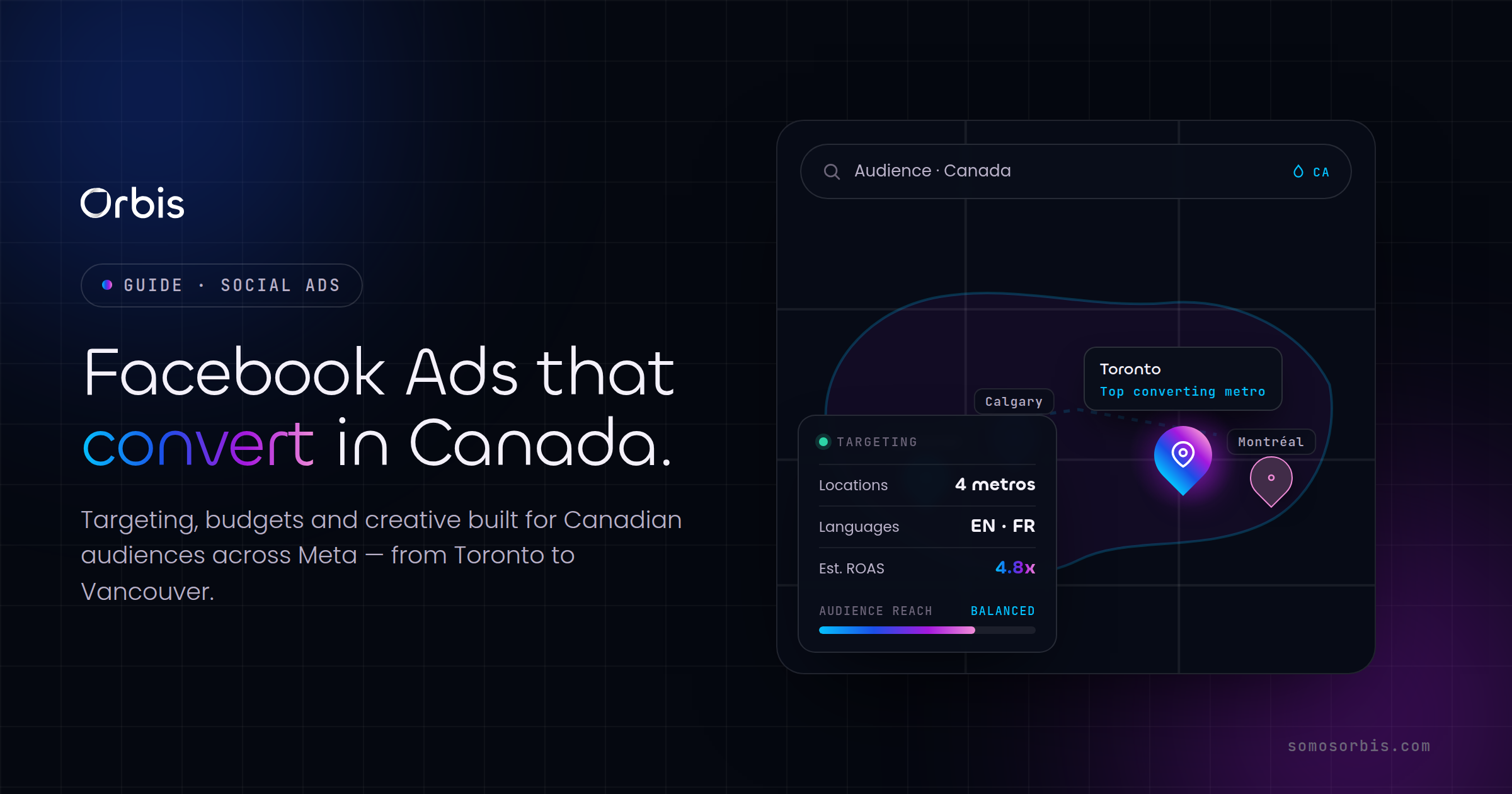
Facebook remains one of the most cost-effective ways to reach Canadian buyers at scale, but the platform punishes lazy execution. The brands that profit from Meta ads in Canada are not the ones with the biggest budgets, they are the ones who match the right audience to the right offer with creative that earns attention in a crowded feed. This guide walks through targeting, budgeting, and creative decisions tailored to the Canadian market, so you can run campaigns that move revenue rather than just rack up impressions. If you want the wider channel picture first, start with our complete guide to social media advertising in Canada, then come back here to go deep on Facebook specifically.
Why Facebook Ads Still Work for Canadian Businesses
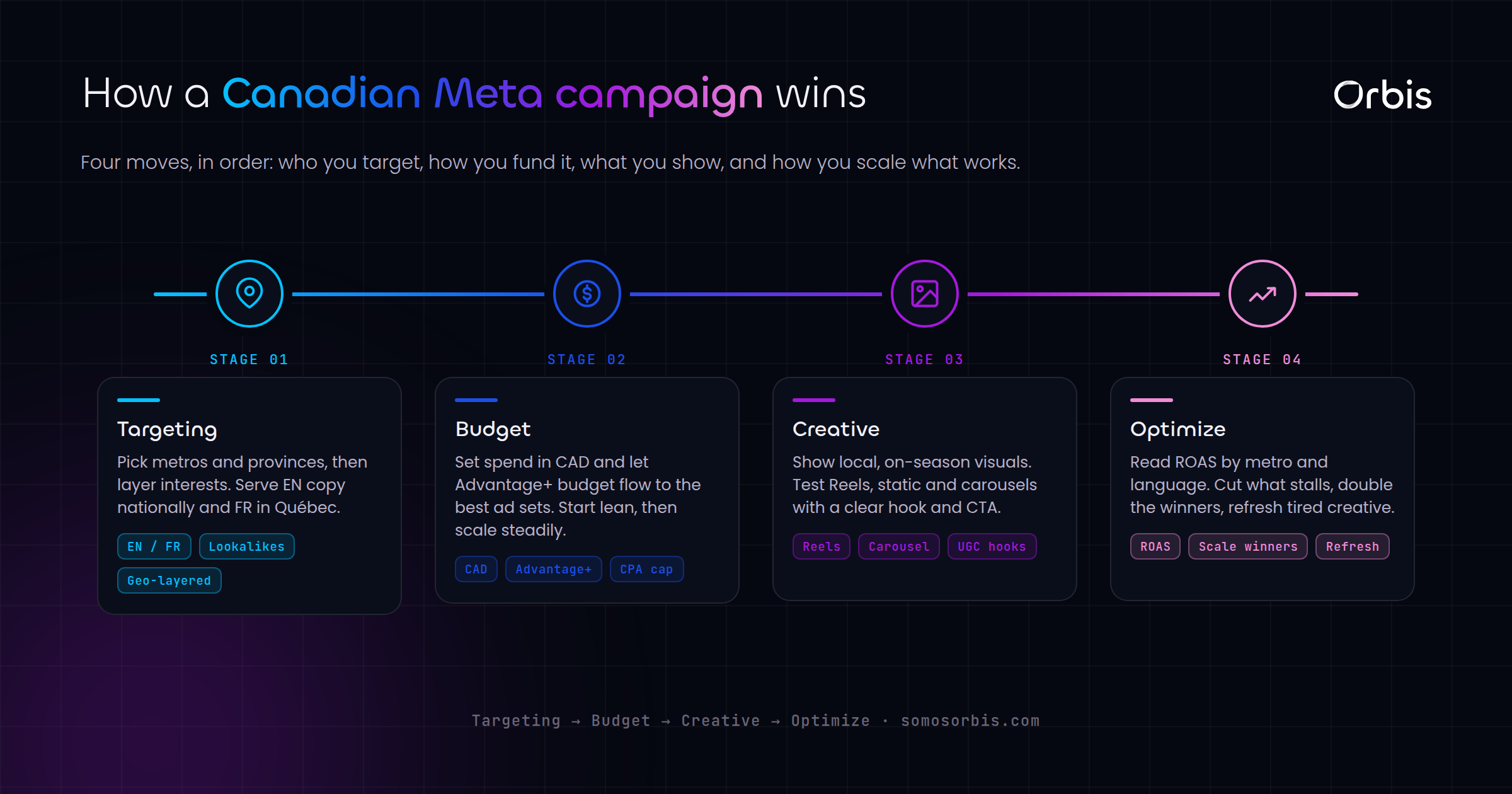
Roughly three quarters of Canadians use a Meta property every month, and the platform's reach is remarkably even across the country, from dense urban markets like Toronto, Vancouver, and Montreal to smaller communities in the Prairies and Atlantic Canada. That breadth is the point. Few channels let a Calgary home services company, a Vancouver DTC brand, and a Quebec City professional firm all find qualified prospects within the same ad account.
What has changed is the bar for performance. Apple's privacy changes, signal loss, and rising auction competition mean you can no longer rely on hyper-granular targeting alone. Meta's machine learning now does much of the audience work for you, which shifts the burden onto two things you still control: a clean conversion signal and creative that resonates. Get those right and Facebook becomes a dependable revenue engine across the entire funnel.
Targeting Canadian Audiences Without Wasting Budget
The biggest mistake we see in Canadian ad accounts is over-segmenting. Splitting a modest budget across a dozen tiny interest audiences starves Meta's algorithm of the data it needs to optimize. Instead, give the system room to learn and let your structure reflect funnel intent rather than micro-demographics.
Broad targeting with strong signal
For most Canadian advertisers, the highest-performing prospecting setup is now broad: a country-wide or province-level audience with minimal interest layering, paired with a well-configured Conversions API and the Meta pixel feeding back clean purchase or lead events. Meta's algorithm uses your conversion data to find lookalike buyers automatically. This works best when you have enough volume, typically 50 or more conversions per week at the ad set level.
Geography and language: the Canadian nuance
- Language matters in Quebec. Serving English-only creative to a Montreal or Quebec City audience leaves money on the table and can feel tone-deaf. Build a French-language ad set for Quebec and run native French creative, not machine-translated copy. Bill 96 also makes French-first communication a practical expectation for brands operating in the province.
- City-level intent. Service-area businesses (clinics, trades, real estate, local retail) should use radius targeting around their service area rather than a national audience. A 25 to 50 km radius around the GTA, Metro Vancouver, or the Greater Montreal area usually balances reach and relevance.
- Seasonality is real here. Canadian buying cycles swing hard around back-to-school in August, the Black Friday to Boxing Day stretch, and the long winter holidays. Build your audience and budget calendar around these peaks rather than running flat year-round.
Retargeting and customer audiences
Your warmest audiences live in your own data. Upload your customer list to build Custom Audiences, then create value-based Lookalikes from your highest-spending segments so Meta prioritizes people who resemble your best customers, not just any converter. Layer in website visitors, video viewers, and people who engaged with your Instagram or Facebook page. For brands that also lean on Instagram, our breakdown of Instagram ads for Canadian brands covers how to coordinate creative across both placements.
Structuring Budgets That Scale Profitably
Budget structure is where good targeting either pays off or gets wasted. Two principles keep Canadian advertisers out of trouble.
Use the funnel to allocate spend
A reliable starting split for a brand with an established offer is roughly:
- Prospecting (cold) — 60 to 70 percent. Broad audiences and lookalikes that fill the top of the funnel. This is where new revenue is created.
- Mid-funnel engagement — 10 to 20 percent. Retargeting video viewers, page engagers, and content readers who know you but have not visited the site.
- Retargeting (warm) — 15 to 25 percent. Site visitors, add-to-carts, and abandoned leads. High ROAS, but capped by audience size, so do not over-invest here expecting it to scale.
Retargeting almost always shows the best return on paper, which tempts advertisers to pour budget into it. Resist that. Warm audiences are small and finite; pour too much in and frequency spikes, fatigue sets in, and returns collapse. Top-of-funnel prospecting is what makes the whole account scalable.
CBO, ABO, and consolidation
Campaign Budget Optimization (Advantage Campaign Budget) lets Meta distribute spend to the best-performing ad sets automatically, which suits accounts with broad audiences and limited time to micromanage. Ad Set Budget Optimization gives you tighter control when you need to guarantee spend on a specific audience, such as a French-language Quebec ad set. As a rule, consolidate rather than fragment: fewer, better-funded campaigns learn faster and stabilize sooner than a sprawl of underfunded ones.
Talking budgets in CAD
Always plan and report in Canadian dollars, and set your account currency to CAD from day one to avoid conversion noise in reporting. Canadian CPMs are typically lower than US CPMs, which is an advantage, but auction costs rise sharply during Q4 retail season. Budget for that inflation. A campaign that delivers a 4x return in October may need a higher cost-per-result tolerance in mid-December simply because every retailer in the country is bidding against you.
A practical benchmark: if you cannot spend at least 50 CAD per day per ad set while staying within your target cost per acquisition, consolidate audiences until you can. Underfunded ad sets never exit the learning phase, and an ad set stuck in learning is an ad set spending your money inefficiently.
Creative That Converts in the Canadian Feed
With targeting increasingly automated, creative is now the single biggest lever you control. Meta itself has said creative is the primary driver of performance in modern accounts. The good news for Canadian advertisers: you do not need a Hollywood budget, you need relevance and volume.
Make it feel local
Generic stock-photo ads underperform because Canadians can spot them instantly. Concrete ways to localize:
- Reference Canadian seasons, weather, and moments your audience actually lives through, from cottage season to the first snowfall.
- Show CAD pricing, Canadian shipping, and local availability directly in the creative when relevant. It removes friction and signals you are a domestic brand.
- Feature real Canadian customers, locations, and user-generated content. Authentic, lo-fi UGC consistently outperforms polished studio production in the feed.
- For Quebec, produce French creative natively. Tone and idiom matter; a literal translation reads as foreign.
Format priorities
- Short-form video. Vertical, 9:16, designed to work with the sound off and grab attention in the first two seconds. This is the dominant format across Feed, Stories, and Reels.
- UGC-style testimonials. A real customer talking to camera about a real problem you solved outperforms most produced ads, and it is cheap to create.
- Static and carousel. Still essential for offer-driven and product-catalogue campaigns; carousels work well for showcasing range or telling a step-by-step story.
Test like a system, not a guess
Stop launching one hero ad and hoping. Build a creative testing system: ship three to five distinct concepts per campaign, each with a clearly different angle (problem-led, benefit-led, social proof, offer-led). Let Meta find the winners, kill the losers quickly, and feed the learnings into your next batch. Plan to refresh creative every two to four weeks for warm audiences, because frequency-driven fatigue hits retargeting fastest. The platform mechanics here mirror what works on emerging channels too; if your audience skews younger, our look at TikTok ads trends in Canada shows how the same creative discipline applies in a different feed.
Measurement, Compliance, and the Boring Stuff That Pays Off
None of the above matters if your measurement is broken. Three foundations separate accounts that scale from accounts that stall.
- Server-side tracking. Implement the Conversions API alongside the pixel so you recover the signal lost to browser restrictions and ad blockers. Clean conversion data is what powers broad targeting and accurate ROAS reporting.
- Privacy and consent by design. Canadian advertisers operate under PIPEDA, and Quebec's Law 25 adds stricter consent and transparency obligations. Build proper consent management and respect current regulations from the start. Treating compliance as a documented process rather than an afterthought protects both your account and your brand.
- Attribution honesty. Meta's in-platform reporting is optimistic. Reconcile it against your own analytics and, ideally, blended marketing efficiency (total revenue versus total spend). Make budget decisions on the trend across reliable sources, not a single dashboard.
This disciplined, documented approach is the difference between an ad account that quietly bleeds budget and one that compounds returns quarter over quarter. It is also where an experienced partner earns their keep.
Putting It Together
Profitable Facebook advertising in Canada comes down to a few repeatable moves: give the algorithm broad audiences with clean conversion signal, respect language and seasonality, fund prospecting properly while keeping retargeting in its lane, and treat creative as a continuously tested system rather than a one-off. Do that consistently and Meta becomes one of the most predictable growth channels available to a Canadian business.
If you would rather have a team build, test, and scale this for you, Orbis runs full-funnel campaigns for Canadian brands every day. Explore our Meta and Facebook Ads management service to see how we turn targeting, budget, and creative into measurable revenue, with documented processes and compliance built in from the first dollar of spend.