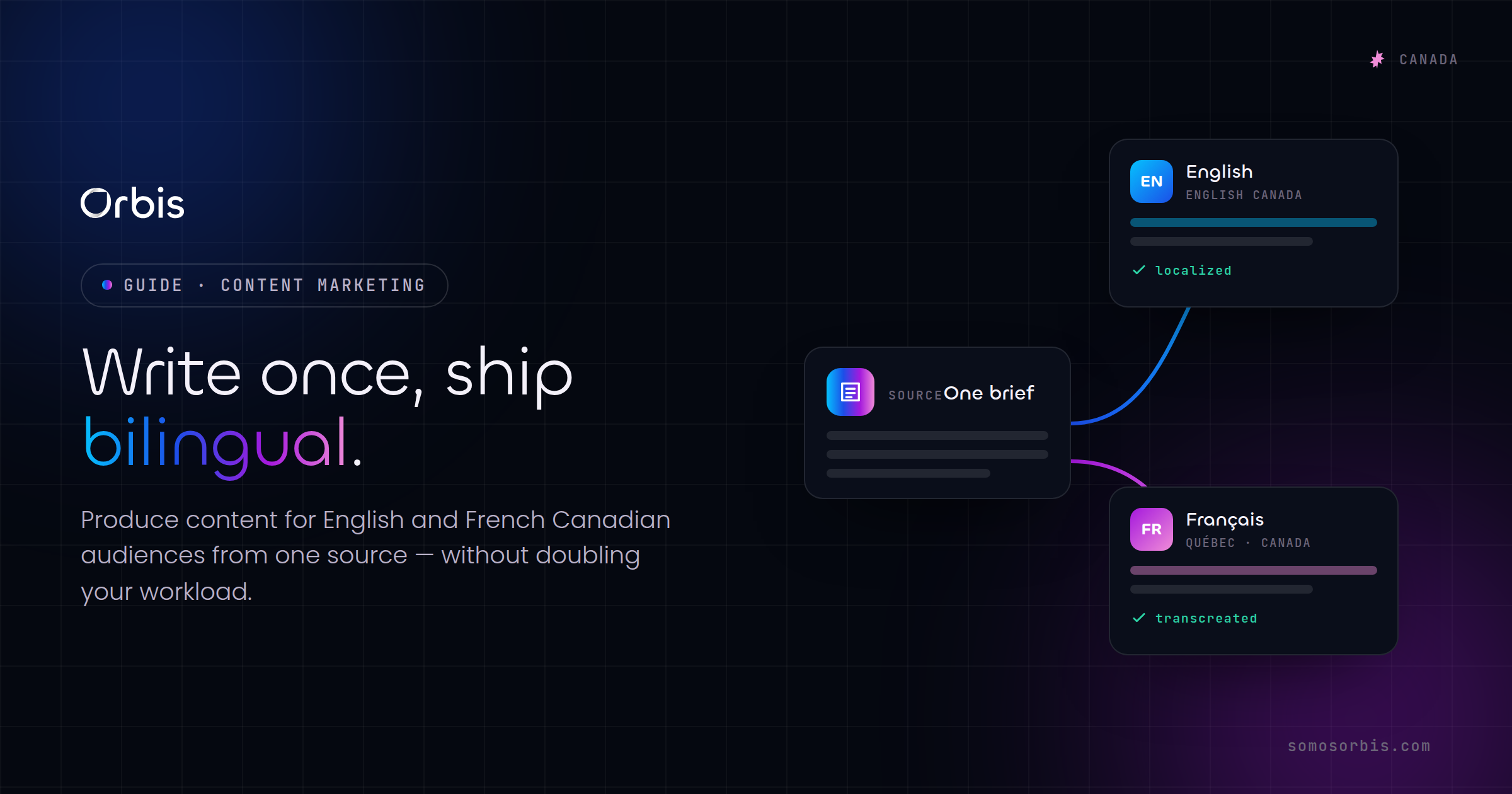
Producing content for Canada is never a single job. Every video, photo set, social clip and creator collaboration eventually has to work in both English and French if you want national reach — and the brands that treat the French version as an afterthought usually pay for it twice: once in rushed translation costs, and again in flat engagement from audiences in Quebec who can tell when they are reading a machine. The good news is that bilingual production is a workflow problem, not a creative ceiling. With the right planning at the front of your process, you can produce for EN and FR Canada in parallel without doubling your budget or your timeline. This guide walks through how to structure that workflow, where the real costs hide, and how to keep both language versions feeling native rather than translated.
If you want the full strategic picture of how content fits into a Canadian marketing program, start with our complete guide to content creation in Canada — this post is the production-focused companion to it, zooming in on the operational side of shipping in two languages.
Why Bilingual Content in Canada Is a Production Decision, Not a Translation Task
The most common and most expensive mistake is treating French as a post-production step. A team shoots the English campaign, edits it, ships it, and then — weeks later — sends the finished assets to a translator to "do the French version." By then every creative decision has already been locked: the voiceover pacing, the on-screen text, the captions, the cultural references, even the length of the sentences. French text runs roughly 15 to 20 percent longer than English, so captions overflow, lower-thirds get cramped, and voiceover no longer matches the cut. The result is a French version that looks and feels like a retrofit, because it is one.
The fix is to make bilingual a requirement at the brief stage. When you plan a shoot or a content series knowing both languages have to ship, you make different and better decisions: you leave room in the edit for longer French copy, you cast talent who can deliver in both languages or you plan two takes, and you flag culturally specific references before they get baked in. This front-loading is the single biggest lever for efficient bilingual production. Federal advertising and most national retail in Canada already operate this way because Official Languages obligations and Quebec's language expectations make it non-negotiable — but even brands without a legal requirement benefit from the same discipline.
Build a Bilingual Production Workflow From the Brief
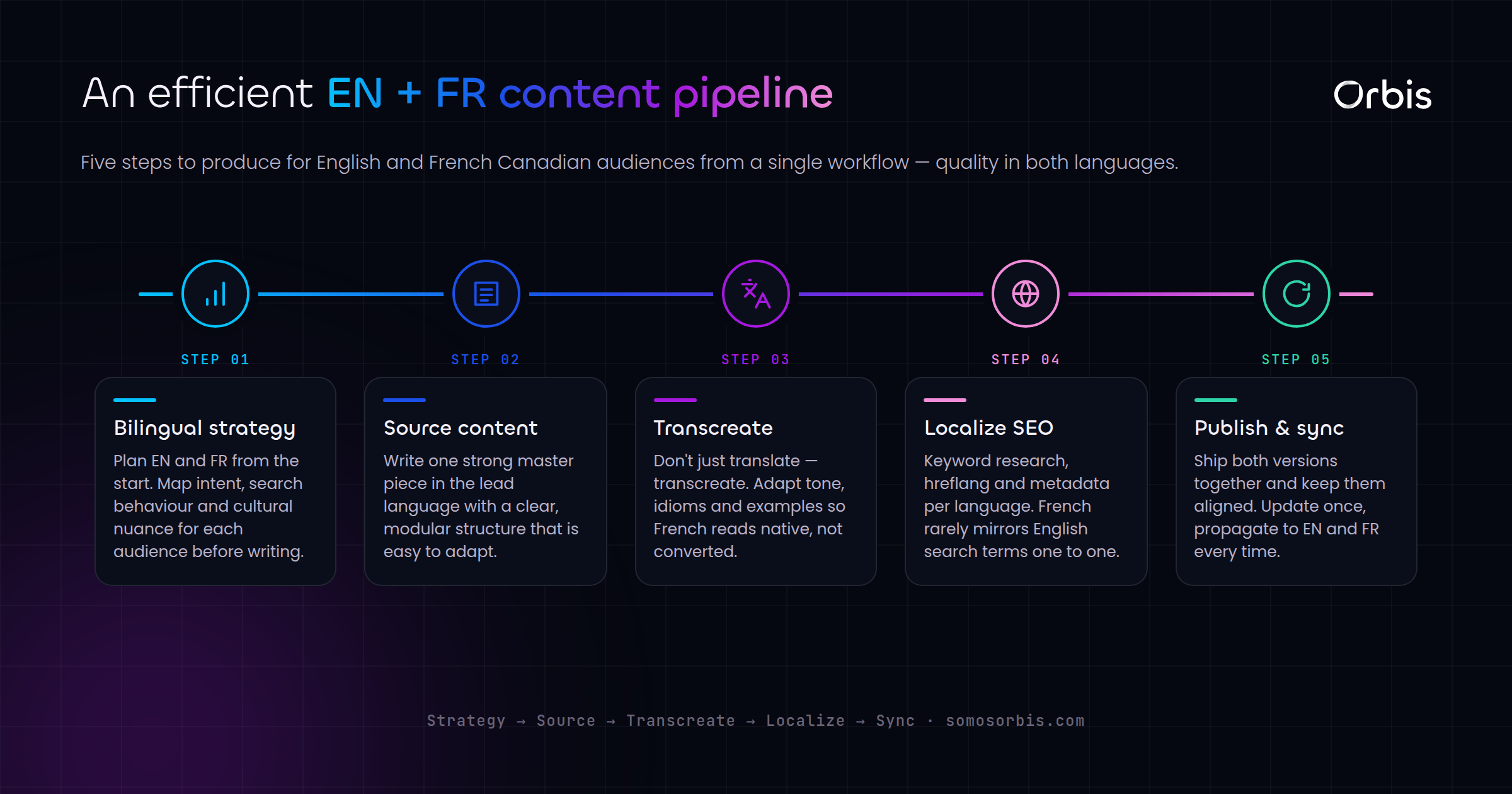
An efficient bilingual workflow front-loads the decisions that are expensive to reverse later. Here is the sequence we use, and recommend, for any Canadian content program that needs to serve both audiences.
- Write the brief in both languages — or at least both audiences in mind. Define the core message, the call to action, and the key visual beats. Ask: does this concept land the same way in Montreal as it does in Toronto? If a joke, idiom, or holiday hook only works in one language, you need a parallel idea ready for the other.
- Decide your adaptation model per asset. Not everything needs the same treatment. Some assets can be fully transcreated (rebuilt for the French audience), some can be localized (same structure, native-quality copy), and some are language-neutral and only need different captions or text overlays. Mapping this early tells you exactly where your translation and talent budget goes.
- Plan the shoot for both versions at once. If a creator or presenter speaks on camera, schedule both-language takes in the same session. The lighting is already set, the talent is already there, and the second take costs minutes instead of a second shoot day.
- Design templates with French expansion built in. Lower-thirds, caption tracks, and text frames should be sized for the longer language. Build your master template to French length and English will always fit comfortably.
- Localize, then quality-check with a native speaker. Quebec French is not France French. Vocabulary, tone, and even punctuation conventions differ. A native Québécois reviewer is the difference between "technically correct" and "actually native."
This is the same discipline that strong video teams already apply to single-language work — our breakdown of video production for Canadian brands covers the pre-production planning that makes the bilingual version far cheaper to execute.
Adapting Video Across EN and FR Efficiently
Video is where bilingual costs balloon if you are not careful, and where smart planning saves the most. The key is to separate the language-dependent layers from the language-neutral ones.
Capture once, version many
Whenever possible, shoot footage that carries no spoken language — b-roll, product shots, lifestyle scenes, demonstrations — as your visual backbone. This footage is identical across both versions, so you capture it once and reuse it. The only layers that change are voiceover, on-screen text, and captions. A 30-second product video built this way might need a five-minute French voiceover session and a caption swap, rather than a full re-edit.
Voiceover vs. on-camera dialogue
If your concept relies on a presenter speaking directly to camera, you have three efficient options:
- Bilingual talent, two takes: book a presenter fluent in both languages and capture both in one session. Most efficient when you can find the right person.
- Voiceover over visuals: keep faces and action on screen but deliver the message through voiceover, which is trivial to re-record in French. This is the most flexible model for scaling across languages.
- Two presenters, parallel shoot: for hero campaigns where authenticity matters, an English and a French presenter shot back-to-back on the same set keeps both versions native without a second production day.
Captions and on-screen text
Roughly 80 percent of social video is watched on mute, so captions are not optional — they are the message. Build two caption tracks from the start and keep your text frames roomy enough for French. For platform-native vertical video, leave your safe zones generous so longer French lines do not collide with the interface or get cut off. Our video production service for Canadian brands is built around this multi-version approach, so the French cut ships alongside the English one rather than chasing it.
Photo and Static Content: Smaller Lift, Same Discipline
Photography travels across languages more easily than video because the image itself is usually language-neutral. The work is in the copy layers and the cultural read.
- Shoot text-free where possible. Avoid props, signage, or packaging shots that lock English text into the frame. Clean images can carry French copy overlays just as easily as English.
- Build layered design files. Keep headlines, body copy, and CTAs on separate, editable layers in your master file so producing the French version is a copy swap, not a rebuild.
- Mind the cultural read of imagery. A seasonal hook — back-to-school in late August, the December holiday stretch, Boxing Day — may carry slightly different connotations or timing emphasis between markets. Confirm the imagery resonates in both before you commit to a hero shot.
- Plan caption and alt-text in both languages. For social and accessibility, French captions and alt-text are part of the deliverable, not an extra.
Working With Bilingual Creators and Influencers
Creator content is the hardest layer to "translate" because the value is the creator's authentic voice — and you cannot transcreate authenticity. A French-Canadian audience can immediately tell when a Quebec creator has been handed an English script and asked to read a stiff translation. The efficient answer is not to translate creator content at all; it is to brief creators in their own language and let them produce natively.
- Run parallel creator rosters. Brief English-Canada creators and Quebec creators on the same campaign goals and key messages, then trust each to adapt the execution to their audience. You get two native campaigns instead of one campaign and one awkward copy.
- Give message pillars, not scripts. Provide the non-negotiables — the offer, the claim, the CTA, the disclosure requirements — and leave the wording to the creator. This both improves authenticity and respects the platform-native style each audience expects.
- Respect Quebec creator culture. The Quebec creator ecosystem has its own platforms, humour, and references. A creator with strong reach in English Canada often has little traction in Quebec, and vice versa, so budget for both rosters rather than expecting one to cover the country.
If creator-led work is a major part of your plan, our deeper look at influencer marketing in Canada covers sourcing, disclosure, and measuring bilingual creator campaigns in more detail.
Asset Management: The Quiet Efficiency Multiplier
The brands that produce bilingual content efficiently are usually the ones with disciplined asset management. When you are shipping two language versions of every asset across multiple platforms and formats, naming and organization stop being housekeeping and become a real cost lever.
- Use a consistent naming convention that encodes language, platform, format, and version — for example campaign_FR_IGstory_9x16_v2. It sounds trivial until you are hunting for the right French cut at 4 p.m. on launch day.
- Keep a single source of truth for copy in both languages, so an approved change to the English message propagates to the French version instead of drifting out of sync.
- Version language pairs together. When the English asset is updated, the French one should be flagged for review in the same step. Decoupled versions are how a campaign ends up with a current English ad and an outdated French one.
Common Pitfalls and How to Avoid Them
The cheapest French version is the one you planned for before you shot, not the one you translated after you wrapped.
A few failure patterns show up again and again in Canadian bilingual production. Watch for them:
- Treating French as a discount deliverable. Quebec is a market of millions of consumers with real purchasing power. Under-resourcing the French version leaves money on the table.
- Machine translation with no native review. Automated translation has improved, but it still produces tone, idiom, and register errors that read as careless to a native audience. Always close with a Québécois reviewer.
- Forgetting timing differences. Seasonal and cultural moments do not always land on identical calendars or with identical emphasis across the two markets. Schedule both versions against the right local moment.
- Ignoring accessibility in the second language. Captions, alt-text, and transcripts are part of every language version, not just the English one.
A Practical Starting Checklist
If you are building or fixing a bilingual production workflow, start here:
- Make "ships in EN and FR" a line in every creative brief.
- Map each asset to an adaptation model: transcreate, localize, or language-neutral.
- Capture language-neutral footage and imagery you can reuse across versions.
- Build templates and safe zones to French length so English always fits.
- Brief creators in their own language; never translate authenticity.
- Close every French asset with a native Québécois quality check.
- Version language pairs together so they never drift apart.
Produce for Both Canadas Without Doubling Your Budget
Bilingual content stops being expensive the moment you stop treating it as two separate jobs and start treating it as one workflow that outputs two native versions. Plan for both languages at the brief, shoot language-neutral footage you can reuse, design for French expansion, and let creators speak in their own voice — and the second version costs a fraction of what it would as a bolted-on afterthought. The brands that get this right reach all of Canada with content that feels made for each audience, because it was.
If you want a production partner who plans bilingual from the first frame, explore our video production service for Canadian brands — we build EN and FR versions into the same workflow so your French audience never gets the leftover cut. Let's produce content that works coast to coast, in both official languages, without doubling your timeline.