
Most Canadian marketers think about awareness in terms of screens. But a large share of your audience spends hours every week with a screen they are not looking at — they are listening. Commuters on the GO Train into Toronto, someone cooking dinner in Montreal, a contractor driving between job sites in Calgary, a student studying in Vancouver. Spotify reaches all of them in a context that display and short-form video simply cannot: hands-busy, eyes-elsewhere, ears-available. For brands trying to build memory and familiarity across Canada's English and French markets, audio is one of the most underused channels in the media plan.
This guide breaks down how Spotify Ads actually work in Canada, how to plan campaigns that respect the EN/FR split, what audio and video formats are worth your budget, and how to measure awareness without pretending audio is a direct-response channel. If you want the bigger picture of how paid social fits together, start with our complete guide to social media advertising in Canada — this post is the audio chapter of that larger story.
Why Audio Belongs in a Canadian Awareness Plan
Audio advertising solves a specific problem: it captures attention during moments when no other channel can. People do not skip audio the way they scroll past a feed, and they cannot install an ad blocker on their morning playlist. On Spotify's ad-supported tier, that listening happens during clearly defined daily routines — the commute, the workout, the focus block, the dinner prep. Each of those is a planning opportunity.
For Canadian advertisers, a few factors make Spotify especially worth a serious look:
- Reach across both official languages. Spotify serves listeners in English and French, which matters enormously in a market where Quebec represents roughly a quarter of the population and expects to be addressed in French, not in a translated afterthought.
- Daypart and context targeting. You can reach people by what they are doing — working out, commuting, studying, relaxing — which lets your message match the moment rather than just the demographic.
- A younger, hard-to-reach audience. Many of the people who have abandoned linear TV and tuned out display ads are reachable on streaming audio.
- Seasonal flexibility. Canadian retail and B2B both run on a distinct calendar — back-to-school in late summer, the long ramp into Black Friday and Boxing Day, the post-holiday January reset. Audio campaigns are quick to launch and adjust around those windows.
The key mindset shift: Spotify is an awareness and consideration channel. It builds the mental availability that makes your search, social, and retargeting campaigns convert more cheaply later. Judge it accordingly.
Understanding Spotify Ad Formats
Spotify is not a single ad product. It is a small portfolio of formats, each suited to a different job. Choosing the wrong one is the most common way Canadian advertisers waste budget here.
Audio Ads
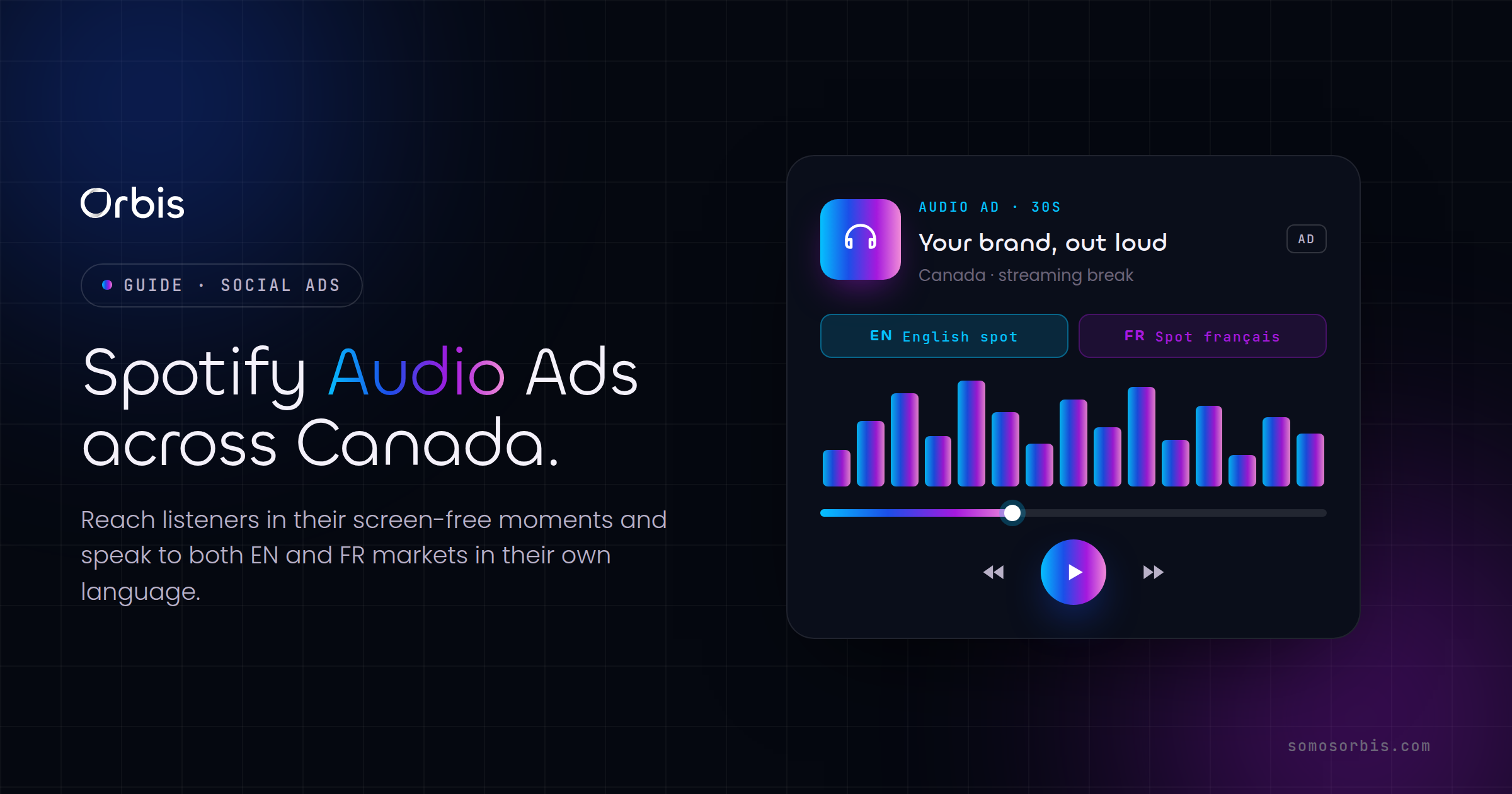
The flagship format. A 15-to-30-second audio spot plays between songs to listeners on the free, ad-supported tier, accompanied by a clickable companion banner. Because the listener's screen is often dark or in a pocket, the audio itself has to do the work — the banner is a bonus, not the message. Audio ads are where most of your Spotify budget should live for awareness, because they deliver the channel's core strength: uninterrupted, voice-led attention.
Video Takeover and Video Ads
Video ads serve when the listener is actively looking at the app — for example, browsing for a new playlist. These earn a viewable impression and are useful when your message genuinely benefits from a visual, such as a product reveal or a seasonal brand spot. Do not default to video just because you have a video asset; only use it when the visual adds something the audio cannot carry alone.
Sponsored Playlists and Sponsored Sessions
These formats tie your brand to a listening context — sponsoring a workout or focus playlist, or offering the listener an ad-free session in exchange for watching one of your ads. They are strong for brand association and for connecting a product to a clear use case (think a sports nutrition brand on a running playlist, or a Canadian coffee brand on a morning-commute mix).
Podcast Ads
Spotify is also a major podcast platform, and podcast ads — both pre-recorded and host-read — reach a highly engaged, attentive audience. Canadian podcasts span both languages and a wide range of niches, which makes them a precise way to reach a defined community. Host-read spots in particular borrow the credibility of the host, which is hard to replicate anywhere else.
Planning a Bilingual Campaign for Canada
This is where most national campaigns either succeed or quietly fail. Canada is not one audience that happens to speak two languages. It is two cultural markets that require genuinely separate creative thinking.
A few rules that consistently hold up:
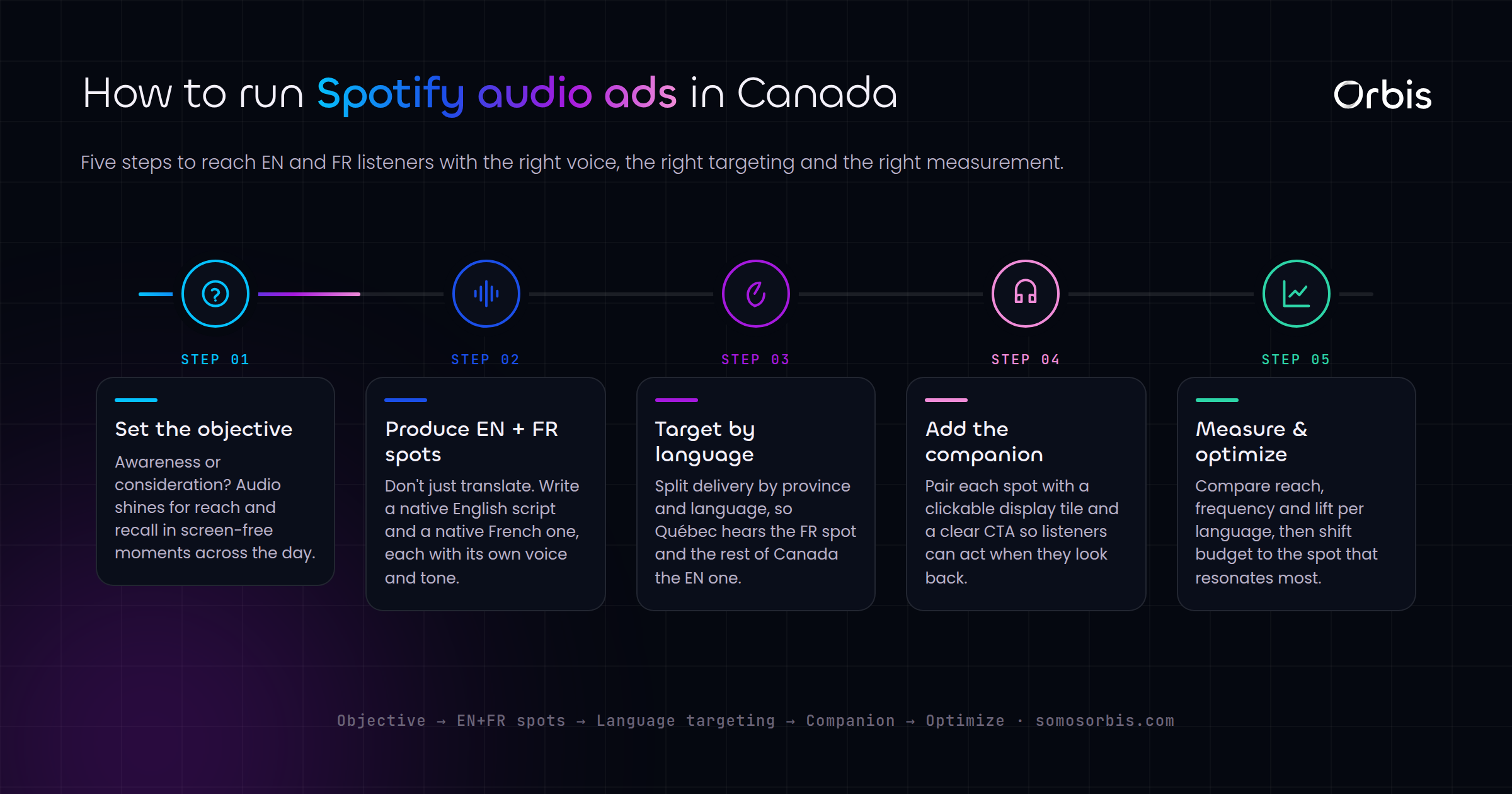
- Produce French creative natively, not as a translation. A spot written in English and run through translation will sound off to a Quebec listener — the idioms, the humour, and the cadence all break. Brief a French-language copywriter from the start so the spot lands as if it were made for that audience, because it was.
- Separate your campaign structure by language. Run distinct EN and FR campaigns (or ad sets) so you can budget, target, and measure each independently. Blending them hides which market is actually working.
- Match voice talent to the market. A Quebec French voice is not the same as a France French voice, and the difference is immediately obvious to local ears. Use Canadian talent for both EN and FR.
- Respect regional context. A Vancouver-focused message and a Montreal-focused message can carry different references, seasonal cues, and even pacing. National efficiency should never come at the cost of local relevance.
The same bilingual discipline that wins on audio applies across every paid channel in Canada. If you are building out your social mix in parallel, our breakdown of TikTok advertising trends in Canada covers how short-form video creative needs the same EN/FR separation — the two channels reinforce each other when the message is consistent.
Writing Audio Creative That Actually Works
Audio is an unforgiving medium. You have a handful of seconds, no visual fallback, and a listener who did not ask to hear from you. The brands that win treat the script like radio copywriting, not like a voiced-over web banner.
Principles worth following on every Canadian spot:
- Lead with sound, not silence. The first two seconds decide whether the listener mentally checks out. Open with a hook — a question, a sound, a sharp statement — not a slow brand intro.
- Say the brand name early and again at the end. Because there is no logo to glance at, repetition is how the name sticks.
- One idea per spot. Cramming three benefits into 30 seconds means none of them survive. Pick the single thought you want remembered.
- Use a sonic signature. A short, consistent sound or jingle across every spot builds recognition far faster than copy alone.
- Make the call to action realistic. The listener's hands are often busy. "Search for [brand]" or "you'll see us next time you're online" usually beats "click the link now."
One more discipline that separates good audio from forgettable audio: write for the moment, not just the message. A commute spot, a workout spot, and a late-evening relaxation spot should not sound identical, even if the offer is the same.
Targeting and Budget for the Canadian Market
Spotify's targeting leans into context and behaviour, which fits awareness work well. You can reach Canadian listeners by age, by language, by region, by device, by activity (workout, focus, commute), and by the kind of music or podcasts they gravitate toward. For a national brand, that means you can run a Quebec French campaign aimed at evening listeners and a separate English campaign aimed at morning commuters in Ontario and the West, each with its own message and budget.
On budgeting, a few practical guardrails for Canadian advertisers:
- Concentrate frequency over a defined window. Audio works through repetition. A small budget spread thin across a whole quarter builds no memory. Better to own a tighter window — a four-to-six-week burst around a season — with enough frequency to be remembered.
- Plan around the Canadian calendar. Boxing Day and the holiday lead-up, back-to-school, the spring home and renovation season — align your audio bursts with the moments your category already peaks.
- Split budget by language deliberately. Do not let your French campaign get whatever is left over. Size it to the opportunity in Quebec, then protect it.
- Pair audio with a retargeting layer. Audio drives the searches and site visits; make sure your search and social retargeting are ready to catch that demand and carry it to conversion.
Measuring Audio Without Fooling Yourself
The fastest way to kill a good audio program is to grade it on last-click conversions. Audio rarely earns the last click — it earns the first impression that makes the later click cheaper. Measure it on the terms it actually delivers.
What to actually watch:
- Reach and frequency. How many unique Canadians did you reach, and how often? This is the primary output of an awareness campaign.
- Brand search lift. Watch branded search volume in Google before, during, and after the flight. A well-run audio burst should visibly lift it.
- Direct and organic traffic. Audio prompts people to look you up later. A rise in direct and branded organic visits during the campaign window is a strong signal.
- Brand lift studies. Where budget allows, a survey-based study measuring awareness and recall is the cleanest read on whether the message landed.
- Assisted conversions. In your analytics, look at audio's role as an early touch in multi-step paths, not just as a final source.
Set these expectations before launch, ideally with documented benchmarks, so the campaign is judged against the right scoreboard from day one. This is the kind of measurement discipline — clear processes, agreed-upon metrics, no moving goalposts — that keeps marketing accountable and keeps budget flowing to what actually works.
How Spotify Fits the Wider Canadian Media Mix
Audio is a team player. It rarely closes the deal on its own, but it makes every other channel work harder. A consumer who has heard your spot a dozen times on their commute clicks your search ad with more trust, recognizes your social creative faster, and bounces from your landing page less often. The combined effect is the point.
For B2B brands in particular, audio can warm an audience that you then convert through more targeted channels. If your goal is reaching decision-makers, Spotify builds the familiarity, while a channel like LinkedIn does the precise targeting and lead capture — our guide to LinkedIn Ads for Canadian B2B covers that conversion layer in depth, and the two work best in sequence rather than isolation.
Think of your mix in three layers: audio and video build mental availability, social and search capture demand as it forms, and retargeting closes it. Spotify owns the top of that structure for many Canadian brands — and when the layers are coordinated, the whole plan compounds.
Getting Started with Spotify Ads in Canada
If you are ready to test audio, start small and disciplined: one clear awareness objective, separate EN and FR creative built natively, a concentrated four-to-six-week flight timed to a season your category already cares about, and a measurement plan that grades the campaign on reach, brand search lift, and assisted conversions rather than last clicks. Learn what your audience responds to in audio, then scale the winners.
Audio is one of the few channels where a thoughtful Canadian brand can still build real share of ear before its competitors catch on. The brands that move now — with native French creative, context-matched messaging, and honest measurement — will own those listening moments for years.
If you want a partner to plan, produce, and run it properly across both of Canada's markets, our team builds and manages Spotify Ads campaigns for Canadian businesses — from bilingual creative and targeting strategy to the measurement framework that proves it worked. As a Google Partner with 15-plus years and 500-plus clients behind us, we bring documented processes and accountable reporting to every audio program. Reach out and let's map your first flight.