
You built a brand that ranks in the United States. Your blog posts pull traffic from New York to Los Angeles, your product pages convert, and your domain authority is finally working for you instead of against you. Then leadership decides it's time to expand into Canada, Mexico, or further abroad. The instinct is to flip a switch, translate a few pages, and let Google sort it out. That instinct is how US brands cannibalize the rankings they spent years building.
International SEO is not translation. It is a structural decision about how search engines understand which version of your content belongs to which audience. Done well, it opens new revenue with almost no risk to your home market. Done carelessly, it splits your authority, confuses Google about which page to serve, and quietly drags down the US rankings that pay your bills. This guide walks through hreflang, ccTLDs versus subdirectories, content localization, and the operational discipline that keeps your expansion from eating your core market.
Why US Brands Lose Rankings When They Go International
The most common failure mode is duplicate content competing against itself. Imagine a Dallas-based ecommerce brand that launches a Canadian storefront. The product descriptions are nearly identical to the US versions. Without the right signals, Google sees two pages saying the same thing and has to guess which one to rank for a given searcher. Sometimes it picks the Canadian page for a US query. Sometimes it suppresses both. Either way, your US conversion rate takes a hit you may not notice for months.
The second failure mode is authority dilution. Every new domain or section you launch starts with zero accumulated trust. If you scatter your expansion across separate domains without a deliberate linking and signaling strategy, you are effectively starting from scratch in each market while weakening the consolidated authority of your main site.
The third is intent mismatch. A shopper in Mexico City searching in Spanish has different seasonality, different payment expectations, and different price sensitivity than a shopper in Miami. Serving them a machine-translated US page tells them you don't understand their market, and it tells Google the same thing.
Choose Your URL Structure Before You Write a Single Line
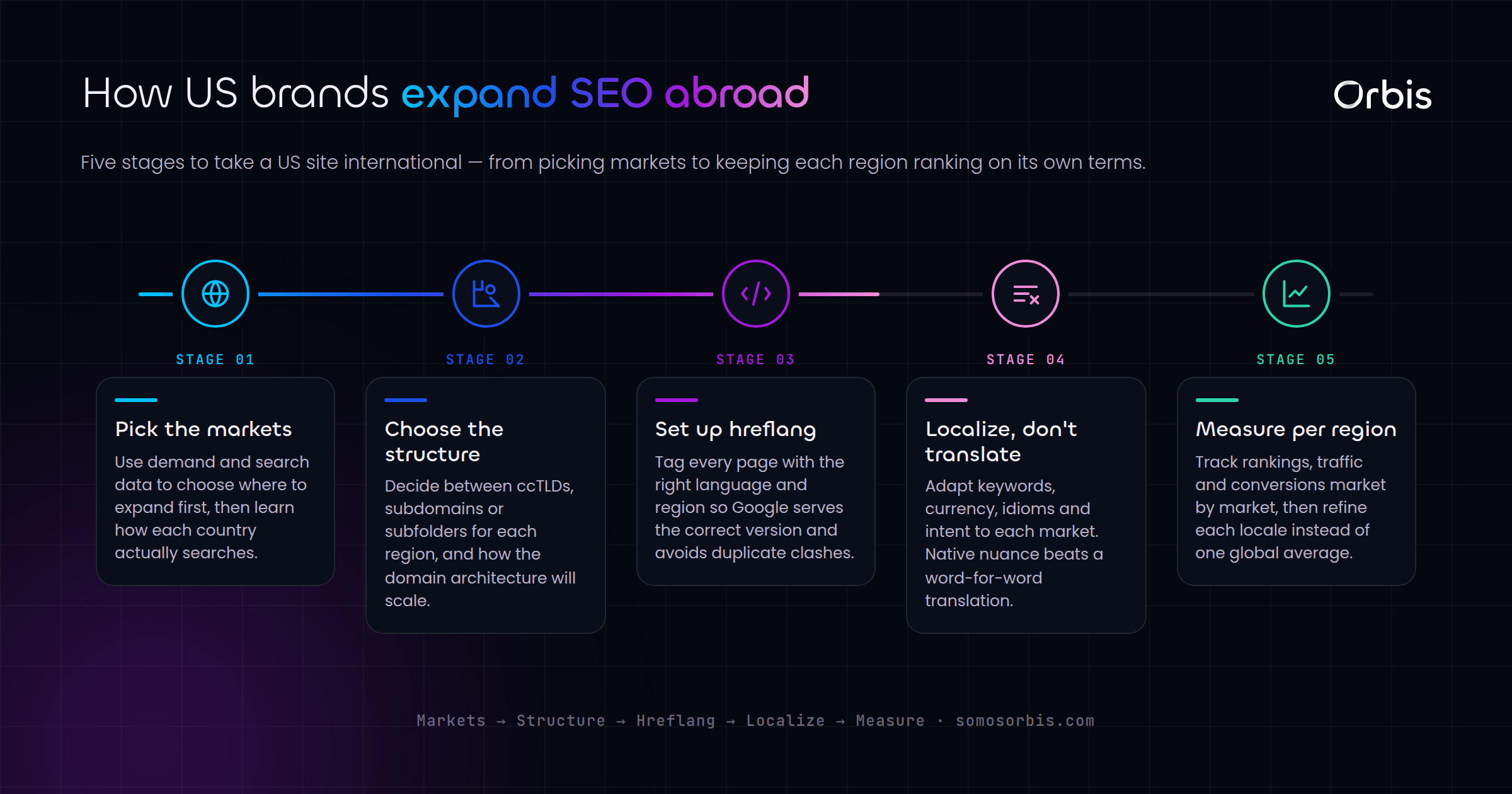
The single most consequential decision in international SEO is your URL architecture. There are three viable options, and the right one depends on your resources and ambitions.
ccTLDs (country-code top-level domains)
A ccTLD is a domain like yourbrand.ca for Canada or yourbrand.mx for Mexico. These send the strongest possible geo-targeting signal to search engines and to users, who trust a local domain. The tradeoff is severe: each ccTLD is a separate site that must build its own authority from zero. For a brand with deep pockets and a long horizon, ccTLDs are the gold standard. For most US brands taking a first step abroad, they are premature.
Subdirectories
A subdirectory keeps everything on your main domain: yourbrand.com/ca/ and yourbrand.com/mx/. This is the pragmatic choice for the vast majority of expanding US brands. Every new market inherits the domain authority you already built in the United States. Maintenance is simpler, your link equity stays consolidated, and you can launch a new market in days rather than months. The downside is a slightly weaker geo signal than a ccTLD, which hreflang and localized content more than compensate for.
Subdomains
A subdomain looks like ca.yourbrand.com. It sits in an awkward middle ground: Google treats it as more separate than a subdirectory but it lacks the trust signal of a ccTLD. Unless you have a specific technical or organizational reason to isolate a market, subdirectories almost always serve US brands better.
Our recommendation for a brand making its first move into Canada or Mexico is simple: start with subdirectories on your existing domain. You preserve authority, you move fast, and you can graduate to ccTLDs later if a market justifies the investment.
Hreflang: The Signal That Stops Cannibalization
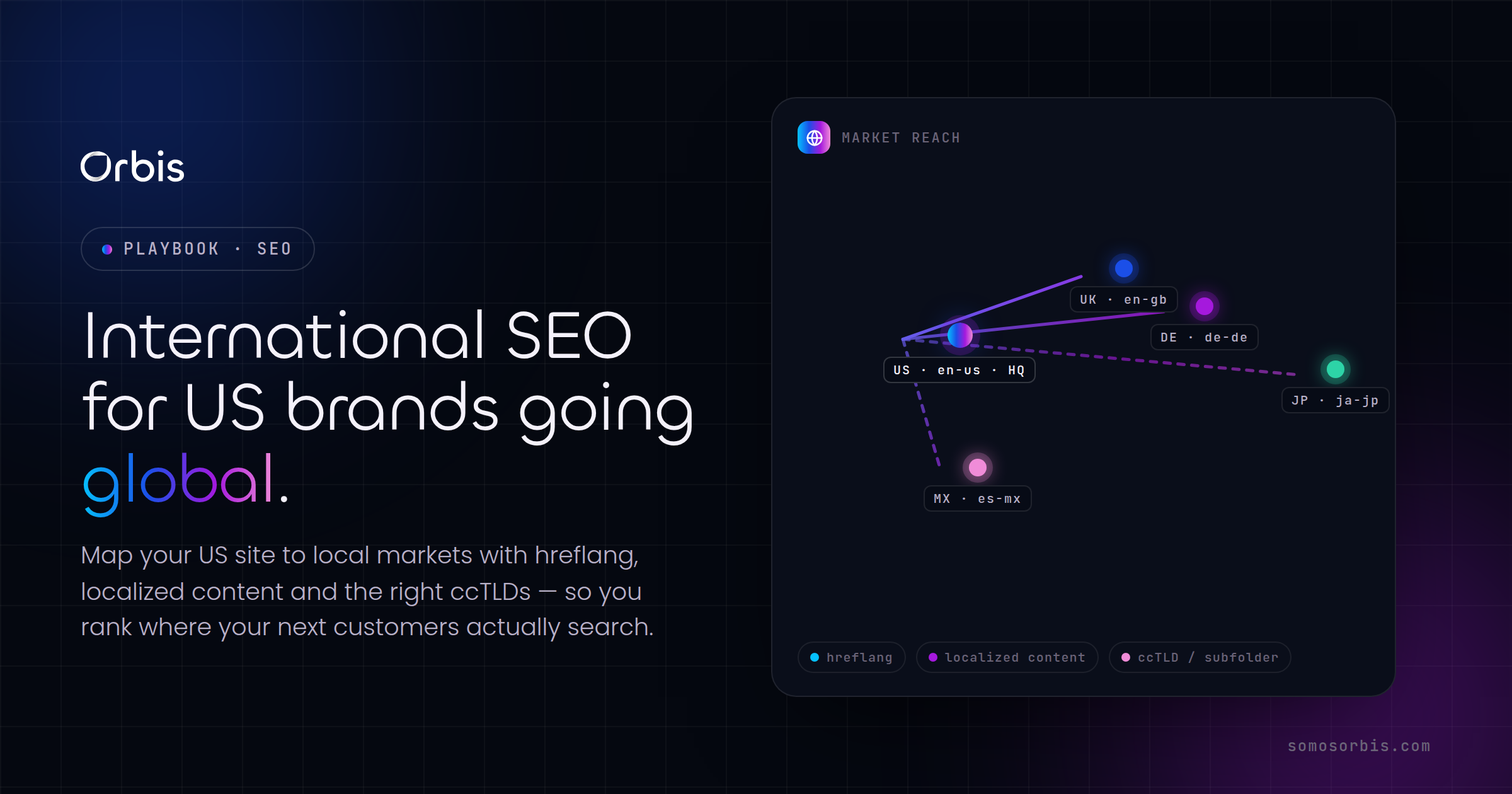
Hreflang is an HTML attribute that tells Google, "this page is the English-US version, that page is the Spanish-Mexico version, and that other one is the English-Canada version." It is the mechanism that prevents your international pages from competing against your US pages. When implemented correctly, Google serves the right version to the right searcher and stops treating your localized pages as duplicates.
Here is what disciplined hreflang implementation requires:
- Return tags on every page. If your US page points to the Canadian version, the Canadian version must point back. Hreflang is bidirectional. A page that is referenced but doesn't reference back is an error Google will ignore.
- Self-referencing tags. Each page must include an hreflang tag pointing to itself. Many implementations break because teams forget the page must declare its own language and region.
- Correct language-region codes. Use en-US for English in the United States, en-CA for English in Canada, es-MX for Spanish in Mexico, es-US for Spanish targeting US Hispanic audiences. Region codes are optional but powerful when you serve the same language to different markets.
- An x-default tag. This catches searchers who don't match any of your specified versions and routes them to a sensible fallback, usually your primary US English page or a country selector.
The single most common hreflang mistake is asymmetry. Your US, Canadian, and Mexican pages must all reference each other in a complete cluster. If you have three versions of a product page, all three must list all three. Audit this with a crawler regularly, because a CMS change or a new template can silently break the cluster and reintroduce the cannibalization you were trying to prevent. If you want a refresher on the technical foundations that make this work, our SEO guide for US businesses in 2026 covers the on-page and crawl fundamentals your international layer sits on top of.
Localization Is Not Translation
Running your US pages through a translation engine and publishing the output is the fastest way to signal low quality to both users and search engines. Real localization adapts the substance of the page to the market.
Adapt currency, units, and formatting
A Canadian shopper expects prices in Canadian dollars, not USD with a conversion note. A Mexican shopper expects pesos. Dates, phone formats, and units of measure should all match local convention. These are small details that compound into trust.
Adapt seasonality and promotions
US seasonality does not map cleanly onto other markets. Black Friday and Cyber Monday have spread internationally but with different intensity and timing. Amazon Prime Day, back-to-school, and US tax season are calendar events that shape US demand but mean little or nothing abroad. When you localize a market, build a content and promotion calendar that reflects that market's real buying rhythms, not a copy of your US one.
Adapt language to local usage
Spanish for Mexico is not interchangeable with Spanish for Spain or for US Hispanic audiences. Vocabulary, idiom, and even the words people type into search differ. This matters enormously, because keyword research has to be redone in-market. The term a US Hispanic shopper in Houston searches may not be the term a shopper in Guadalajara uses. If reaching US Hispanic audiences is part of your expansion thinking, our deep dive on bilingual SEO for the US Hispanic market shows how to serve es-US searchers without diluting your en-US rankings.
Do Real Keyword Research in Every Market
Translating your US keyword list is not keyword research. Search volume, competition, and the exact phrasing of intent are different in every country. A high-volume term in your US strategy may have negligible demand in Canada, and a term you never targeted may dominate in Mexico.
- Use local search data. Pull volumes and competition for each target country, not aggregated or US-weighted numbers.
- Map intent, not words. A term that signals purchase intent in the US may be informational in another market, which changes the type of page you need to rank.
- Watch for English queries in non-English markets. In Canada and parts of Mexico, plenty of high-intent searches happen in English. Don't assume language follows the border cleanly.
- Validate with SERP analysis. Look at who actually ranks in each market. If the page-one results are all local players with localized content, a thin translation will not break through.
Technical Foundations That Travel
International SEO sits on top of solid technical SEO. If your foundation is weak, expansion multiplies the problem across every market.
- Set geotargeting in Search Console. For subdirectories and subdomains, you can specify the target country in Google Search Console. For ccTLDs, the domain itself signals the country and no setting is needed.
- Keep canonical and hreflang aligned. A page's canonical tag should point to itself, not to the US version. A common catastrophic error is canonicalizing every international page back to the US page, which tells Google to ignore your localized versions entirely.
- Localize your XML sitemaps. You can declare hreflang relationships in sitemaps as an alternative or complement to on-page tags, which is often cleaner for large catalogs.
- Mind site speed per region. A shopper in Mexico City loading a US-hosted site may see slower performance. A CDN with regional edges keeps Core Web Vitals healthy across markets.
- Respect local privacy expectations. US privacy norms around consent and data handling are not universal. Each market has its own standards, and your consent banners, data collection, and tracking should respect the rules that apply where the user is, in line with current regulations.
A Phased Rollout That Protects Your US Market
The safest way to expand is incrementally, measuring the impact on your home market at every step.
- Phase one: one market, high-value pages only. Pick Canada or Mexico, not both, and localize your top revenue pages first. This limits the blast radius if something goes wrong.
- Phase two: implement and audit hreflang. Before scaling, confirm your hreflang clusters are complete and symmetrical. Verify in Search Console that Google is recognizing the relationships.
- Phase three: monitor US rankings closely. For the first 60 to 90 days, watch your US organic traffic and rankings like a hawk. A dip is your early warning that cannibalization is happening and your signals need fixing.
- Phase four: scale to the full catalog and the next market. Only once the first market is stable and your US rankings are unaffected do you expand the page set and add the second country.
The goal of international SEO is asymmetric: unlimited upside in new markets, near-zero downside in your home market. You achieve that asymmetry through disciplined signaling, not aggressive launching.
Measuring Success Without Fooling Yourself
Set up segmented reporting from day one. Separate your US organic performance from each international market so a new market's early traffic doesn't mask a decline at home. Track rankings, organic sessions, and conversions per country. The metric that matters most in the first quarter is not how much traffic your new market generates, but whether your US numbers held steady. If they did, you expanded correctly. If they slipped, your hreflang or canonical signals need an audit before you go any further.
Watch for these warning signs that cannibalization is creeping in: US pages losing rankings to your own international pages, the wrong country version appearing in US search results, or impressions for US queries shifting to localized URLs. All three are fixable, and all three trace back to incomplete or contradictory signals.
Get International Expansion Right the First Time
International SEO rewards brands that treat expansion as an engineering problem, not a translation project. The structure of your URLs, the symmetry of your hreflang clusters, the depth of your localization, and the discipline of your rollout determine whether you open new revenue or quietly erode the US rankings you depend on. Most of the risk is avoidable, and almost all of it comes from skipping the structural work in a rush to launch.
If you're a US brand planning a move into Canada, Mexico, or further abroad, our team builds the architecture, signaling, and localized content that lets you scale without cannibalizing your home market. Explore our international SEO services and let's map an expansion that protects what you've built while opening what comes next.