
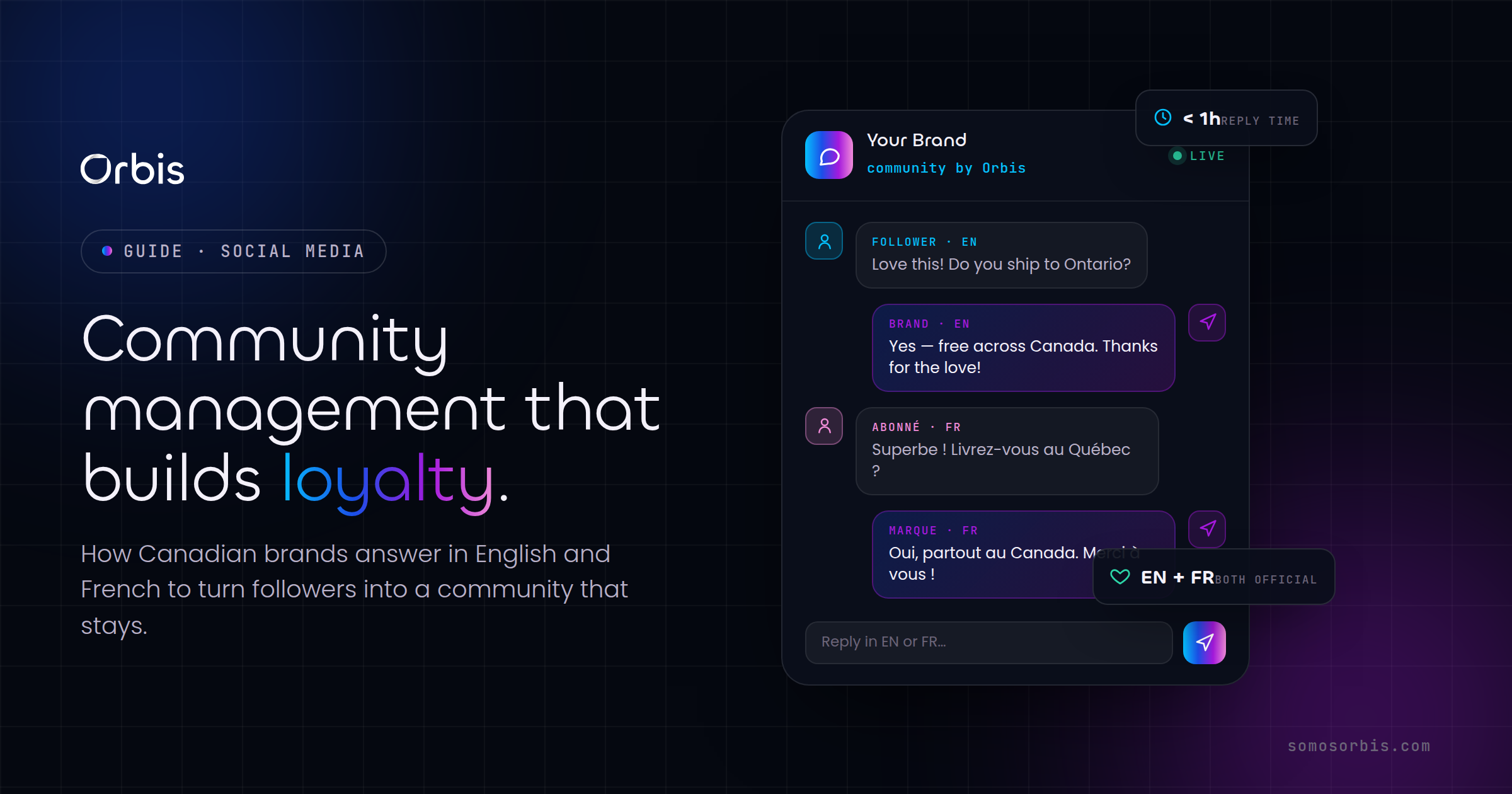
For Canadian brands, the comment section is the front door. Long before a prospect books a demo or adds something to cart, they are watching how you reply to a frustrated customer on Instagram, whether your French response sounds as fluent as your English one, and how quickly a DM gets answered on a Saturday afternoon. Community management is no longer a soft, "nice to have" function. In a market that is bilingual by law, regionally distinct, and quick to call out tone-deaf brands, the way you manage your community is a measurable driver of loyalty, retention, and revenue.
This guide breaks down how to build and run a community management practice that works in both English and French, respects the realities of Canadian audiences across Toronto, Vancouver, Montreal, and Calgary, and turns everyday interactions into long-term trust. If you want the full strategic picture of how social fits into your business, start with our complete guide to social media management in Canada, then use this post to go deep on the community layer.
Why Community Management Is a Loyalty Engine, Not a Cost Centre
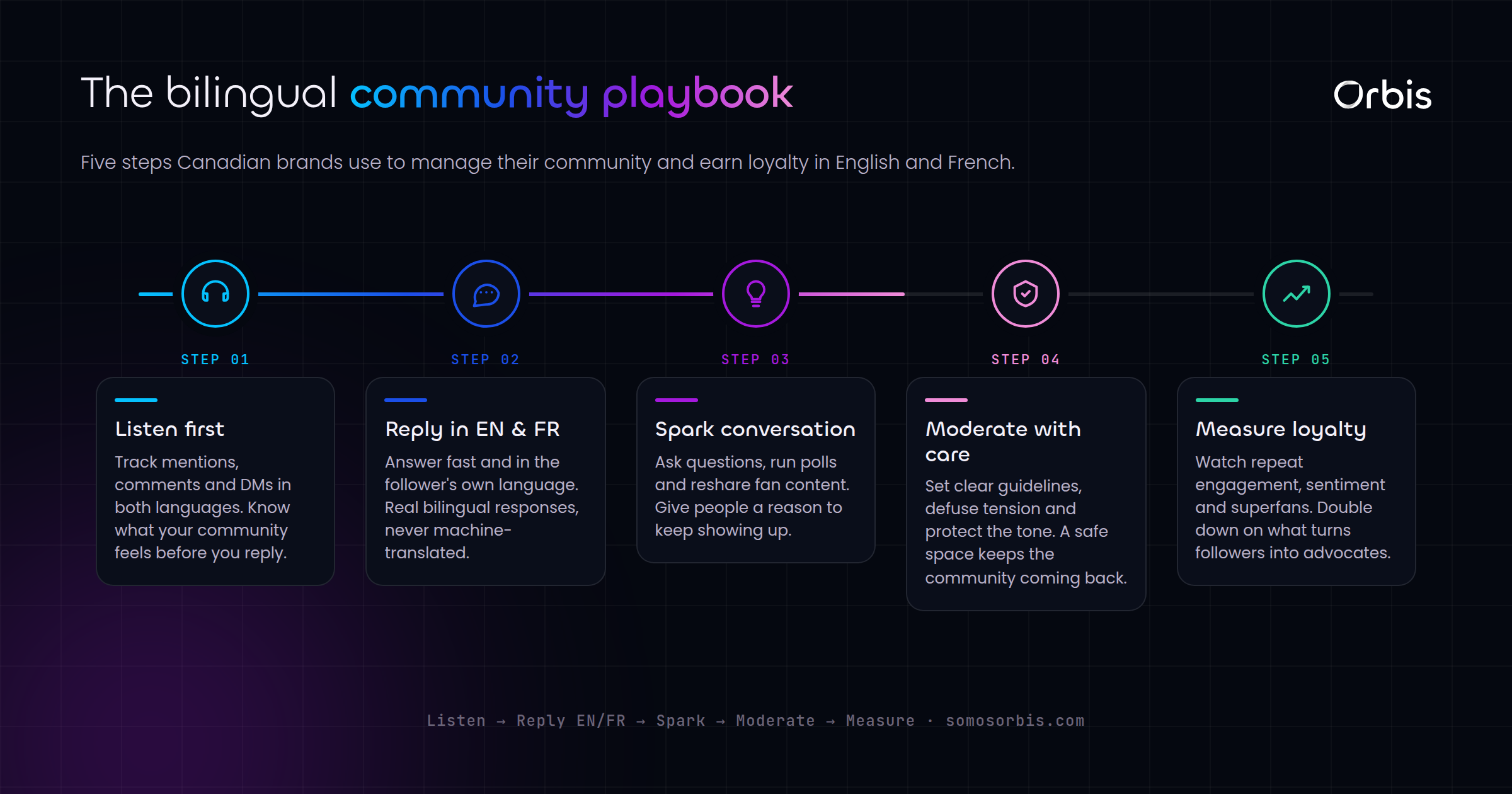
Most brands treat community management as cleanup duty: answer the angry comment, hide the spam, move on. That framing leaves enormous value on the table. Every reply is a public demonstration of how you treat people. A single thoughtful response to a complaint is often seen by dozens or hundreds of silent observers who are quietly deciding whether to trust you.
The business case is straightforward:
- Retention compounds. Keeping an existing customer is far cheaper than acquiring a new one, and responsive community management is one of the few touchpoints that reaches customers after the sale, when most marketing goes quiet.
- Public proof builds trust. Your reviews and visible reply history are read like testimonials. A pattern of fast, human, helpful responses does more for credibility than any ad.
- Insight flows upstream. Comments and DMs are an unfiltered focus group. Recurring questions reveal gaps in your product, pricing, or onboarding that no survey would surface as honestly.
Treated well, community management feeds directly into a structured community management practice that protects revenue rather than just absorbing complaints.
The Bilingual Reality: EN and FR Are Not Optional
Canada's bilingual landscape is the single biggest factor that separates community management here from the US playbook. Roughly one in five Canadians speaks French as a first language, concentrated heavily in Quebec but present coast to coast. For many of those customers, being answered in French is not a courtesy; it is the baseline expectation, and in Quebec it is increasingly tied to consumer expectations around French-first service.
What "bilingual community management" actually requires
Posting bilingual content is the easy part. The hard part is the live, unscripted layer: replies, DMs, and comments that arrive at any hour, in either language, often mixed within a single thread. To handle this well, you need:
- Native or near-native French capacity. Machine translation is fine for triage but dangerous for public replies. Quebec French has its own idioms and tone, and a stiff, obviously-translated answer reads as inauthentic to a francophone audience.
- Language detection at intake. Whoever monitors your channels should route French threads to a French-capable responder quickly, so francophone customers are not left waiting longer than anglophone ones.
- Parallel, not translated, response libraries. Build saved replies natively in each language rather than translating your English ones. The intent stays the same; the phrasing should feel local.
- Consistent voice across both languages. Your brand should sound like the same company whether someone reads it in English or French. That means a shared tone guide that both language teams work from.
A practical rule: never let response time in French lag behind response time in English. If francophone customers consistently wait longer, that gap becomes its own reputational problem.
Set Response Time and Tone Standards Before You Scale
Loyalty is built on predictability. Customers do not expect instant answers, but they do reward consistency. Define your standards explicitly so every responder, in either language, knows the bar.
- First-response targets by channel. Decide what "good" looks like, for example a few hours during business days for comments and DMs, with a clearly communicated slower cadence on weekends and holidays.
- Escalation paths. Define exactly when a community manager loops in support, sales, or a manager, and how a thread moves from public comment to private DM to a formal support ticket.
- Tone tiers. A delighted customer, a confused prospect, and an angry one each need a different register. Document how warm, how formal, and how apologetic each should be, in both EN and FR.
Write these standards down. A documented playbook is what keeps quality consistent as you add responders, switch agencies, or cover vacations, and it is the difference between a community that feels cared for and one that feels random.
Handling the Hard Conversations: Complaints and Crises
How you respond when things go wrong matters more than anything you post when things go right. Canadian audiences are generally polite but unforgiving of brands that get defensive or evasive in public.
A simple framework for complaints
- Acknowledge fast and publicly. A quick, visible "We hear you and we're looking into this" reassures the complainant and the silent audience watching.
- Move the detail to DM. Resolve specifics, account numbers, and back-and-forth privately, then return to the public thread to confirm it was handled.
- Never argue in the comments. Even when you are right, a public argument makes the brand look defensive. Stay calm, factual, and human.
- Close the loop. Once resolved, a short public note that the issue was sorted out turns a complaint into proof that you follow through.
For larger flare-ups, you need to know about problems before they trend. That is where listening tools and a defined escalation protocol matter, which we cover in depth in our guide to social listening and reputation management for Canadian brands. The community manager is often the first person to spot a brewing crisis; give them a clear, fast path to raise the alarm.
Turn Your Community Into Advocates
Defensive community management answers problems. Proactive community management creates fans. The brands that win loyalty in Canada treat their comment sections and DMs as relationship-building space, not just a help desk.
- Reward your regulars. Recognize the people who consistently engage, tag friends, or defend you in threads. A reply that uses their name, a feature of their content, or a small surprise goes a long way.
- Ask, don't just answer. Use comments and Stories to ask genuine questions. Canadians respond well to brands that show real curiosity rather than broadcasting at them.
- Celebrate local and seasonal moments. Engage authentically around the rhythms your audience actually lives: back-to-school in late summer, the holiday rush, Boxing Day, and regional moments. A brand that feels in sync with the Canadian calendar feels like it belongs here.
- Spotlight user-generated content. Resharing customer photos and reviews, with permission, signals that you see your community as partners, not just buyers.
This advocacy layer is most powerful when it is planned, not improvised. Knowing which moments you will lean into, and in which language, keeps engagement consistent rather than reactive. Map those moments alongside your wider posting plan using our guide to building a social content calendar for Canada, so community engagement and content reinforce each other.
Regional Nuance Across Canada
Canada is not a single audience. A response style that lands in downtown Toronto can feel off in Calgary or Montreal. You do not need a separate team per city, but you do need awareness.
- Quebec and Montreal: French-first expectations, distinct cultural references, and a strong preference for brands that respect the language rather than treating it as an afterthought.
- Toronto and the GTA: Highly diverse, fast-paced, and multicultural. Inclusive language and quick responses are expected.
- Vancouver and BC: Outdoor, wellness, and sustainability themes resonate; tone tends to be relaxed and values-driven.
- Calgary and the Prairies: Direct, practical, community-minded. Straight answers and authenticity beat polish.
Pricing, promotions, and seasonal references should always be framed in Canadian terms, including CAD pricing and Canadian holidays, so your community never feels like it is reading content built for a US audience and lazily reused.
Measure What Actually Signals Loyalty
Vanity metrics like follower count tell you little about loyalty. Track the indicators that reflect real relationship health:
- Response rate and response time, tracked separately for English and French to catch any imbalance.
- Sentiment trend over time, not just at a single moment, so you can see whether community feeling is improving or eroding.
- Repeat engagement, the share of interactions coming from people who have engaged before, which is a strong loyalty signal.
- Resolution rate, how often a raised issue is actually closed to the customer's satisfaction.
- Review volume and rating, since public reviews are downstream of how well you manage the community day to day.
Review these numbers on a regular cadence and feed what you learn back into your response libraries, your content calendar, and your product team. Community management only compounds when the insights it generates are acted on.
Build It on Documented Processes
The brands that sustain great community management over years are not the ones with the most talented individual responders; they are the ones with the best processes. A documented approach, covering response standards, bilingual routing, escalation, tone guides, and reporting, is what keeps quality steady through team changes, seasonal spikes, and growth. It is the difference between community management that depends on one person remembering how things are done and a system that delivers consistently no matter who is at the keyboard.
That documented, process-first approach is exactly how strong community management protects revenue rather than just reacting to problems, and it is how loyalty is engineered rather than hoped for.
Make Your Community Your Strongest Channel
In a bilingual, regionally diverse market like Canada, community management is one of the highest-leverage things a brand can get right. Done well, it turns silent followers into loyal customers, complaints into proof of reliability, and everyday comments into a steady stream of insight. Done poorly, it quietly erodes trust one ignored or tone-deaf reply at a time.
If you want a community management practice built on documented processes, native EN and FR coverage, and standards that hold up as you grow, explore our community management services for Canadian brands. We will help you turn your comments, DMs, and reviews into a loyalty engine that works in both official languages, across every region you serve.