
Google Ads is the single largest paid-acquisition channel for most Canadian businesses, and for good reason: it reaches buyers at the exact moment they're searching, comparing, or watching. But running it well in Canada means more than copying a U.S. playbook. You're working in Canadian dollars, navigating bilingual English and French markets, accounting for Quebec's language requirements, and timing spend around a uniquely Canadian retail calendar that runs from back-to-school through Boxing Day. This guide walks through the full funnel of Google Ads for Canadian advertisers, Search, Shopping, Display, and YouTube, with practical setup decisions, bidding guidance, and budget planning you can act on this quarter.
At Orbis we manage paid media for Canadian and North American advertisers as a Google Partner agency offering full-funnel paid media management, and the patterns below come from running real CAD budgets across competitive verticals. Wherever possible we link to deeper, channel-specific guides so you can go from strategy to execution without guessing.
How Google Ads Fits the Canadian Buyer Journey
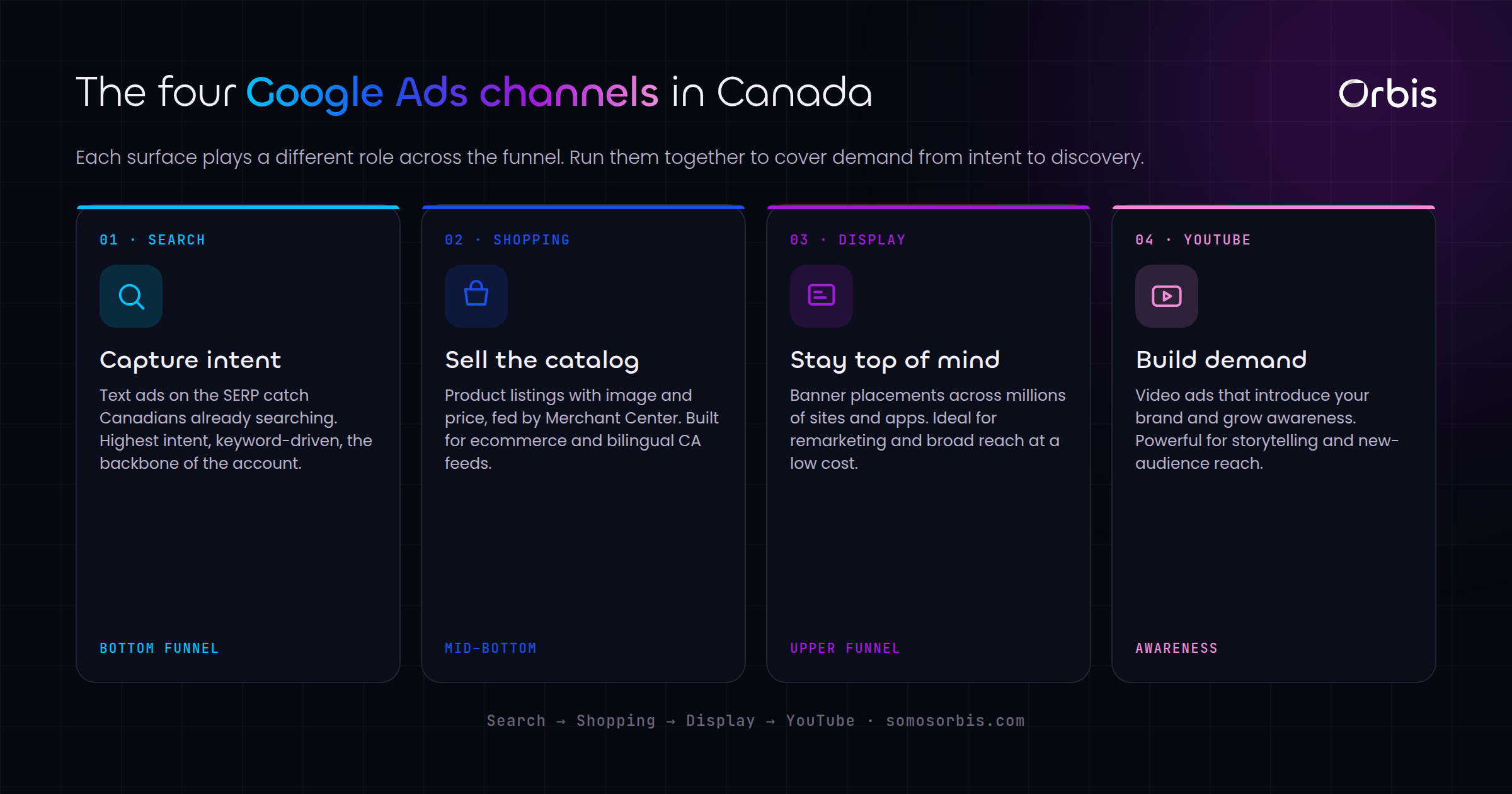
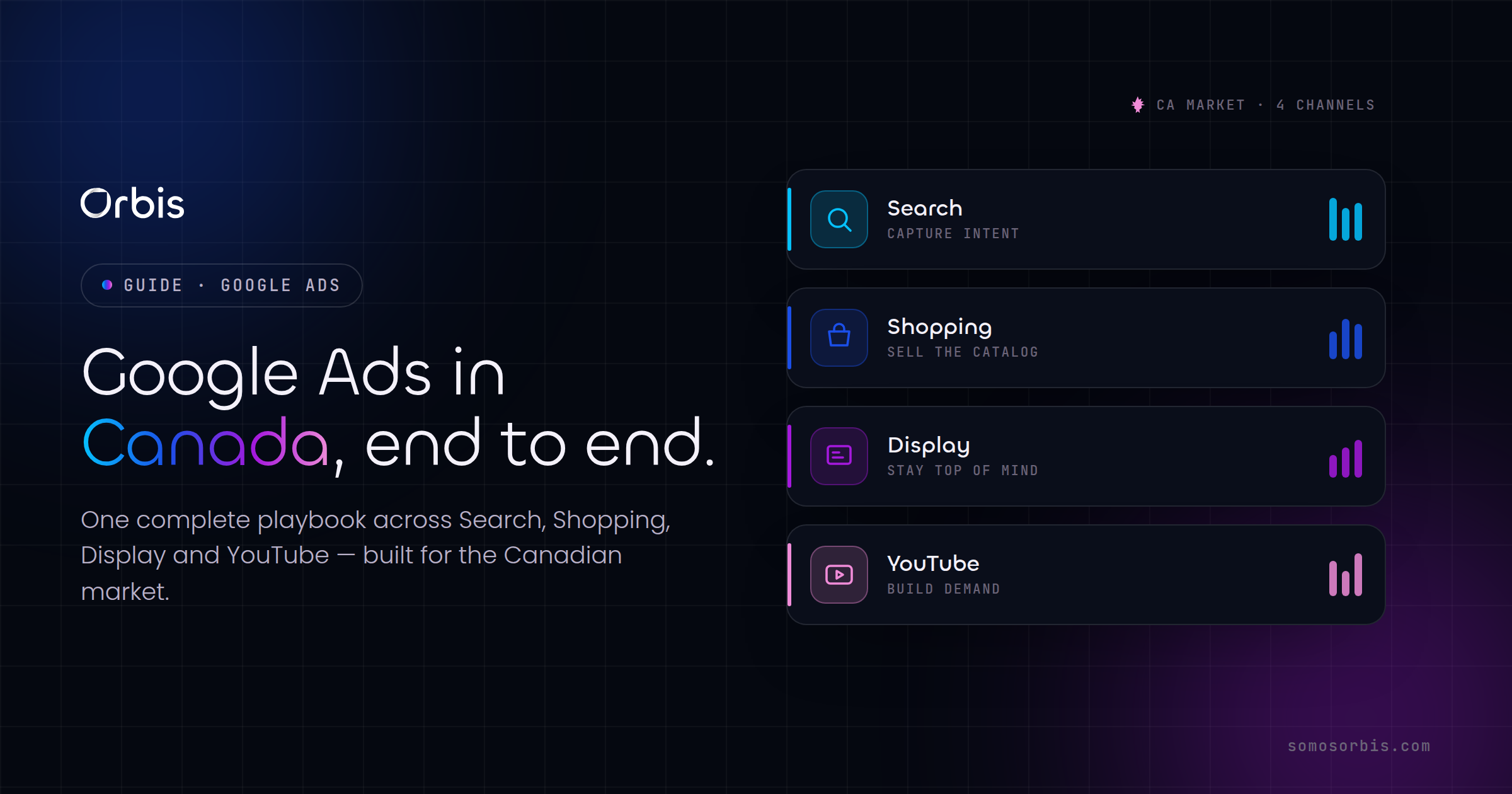
Before touching a single campaign, it helps to map each Google Ads format to a stage of intent. Treating all of Google as one undifferentiated channel is the most common reason Canadian advertisers overpay for results.
- Search captures active, high-intent demand, someone in Calgary typing "commercial HVAC repair" is ready to buy. This is your bottom-of-funnel workhorse.
- Shopping serves product listings to shoppers comparing options, critical for any Canadian retailer or ecommerce brand.
- Display builds reach and, more importantly, powers remarketing, keeping your brand in front of people who already visited.
- YouTube drives awareness and consideration, ideal for explaining a product, launching a category, or warming up cold audiences before they ever search.
The mistake we see most often is pouring the entire budget into Search because it converts best, then wondering why growth stalls. Search only harvests demand that already exists. Display and YouTube create and nurture it. A balanced Canadian program uses all four in concert, with measurement that credits the assist, not just the last click.
Setting Up Your Account for the Canadian Market
A handful of account-level decisions shape everything downstream. Get these right before you build campaigns.
Currency, Billing, and Time Zone
Set your account currency to CAD and your time zone to the province where most of your customers live, Eastern for Ontario and Quebec-heavy accounts, Pacific for B.C., Mountain for Alberta. These choices are permanent, and a mismatch quietly distorts every report. Reporting in CAD also keeps your cost-per-acquisition and return-on-ad-spend numbers honest when you compare them against margins priced in Canadian dollars. If you've imported a historical account that was set to USD, the exchange-rate noise alone can make month-over-month trends meaningless.
Geographic Targeting Done Properly
Canada's population is concentrated in a handful of metros, the Greater Toronto Area, Montreal, Vancouver, Calgary, Edmonton, and Ottawa, but it's also one of the largest countries on earth by land area. Default location settings can burn budget on regions you don't serve. Two rules:
- Set location options to "Presence" (people in your target areas), not "Presence or interest," unless you genuinely want to reach people merely searching about a place.
- Use location bid adjustments. A plumber serving the GTA shouldn't pay the same to appear in Sudbury. Layer in radius targeting around service areas and exclude regions you can't fulfill.
Bilingual and Quebec Considerations
Roughly a fifth of Canadians speak French as a first language, concentrated in Quebec, and serving them in English alone leaves money on the table, often at lower competition and cheaper clicks. If you operate in Quebec, French-language advertising isn't just good practice; it aligns with the province's expectations around serving consumers in French. Build separate French campaigns rather than relying on machine translation in your existing ones: French ad copy needs native phrasing, French keywords, and French landing pages to earn a strong Quality Score. Treat EN and FR as two distinct go-to-market efforts that happen to share a budget.
Google Search Ads: The Canadian Demand Harvester
Search is where most accounts should start because intent is explicit and measurement is clean. The fundamentals, tight ad groups, strong Quality Score, and disciplined negative keywords, matter more than any bidding gimmick.
Account Structure That Scales
Organize campaigns by theme and margin, not by whim. A common, durable structure separates branded terms (people searching your company name, cheap and high-converting) from non-branded terms (the expensive, competitive head terms) and from long-tail intent clusters. Keep branded and non-branded in separate campaigns so brand traffic doesn't inflate your non-brand performance and hide problems.
Within each campaign, build tightly themed ad groups so your responsive search ads can speak directly to the query. The closer your headline mirrors the searcher's words, the higher your Quality Score, and in Canada's competitive metros, Quality Score is the difference between a $4 and a $9 click. For the full build, our step-by-step guide to setting up Google Search Ads in Canada walks through campaign structure, match types, and conversion tracking in detail.
Match Types and Negative Keywords
Phrase and exact match give you control; broad match paired with Smart Bidding and a solid conversion signal can find incremental volume, but only once you've built a robust negative keyword list. Start conservative. Mine your search terms report weekly and add negatives aggressively, especially job-seeker, DIY, and "free" queries that drain budget without converting. A disciplined negative list is the cheapest performance lever in Search.
Bidding Strategy
New campaigns rarely have enough conversion data for Smart Bidding to work well, so begin with Maximize Clicks or manual CPC to gather signal, then graduate to Target CPA or Target ROAS once you've logged 30+ conversions in 30 days. Set your targets against real Canadian margins. A Target ROAS that ignores CAD shipping costs and returns is a fantasy. When you're ready to delegate ongoing optimization, our managed Google Search Ads service covers bid management, ad testing, and search-term hygiene.
Writing Ads That Earn the Click
Responsive search ads let you supply up to 15 headlines and 4 descriptions, and Google assembles combinations. Give the system room to work, but pin one or two headlines that must always appear, your brand name, your core offer, or a compliance-required phrase. For Canadian audiences, small signals of localness lift click-through rate: reference the city or region, quote prices in CAD, mention free shipping across Canada, or note bilingual service where relevant. Spell to Canadian convention ("centre," "colour," "licence") so your copy reads native rather than imported. Use ad extensions, now called assets, generously: sitelinks to your highest-converting pages, callouts for differentiators like "Google Partner" or "Serving Canada since 2009," structured snippets, and call assets with location-aware numbers. Extensions are free real estate that expand your ad's footprint and push competitors down the page.
Landing Page Alignment
Quality Score has three inputs: expected click-through rate, ad relevance, and landing page experience. The last is the one advertisers most often neglect. The page a Canadian searcher lands on must mirror the promise of the ad, load fast on mobile, and present prices and availability in CAD. If you advertise a French keyword, the landing page must be in French, sending a Quebec searcher to an English page tanks both conversion rate and Quality Score. Dedicated landing pages per campaign theme almost always outperform routing all traffic to a generic homepage.
Google Shopping: Essential for Canadian Retailers
If you sell physical products, Shopping is non-negotiable. It puts your product image, price, and store name directly in results, pre-qualifying clicks because shoppers see the price before they arrive. For Canadian retailers competing against U.S. giants, Shopping is often the highest-ROAS channel in the account, when the feed is clean.
The Feed Is Everything
Shopping has no keywords; Google matches queries to your product feed. That makes feed quality your single biggest lever. Prioritize:
- Titles that front-load brand, product type, and key attributes (size, colour, material), the way Canadians actually search.
- Accurate CAD pricing and availability synced in real time. Nothing kills performance faster than serving an ad for an out-of-stock item or a price that doesn't match the landing page.
- GTINs and product identifiers filled in completely, they materially affect how often you show.
- Canadian shipping and tax settings configured in Merchant Center so the displayed total reflects reality.
Once the feed is solid, segment campaigns by product margin and intent so your best-margin SKUs get the bids they deserve. Our Google Shopping guide for Canadian retailers goes deep on feed optimization, Performance Max structure, and Merchant Center setup, and you can hand the whole operation to our Google Shopping management service when you're ready to scale.
Performance Max and Standard Shopping
Google increasingly steers retailers toward Performance Max, which blends Shopping, Display, YouTube, and Search into one automated campaign. PMax can deliver strong results, but it's a black box, so feed it clean conversion data, segment by asset group thoughtfully, and use exclusions to protect brand traffic. For new accounts, running standard Shopping alongside PMax for a period gives you visibility into search terms that PMax otherwise hides.
Google Display: Reach and Remarketing
The Display Network reaches the vast majority of Canadian internet users across millions of sites and apps. Used for cold prospecting alone, Display can be inefficient. Used for remarketing, it's one of the highest-leverage tactics in the account.
Remarketing Is Where Display Earns Its Keep
People rarely buy on the first visit, especially for considered purchases. Remarketing keeps your brand in front of Canadians who visited but didn't convert, segmented by behaviour: cart abandoners get a different message than blog readers. Build audience lists by page visited and time since visit, then tailor creative and frequency caps so you stay present without becoming annoying. Our Google Display and remarketing guide for Canada covers audience strategy, frequency capping, and creative best practices.
Prospecting With Display
For top-of-funnel reach, layer in-market and custom-intent audiences, Canadians actively researching your category, rather than broad demographic targeting. Pair Display prospecting with a remarketing layer so the awareness you buy gets a second and third touch. Treat Display prospecting as a demand-generation investment measured over weeks, not a last-click conversion channel.
Creative and Placement Discipline
Responsive display ads adapt your images, headlines, and logos to fit millions of placements, but adaptability is no substitute for quality. Supply crisp images, a clear value proposition, and a logo that reads at small sizes. Then guard where you appear: exclude mobile games and low-quality content categories that generate accidental clicks, and review your placement report regularly to prune sites that spend without converting. A short exclusion list, parked-domain placements, sensitive content, and apps you don't want association with, protects both budget and brand. For Canadian advertisers worried about appearing alongside content in the wrong language, content and topic targeting can keep you on French or English inventory as appropriate.
YouTube Ads: Building Brand Awareness in Canada
YouTube reaches almost the entire Canadian online adult population, and as a Google property, its targeting and measurement plug straight into your Ads account. It's the most underused channel by Canadian small and mid-sized advertisers, which makes it an opportunity.
Use YouTube to explain what you do, demonstrate a product, or build category awareness before demand exists. Skippable in-stream ads only charge when viewers watch meaningfully, so a strong first five seconds, lead with the hook, name the problem, show the payoff, protects your budget. For Quebec audiences, run French-language creative; dubbed or subtitled English rarely lands. The audiences you build on YouTube can then be remarketed across Search and Display, turning awareness into a measurable pipeline. Our YouTube Ads guide for Canadian brand awareness covers ad formats, creative structure, and audience building.
Don't Forget Microsoft Ads
Google isn't the only search engine worth your budget. Microsoft Advertising (Bing) reaches a meaningful slice of Canadian desktop users, often older, often higher-income, and frequently at a lower cost-per-click than Google because competition is thinner. Importing your Google campaigns into Microsoft Ads is straightforward and frequently delivers incremental conversions at attractive economics. It shouldn't be your primary channel, but leaving it off the table means leaving cheap, qualified clicks for competitors. Our guide to Microsoft Ads and Bing in Canada shows how to import, adjust, and measure it.
Budgeting in CAD and Planning for Canadian Seasonality
Budget planning is where Canadian context matters most. Costs, competition, and consumer demand all swing with a calendar that doesn't match the U.S. or anywhere else.
The Canadian Retail Calendar
Your bidding should breathe with the year:
- Back-to-school (August into early September) spikes demand across retail, electronics, and services, with the timing shaped by provincial school calendars.
- Black Friday and Cyber Monday now anchor Canadian holiday shopping, with CPCs climbing sharply as everyone bids up.
- Boxing Day and Boxing Week remain a distinctly Canadian post-Christmas surge, U.S.-centric playbooks miss this entirely.
- Holiday season overall demands earlier budget ramps and higher targets, because auction prices rise and you need lead time to capture share.
- Q1 lulls after the holidays often mean cheaper clicks, a good window for prospecting and brand building when competitors pull back.
Allocating the Budget
A practical starting split for a growth-minded Canadian advertiser weights bottom-funnel Search and Shopping most heavily, reserves a meaningful slice for remarketing across Display and YouTube, and dedicates a smaller, protected portion to top-funnel prospecting that you measure over a longer window. Reallocate monthly based on performance, and raise budgets ahead of known demand spikes rather than reacting once CPCs have already climbed. For the full framework, including how to model CAD budgets against seasonal CPC inflation, see our guide to Google Ads budgeting in CAD and Canadian seasonality.
Measurement: Knowing What Actually Works
None of the above matters without clean measurement. In Canada, that means accurate conversion tracking, enhanced conversions to recover signal lost to privacy changes, and an attribution model that credits the full journey rather than rewarding only the last click. Tie every conversion to a CAD value so you can optimize toward revenue and margin, not vanity clicks. If you're running across Search, Shopping, Display, and YouTube, a last-click view will systematically undervalue the upper funnel and push you to defund the very channels that feed your best-converting Search traffic.
Set up offline conversion imports if you have a sales cycle, so a closed deal in your CRM flows back to the campaign and keyword that started it. This is especially valuable for Canadian B2B and high-consideration services where the buying journey spans weeks.
Privacy, Consent, and Consent Mode
Canadian advertisers operate under privacy expectations that reward clean data handling. As third-party cookies fade and browser restrictions tighten, the accounts that keep measuring accurately are the ones that implemented enhanced conversions and consent-aware tagging early. Consent Mode lets you respect a visitor's cookie choices while still modelling conversions you'd otherwise lose, preserving optimization signal without overstepping. Pair a clear consent banner with server-side tagging where you can, and you'll hold onto far more measurable data than competitors who ignored the shift. The practical payoff is concrete: Smart Bidding is only as good as the conversion signal you feed it, so protecting that signal directly protects performance.
Common Mistakes Canadian Advertisers Make
After auditing hundreds of accounts, the same avoidable errors recur. Watch for these:
- Running USD-imported accounts in Canada without resetting currency and time zone, which corrupts every cost and ROAS figure.
- Ignoring French entirely, ceding the Quebec market and cheaper clicks to competitors who bothered to localize.
- Targeting "Canada" broadly when the business only serves one or two metros, paying for clicks from regions it can't fulfill.
- Letting Performance Max cannibalize brand search, taking credit for conversions that would have happened anyway, because brand terms weren't excluded.
- Optimizing to clicks or even conversions instead of revenue, so the account chases cheap leads that never become customers.
- Judging Display and YouTube by last-click, then defunding the upper funnel that quietly feeds the Search campaigns everyone praises.
- Reacting to seasonal CPC spikes instead of raising budgets ahead of back-to-school, Black Friday, and Boxing Week when share is still affordable.
None of these are exotic. They're the difference between an account that quietly bleeds budget and one that compounds.
A 90-Day Plan to Get Started
If you're building or rebuilding a Canadian Google Ads program, sequence the work rather than launching everything at once:
- Days 1-15: Set account currency, time zone, and geographic targeting. Implement conversion tracking with CAD values, enhanced conversions, and consent handling. Build your first branded and non-branded Search campaigns.
- Days 16-45: Launch Shopping if you sell products, with a clean, CAD-priced feed. Add negative keyword lists and begin daily search-term review. Stand up remarketing audiences so no traffic goes un-retargeted.
- Days 46-75: Layer in Display remarketing and, if budget allows, a YouTube awareness campaign with native creative, French where Quebec matters. Import campaigns into Microsoft Ads for incremental reach.
- Days 76-90: Move qualified Search campaigns to Smart Bidding now that data has accumulated. Review attribution beyond last-click, reallocate budget toward revenue, and plan the next seasonal ramp.
By the end of the quarter you'll have a full-funnel system producing clean signal, ready to scale into your next demand spike rather than scrambling to react to it.
Related Guides in This Series
This pillar links to a full library of channel-specific playbooks. Start with the format most relevant to your business, then expand:
- Setting up Google Search Ads in Canada
- Google Shopping for Canadian retailers
- Google Display and remarketing in Canada
- YouTube Ads for Canadian brand awareness
- Microsoft Ads and Bing in Canada
- Google Ads budgeting in CAD and Canadian seasonality
Bringing It Together
Winning with Google Ads in Canada isn't about mastering one format, it's about orchestrating Search, Shopping, Display, and YouTube as a single full-funnel system, priced in CAD, tuned for bilingual markets, and timed to a Canadian calendar. Search harvests demand, Shopping converts comparison shoppers, Display and YouTube create and nurture the demand that feeds them, and clean measurement keeps the whole machine honest. Build deliberately, measure in revenue, and let the data, not last-click bias, guide where the next dollar goes.
If you'd rather have a Google Partner team build, run, and optimize this for you, our paid media management service for Canadian advertisers covers the full stack, from CAD budget planning to bilingual campaign builds across every Google surface. With a 4.9-star rating across 58 reviews, more than 500 clients served, and over 15 years of experience, we bring documented processes and revenue-focused execution to every account. Let's turn your Google Ads spend into a system that compounds.