
Ranking on Google in Canada is not the same job as ranking in the United States, the United Kingdom, or anywhere else. You are working across two official languages, a handful of dense metro markets separated by thousands of kilometres, provincial buying behaviour, a currency and shopping calendar that march to their own beat, and an audience that increasingly gets its answers from AI before it ever clicks a blue link. If your SEO strategy treats Canada as "the US with extra spelling," you will leave revenue on the table and hand it to competitors who understand the terrain. This guide walks Canadian businesses through the complete picture: local search across multiple cities, bilingual EN/FR optimization, e-commerce, B2B lead generation, link building, US expansion, and the new world of AI answer engines. It is the pillar; each section points to a deeper guide so you can go as far down any path as your business needs.
At Orbis, we approach search the way we approach every channel: as a documented, repeatable revenue process rather than a bag of tricks. The tactics below are the ones we actually deploy for Canadian clients, and they are built to survive algorithm updates because they are grounded in genuine user value and clean technical foundations. If you would rather hand the whole programme to a team, our SEO services for Canadian businesses cover everything in this guide end to end.
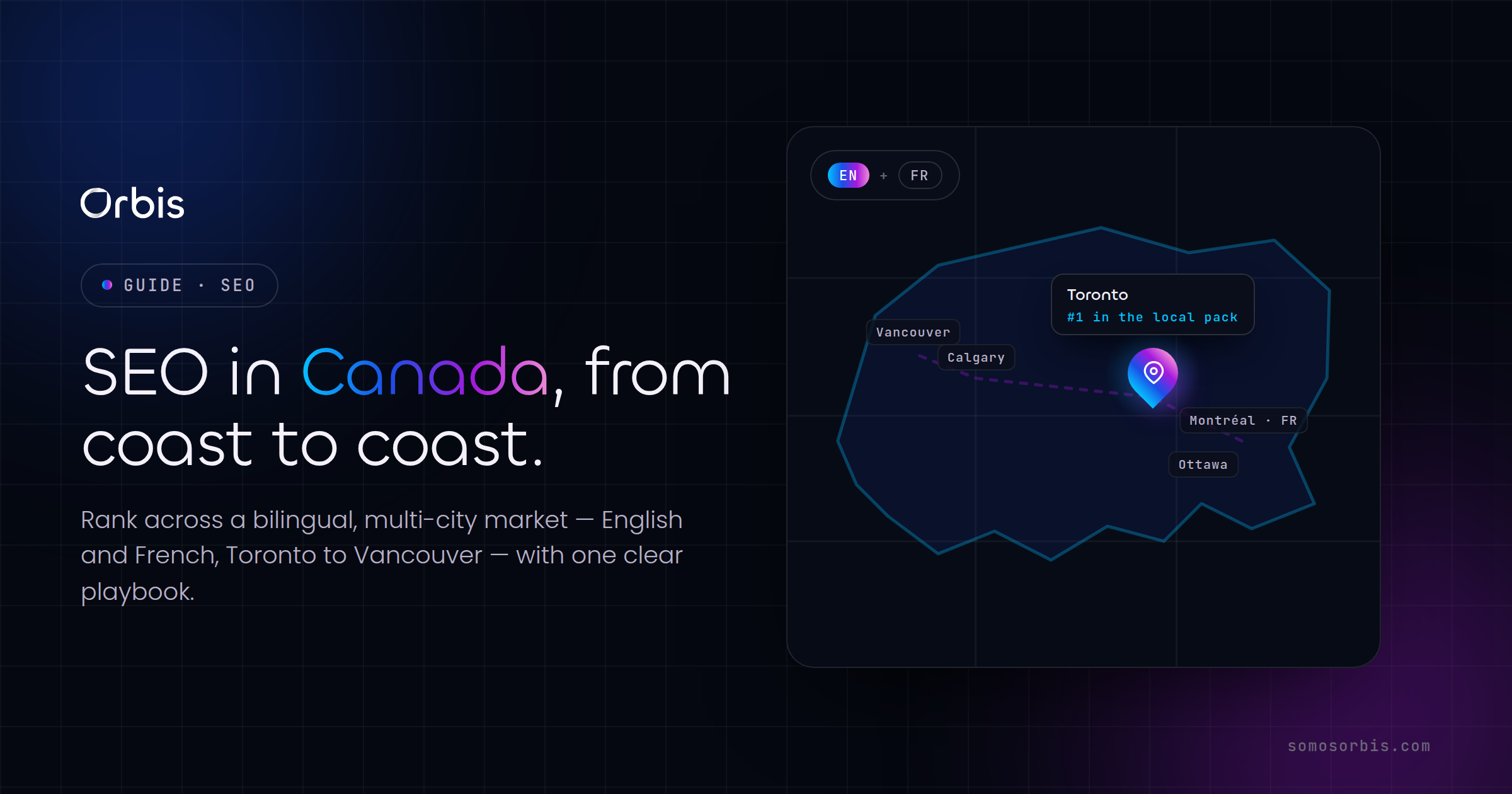
Why Canadian SEO Is Its Own Discipline
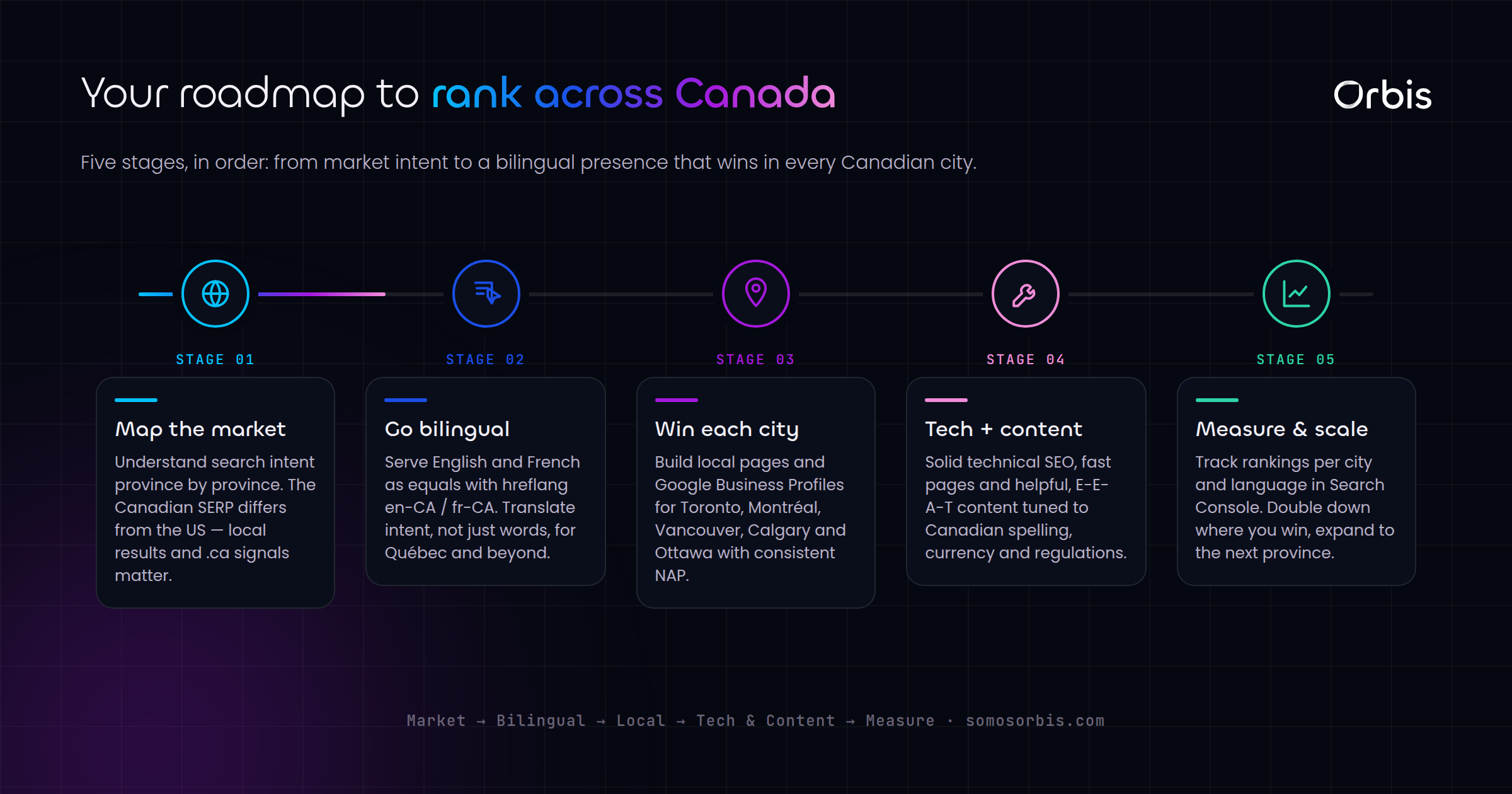
Most off-the-shelf SEO advice is written for a single-language, single-market world. Canada breaks several of those assumptions at once, and each break is an opportunity if you handle it deliberately.
- Two official languages. Federally and in Quebec, French is not a "nice to have." A meaningful share of your addressable market searches, reads, and buys in French, and Google serves them French-language results. Ignoring French means ignoring Montreal, Quebec City, Gatineau, Moncton, and a francophone audience scattered across the country.
- Distinct metro markets. Toronto, Vancouver, Montreal, Calgary, Ottawa, Edmonton, and Winnipeg each have their own competitive landscape, search demand, and local intent. A plumber in Calgary and a plumber in Vancouver are not competing with each other, so your local strategy has to be city-aware.
- Canadian Google behaviour. Searchers expect results in CAD, with Canadian shipping, Canadian phone formats, Canadian addresses, and Canadian context. Google uses signals like your ccTLD or geotargeting, server signals, currency, and on-page cues to decide whether you belong in Canadian results.
- A different calendar. Boxing Day and Boxing Week, Canadian back-to-school timing, the long weekends, and the deep-winter shopping season all shift demand. US-centric content calendars miss these peaks.
- Lower keyword volumes, higher intent. Canada is roughly a tenth the population of the US. Search volumes are smaller, which means you compete on relevance and intent rather than brute-force content volume. Precise, well-structured pages beat thin content farms here.
There is also a competitive reality worth naming. Because Canada is a smaller market, many large international brands under-invest in localizing for it; they run a global page and hope Canadian searchers find it. That gap is your opening. A mid-sized Canadian business that genuinely localizes, in both languages and across its real service cities, can outrank far bigger names that treat Canada as an afterthought. The barrier to entry is effort and local knowledge, not budget, which levels the field in favour of operators who actually understand their market.
The upshot: Canadian SEO rewards businesses that localize properly and punishes those that copy-paste a foreign playbook. The rest of this guide is how to localize properly.
The Foundation: Technical SEO That Signals "Canada"
Before any content or links matter, Google has to be able to crawl your site, understand it, and place it geographically. Get these foundations right first.
Tell Google where you operate
- Domain and geotargeting. A
.cadomain sends a strong Canada signal automatically. If you use a.com, set your international targeting deliberately and make sure your business address, NAP (name, address, phone) details, and Canadian context are visible on the page. - Hosting and Core Web Vitals. Page speed is a ranking and conversion factor. Serve assets from a CDN with Canadian edge locations, compress images, and keep Largest Contentful Paint, Interaction to Next Paint, and Cumulative Layout Shift in the green for both mobile and desktop.
- Mobile-first. Google indexes the mobile version of your site. If your mobile experience hides content or breaks layout, your rankings suffer everywhere.
Structured data and schema
Schema markup is how you hand Google clean, machine-readable facts about your business. For Canadian sites, the highest-leverage types are LocalBusiness (with Canadian address and areaServed), Organization, Product with priceCurrency set to CAD, FAQPage, Breadcrumb, and Article. Clean structured data also feeds AI answer engines, which we cover later. Mark up prices in CAD explicitly so Google never guesses the wrong currency.
Crawlability and architecture
- Keep a logical, shallow URL structure so important pages are a few clicks from the homepage.
- Maintain an accurate XML sitemap and a clean
robots.txt. - Use canonical tags to prevent duplicate-content issues, which become especially important once you add French versions and US versions of pages.
- Fix broken internal links and redirect chains; they waste crawl budget and leak authority.
Keyword Research the Canadian Way
Keyword research is where a Canadian strategy either gains an edge or quietly fails. The instinct is to pull a US keyword list and assume it transfers. It does not transfer cleanly, and the differences cost you.
Search for Canadian intent and Canadian spelling
- Spelling shifts the term. Canadians search "labour," "centre," "cheque," and "licence," but also frequently use US spellings depending on context. Capture both variants where they matter, and let your visible copy lean Canadian so the page reads native.
- Geo-modifiers carry the volume. "Accountant Toronto," "HVAC repair Calgary," and "comptable Montreal" are where high-intent local demand lives. Build your keyword map around city and neighbourhood modifiers, not just national head terms.
- Validate volumes with Canadian settings. Set your research tools to Canada and to the right language. US volumes will overstate demand and mislead your prioritization.
Match keywords to intent, not just volume
In a smaller market, chasing the biggest number is a trap. A national head term with thousands of searches may convert worse than a tightly scoped local or bottom-of-funnel term with a fraction of the volume. Sort your targets by commercial intent first, then by volume. "SEO agency Vancouver" is worth more to a Vancouver agency than "what is SEO," even though the latter is searched far more often. Intent is the currency; volume is just one input.
Build topic clusters, not orphan pages
Google rewards demonstrated topical authority. Rather than publishing scattered one-off articles, group related content into clusters: one pillar page that covers a theme broadly (like this one) surrounded by focused supporting pages that go deep on each sub-topic, all interlinked. That structure helps users navigate, helps Google understand your expertise, and is exactly how the related guides in this series are organized.
Local SEO Across Toronto, Vancouver, Montreal, and Beyond
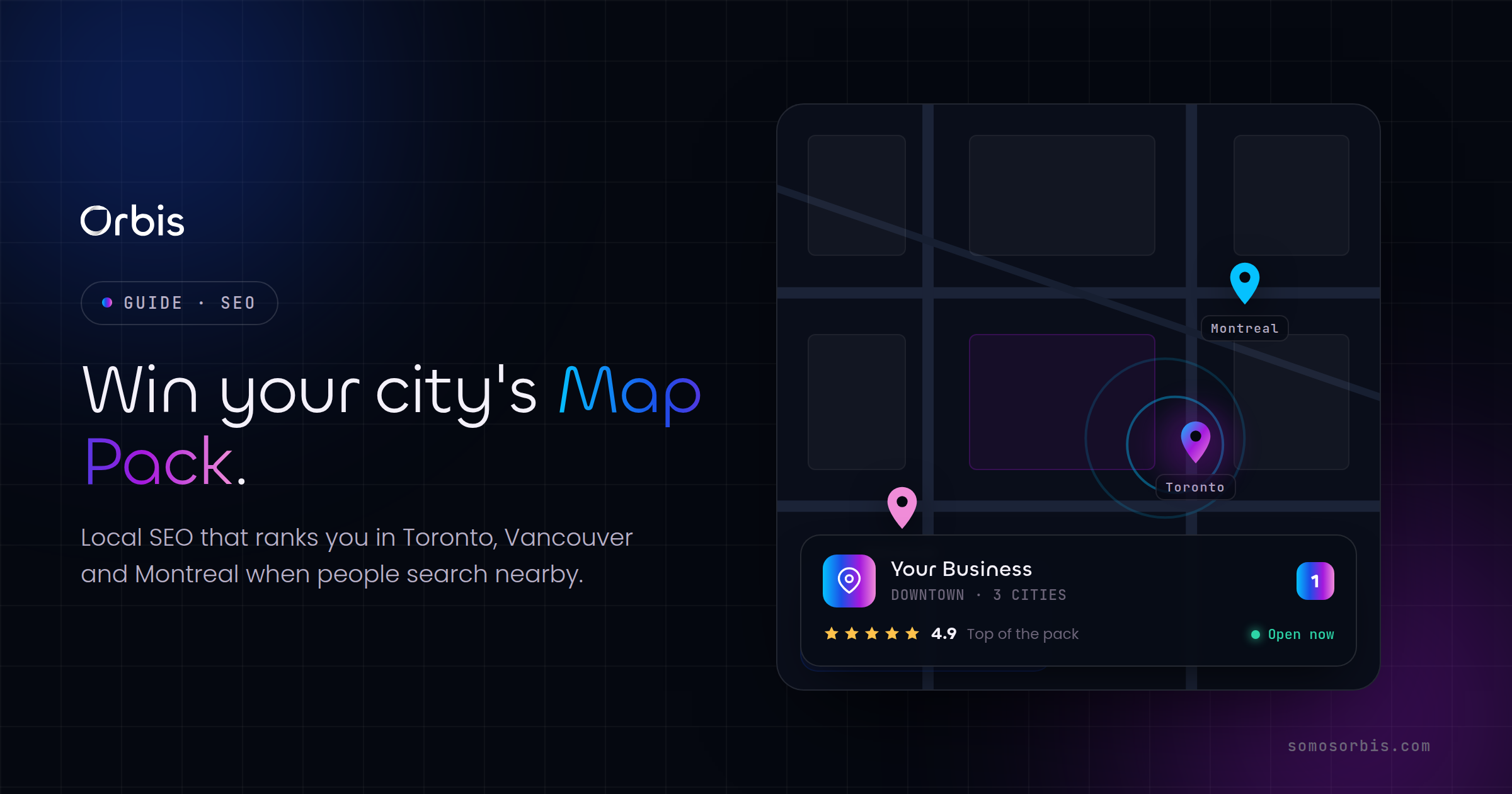
For any business that serves customers in physical places, including service-area businesses, local search is the highest-ROI starting point. Canadian local SEO is multi-city by nature, and each metro needs its own attention.
Google Business Profile is your anchor
Your Google Business Profile (formerly Google My Business) is the single most important local asset. For each location:
- Choose the most specific primary category, then add relevant secondary categories.
- Write a description in the language of that market; in Montreal, that often means French first.
- Keep NAP consistent everywhere it appears online, character for character.
- Add Canadian phone formatting, real photos, products or services, and current hours including holiday hours for Boxing Day and the long weekends.
- Earn and respond to reviews steadily. Reviews are both a ranking factor and a conversion driver, and responding in the reviewer's language matters in bilingual markets.
City pages done right, not done spammy
If you serve multiple cities, you need genuinely useful, distinct pages for each, not a template with the city name swapped in. A strong Toronto page references Toronto neighbourhoods, local context, local pricing, and local proof; the Vancouver page does the same for Vancouver. Thin doorway pages get filtered out. The full multi-city playbook, including how to structure these pages and avoid duplication penalties, is in our guide to local SEO for Toronto, Vancouver, and Montreal.
Local citations and directories
Get listed in Canadian directories and industry-specific platforms with consistent NAP data. Citations reinforce your location signals and feed both Google and the data aggregators that local search relies on. If managing this across multiple cities sounds like a full-time job, it largely is, which is why our local SEO service handles profile management, citation building, review strategy, and city-page architecture as one programme.
Bilingual SEO: Winning in English and French
This is where most foreign agencies fall down, and where a properly localized Canadian strategy pulls ahead. Doing French SEO well is not translation; it is parallel optimization.
Translation versus transcreation
Running your English pages through machine translation produces French that reads as foreign and ranks poorly. French Canadian searchers use different keywords, different phrasing, and culturally specific terms. You need keyword research conducted natively in French, then content written or adapted by people who write French Canadian fluently. The goal is a page that feels native to a Montrealer, not a page that feels translated.
hreflang: the technical backbone
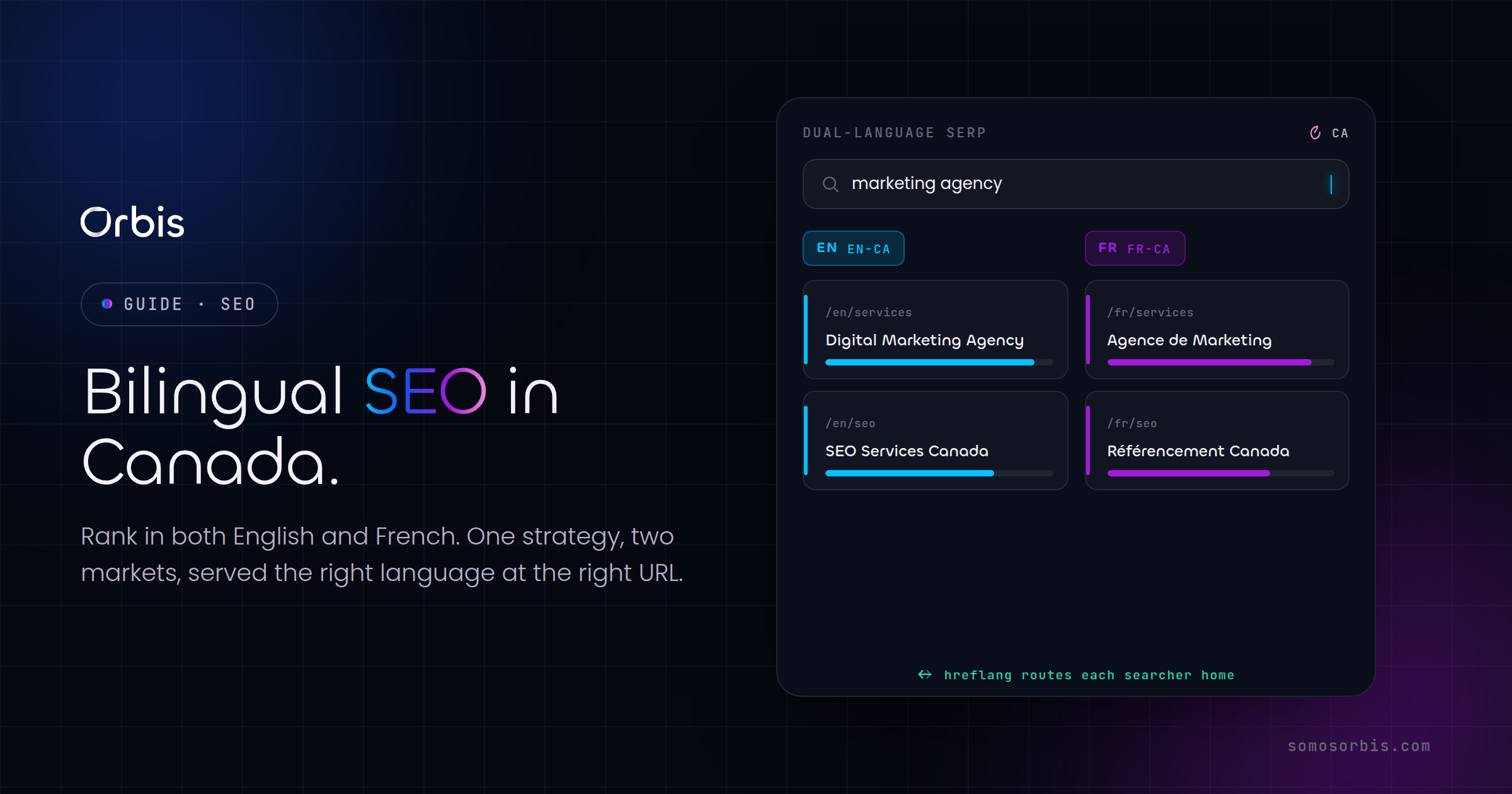
When you publish English and French versions of the same content, hreflang tags tell Google which version to serve to which audience. Get this wrong and Google may show French pages to English searchers, split your authority, or treat the versions as duplicates. Implement hreflang for en-CA and fr-CA consistently, with self-referencing and return tags, and keep your URL structure for languages clean (subdirectories like /fr/ are usually the most maintainable).
Quebec is its own market
Quebec has distinct search behaviour, distinct competition, and language expectations reinforced by provincial norms around French. Treating Quebec as a translated afterthought is a missed opportunity; treating it as a primary French market is a competitive advantage. Our complete walkthrough of keyword research, hreflang, transcreation, and Quebec strategy lives in the guide to bilingual SEO for English and French in Canada.
E-Commerce SEO for Canadian Stores
Online retail in Canada has its own ranking and conversion mechanics. Whether you are on Shopify or a custom platform, these are the levers that move organic revenue.
Product and category pages that rank
- Category pages are usually your biggest organic asset. Give each one unique intro copy, internal links, and clear structure. These often outrank individual product pages for high-volume terms.
- Product pages need unique descriptions (never the manufacturer's default copy),
Productschema with CAD pricing and availability, real reviews, and fast-loading images. - Faceted navigation (filters for size, colour, price) can generate thousands of crawlable URLs. Control it with canonical tags and crawl rules so you do not bury Google in near-duplicate pages.
Canadian commerce signals
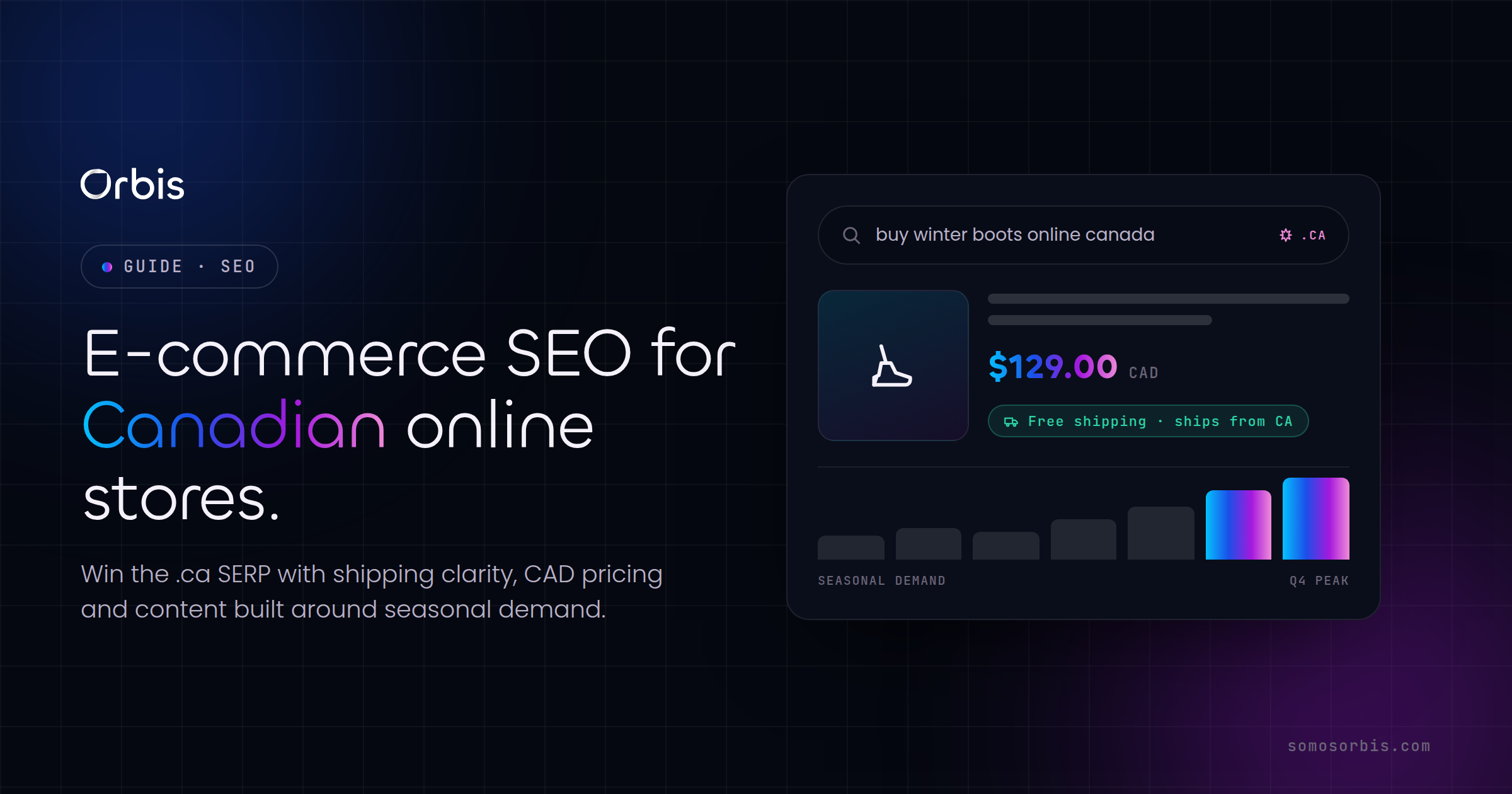
Show prices in CAD, state shipping to Canadian provinces clearly, surface duty and tax expectations, and align your merchandising and content with the Canadian calendar: Boxing Week, back-to-school, the winter holidays, and seasonal demand swings. A US-timed promotion calendar misses your actual peaks. The full e-commerce playbook, from Shopify technical setup to seasonal content, is in our guide to e-commerce SEO for Canadian stores.
B2B SEO and Lead Generation
B2B search in Canada is lower volume but extremely high value. A single ranking page can generate the kind of qualified leads that close into multi-year contracts. The strategy differs sharply from e-commerce.
Optimize for the buying committee, not just the buyer
B2B purchases involve researchers, users, and decision-makers, each searching different terms at different stages. Map content to that journey: educational top-of-funnel guides, comparison and solution pages mid-funnel, and bottom-of-funnel pages targeting high-intent terms like "[service] for [industry] in Canada." Bottom-of-funnel pages convert best even though they have modest volume.
Authority and proof
B2B buyers vet you before they ever fill out a form. Demonstrate expertise with substantive content, case studies, documented processes, and credible signals. This is exactly where Business Assurance matters: prospects want evidence that you operate with documented processes and compliance built in, not just promises. The complete B2B framework, including lead-capture and intent mapping, is in our guide to B2B SEO and lead generation in Canada.
Link Building for Canadian Websites
Links remain a core ranking signal, but the way you earn them in Canada has a local flavour. The objective is relevant, authoritative links from sites that reinforce both your topic and your Canadian footprint.
- Canadian publications and industry bodies carry geographic relevance that generic global links do not.
- Digital PR built around Canadian data, surveys, or commentary earns coverage and links from Canadian media.
- Local partnerships, sponsorships, and associations produce links that double as local citations.
- Resource and guest content on reputable Canadian sites in your sector builds topical authority.
Avoid link schemes and low-quality directories; they are a liability, not an asset. Quality and relevance beat volume every time. Our full link-building approach for Canadian sites, including outreach and digital PR tactics, is in the guide to link building for Canadian websites.
International SEO: Expanding from Canada into the US and Beyond
Many of our Canadian clients want to grow into the United States. Done carelessly, US expansion cannibalizes your Canadian rankings or confuses Google about which audience each page serves. Done well, it doubles your addressable market.
- Decide your structure early: separate ccTLDs, subdirectories, or subdomains for each country, each with trade-offs for authority and maintenance.
- Use hreflang for country and language combinations (
en-CA,en-US,fr-CA) so the right page reaches the right searcher. - Localize currency, spelling, and proof: US pages should show USD, US spelling, and US-relevant context, while Canadian pages stay Canadian.
- Protect your Canadian equity: do not let a US push dilute the local signals that win you Canadian rankings.
The detailed expansion roadmap, including structure decisions and how to avoid cannibalization, is in our guide to international SEO for expanding from Canada into the US.
AEO and AI Search: The New Answer Layer
Search is no longer only ten blue links. Google's AI Overviews, ChatGPT, Perplexity, Gemini, and Copilot increasingly answer questions directly, citing a handful of sources. If your content is not structured to be quoted by these systems, you become invisible in the answers your customers now read first. This shift is often called Answer Engine Optimization (AEO) or Generative Engine Optimization.
How to earn AI citations
- Answer questions directly and early. Lead with a clear, self-contained answer, then expand. AI engines extract concise, factual statements.
- Structure for extraction. Use clear headings, lists, definitions, and FAQ blocks. Clean structure helps both crawlers and language models lift your content accurately.
- Be demonstrably credible. AI systems favour sources with clear expertise, consistent information, and supporting structured data. The same Business Assurance signals that win B2B buyers also make you a trustworthy source for AI.
- Keep facts consistent across the web. Contradictory information about your business, hours, or offerings reduces the confidence an AI engine has in citing you.
This is a fast-moving field, and it rewards early movers in the comparatively less crowded Canadian market. Our deep dive on AEO and AI search in Canada covers the tactics in detail, and our AEO and AI SEO service builds answer-ready content and structured data so you show up where buyers now ask their questions.
Measuring What Matters
SEO without measurement is guesswork. Track the metrics that connect to revenue, not just vanity rankings.
- Organic visibility by market and language: rankings and impressions split by EN/FR and by city, so you see where you are winning and where you are not.
- Organic conversions and revenue: leads, sales, and pipeline attributed to organic search, in CAD.
- Local performance: Business Profile views, direction requests, and calls per location.
- Technical health: Core Web Vitals, indexation, and crawl errors over time.
- AI answer presence: whether you appear in AI Overviews and are cited by answer engines for your key questions.
Set up Google Search Console with separate property views where it helps, connect analytics with goal and revenue tracking, and review on a steady cadence. What gets measured gets improved.
A Practical 90-Day Starting Plan
- Days 1 to 30 — Foundations. Technical audit, fix crawl and speed issues, implement core schema with CAD pricing, set geotargeting, and clean up your Google Business Profiles with consistent NAP across cities.
- Days 31 to 60 — Content and local. Build out genuine city pages, publish high-intent service or category pages, start native French keyword research if Quebec is in scope, and implement hreflang for any bilingual pages.
- Days 61 to 90 — Authority and answers. Launch link-building and digital-PR outreach to Canadian sources, add FAQ and structured answer blocks for AEO, and establish your measurement dashboard split by language and city.
Related Guides in This Series
This pillar is the map; these are the deep dives. Read whichever matches your priorities:
- Local SEO for Toronto, Vancouver, and Montreal — multi-city local strategy, Business Profiles, and city pages.
- Bilingual SEO for English and French in Canada — transcreation, hreflang, and the Quebec market.
- E-commerce SEO for Canadian stores — product and category optimization, CAD signals, and seasonal demand.
- B2B SEO and lead generation in Canada — buying-committee content and high-intent pages.
- Link building for Canadian websites — digital PR, partnerships, and quality links.
- International SEO: expanding from Canada into the US — structure, hreflang, and protecting Canadian equity.
- AEO and AI search in Canada — getting cited by AI Overviews and answer engines.
Where Orbis Fits
SEO in Canada rewards businesses that respect the market: two languages, several cities, Canadian buyers, and a search landscape that now includes AI answers. The work is real, but the payoff is durable organic visibility that compounds while paid budgets keep resetting to zero.
Orbis builds and runs this entire programme for Canadian businesses as a documented, measurable revenue engine. As a Google Partner with a 4.9-star rating across 58 reviews, more than 500 clients served, and over 15 years of experience, we bring the structure and accountability of Business Assurance to every engagement. If you want a search strategy built for Canada from the ground up, explore our SEO services and let us turn organic search into a predictable channel for your business.