
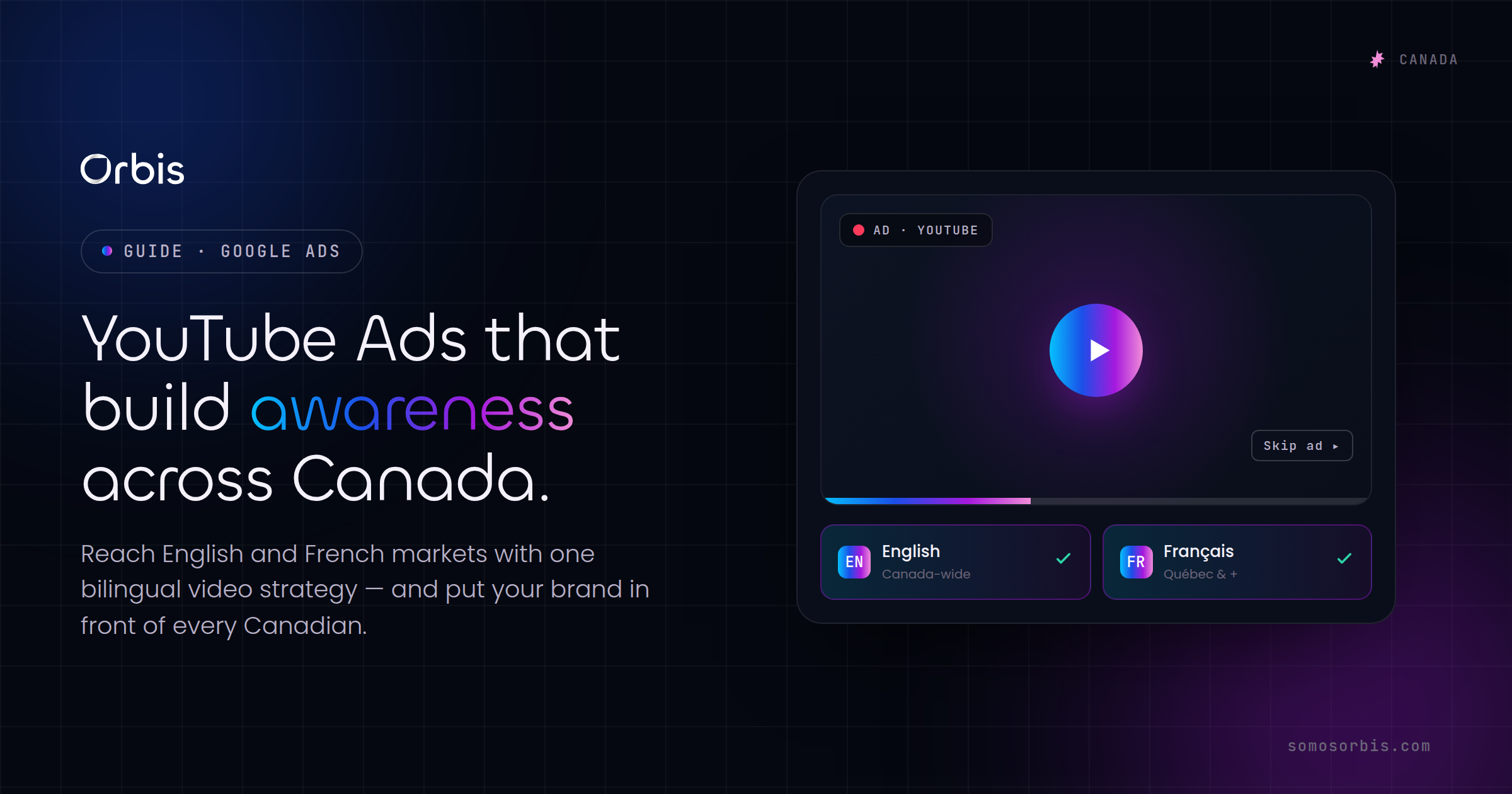
YouTube is one of the few places where a Canadian brand can reach a national audience at scale, in both official languages, with the kind of targeting precision that traditional TV never offered. Canadians are among the heaviest YouTube users in the world, and the platform sits at the intersection of broadcast reach and digital accountability. For brands that want to build awareness without lighting money on fire, that combination is hard to beat — but only if you plan the campaign around how Canadians actually watch, search, and switch between English and French.
This guide walks through how to structure YouTube awareness campaigns for the Canadian market: choosing the right ad formats, planning bilingual creative, building audiences that respect Canada's regional and linguistic mix, and — most importantly — measuring the brand lift you're paying for instead of guessing. If you're already running search and want the broader paid context, our complete guide to Google Ads in Canada is the pillar that ties the whole paid ecosystem together; this article is the YouTube-specific deep dive within it.
Why YouTube Works for Canadian Brand Awareness
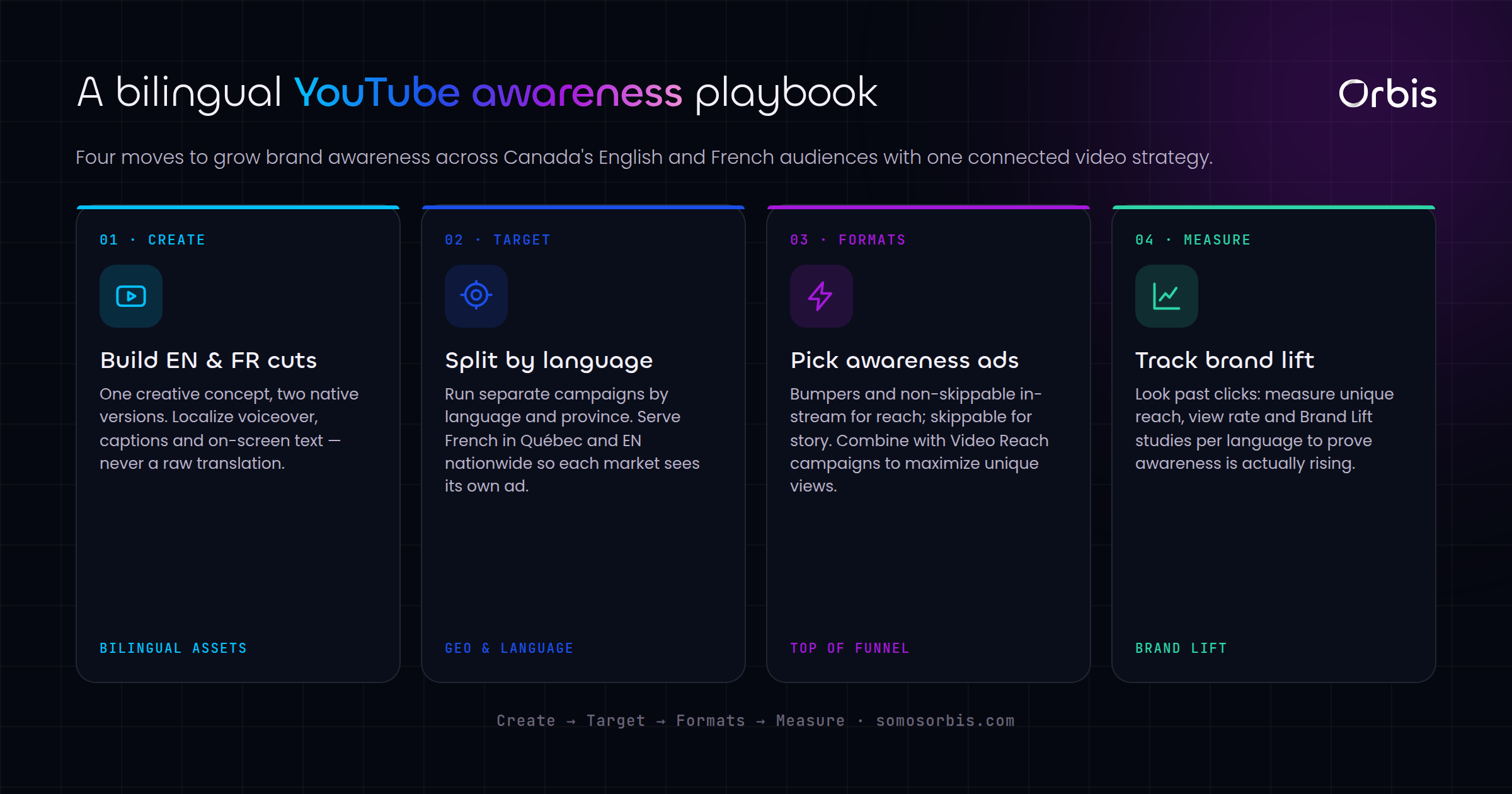
Awareness is the hardest objective to justify on a spreadsheet, because the payoff shows up weeks or months later as cheaper search clicks, higher branded query volume, and better conversion rates across every other channel. YouTube is built for exactly this stage of the funnel, and a few Canadian realities make it especially effective here:
- Reach that crosses the country. A single campaign can cover Toronto, Vancouver, Calgary, and Montreal without buying separate regional media. You set the geography; the auction does the rest.
- Bilingual delivery in one platform. You can serve French creative to French-preference viewers in Quebec and English creative everywhere else, managed from the same account, with the same reporting.
- Connected TV is now mainstream. A large and growing share of Canadian YouTube viewing happens on the living-room TV screen. That means your "digital" video buy is competing for the same attention as broadcast — at a fraction of the production and placement cost.
- Intent signals from Search. Because YouTube and Google share the same audience graph, you can build awareness against people who are already searching for your category, then retarget them later with display and remarketing.
The strategic point: YouTube awareness isn't a vanity exercise. Done correctly, it lowers the cost of every dollar you later spend on conversion campaigns. That's the lens to hold throughout.
Choosing the Right YouTube Ad Formats
Format choice is where most awareness budgets get wasted. Each format has a job, and matching the job to your objective is the single biggest lever you control.
Skippable in-stream ads
These run before or during other videos and let the viewer skip after five seconds. They're the workhorse of awareness because you generally pay only when someone watches a meaningful portion or interacts. For Canadian brands, this is usually where the bulk of the budget should sit: broad reach, efficient cost, and a built-in quality filter — if people skip, you didn't pay much, and you learned the creative needs work.
Non-skippable in-stream ads
Fifteen-second forced views guarantee the full message lands. Use these sparingly and only when you have a tight, genuinely good creative. They cost more per impression and can irritate viewers if the message is weak, so reserve them for high-stakes moments — a seasonal launch around Boxing Day, back-to-school, or the holidays — where completion matters more than raw efficiency.
Bumper ads
Six seconds, non-skippable, designed for frequency and recall. Bumpers are excellent for reinforcing a message after a longer skippable ad has introduced the brand. A common Canadian pattern: run a 15–30 second skippable spot to tell the story, then layer six-second bumpers to keep the brand top of mind through a campaign flight.
In-feed video ads
These appear in YouTube search results and alongside related videos, inviting a click rather than interrupting playback. They work well for considered purchases where people are actively researching — useful when your category has a strong "how-to" or comparison search behaviour.
Building Awareness in English and French Markets
The most common mistake Canadian advertisers make on YouTube is treating French as an afterthought — running English creative everywhere and slapping subtitles on it for Quebec. That approach underperforms because language preference in Canada is a cultural signal, not just a translation problem.
Here's how to do it properly:
- Produce, don't translate. Build French creative with French copywriters and, ideally, French voiceover talent. A direct translation of an English script almost always reads as stiff or slightly off to a native Quebec viewer. Adapt the message, the humour, and the cultural references, not just the words.
- Split campaigns by language preference. Use audience language settings alongside geography so French creative reaches French-preference viewers and English creative reaches everyone else. Don't rely on province alone — there are French speakers outside Quebec and English speakers inside it.
- Localize the offer, not only the language. Canadian seasonality and shopping moments matter in both markets. Boxing Day, back-to-school, and the holiday run-up land differently across regions, and your creative calendar should reflect that rather than importing a generic North American schedule.
- Keep CAD and Canadian context visible. Pricing, shipping, and availability should read as unmistakably Canadian. Nothing erodes trust faster than an ad that looks like it was built for another market and pointed at Canada.
When you run two genuinely native creative sets, you also get cleaner data: you can see which market responds to which message, and you can shift budget toward the audience that's actually moving.
Targeting Canadian Audiences That Matter
Awareness still needs guardrails. "Everyone in Canada" is rarely the right answer — it spends fast and teaches you little. Build your audiences in layers:
- Geography with intent. Start with your priority metros — Toronto, Vancouver, Montreal, Calgary — then expand once you see which regions respond. You can always broaden; it's harder to claw back wasted spend.
- In-market and affinity segments. Reach people whose behaviour signals they're in your category or share relevant interests. This keeps awareness pointed at viewers who can plausibly become customers.
- Custom segments from search behaviour. Build audiences around the terms and competitor names people are actually searching. This is where YouTube's connection to Google's search graph pays off.
- Your own data. Layer in site visitors and customer lists so you can either expand from your best customers or deliberately exclude existing ones from a pure-acquisition campaign.
Once a viewer has seen your video, they shouldn't disappear. The natural next step is to capture that warmed-up attention with display and remarketing — the mechanics of which we cover in our piece on Google Display and remarketing in Canada. Sequencing video awareness into remarketing is how you turn a brand impression into a measurable path to revenue.
Measuring Brand Lift, Not Just Views
View counts feel good and prove nothing. The whole point of an awareness campaign is to move how people think about your brand, so you have to measure the thinking — not the playback.
Brand Lift studies
Google's Brand Lift measurement compares people exposed to your ads against a control group and surveys the difference in ad recall, awareness, and consideration. For campaigns of meaningful size, this is the cleanest way to prove the work is changing perception. Set it up before the campaign launches so you're capturing the lift from day one rather than reconstructing it afterward.
Search-side signals
Watch for rising branded search volume and direct traffic during and after a flight. When awareness is working, more people start searching your name. That lift then makes your branded search campaigns cheaper and your generic search campaigns convert better — a compounding effect across the account.
Downstream efficiency
Track whether your conversion campaigns get more efficient after the awareness flight. Cheaper cost-per-acquisition on search, higher conversion rates on retargeting, and stronger assisted-conversion paths are all evidence the awareness layer is doing its job, even if the video itself rarely gets the "last click."
The honest standard for awareness measurement: did the people who saw your video behave differently afterward than the people who didn't? If you can't answer that, you're buying views, not building a brand.
A Practical 90-Day Plan
Here's a sequence that works for most Canadian brands stepping into YouTube awareness for the first time:
- Weeks 1–2 — Foundation. Define priority metros, build separate English and French creative, and set up Brand Lift measurement and conversion tracking before any spend goes live.
- Weeks 3–6 — Launch and learn. Run skippable in-stream as your core format across both language audiences. Keep budgets modest, watch view rates and skip behaviour, and kill weak creative early.
- Weeks 7–10 — Reinforce. Layer in bumper ads for frequency against the audiences that engaged, and begin remarketing to viewers who watched a meaningful share of your video.
- Weeks 11–13 — Read the lift. Review Brand Lift results, branded search trends, and downstream conversion efficiency. Double down on the language market and creative that moved the numbers.
This cadence keeps you from over-committing before you have evidence, and it builds a remarketing pool you can monetize even while the awareness story is still developing.
How YouTube Fits Your Wider Paid Mix
YouTube rarely works best in isolation. It earns its keep as the top of a connected system: video builds awareness, display and remarketing keep the brand present, and search captures the demand you created. If your category also has strong search behaviour on other engines, it's worth extending coverage there too — our look at Microsoft Ads and Bing in Canada shows where that incremental reach can be found, particularly among older and desktop-heavy Canadian audiences.
The thread running through all of this is documented, repeatable process. Awareness campaigns fail when they're run on instinct and reported on vanity metrics. They succeed when every flight has a defined audience, native bilingual creative, lift measurement set up in advance, and a clear handoff into conversion campaigns. That discipline — built once and applied consistently — is what turns YouTube from an expensive brand exercise into a predictable engine for demand.
Ready to Build Brand Awareness That Pays Off?
Reaching Canada's English and French markets on YouTube takes more than a good video — it takes the right formats, genuinely native bilingual creative, audience structure that respects how Canadians watch, and measurement that proves the lift. As a Google Partner with more than 15 years of experience and 500-plus clients, our team plans and runs Google and YouTube advertising campaigns for the Canadian market built on documented processes and measurable results, not guesswork. If you want a YouTube awareness program that makes the rest of your paid media cheaper and more effective, let's talk.