
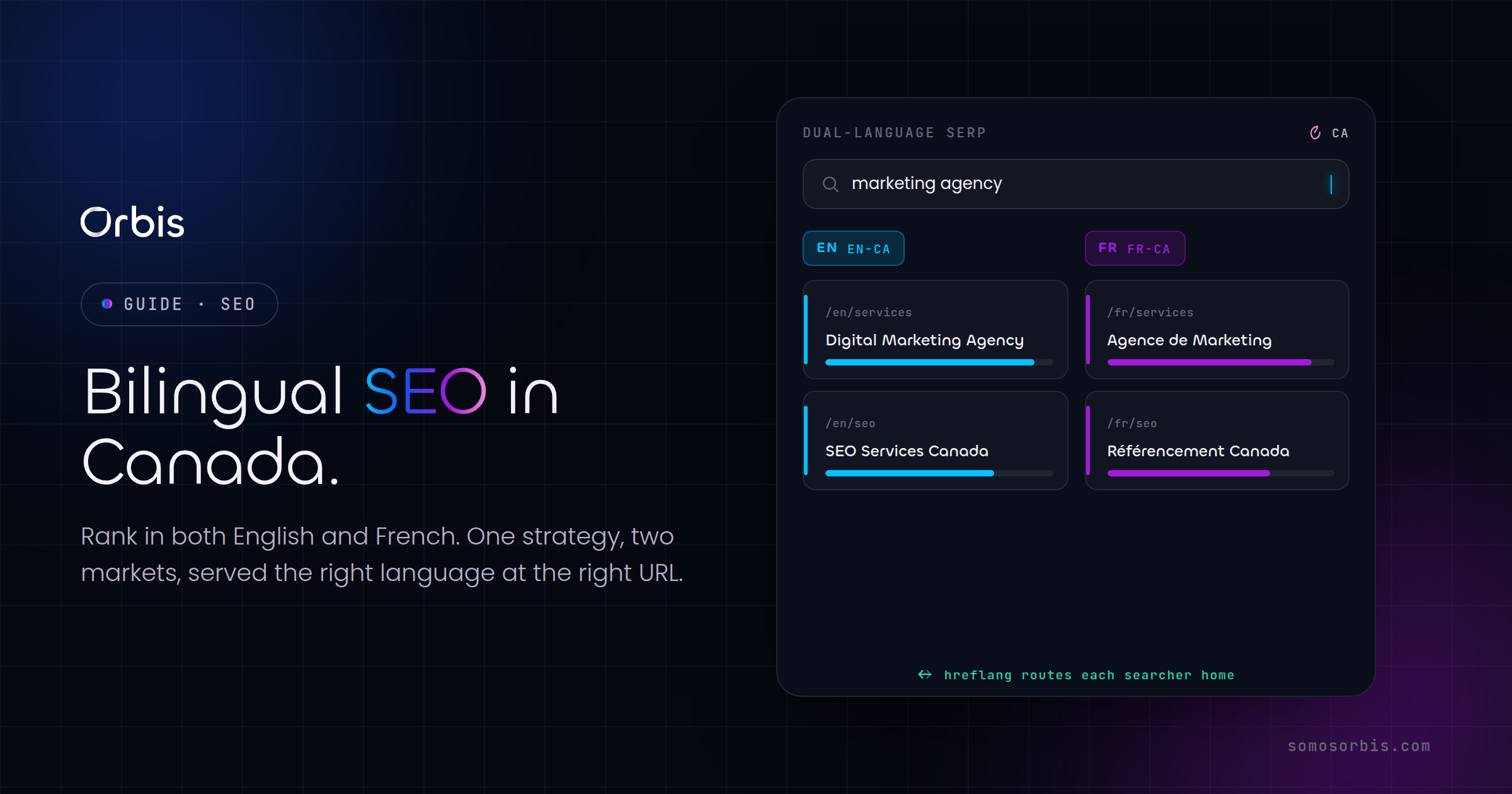
Canada is officially bilingual, and so is its search market. If you sell across the country, "ranking in Canada" really means ranking twice: once for English searchers in Toronto, Vancouver, Calgary and the Maritimes, and once for French searchers in Quebec, parts of New Brunswick and francophone pockets nationwide. Google treats those as different audiences with different queries, different intent and different competitors. Get the bilingual structure right and you double your organic footprint. Get it wrong and you split authority, confuse crawlers, and watch your French pages never surface for the people who would actually convert.
This guide walks through the practical architecture of bilingual SEO in Canada: how to structure URLs, implement hreflang correctly, translate content for search (not just for accuracy), and earn rankings in both Quebec and the rest of the country. It is a companion to our complete guide to SEO in Canada, which covers the broader fundamentals every Canadian site needs before layering bilingualism on top.
Why bilingual SEO is its own discipline in Canada
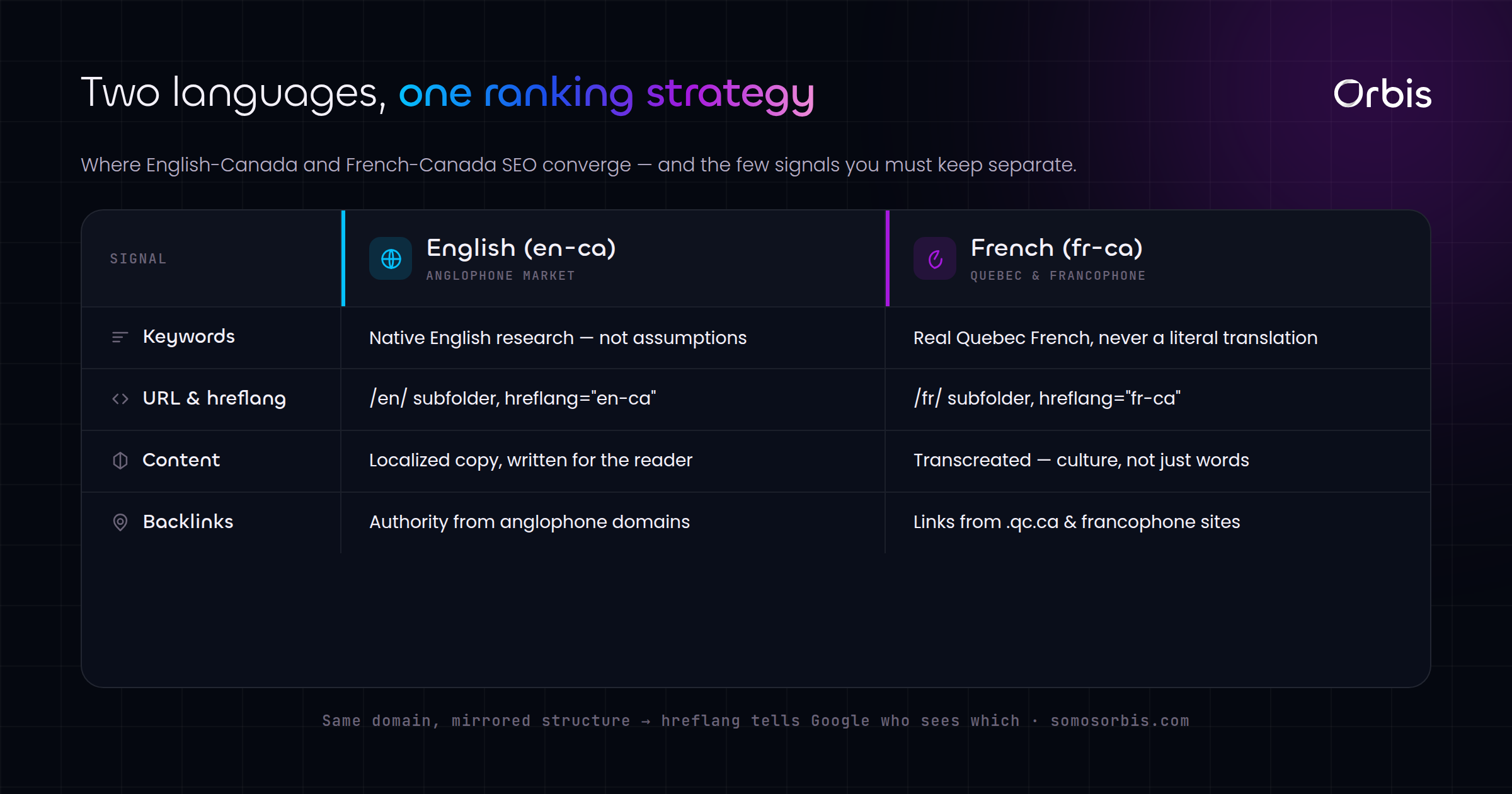
A lot of teams treat French as an afterthought: translate the English site, drop it in a folder, move on. That approach quietly costs you rankings for three reasons.
- Quebec French is not France French. Search behaviour, vocabulary and spelling differ. A Montrealer searches "magasiner" where a Parisian searches "faire du shopping." Optimizing for the wrong variant means optimizing for queries nobody in your market types.
- The competitive set is different per language. The companies you compete with for an English keyword in Toronto are rarely the same ones ranking for the French equivalent in Quebec City. Your keyword research has to be run twice, natively, in each language.
- Quebec has its own legal and cultural expectations. The Charter of the French Language (commonly known by its bill number) means French-first or French-equal presentation is expected for business in Quebec. Search aside, a French page that reads like a machine translation erodes trust with exactly the customers you want.
Bilingual SEO sits at the intersection of technical setup and genuine localization. It overlaps heavily with international SEO when you expand from Canada into the US, because both rely on the same hreflang machinery. The difference is that bilingual targeting happens inside one country, which makes the geo-targeting signals subtler and the content nuances sharper.
Choosing your URL structure for two languages
Before you write a single line of hreflang, decide how the two language versions live on your site. You have three realistic options, and for a single Canadian business one of them is almost always correct.
Option 1: Subdirectories (recommended)
Serve English from /en/ and French from /fr/ on the same domain, for example yourbrand.ca/en/services/ and yourbrand.ca/fr/services/. This is the right default for the vast majority of Canadian businesses because:
- All your link authority consolidates on one domain instead of being split across separate sites.
- Setup, hosting and maintenance stay simple, and analytics live in one place.
- Google handles language folders cleanly when paired with correct hreflang tags.
Option 2: Subdomains
Using en.yourbrand.ca and fr.yourbrand.ca works technically, but it makes authority-sharing fuzzier and adds operational overhead. Choose it only if your English and French operations are genuinely run as separate units with separate teams and infrastructure.
Option 3: Separate ccTLDs
Running yourbrand.ca for English and a different domain for French is the heaviest option and rarely makes sense within a single country. Reserve country-code domains for true cross-border expansion, not for English-versus-French inside Canada.
Rule of thumb: one Canadian brand, one .ca domain, two language subdirectories. It is the cleanest path to ranking in both languages without diluting your authority.
Implementing hreflang correctly
Hreflang is the signal that tells Google "this page has an equivalent in another language; serve the right one to the right searcher." Done correctly, it prevents your English page from cannibalizing your French page and ensures a Quebec searcher lands on the French URL. Done incorrectly, it is silently ignored. Most hreflang problems come from a handful of avoidable mistakes.
Use the right language and region codes
For a Canada-only bilingual site, target language with optional region:
en-CAfor Canadian Englishfr-CAfor Canadian Frenchx-defaultfor a fallback (often a language-selector page or your primary English version)
Using fr-CA rather than a bare fr matters: it signals Canadian French specifically, helping you avoid being lumped in with France-targeted results and reinforcing relevance for Quebec searchers.
Make hreflang reciprocal and self-referencing
Every page in the set must point to every other version, including itself. If your English page references the French version, the French version must reference the English version back. Missing return tags are the single most common reason hreflang gets ignored. A correct pairing looks like this on both URLs:
<link rel="alternate" hreflang="en-CA" href="https://yourbrand.ca/en/services/" /><link rel="alternate" hreflang="fr-CA" href="https://yourbrand.ca/fr/services/" /><link rel="alternate" hreflang="x-default" href="https://yourbrand.ca/en/services/" />
Map equivalents page-by-page, not site-wide
Hreflang connects specific equivalent pages. Your French services page points to your English services page, not to the English homepage. If a French equivalent does not exist yet, do not point it at an unrelated page or a generic fallback that frustrates the user. Either create the equivalent or leave that page out of the hreflang set until it exists.
Always use absolute URLs and consistent canonicals
Hreflang URLs must be fully qualified, including protocol and domain. Each language version should canonicalize to itself, never cross-canonical the English page to the French one or vice versa. A self-canonical plus correct hreflang is the combination that keeps both versions indexable.
Translating content for search, not just for meaning
Accurate translation and search-optimized translation are different jobs. A French page can be grammatically perfect and still rank for nothing because it targets vocabulary real Quebec searchers never use. This is where most bilingual SEO projects quietly fail.
Run keyword research natively in each language
Do not translate your English keyword list into French and assume the volumes carry over. Build the French list from scratch using Quebec-specific data. The intent, the phrasing and even the search volume distribution can be completely different. Watch for:
- Quebec-specific terminology. Local usage often differs from European French, and Quebec searchers expect their own vocabulary.
- Anglicisms that locals actually search. In some industries Quebec users search a borrowed English term even when a "proper" French word exists. Rank for what people type, not what a style guide prefers.
- Different long-tail patterns. Question phrasing and modifiers vary between the two languages, so your FAQ and supporting content should be built per language.
Localize, do not just translate
Adapt examples, currency, seasonality and references to each audience. Mention CAD pricing, reference Canadian seasonality (Boxing Day, back-to-school, the holiday run) and use city and region names your readers recognize. A French page that references francophone realities will out-convert a literal translation every time.
Translate metadata and structured data too
Title tags, meta descriptions, image alt text, schema markup and breadcrumb labels all need their language-appropriate version. A French page with an English title tag sends a mixed signal and looks careless in the SERP. Keep structured data consistent across both versions so each language earns its own rich-result eligibility.
Where bilingual meets local: Quebec versus the rest of Canada
Language targeting and geographic targeting reinforce each other. Most of your French searchers cluster in Quebec, while your English demand spreads across Ontario, BC, Alberta and beyond. That means your bilingual strategy should ride alongside a solid local SEO approach across Toronto, Vancouver and Montreal.
- French + Montreal/Quebec City local signals. Pair your French pages with French-language Google Business Profiles, local citations and city-specific landing pages for the Quebec market.
- English + multi-city coverage. Your English pages should target the major English-speaking metros where your demand actually lives, with location pages that speak to each market.
- Bilingual entities. If you serve customers in both languages from the same physical location, present both languages on-site and make the language switch obvious and crawlable (a real link, not a JavaScript-only toggle).
The payoff is compounding: a French page that is both correctly hreflang-tagged and locally optimized for Quebec will outrank a competitor who has only done one of the two.
Technical checklist before you launch
Run through this list before pushing a bilingual site live. Each item maps to a common failure mode we see on Canadian sites.
- Language switcher is a real, crawlable link that takes users to the equivalent page in the other language, not back to the homepage.
- Hreflang is reciprocal and self-referencing across every page in each set, with
en-CA,fr-CAandx-default. - Each language version self-canonicals and is independently indexable.
- No automatic redirects based on browser language that trap users or block Googlebot from crawling the other version. Offer the choice; do not force it.
- Sitemaps include both language versions, ideally with hreflang annotations in the XML sitemap.
- Metadata, alt text and schema are fully translated on every French page.
- Internal links stay within-language so English pages link to English pages and French pages link to French pages, keeping each language graph coherent.
Measuring success in two languages
Track each language separately or you will misread your own results. In Google Search Console, filter performance by the /en/ and /fr/ directories to see impressions, clicks and average position per language. Watch for the telltale signs of a broken setup: French pages getting impressions on English queries, or the wrong language version surfacing in a given region. Segment your analytics by language path too, so you can compare conversion behaviour and spot where one language is underperforming and needs more content or stronger links.
Over time, you should see two distinct ranking profiles forming, one per language, each with its own keyword universe and its own growth curve. That separation is the sign your bilingual architecture is working as intended.
Ranking in both languages, done right
Bilingual SEO in Canada is not about translating a site and hoping. It is about deliberate URL structure, airtight hreflang, native keyword research in each language, and local signals that match where your French and English audiences actually live. Do all four and you stop competing with yourself and start owning both halves of the Canadian search market.
This is precisely the kind of structural, multi-language work our team handles through our international SEO services, where we build the hreflang architecture, run native keyword research in English and French, and align your technical setup with the realities of ranking across Quebec and the rest of Canada. If you want a search presence that performs in both official languages, that is where to start.