
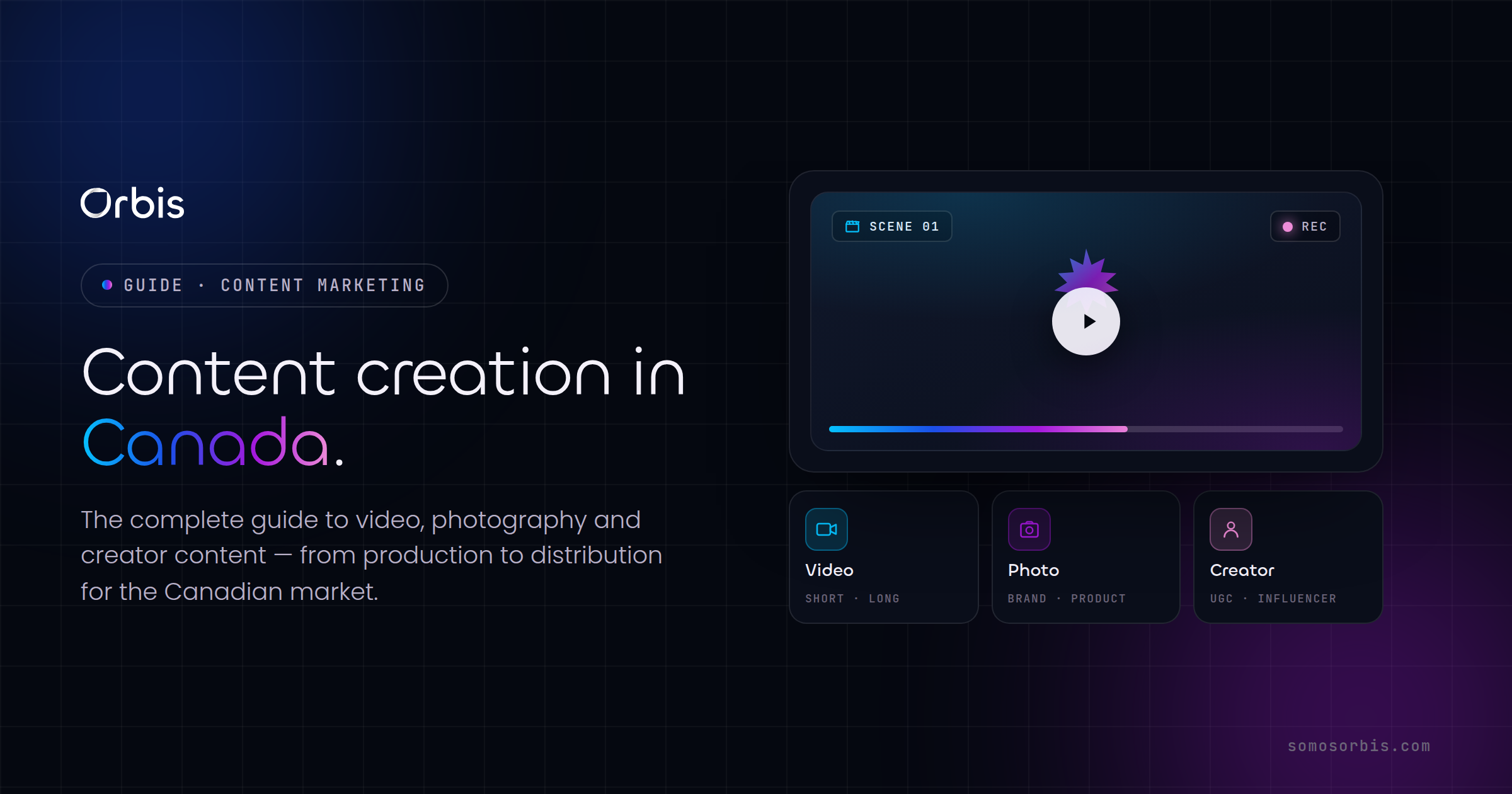
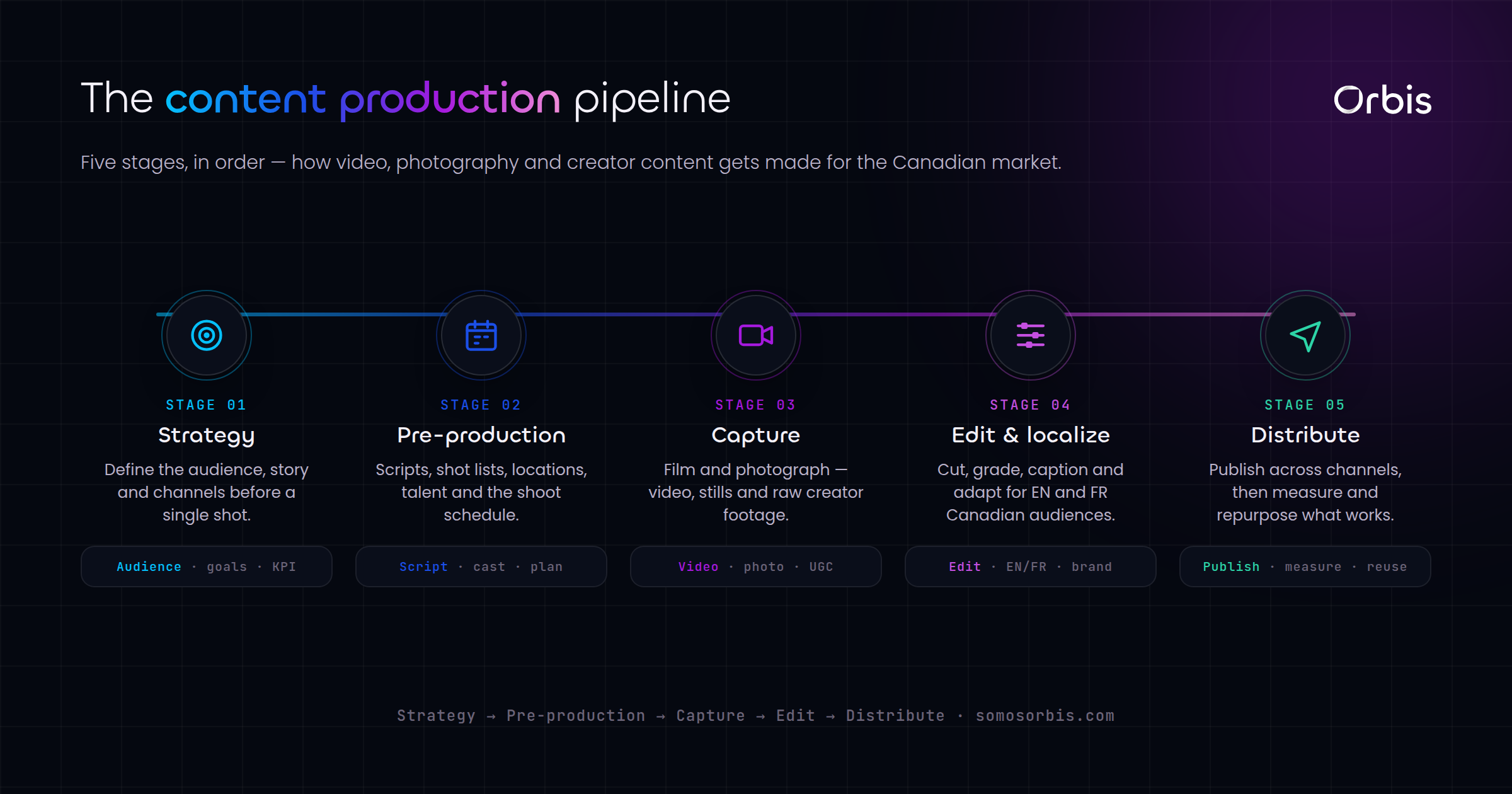
Content has quietly become the most demanding part of a Canadian marketing budget. A decade ago, a brand could win attention with a single well-produced TV spot and a handful of stock photos. Today, that same brand needs vertical video for Reels and TikTok, polished product photography for its Shopify store and Amazon.ca listings, creator partnerships that feel native to each platform, user-generated content that earns trust, and increasingly, aerial footage that gives a sense of place. It needs all of it in English and, depending on the market, in French. And it needs it on a publishing cadence that never really stops. This guide is a practical, end-to-end look at how Canadian brands actually plan, produce, and distribute content across video, photography, influencer, UGC, and drone formats — and how to do it without burning the budget or the team.
We have spent more than fifteen years producing content for Canadian and international brands, and the throughline is always the same: content that performs is content that was built with a clear job to do, for a specific channel, with the right production discipline behind it. The sections below break down each format, the Canadian-market considerations that change how you approach it, and the systems that let you scale without sacrificing quality. If you would rather hand the whole thing to a team that does this every day, our content creation services for Canadian brands cover the full pipeline from strategy to delivery.
Why content creation is different in the Canadian market
Canada is not a smaller version of the United States, and content that simply ports south-of-the-border campaigns rarely lands. There are structural realities that shape every brief, and ignoring them is the fastest way to produce content that feels off to the audience you are trying to reach.
Bilingual by default, not as an afterthought
Roughly a fifth of Canadians speak French as a first language, and in Quebec, French is not a translation layer — it is the primary market. Producing a campaign in English and then running it through a translation tool for the Quebec rollout almost always shows. Idioms break, cultural references miss, and the casting or on-screen talent may not reflect the audience. The brands that win in both markets plan bilingual production from the storyboard stage: scripts written natively in each language, talent cast for each market, and edits that account for different copy lengths. We go deep on this in our guide to bilingual content creation for the English and French Canadian markets, but the headline is simple — budget for two creative tracks, not one plus a translation.
A genuinely seasonal calendar
Canadian retail and consumer behaviour follows a distinct seasonal rhythm. Back-to-school ramps in August. The Q4 stretch runs from Black Friday through Boxing Day and the post-holiday clearance — and Boxing Day still carries real weight in Canada in a way it does not in the US. Winter is long, which makes indoor lifestyle content and cold-weather product demos relevant for months. Cottage season, patio season, and the short but intense summer all create their own content windows. Smart brands build a content calendar around these moments and shoot for them well in advance. You cannot capture authentic snow-on-the-ground footage in July, and you cannot fake a Canadian winter convincingly.
Climate and geography that affect production logistics
Weather is a production variable in Canada in a way it rarely is elsewhere. Outdoor shoots in Toronto, Montreal, Calgary, or Vancouver need weather contingency days built into the schedule. Drone work is governed by wind and temperature limits as well as airspace rules. Winter shoots require gear that handles the cold and crews who know how to work in it. Distances between major markets are vast, so a national campaign often means either multiple regional shoots or a centralized production with strong remote coordination. None of this is a reason to lower ambition — it is a reason to plan with documented timelines and contingency built in.
Video production: the highest-leverage format
If you can only invest deeply in one format, video is usually it. It is the format that performs across the most channels — paid social, organic social, YouTube, connected TV, your website, email, and sales decks — and a single well-planned shoot day can generate dozens of deliverables when you approach it as a system rather than a one-off. Our full breakdown of video production for Canadian brands covers the service side, and the post on how Canadian brands plan and produce video that performs goes deeper on strategy. Here is the practical framework.
Plan for the channel before you plan the shoot
The single biggest mistake we see is shooting first and figuring out distribution later. A 16:9 hero film does not crop cleanly to a 9:16 Reel, and a talking-head explainer built for YouTube falls flat as a six-second bumper. Before the camera comes out, decide which channels matter and what each one needs:
- Vertical 9:16 for TikTok, Instagram Reels, and YouTube Shorts — the fastest-growing surface for most Canadian brands, and the one that rewards native, lower-polish energy.
- Square 1:1 and 4:5 for in-feed social, where vertical real estate is at a premium.
- Horizontal 16:9 for YouTube, connected TV, website hero video, and longer-form storytelling.
- Short cutdowns — six, fifteen, and thirty seconds — for paid media, each with the hook front-loaded in the first two seconds.
When you frame and shoot with all of these in mind — protecting the safe zones, capturing extra headroom, and recording clean audio for every setup — one production day can feed a quarter of content.
The production tiers Canadian brands actually use
Not every video needs a full crew. Matching production value to the job is how you keep quality high and cost sane:
- Flagship brand films — full crew, professional lighting, talent, and a director. Reserved for your hero brand story, a major launch, or a campaign anchor. Shoot once a year, maybe twice.
- Product and explainer video — a smaller crew or studio setup, focused on clarity. These do the heavy lifting on product pages, in onboarding, and across YouTube.
- Social-native content — agile, fast-turnaround production designed to look at home on the platform. This is the volume layer, and it is where consistency beats polish.
- Repurposed and cutdown assets — derived from the above, edited for specific placements. The cheapest content you will ever make because the footage already exists.
Post-production is where the value compounds
A great edit can turn one shoot into months of content. Captions are non-negotiable — most social video is watched without sound, and in Canada you will often want both English and French caption tracks. Colour grading and sound design separate professional content from amateur footage. And building a clear naming and storage system for your raw footage means you can come back six months later and cut new variations without reshooting. Treat your footage library as an asset, not a byproduct.
Commercial photography: still the workhorse of conversion
Video gets the attention, but photography still does an enormous amount of the conversion work — especially in e-commerce. Product imagery is the single biggest driver of purchase confidence on a Shopify store, an Amazon.ca listing, or a Walmart.ca product page. Our guide to commercial photography for Canadian brands covers this in depth, and the essentials are worth restating here.
The photography types every brand needs
- Studio product photography — clean, consistent, well-lit shots on white or controlled backgrounds. These are your listing images and the baseline of trust for any online store.
- Lifestyle and in-context photography — your product in use, in a real setting, with real people. This is what makes a product feel desirable rather than just available, and it is where Canadian context matters: a parka shot in a genuine Canadian winter reads completely differently from one shot in a studio.
- Brand and team photography — for your About page, careers content, and PR. Authentic team imagery builds credibility, particularly for B2B and service brands.
- Detail and texture shots — close-ups that communicate material quality, finish, and craftsmanship. Often the difference between a premium and a budget perception.
Shoot for reuse, plan for the grid
The most efficient brands plan photography shoots the same way they plan video — for multiple outputs. A single product styled in three settings, shot from the angles each channel needs, with both cropped-tight and negative-space variations, can supply your website, your ad creative, your social grid, and your email program for a season. Maintaining a consistent visual style across all of it is what makes a brand feel coherent, and that consistency is far easier to achieve when one team holds the look and the shot list across the year.
Influencer and creator marketing in Canada
Creator partnerships have matured from a novelty into a core channel. Canadian audiences are sophisticated and quick to spot inauthentic endorsements, so the bar for doing this well is high. Our full guide to influencer marketing in Canada covers selection, briefing, and measurement, and there are a few Canadian-specific points that matter most.
Disclosure is not optional
Canada's Competition Bureau has been clear and increasingly active on influencer disclosure. Paid partnerships, gifted product, and any material connection between a brand and a creator must be disclosed clearly and prominently — not buried in a hashtag at the end of a caption. Building disclosure into your creator briefs is both a compliance requirement and, in our experience, a trust builder. Audiences respond better to transparent partnerships than to ones that feel like they are hiding something. This is exactly the kind of compliance-by-design thinking that should sit inside your content process from the start, not get bolted on after a campaign launches.
Match the creator tier to the goal
- Nano and micro creators (1K–100K followers) tend to have the highest engagement and the strongest niche trust. For most Canadian SMBs, a portfolio of micro creators outperforms a single big name.
- Mid-tier creators (100K–500K) balance reach and authenticity, and are often the sweet spot for regional or category-specific campaigns.
- Macro and celebrity creators deliver reach and brand-safety scale but at a premium, and they work best for awareness moments rather than performance.
Regional and bilingual creator strategy
A creator with a large following in Toronto may have almost no relevance in Quebec, and vice versa. National creator campaigns in Canada usually mean building a roster that covers the English market and a separate, natively French roster for Quebec — creators who speak the language and the culture, not English-market creators captioned in French. The same logic applies to regional campaigns: a Vancouver outdoor brand and a Montreal food brand need different creator ecosystems.
User-generated content: the trust multiplier
UGC sits at the intersection of authenticity and efficiency, and it has become one of the most reliable performers in paid social. Content that looks like it came from a real customer — handheld, unpolished, honest — consistently outperforms glossy brand-produced ads on platforms like TikTok and Instagram. Our UGC content production service exists precisely because demand for this format has exploded, and the post on UGC content for Canadian brands covers the playbook in detail.
The two kinds of UGC, and why the distinction matters
There is organic UGC — content your actual customers create and post on their own — and there is creator-produced UGC, where you commission creators to make content in the UGC style that you own and can run as paid ads. Both have a place:
- Organic UGC is the most credible because it is genuinely unsolicited, but you cannot control volume or quality, and you need rights before you reuse it.
- Commissioned UGC gives you reliable volume, clear usage rights, and creative direction while preserving the authentic feel — which is why it has become a staple of performance marketing.
Building a UGC engine
The brands that win with UGC treat it as a system, not a campaign. That means making it easy for customers to create and share content, securing usage rights properly up front, and feeding a steady stream of fresh UGC into your paid social so creative fatigue never sets in. For Canadian brands running bilingual programs, it also means commissioning UGC in both English and French rather than relying on one and subtitling the other. A documented rights-and-approval process keeps you compliant and lets you move fast — the same Business Assurance discipline that protects you everywhere else in the content pipeline.
Drone and aerial content: scale, place, and production value
Aerial footage has gone from a luxury to an accessible, high-impact tool. For real estate, tourism, construction, agriculture, events, and any brand whose story is tied to a place, drone content delivers scale and a sense of context that nothing else can. Canada's landscapes — coastlines, mountains, lakes, and cities — are a genuine asset here. Our guide to drone video for Canadian brands covers the creative and regulatory side, and the regulatory side is the part you cannot skip.
Fly legally, or do not fly
Drone operation in Canada is regulated by Transport Canada, and commercial work requires the appropriate pilot certificate, a registered aircraft, and adherence to airspace rules. Flying near airports, in controlled airspace, or over crowds without authorization is not a grey area — it carries real penalties and real safety risk. Any reputable production partner will hold the proper certification and handle the airspace permissions as part of the job. If a vendor is vague about this, that is your signal to walk. Compliance here is not bureaucracy; it is what keeps your brand off the wrong side of a news story.
Where drone content earns its keep
- Real estate and development — establishing shots, property context, and progress documentation.
- Tourism and hospitality — the single most effective way to sell a destination.
- Brand films — aerial openers and transitions that instantly raise perceived production value.
- Events and venues — scale shots that ground footage make impossible.
As with photography, the seasonal point applies sharply: aerial footage of a snow-covered landscape, fall colours, or a green summer coastline can only be captured in its window. Plan your drone shoots around the look you need, not around when the budget happens to clear.
Building a content system, not a pile of one-offs
The brands that produce great content sustainably are not the ones with the biggest budgets — they are the ones with the best systems. A content system turns every shoot into multiple assets, keeps quality consistent across formats and languages, and removes the scramble that comes with producing everything reactively.
The content pillar approach
Rather than briefing content piece by piece, organize production around a small set of recurring content pillars — the themes your brand owns. For each pillar, plan a production batch that yields a flagship asset plus the cutdowns, photography, and UGC variations that flow from it. This is the difference between commissioning twelve separate videos a year and running four efficient shoots that each produce a month of content.
One production calendar, planned in advance
Map your content calendar against the Canadian seasonal moments that matter to your category — back-to-school, the Black Friday through Boxing Day stretch, the summer windows — and shoot for them well ahead of time. Seasonal content produced in its proper season looks right; seasonal content faked at the last minute looks faked. A documented calendar also lets you coordinate bilingual production, talent, and locations efficiently rather than chasing each deadline.
Process, rights, and consistency: the Business Assurance layer
The unglamorous parts of content production are what let it scale: documented production processes so quality does not depend on one person, clear usage rights and disclosure on every creator and UGC asset so you stay compliant with current regulations, and a consistent visual and verbal identity across every format and both languages. This is what we mean by Business Assurance applied to content — documented processes, content built to drive revenue rather than just fill a feed, and compliance handled by design rather than as an afterthought. It is the difference between a content operation that grows with you and one that breaks the moment you try to scale it.
Related guides
This pillar gives you the map. Each of the guides below goes deeper on a single format with Canadian examples and a practical playbook:
- Video production for Canadian brands — planning, shooting, and editing video that performs across channels.
- Commercial photography in Canada — studio, lifestyle, and brand imagery that converts.
- Influencer marketing in Canada — creator selection, disclosure, and measurement.
- UGC content for Canadian brands — building an authentic, compliant UGC engine.
- Drone video in Canada — aerial content and Transport Canada compliance.
- Bilingual content creation — producing natively for English and French Canada.
Measuring whether your content is actually working
A content system is only worth running if you can tell what is paying off. The mistake here is measuring everything by vanity reach. Tie each format to the job it was hired to do: brand films and aerial content to awareness and watch-time, product photography and explainer video to on-page conversion rate, UGC and creator content to paid-social cost per acquisition and creative win rate. Run new creative against your current best performers rather than against a blank slate, and retire assets when their performance decays instead of running them until they are invisible. For bilingual programs, measure the English and French markets separately — blended numbers hide the fact that one market may be carrying the other, and the fix is almost always more native production in the underperforming language, not more translation.
In-house, agency, or hybrid
Most Canadian brands land on a hybrid model, and it is usually the right call. Keep the high-frequency, low-complexity work — quick social cutdowns, community management content, simple product shots — close to the brand, often in-house, because speed and brand familiarity matter more than polish there. Bring in a production partner for the work that benefits from craft, crew, equipment, and process: flagship video, full photography shoots, creator program management, and anything involving drones or bilingual coordination at scale. The partner also carries the parts that are genuinely risky to improvise — disclosure compliance, usage rights, airspace authorization — so your team is not exposed when a campaign scales. The goal is not to outsource everything or to build a studio; it is to put each piece of work where it will be done well, repeatably, and within current regulations.
Where to start
If you are early, do not try to do everything at once. Pick the format that maps to your most important business goal — usually video for awareness and consideration, photography for e-commerce conversion, or UGC for paid social efficiency — and build a repeatable system there first. Get the production discipline, the rights process, and the bilingual workflow right on one format, then extend the same system to the next. That is how a content operation compounds instead of collapsing under its own weight.
If you would rather move faster with a team that has produced content for Canadian brands for over fifteen years, that is exactly what we do. Explore our content creation services to see how we plan, produce, and deliver video, photography, influencer, UGC, and drone content as one coordinated, bilingual system — built to perform across every channel your audience actually uses. Reach out and we will help you map a content plan that fits your market, your calendar, and your budget.