
For Canadian brands, video has stopped being a "nice to have" and become the format that decides whether your message lands. The catch is that one polished sixty-second film no longer cuts it. A YouTube pre-roll, an Instagram Reel, a LinkedIn explainer, a connected-TV spot for the holiday push, and a French-language version for Quebec are all different deliverables with different rules. The brands that win are the ones who plan for that fragmentation from the very first concept meeting instead of trying to retrofit a single edit after the fact. This guide walks through how to produce video that works across YouTube, social, and paid media in both official languages, without blowing your budget on five separate shoots.
If you want the wider context for how video fits alongside photography, copy, and design, start with our complete guide to content creation in Canada, which frames video as one pillar inside a connected content system. This post zooms in on the production side: concept, shoot, and the multi-platform cut.
Start with the Cut, Not the Camera
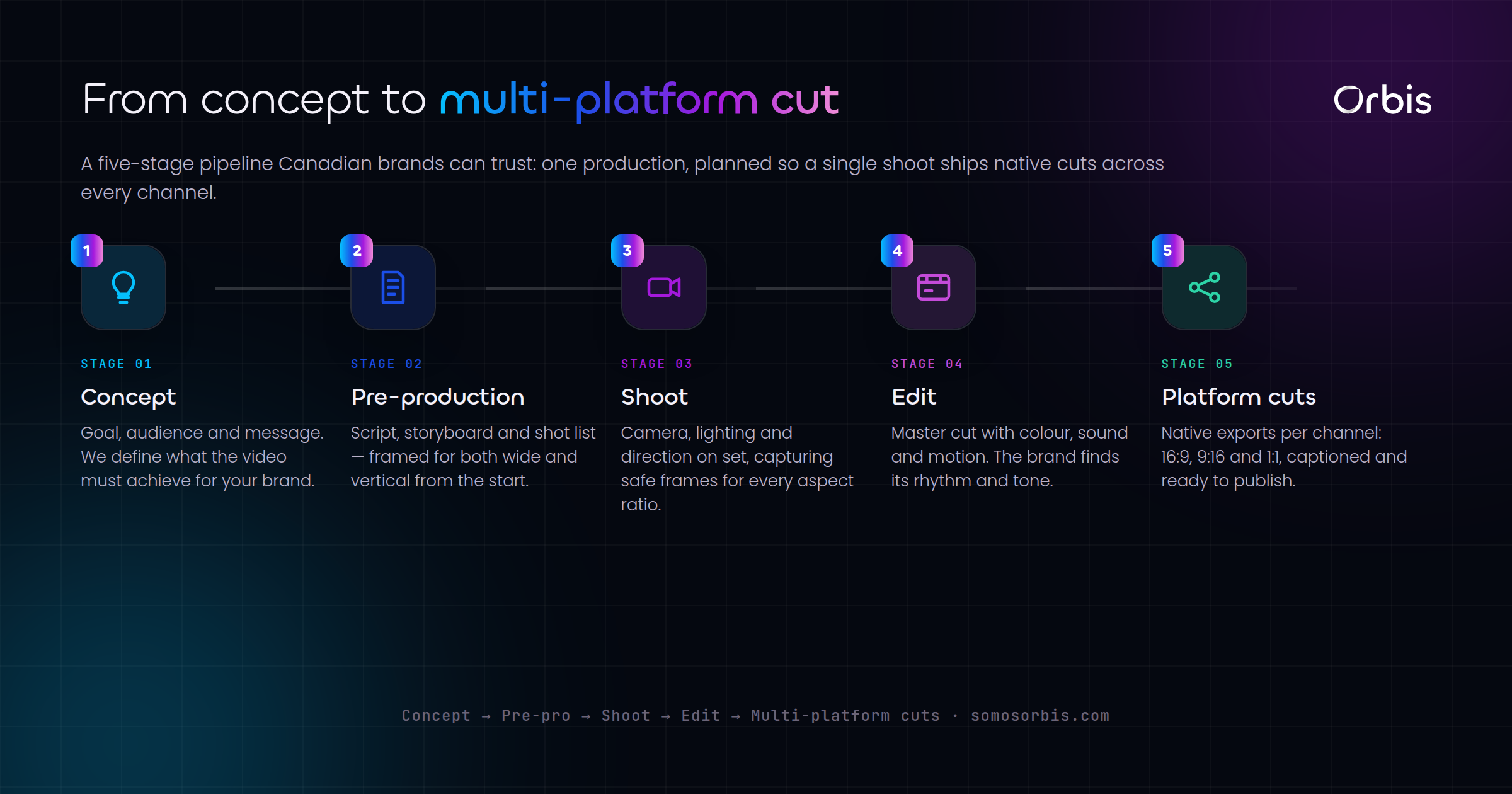
The single most expensive mistake Canadian brands make is shooting first and figuring out the formats later. By the time you are in the edit suite, the framing is locked, the talent has wrapped, and you discover that the wide cinematic composition you fell in love with simply does not survive a 9:16 crop for TikTok or Reels. The fix is simple but disciplined: define your full deliverables list before anyone calls "action."
A realistic multi-platform deliverables list for a Canadian campaign usually looks like this:
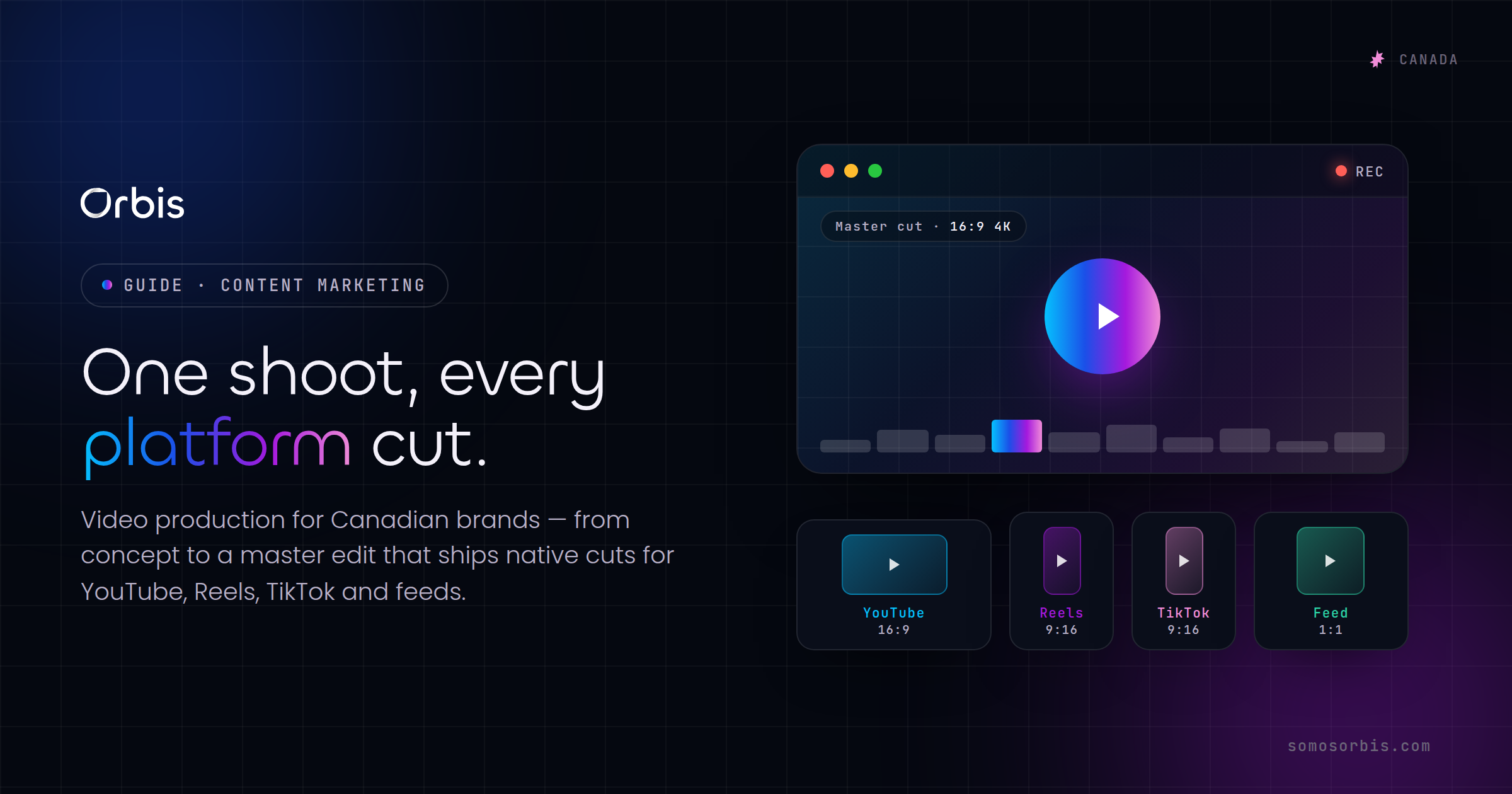
- YouTube hero (16:9): 30 to 90 seconds, the fullest expression of the story, often the only place a longer narrative survives.
- YouTube bumper and skippable pre-roll: 6-second and 15-second cutdowns engineered to land the brand in the first two seconds before a viewer hits skip.
- Vertical social (9:16): Reels, TikTok, Stories, and Shorts, each reframed so the subject stays centred and captions never collide with platform UI.
- Square or 4:5 (in-feed): Instagram and Facebook feed placements where vertical real estate is capped.
- Paid performance cutdowns: hook-led 6 to 15 second versions with a single clear call to action, often A/B tested against each other.
- French-language versions: not just subtitled, but properly localized for Quebec audiences (more on this below).
When you know this list up front, you shoot for it. That means capturing safe areas for vertical crops, recording clean audio you can re-voice in French, and grabbing extra B-roll so your editor has room to build short performance cuts without re-shooting. Planning the edit before the shoot is the whole game, and it is the discipline that separates a working video production engagement from an expensive home movie.
Concept: Build a Story That Survives Compression
A concept that depends on a slow build will die on social. Canadian feeds are as crowded and fast-scrolling as anywhere in North America, and the brutal reality is that you have roughly two seconds to earn the next eight. So your concept has to carry a hook that works in isolation, while still expanding into a satisfying full-length story for YouTube and connected TV.
The hook-first structure
Think of your concept in layers that can be stacked or stripped:
- The hook (0 to 2 seconds): a visual or verbal pattern interrupt that states the stakes immediately. This is what your 6-second bumper is built around.
- The payoff (2 to 15 seconds): the core promise or transformation. This is your performance-ad sweet spot.
- The expansion (15 to 90 seconds): context, proof, and emotional resonance that a YouTube or brand viewer will sit through.
By designing in layers, you produce one coherent story that naturally cuts down. Your editor is not hacking a long film to pieces; they are revealing shorter versions that were always inside it.
Make it unmistakably Canadian when it matters
You do not need a moose in every frame, but cultural relevance moves the needle. A back-to-school campaign in August, a Boxing Day push, the shift to winter light in November, French signage in a Montreal street scene, the visual language of a Vancouver versus a Calgary setting, these signals tell Canadian viewers the brand is speaking to them, not recycling American creative. Just as commercial photography for Canadian brands leans on authentic local environments rather than generic stock, video should ground itself in real Canadian context to build trust.
Pre-Production: Where Budgets Are Won or Lost
Most of the cost control in video happens before the shoot day, not during it. A tight pre-production process protects both your budget and your timeline, and it is where documented processes earn their keep. Here is what a disciplined pre-production phase covers:
- Creative brief and script: a single source of truth that ties every shot to a deliverable and a platform.
- Shot list and storyboard: mapped against your deliverables list so you know which setups feed which cuts.
- Bilingual script lock: finalize English and French copy together, so timing and pacing work in both languages before you cast a voice.
- Casting and talent releases: confirm usage rights cover every platform and paid placement you intend to run, including any whitelisting for paid social.
- Location and permits: Canadian municipalities each have their own permit processes; build that lead time in early.
- Shoot schedule with format safe areas: explicitly note where you need 9:16 protection and clean plates for graphics.
The brands that treat pre-production as paperwork end up paying for it on shoot day with overruns and missed coverage. The brands that treat it as engineering walk onto set knowing exactly what they need and walk off with everything the edit requires.
Production: One Shoot, Many Formats
The economics of Canadian video production reward consolidation. Crews, gear, talent day rates, and location fees are your big line items, so the goal is to extract every deliverable from as few shoot days as possible. A few principles make that possible:
- Shoot for the crop. Frame with vertical and square safe areas in mind from the start, leaving headroom and side margins so a single take serves 16:9, 1:1, and 9:16.
- Capture clean audio for re-voicing. If you record dialogue cleanly and avoid baking music or effects into the production track, you can drop in a French voiceover later without a reshoot.
- Over-capture B-roll. Short performance cuts and platform variants are hungry for coverage. An extra hour of B-roll on set is far cheaper than a second shoot day.
- Plan graphic plates. Shoot clean backgrounds where on-screen text, prices, or bilingual captions will live so localization is a graphics swap, not a re-edit.
Aerial and establishing shots deserve their own mention. Drone footage can elevate a brand film and give you sweeping, ownable establishing shots of Canadian landscapes and cityscapes that stock simply cannot match. If aerials are part of your concept, plan them deliberately, our breakdown of drone video production in Canada covers the regulatory and creative side, including the certification realities of flying commercially across the country.
The Bilingual Reality: English and French Done Right
For Canadian brands, bilingual delivery is not an afterthought, and in many cases it is a compliance and market-access requirement. Doing it well is a competitive advantage; doing it lazily is worse than not doing it at all, because a clumsy French version signals to a Quebec audience that they were an edit-suite afterthought.
Subtitles versus localization
There is a real difference between slapping French subtitles on an English video and producing a genuinely French version:
- Subtitles are the minimum bar and work for short social cuts, but text-heavy English on screen still reads as an English-first asset.
- Localized voiceover and on-screen graphics produce a video that feels native to French-speaking viewers, with idiomatic copy rather than literal translation.
- Quebec French nuance matters. Parisian French phrasing can feel off to a Quebec audience, so localization should be reviewed by someone who writes for that market.
Because timing and lip-sync differ between languages, the smart move is to lock both scripts in pre-production. When the French track is planned from the start, the production track stays clean for re-voicing and your bilingual deliverables come out of the same shoot rather than a costly second production.
Post-Production and the Multi-Platform Cut
This is where the up-front discipline pays off. With a properly captured shoot and a clear deliverables list, post-production becomes a structured exercise rather than a scramble. A typical workflow:
- Build the hero edit first. Lock the story, the colour grade, the music, and the brand sign-off on the 16:9 master.
- Derive the cutdowns. Pull the 6, 15, and 30-second versions from the hero, each engineered around its own hook for paid placements.
- Reframe for vertical and square. Reposition the subject for 9:16 and 4:5, adjusting captions and graphics so nothing is clipped by platform UI.
- Localize. Drop in French voiceover, swap on-screen graphics, and review captions in both languages.
- Spec to platform. Export each deliverable to the right resolution, frame rate, aspect ratio, and file size, with captions burned in where autoplay-muted feeds demand it.
Platform specs that actually matter
A few practical reminders that save re-exports:
- Design for sound-off. The majority of social video plays muted, so captions and visual storytelling have to carry the message on their own.
- Front-load the brand. On skippable formats, your brand and core message belong in the first two to three seconds.
- Respect safe zones. Keep key information away from edges where like buttons, captions, and profile handles sit.
- Match the placement to the cut. A brand-building YouTube hero and a direct-response Reel are different jobs; do not run the same edit everywhere and expect both to perform.
Measuring What Your Video Actually Does
Production quality is necessary but not sufficient. The brands that get repeat budget for video are the ones who can show what it returned. Tie each cut to a job and a metric: brand films to view-through and brand-lift signals, performance cutdowns to click-through and cost per acquisition, social variants to retention curves and saves. When you A/B test hook-led cutdowns against each other, you learn which opening earns the scroll, and you feed that learning back into the next concept. Video stops being a cost line and starts being a measurable revenue engine.
Bringing It Together
Great Canadian video production is less about the camera and more about the plan. When you start from the deliverables list, build a layered concept that compresses cleanly, lock your bilingual scripts in pre-production, shoot once for many formats, and treat the multi-platform cut as an engineering exercise, you get a library of platform-ready assets from a single, well-run shoot, in both official languages, ready for YouTube, social, and paid. That is how a brand gets the reach of five videos for something much closer to the cost of one.
If you are planning your next campaign and want a partner who builds the cut into the concept from day one, explore our video production services for Canadian brands. We help brands across Toronto, Vancouver, Montreal, and Calgary turn a single shoot into a full multi-platform, bilingual content library, with documented processes and clear measurement built in from the start.