
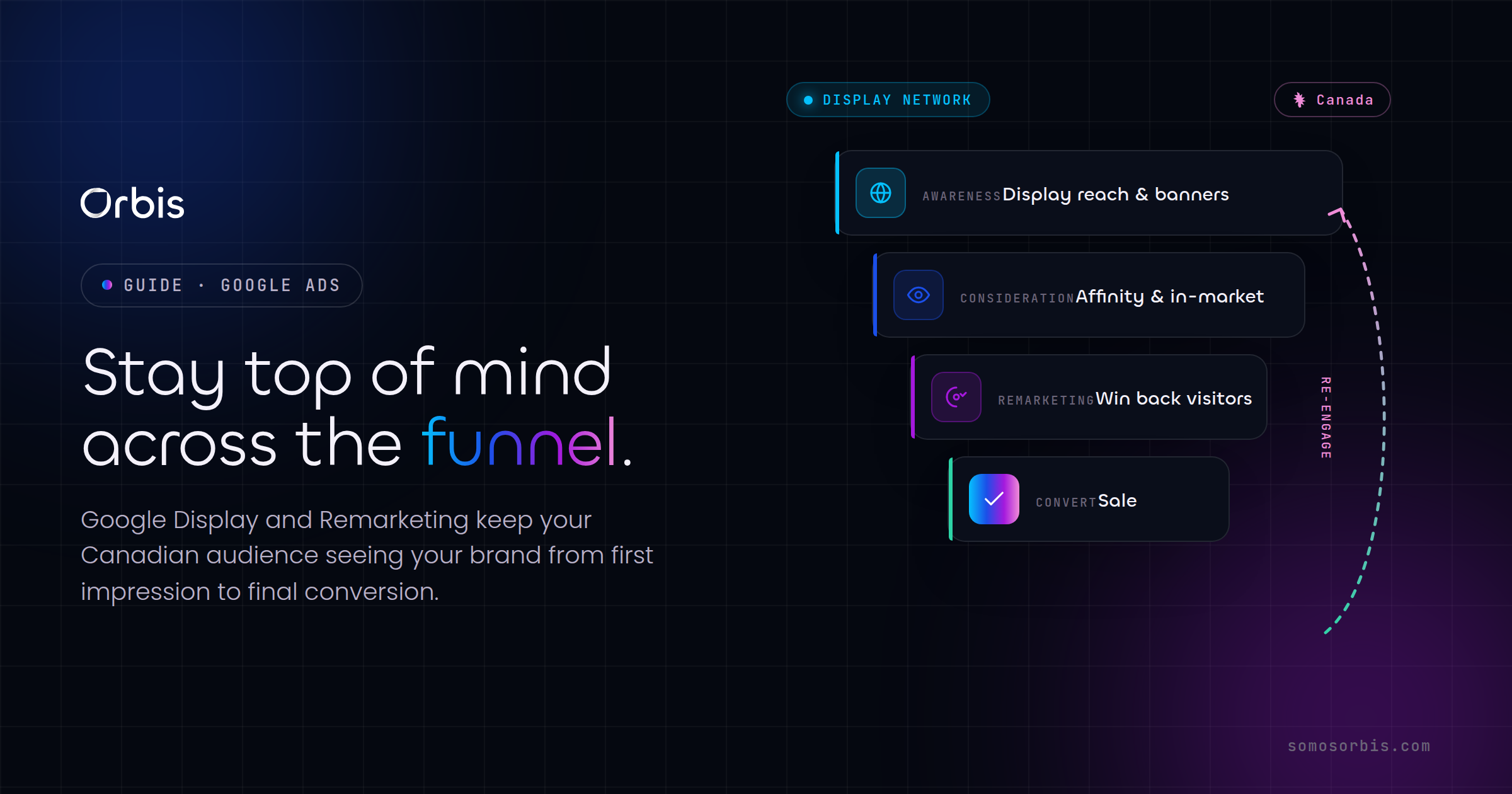
Search captures demand that already exists. But most Canadian buyers don't convert the first time they meet your brand, and many aren't actively searching at all yet. That's the gap the Google Display Network and remarketing are built to close. Done well, Display keeps you visible to the right people across two million-plus websites, apps, and Gmail inboxes, while remarketing quietly re-engages the shoppers who browsed, abandoned a cart, or read a pricing page and then went quiet. Done poorly, it's the fastest way to burn budget on cheap, irrelevant impressions. This guide focuses on the difference, with a Canadian lens: bilingual creative, CAD budgets, retail seasonality, and the privacy realities Canadian advertisers now operate under.
If you're building out a full paid program, this article sits alongside our complete guide to Google Ads in Canada, which is the best starting point for the wider account structure. Here we go deep on the two channels that keep you top of mind across the funnel.
Display vs. remarketing: two jobs, one network
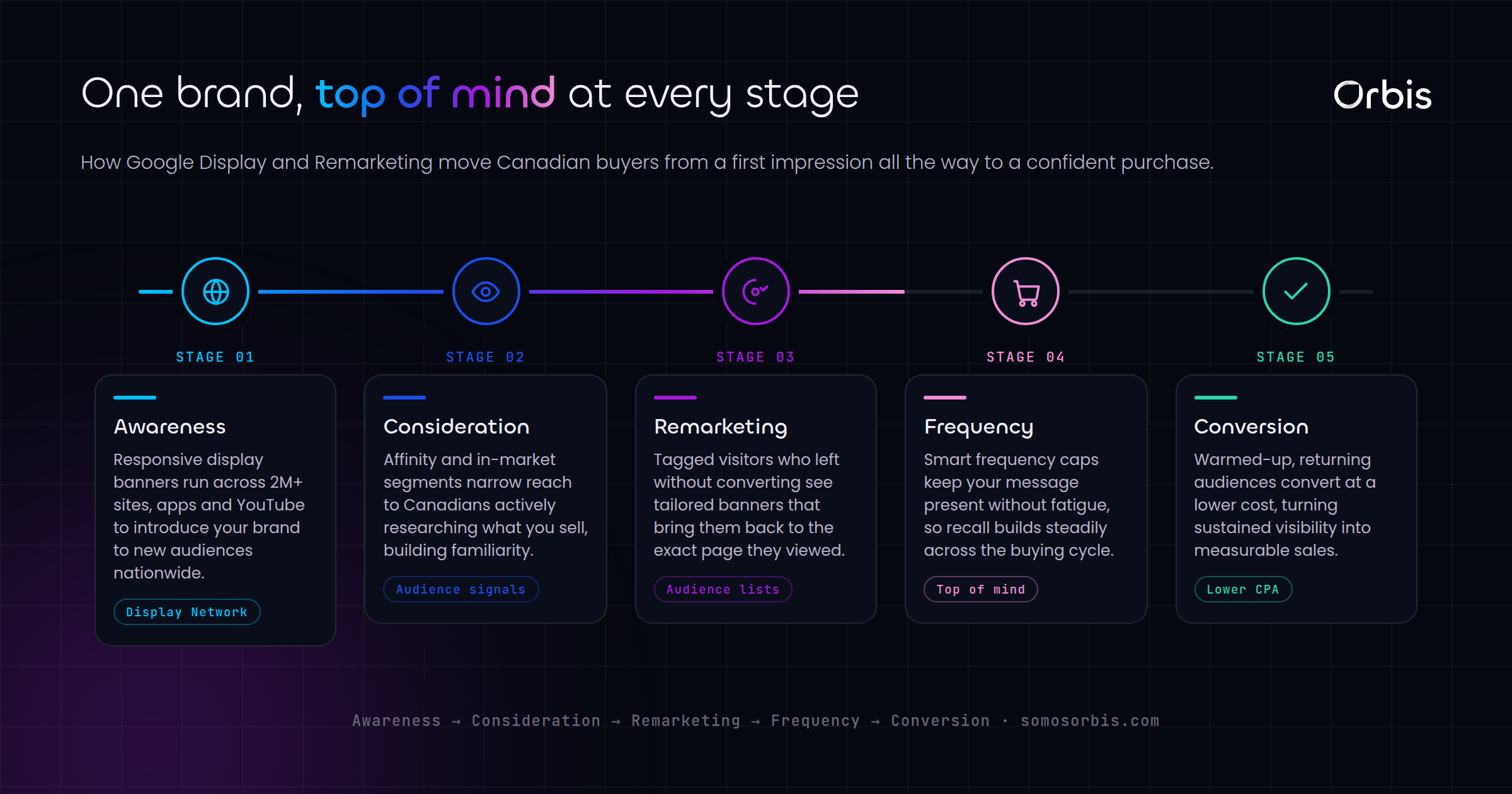
People lump these together because they run on the same network, but they do very different work. Getting the distinction right is what separates a profitable upper-funnel program from a money pit.
- Prospecting Display introduces your brand to people who have never interacted with you, using audience signals to approximate intent. It's a cold channel, so expectations on cost-per-acquisition should be set accordingly.
- Remarketing (also called retargeting) shows ads to people who have already visited your site, used your app, or engaged with your content. Intent is warmer, conversion rates are higher, and CPAs are usually a fraction of prospecting.
For most Canadian advertisers with a finite budget, remarketing is where you start. It produces the clearest return, builds confidence in the channel, and gives you the data and creative you'll need before you scale into colder prospecting audiences.
Setting up remarketing the right way
Remarketing only works if your audience lists are clean, well-segmented, and large enough to serve. A single "all visitors" list is the most common mistake we see in audited accounts. Treat your audiences like a funnel.
Build segmented audience lists
- All visitors (last 30 days) — your broad safety net, useful for reach but low intent.
- Product or category viewers — someone who looked at winter tires, a specific SaaS plan, or a service page has shown real interest.
- Cart abandoners — for ecommerce, this is your highest-value list. They were one step from buying.
- Past purchasers — separate these out. You'll either exclude them or run dedicated cross-sell and replenishment campaigns.
- Lead-form starters who didn't finish — for B2B and service businesses, this is the equivalent of a cart abandoner.
Each segment deserves its own message and bid. A cart abandoner who left a $400 CAD order behind warrants a more aggressive bid and a stronger incentive than a homepage bouncer.
Respect frequency and recency
Nothing damages a brand faster than chasing someone around the internet with the same ad fifteen times a day. Cap frequency (a common starting point is three to five impressions per user per day) and tighten membership windows so you're not paying to reach people whose intent has gone cold. A 90-day window might suit a considered B2B purchase; a 7-day window is often plenty for an impulse retail buy.
Display targeting options that actually work in Canada
Prospecting Display lives or dies on targeting. Google offers a long menu of options; these are the ones that consistently earn their keep for Canadian advertisers.
- In-market audiences — Google's signal that someone is actively researching a purchase in a category (e.g. "Home & Garden > Major Kitchen Appliances"). This is the closest Display gets to search-level intent.
- Custom segments — build your own audience from keywords, competitor URLs, and apps. Want to reach people researching your top three Canadian competitors? This is how.
- Your-data segments — lookalike-style expansion built from your remarketing and customer lists, finding new people who resemble your best buyers.
- Detailed demographics and location layering — essential in Canada, where buying behaviour, language, and seasonality differ sharply between Toronto, Vancouver, Montreal, and Calgary. You can also bid up around store locations or service areas.
The bilingual creative requirement
Canada is not a single-language market, and Display makes the cost of ignoring that very visible. If you serve Quebec, French-language creative isn't a nice-to-have; for many advertisers it's a legal and a performance necessity. Run separate ad groups or campaigns targeting French-language users and French-Canadian geographies with native French copy and visuals, not machine-translated English. The same discipline applies to seasonal moments: a Boxing Day banner, a back-to-school push in late August, and a holiday gifting message should each have their own creative rather than a recycled evergreen ad.
Responsive Display Ads do the heavy lifting here. Supply Google several headlines, descriptions, logos, and images per language and let the system assemble combinations. Just make sure every asset reflects Canadian context: CAD pricing, local imagery, and offers that map to Canadian seasonality.
Budgeting and bidding for Display in CAD
Display impressions are cheap, which is exactly why budgets leak. The goal is efficient reach against qualified audiences, not the largest possible impression count. A few principles keep spend honest:
- Start small and prove the channel. A modest daily budget in CAD on a tight remarketing audience will teach you more than a large prospecting spend ever will.
- Use conversion-based bidding once you have data. Target CPA or Target ROAS keeps Display accountable to outcomes. Until you have enough conversions, Maximize Conversions with a sensible cap is a reasonable bridge.
- Exclude waste aggressively. Add placement exclusions for mobile games and low-quality apps, exclude already-converted users, and use content exclusions to keep your brand away from sensitive inventory.
- Watch the placements report weekly. This is the single highest-leverage Display habit. You will find junk placements draining budget, and pruning them improves performance immediately.
For a structured approach to managing these campaigns end to end, our Google Display and remarketing service covers audience architecture, creative production in both official languages, and the ongoing placement hygiene that keeps Display profitable.
Privacy, consent, and the Canadian reality
Remarketing depends on tracking, and tracking in Canada operates within real constraints. Browsers are phasing out third-party cookies, Consent Mode shapes how data flows, and Canadian privacy expectations are tightening. None of this kills remarketing, but it changes how you build it.
- Capture consent properly. Implement a consent banner and pass signals through Google Consent Mode so measurement and audience building stay compliant with current regulations.
- Lean on first-party data. Customer Match lists built from your own CRM and email database are more durable than cookie-based audiences and often perform better. This is where strong quality processes around data collection pay off.
- Strengthen server-side measurement. Enhanced conversions and server-side tagging recover signal that browser restrictions would otherwise lose, keeping your bidding accurate.
Treating privacy as an engineering discipline rather than an afterthought is exactly the kind of compliance-by-design thinking that protects your remarketing program as the rules keep shifting.
How Display and remarketing fit the rest of the funnel
These channels are most powerful when they work as a system with your other Google investments rather than in isolation. A few connections worth wiring up deliberately:
- Shopping feeds your remarketing. If you're a retailer, dynamic remarketing pulls the exact products a shopper viewed back into their feed. That feed quality starts upstream, which is why it's worth getting right alongside your Google Shopping setup for Canadian retailers.
- YouTube builds the audiences Display re-engages. Video views are some of the richest signals you can remarket against. If brand awareness is part of your goal, pair this with our guide to YouTube ads for brand awareness in Canada so your awareness spend feeds your retargeting pools.
- Search closes what Display warmed up. Someone introduced to your brand on Display will often convert later via a branded search. Attribution models that credit only the last click will undervalue Display; use data-driven attribution to see its true contribution.
A practical 30-day rollout
If you're starting from scratch, here's a sequence that builds confidence without overspending:
- Week 1 — Foundation. Install and verify tags, set up consent mode, and build segmented remarketing lists. Confirm conversion tracking is firing correctly.
- Week 2 — Launch remarketing. Start with cart abandoners and high-intent page viewers. Set frequency caps, exclude past purchasers, and ship bilingual creative where relevant.
- Week 3 — Optimize. Review placements, prune waste, and adjust bids by audience value. Let conversion data accumulate before judging performance.
- Week 4 — Expand carefully. Introduce one prospecting campaign using in-market or custom segments, funded modestly, and feed its engaged visitors into your remarketing lists.
From there, scale what works and cut what doesn't, reviewing weekly.
Keep your brand in the consideration set
Canadian buyers compare, hesitate, and come back. Display and remarketing are how you stay present through that whole journey, gently and efficiently, so that when the moment to buy arrives your brand is already familiar. The advertisers who win aren't the ones who shout loudest; they're the ones who show up consistently to the right people, in the right language, at the right moment, without wasting a dollar on the wrong impressions.
If you'd like a team to architect, build, and maintain a Display and remarketing program that respects both your budget and Canadian privacy standards, explore our Google Display and remarketing services and let's keep your brand top of mind across the funnel.