
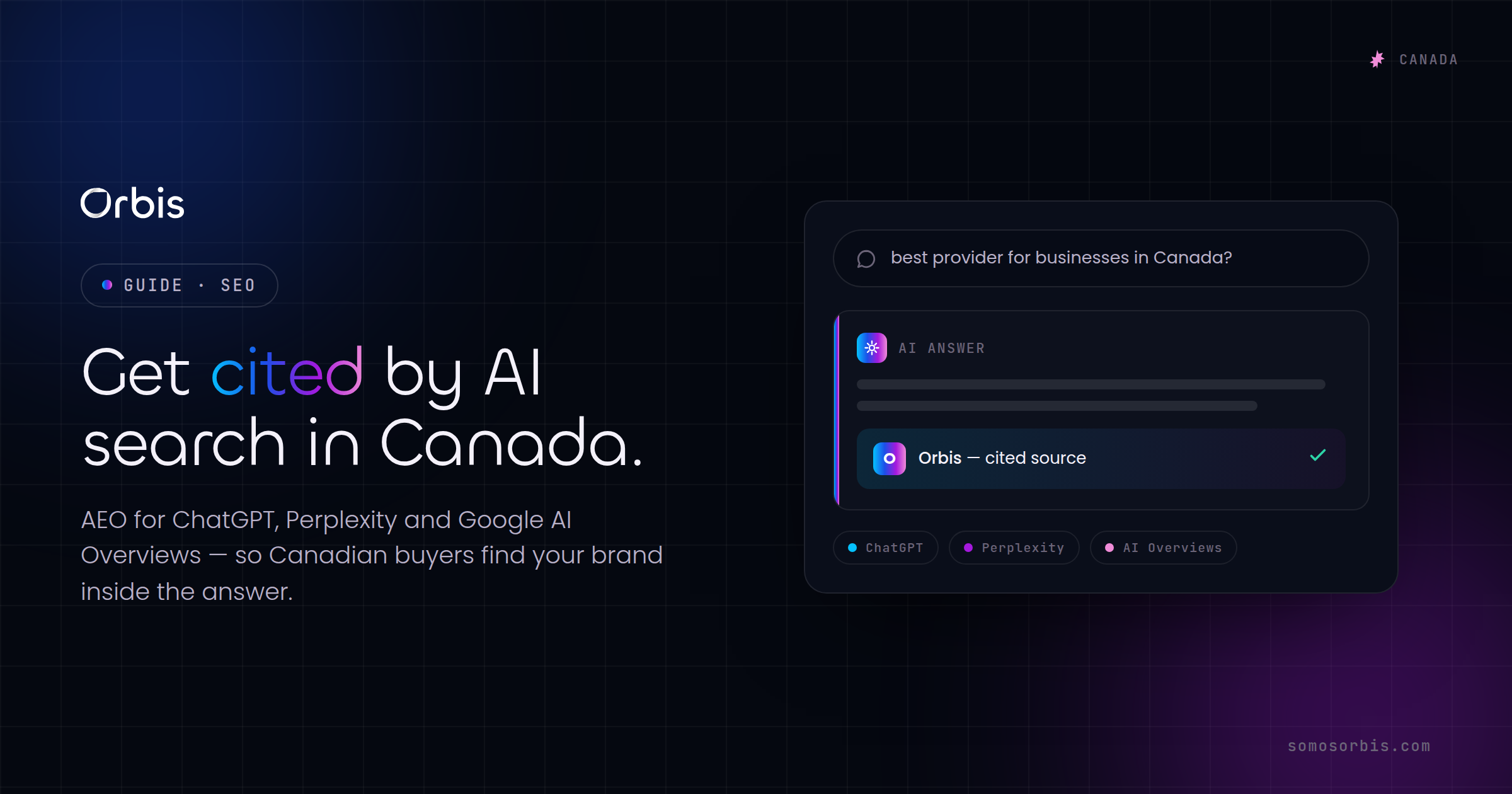
Search in Canada is no longer a list of ten blue links. When a buyer in Toronto asks ChatGPT for "the best fractional CFO services in Ontario," or a marketer in Vancouver types a question into Google and reads the AI Overview without scrolling, the discovery moment happens inside an AI answer — often without a single click to your website. This shift has a name: Answer Engine Optimization (AEO), sometimes called Generative Engine Optimization (GEO). It is the practice of getting your brand cited, quoted, and recommended by AI systems like ChatGPT, Perplexity, Google AI Overviews, and Gemini. For Canadian brands, the stakes are concrete: bilingual audiences, region-specific buying seasons, and a competitive landscape where being the cited source is the new page-one ranking.
This guide explains how AEO works, why zero-click search is reshaping discovery in Canada, and the practical steps your team can take to start earning AI citations. It is a companion to our complete guide to SEO in Canada, which we recommend reading first if you want the foundational picture — AEO builds directly on top of solid technical and content SEO.
What AEO actually is (and how it differs from SEO)
Traditional SEO optimizes a page to rank in a list of results. The user still chooses which link to click, and you win the click if you rank high enough. AEO optimizes for a different outcome: being the source an AI model pulls from when it composes an answer. Instead of competing for position, you are competing to be quoted.
The mechanics are different in three important ways:
- Retrieval, not just ranking. Answer engines retrieve passages — specific paragraphs, list items, or table rows — rather than whole pages. A page that ranks #4 in Google can still be the passage an AI cites if that passage answers the question cleanly.
- Synthesis across sources. AI Overviews and Perplexity blend multiple sources into one answer. Your goal is to be one of the three or four sources that consistently get pulled for a query cluster, not necessarily the single top result.
- Citation as the new click. When an AI answer names "Orbis" or links to your domain, that mention drives trust and, increasingly, qualified traffic from users who click through to verify or go deeper.
If your foundational SEO is weak — slow pages, thin content, no structured data — AEO will not save you. The two disciplines stack. Strong on-page SEO makes your content retrievable; AEO makes it citable.
Why zero-click search matters more in Canada right now
Zero-click search — where the user gets their answer without leaving the results page — has been climbing for years, and Google AI Overviews accelerated it dramatically. For Canadian brands, three local realities make this especially urgent:
1. A bilingual market doubles the surface area
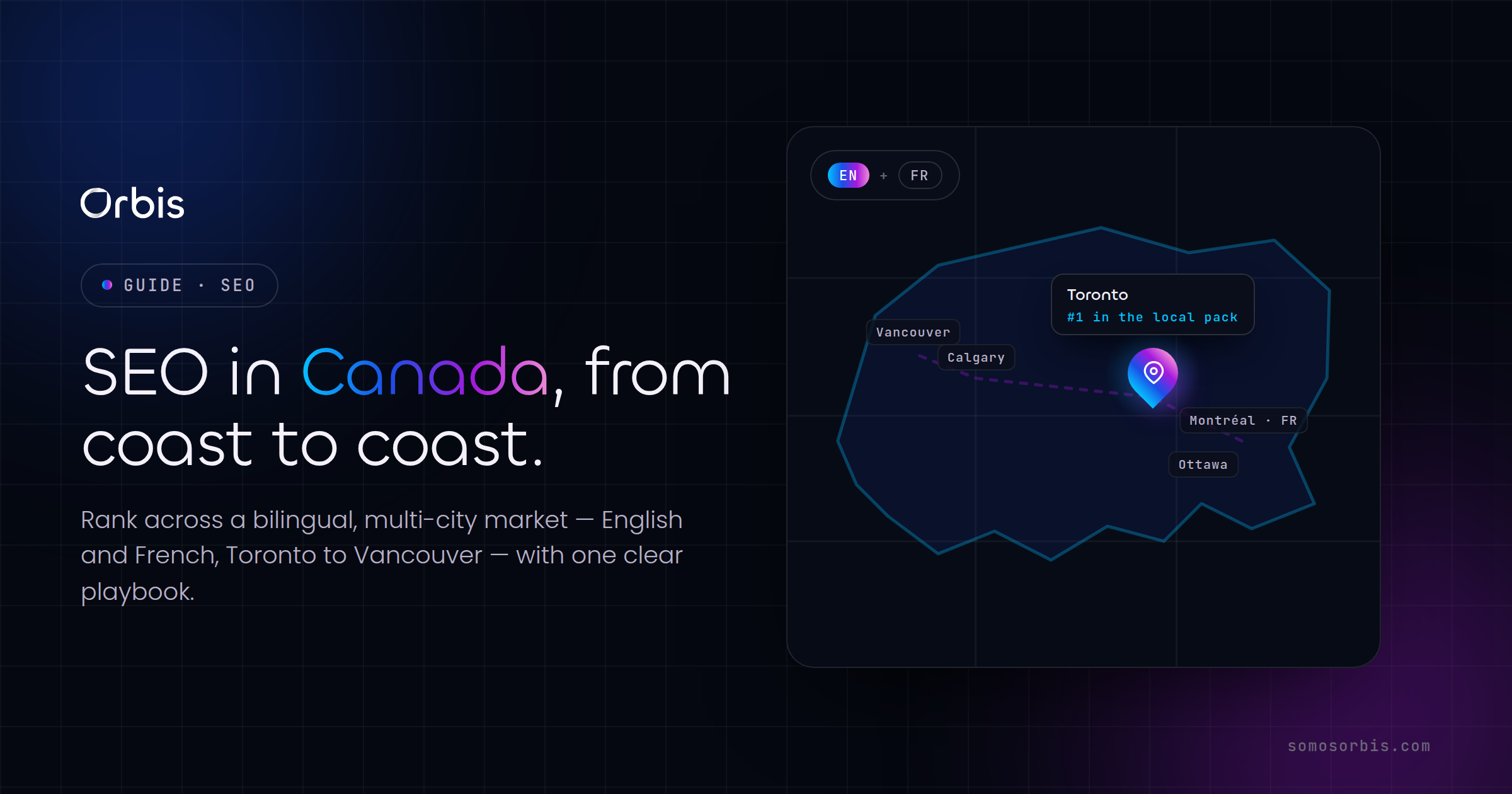
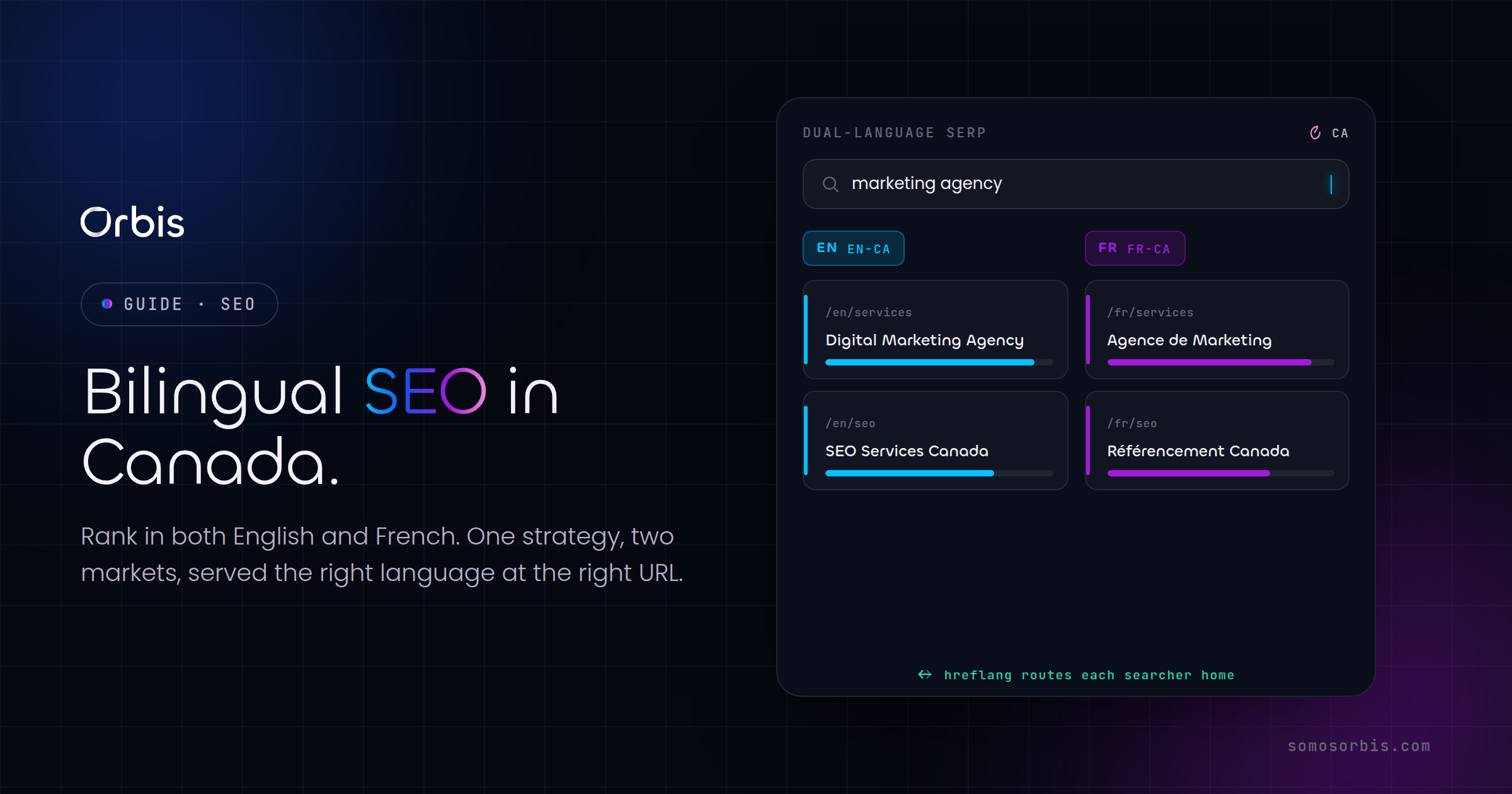
Canada's EN/FR reality means a query like "meilleur logiciel de comptabilité pour PME" and "best accounting software for small business" are two separate answer-engine battles. AI models retrieve French and English sources independently. Brands that only publish in English are invisible in the French answer layer, and vice versa. Montreal and large parts of the federal and Quebec markets reward bilingual coverage. This is closely tied to how you structure international and multi-region content, which we cover in our guide on international SEO for expanding between Canada and the US.
2. Canadian seasonality shapes the questions people ask
Boxing Day, back-to-school, RRSP season, and the Canadian holiday calendar all generate predictable spikes in question-shaped searches: "best Boxing Day deals on X in Canada," "when is the RRSP deadline," "back-to-school checklist for Ontario students." Answer engines love seasonal, intent-rich questions. Brands that publish timely, accurate, Canada-specific answers ahead of these windows earn citations exactly when demand peaks.
3. Canadian buyers expect local specificity
A generic answer that quotes US pricing in USD, references US tax rules, or ignores provincial differences reads as untrustworthy. AI models increasingly disambiguate by region. Content that says "CAD pricing," "compliant with current Canadian regulations," and "available in Ontario, British Columbia, and Quebec" gives the model concrete signals that you are the right source for a Canadian query.
How AI answer engines choose what to cite
While the exact algorithms are proprietary and changing, the observable patterns are consistent across ChatGPT, Perplexity, Gemini, and Google AI Overviews. They favour content that is:
- Direct and extractable. The answer to the likely question appears in the first sentence or two of a section, not buried after three paragraphs of preamble.
- Structured. Clear headings, bulleted lists, tables, and step-by-step instructions are easier to retrieve as clean passages.
- Authoritative. Signals like author expertise, citations to credible sources, consistent NAP (name, address, phone) data, and recognized partnerships build the trust that models weight heavily.
- Fresh and dated. Visible publish and update dates matter. Answer engines prefer recent content for anything time-sensitive, which most Canadian seasonal and regulatory queries are.
- Schema-marked. FAQ, HowTo, Article, Organization, and LocalBusiness structured data give models explicit, machine-readable context.
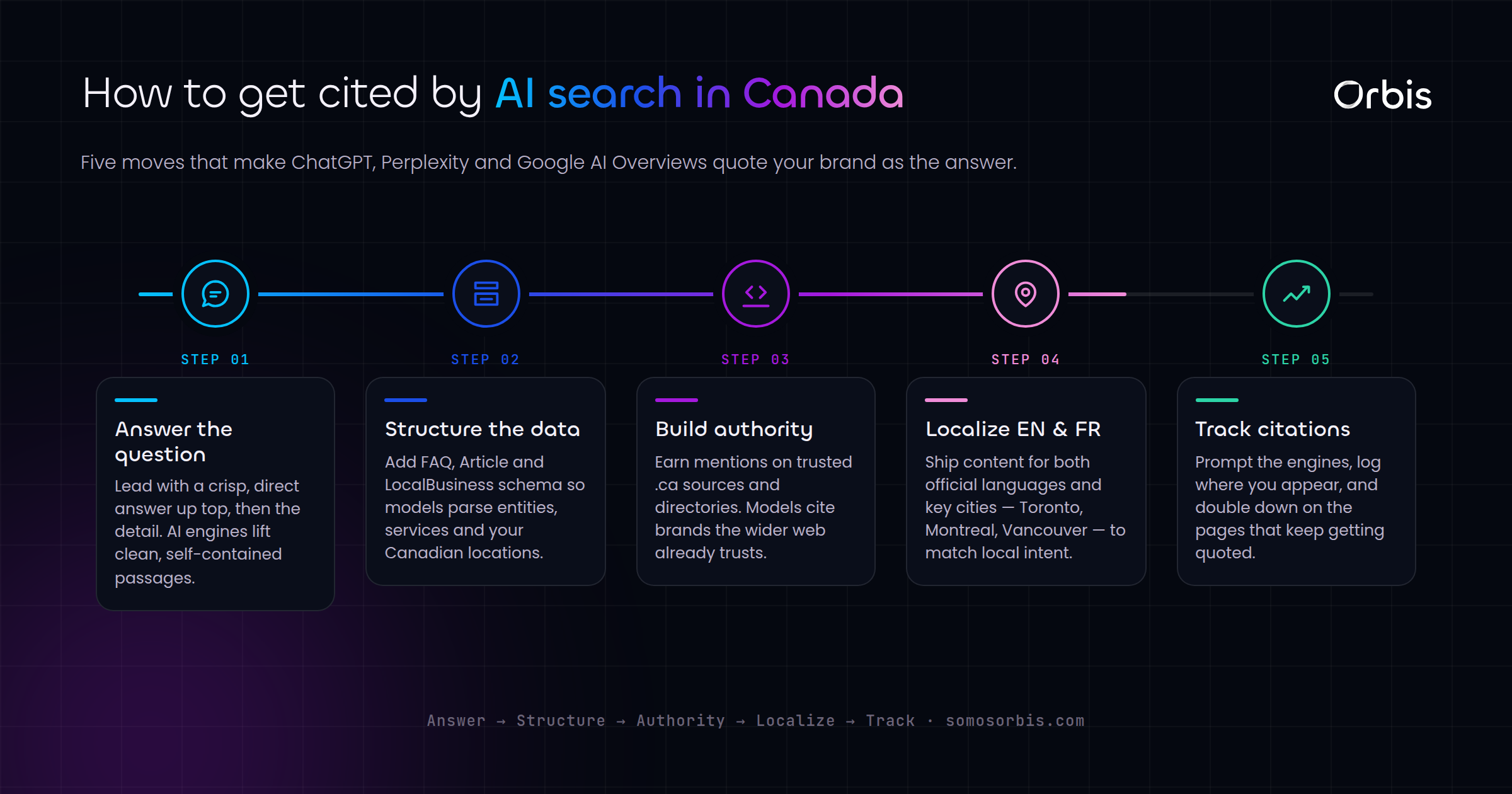
A practical AEO playbook for Canadian brands
Here is an actionable sequence your team can start this quarter. None of it requires a rebuild — it is mostly disciplined content and technical hygiene applied with AI retrieval in mind.
Step 1: Map the questions, not just the keywords
Answer engines run on questions. Build a list of the real questions your Canadian buyers ask — pulled from your sales calls, support tickets, "People Also Ask" boxes, and Reddit threads in Canadian subreddits. Group them into clusters (for example, "AI search," "local SEO," "bilingual content"). Each cluster becomes a content pillar with satellite pieces answering specific sub-questions. This is exactly the cluster model that makes pages mutually reinforcing and easier for AI to retrieve.
Step 2: Lead every section with the answer
Restructure your content so each H2 or H3 is followed immediately by a clean, quotable answer. A good test: if you copied the first two sentences under a heading and pasted them into a chat, would they stand alone as a correct, complete answer? If not, rewrite. Models extract the passage that answers the query — make that passage obvious.
Step 3: Add the structured data answer engines read
Implement at minimum:
- Organization schema with your real credentials — a Google Partner badge, review counts, years in business, and named partner relationships (for example, recognized Meta, Shopify, and Pinterest partnerships) all reinforce authority.
- FAQ schema on pages that answer multiple related questions.
- Article schema with author, publish date, and modified date.
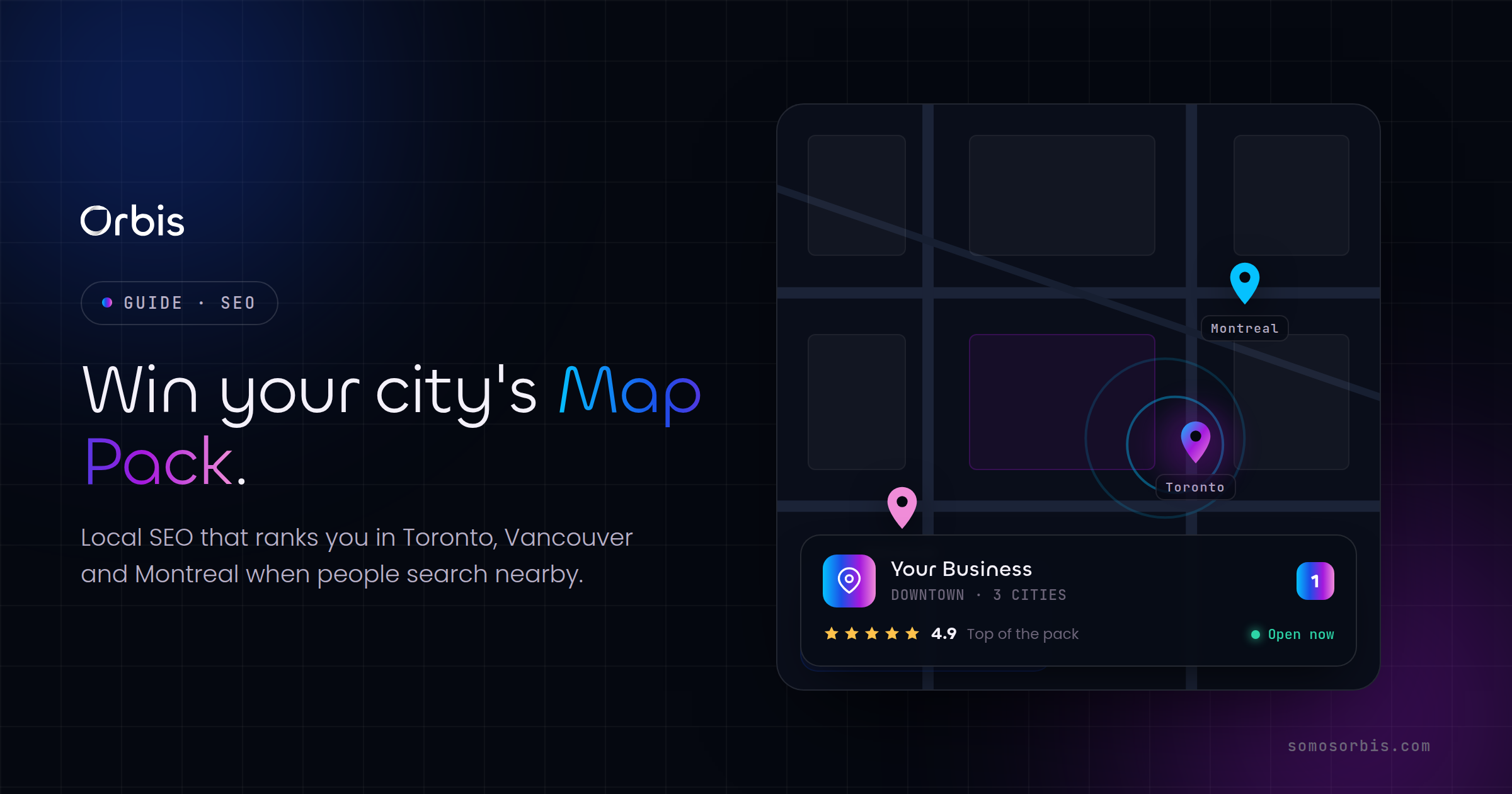
- LocalBusiness schema with accurate Canadian address and service-area data if you serve specific provinces or cities.
Step 4: Build citable assets — data, definitions, and lists
Answer engines disproportionately cite original data, clear definitions, and well-structured comparison lists. Publish a small piece of proprietary insight your competitors cannot copy: a Canadian benchmark, a survey of your client base (without naming clients), or a definitive "X vs Y for Canadian businesses" comparison. These become the passages models reach for.
Step 5: Cover both official languages where it matters
If any meaningful share of your audience is francophone, produce native French content — not machine-translated copy that reads awkwardly. Quebec and federal-market buyers can tell the difference, and so, increasingly, can the models evaluating quality. Native bilingual coverage is one of the highest-leverage moves available to Canadian brands in AEO precisely because so few competitors do it well.
Step 6: Earn mentions across the web
AI models are trained and grounded on the broader web. The more your brand is mentioned in credible places — industry publications, directories, partner sites, and well-moderated communities — the more likely a model is to "know" you and surface you. For B2B brands, this overlaps heavily with demand generation; our guide to B2B SEO and lead generation in Canada covers how to turn that visibility into pipeline rather than vanity mentions.
Measuring AEO: what to track when there is no click
The hardest part of AEO is measurement, because a citation may produce influence without an immediate click. Track a blended set of signals:
- Citation presence. Regularly query ChatGPT, Perplexity, Gemini, and Google AI Overviews with your priority questions and record whether your brand or domain is cited. Do this on a fixed schedule so you can see trends.
- Branded search lift. When AI answers mention you, branded search volume in Canada often rises. Watch it in Search Console and Google Trends.
- Referral traffic from AI engines. Perplexity and ChatGPT increasingly pass referral data; segment it in your analytics.
- Assisted conversions. Users who first encounter you in an AI answer often convert later through branded or direct visits. Look at multi-touch attribution, not just last-click.
Common AEO mistakes Canadian brands make
- Treating AEO as separate from SEO. They are layers of the same stack. Weak technical SEO undermines everything above it.
- Writing for the model instead of the reader. Stuffing question phrases unnaturally backfires. Models reward genuinely useful, well-structured content — the same thing readers reward.
- Ignoring French. Skipping native bilingual content cedes the entire French answer layer to competitors.
- Vague regional signals. Failing to specify CAD pricing, provincial availability, and Canadian context makes you a worse match for Canadian queries.
- No freshness discipline. Undated, stale content loses to dated, maintained content on time-sensitive questions — and most Canadian commercial questions are time-sensitive.
Where AEO is heading
Expect three trends to deepen through the coming year. First, answer engines will keep folding more commercial queries into AI responses, shrinking the classic blue-link real estate further. Second, models will get better at regional disambiguation, rewarding genuinely Canadian content and penalizing US-centric copy in Canadian contexts. Third, structured, verifiable data — schema, clear sourcing, visible expertise — will matter more, not less, as engines work to reduce hallucination and cite trustworthy sources.
The brands that win will be the ones that treat AEO as an extension of disciplined marketing: real expertise, documented processes, clear structure, and bilingual coverage where it counts. There are no shortcuts and no invented metrics — just the steady work of becoming the most useful, most citable answer for the questions your Canadian buyers actually ask.
Get cited, not just ranked
AEO is where search discovery is heading, and Canadian brands that move now will own the answer layer before their competitors realize it exists. If you want a structured, accountable approach — built on documented processes and engineered for measurable results — explore our AEO and AI SEO services for Canadian brands. We will help you map the questions your buyers ask, structure content that answer engines cite, and turn AI visibility into pipeline. And if you are building your foundation first, start with our complete SEO guide for Canada — AEO works best when it sits on top of SEO done right.