
If you sell SaaS or B2B services in the United States, you already know the hard truth: ranking for a few broad keywords does not pay the bills. A pipeline does. The companies winning organic search in 2026 are not the ones with the most blog posts. They are the ones that built a deliberate content engine aimed at high-intent buyers in markets like New York, San Francisco, Austin, Chicago, and Miami, and that turn those rankings into demos, trials, and signed contracts.
This guide breaks down a practical B2B SEO strategy built for US SaaS and service companies: how to prioritize bottom-funnel pages, build comparison content that converts, capture existing demand, and measure what actually moves revenue. No fluff, no vanity metrics, just the moves that compound.
Why B2B SEO Works Differently Than B2C
B2B buying in the US is rarely a single click. A typical SaaS purchase involves three to seven people: a champion who finds you, an economic buyer who signs, and a handful of skeptics in finance, security, and operations. Each of them searches differently, and your content has to meet all of them.
That changes the math. A consumer ecommerce brand chasing Black Friday traffic can win on volume. A B2B company selling a $40,000-per-year platform wins on relevance. One qualified visitor from a Series B startup in Austin searching "best [category] software for mid-market" is worth more than a thousand readers who will never buy.
So the strategy is not "publish more." It is "rank for the queries your buyers type when they are close to a decision, and own those results completely." For the strategic foundation behind this approach, our complete SEO guide for US businesses in 2026 covers the broader framework; this article zooms into the B2B SaaS and service-company playbook specifically.
Map Your Funnel Before You Write a Word
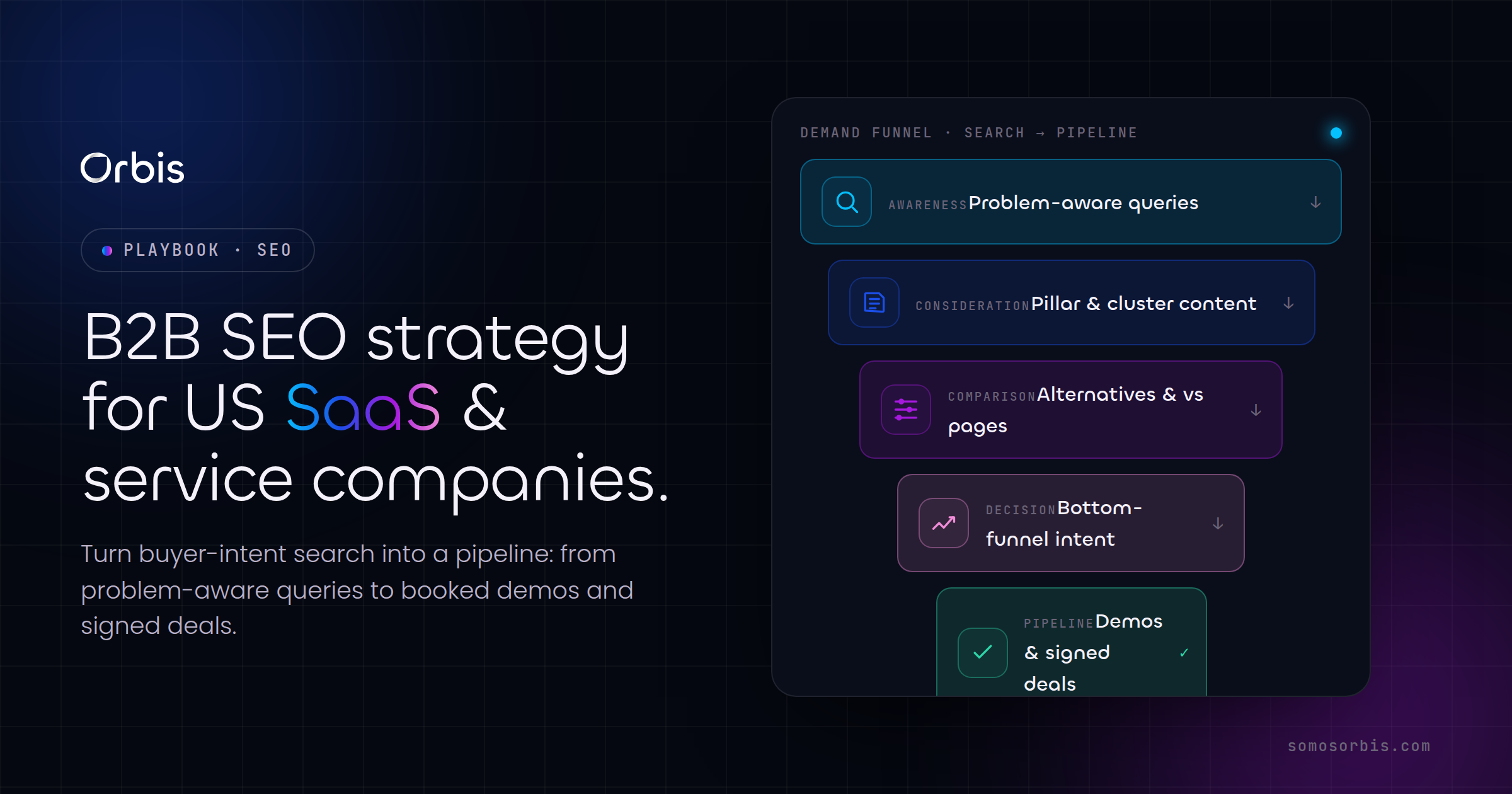
Every effective B2B content engine starts with a keyword map organized by buyer intent, not by topic. We group queries into three tiers.
Bottom-of-Funnel (BOFU): Demand Capture
These are the queries from people ready to buy. They have low volume and brutal conversion rates. Examples for a US SaaS company:
- "[Your category] software pricing"
- "Best [category] tools for [industry]"
- "[Competitor] alternatives"
- "[Category] software for enterprise / mid-market / startups"
- "[Use case] software with [specific integration]"
Build these pages first. A page targeting "best payroll software for restaurants" will convert at five to ten times the rate of a generic "what is payroll" explainer. BOFU pages are the foundation of revenue engineering: they capture buyers who already have budget and intent.
Middle-of-Funnel (MOFU): Problem-Aware
These buyers know they have a problem but have not committed to a category solution yet. Think "how to reduce customer churn," "automating accounts payable," or "alternatives to spreadsheets for project tracking." MOFU content builds trust and seeds your product as the obvious answer.
Top-of-Funnel (TOFU): Education
Broad, high-volume queries that build authority and feed your retargeting audiences. They rarely convert directly, but they earn links and establish topical depth. Do not start here. Earn the right to play in TOFU by first winning the bottom of the funnel.
Build Bottom-Funnel Pages That Actually Convert
Most B2B companies treat BOFU pages like an afterthought. That is the mistake. A high-intent landing page is a sales asset that works 24/7. Here is how to build one that closes.
- Lead with the buyer's situation, not your features. A CFO in Chicago evaluating expense software does not care about your "robust dashboard." She cares about closing the books three days faster. Frame the value in their language.
- Answer objections on the page. Security, pricing transparency, implementation time, contract length. If a buyer has to email you to learn your pricing model, you have already lost momentum.
- Include real proof. Logos, named outcomes, and review scores. In the US market, third-party validation from review platforms carries serious weight with procurement teams.
- Make the next step obvious. One primary CTA: book a demo, start a trial, or get a quote. Not five competing buttons.
For SaaS specifically, structure the page so it ranks AND converts. That means a clear H1 matching the query, a fast-loading layout, schema markup for software and reviews, and internal links to supporting content. This is the exact discipline our team applies in our B2B SEO services: every page engineered to earn the ranking and the meeting.
Comparison and Alternative Content: The B2B SEO Cheat Code
If there is one content type that consistently outperforms for US B2B SaaS, it is comparison content. Buyers in the consideration phase search exactly this way:
- "[Your product] vs [Competitor]"
- "[Competitor] alternatives for [use case]"
- "Best [category] software 2026"
- "[Competitor A] vs [Competitor B]" (where you are the third option)
These pages work because the searcher has already decided to buy something. The only question is what. By showing up here with an honest, useful comparison, you insert yourself into a decision that was about to happen without you.
A few rules for comparison content that does not get penalized or ignored:
- Be genuinely fair. Acknowledge where competitors are stronger. Buyers trust content that admits trade-offs, and so do AI answer engines summarizing the results.
- Use a clear comparison table. Feature, pricing model, ideal customer, integrations. Make it scannable.
- Target the long tail. "[Competitor] alternatives for healthcare" beats a generic "alternatives" page on both intent and competition.
- Keep it updated. Pricing and features change quarterly in SaaS. A stale comparison loses trust fast.
For a mid-market SaaS company, a portfolio of 15 to 30 well-built comparison pages often produces more pipeline than the entire rest of the blog combined.
Demand Capture vs. Demand Generation
There is a long-running debate in US B2B marketing between demand capture (showing up when buyers search) and demand generation (creating awareness before they search). The honest answer is that SEO does both, but you should sequence them.
Start with demand capture. Existing demand is the fastest path to revenue. People are already searching for your category, your competitors, and your use cases. Capturing that demand requires no new market education, just better pages than the incumbents.
Then layer in demand generation. Once you own the bottom funnel, expand into the educational, problem-aware content that creates new demand. This is where thought leadership, original research, and TOFU guides earn links and brand recognition that feed back into your capture pages.
A practical US example: a fintech SaaS targeting small businesses might first capture demand around "best accounting software for LLCs" and "[competitor] alternatives," then generate demand with content around tax season planning, quarterly estimated taxes, and 1099 contractor management. The seasonal content (think tax season in Q1, back-to-school cash flow crunches in late summer) generates net-new interest that the BOFU pages then convert.
Authority and Links: You Cannot Rank BOFU Without Them
Here is the part most B2B teams underestimate. Competitive commercial queries are won by sites with authority. You can write the best comparison page in your category, but if a domain with hundreds of relevant referring domains is ranking above you, content quality alone will not close the gap.
That is why link building is inseparable from B2B SEO strategy. Digital PR, original data studies, partner co-marketing, podcast appearances, and earned placements all build the domain authority that makes your money pages rank. We go deep on the tactics that hold up in the American market in our breakdown of link building strategies that actually work in the US market. Pair that link engine with the page strategy here and you get compounding results.
A few high-leverage link plays for US B2B specifically:
- Original benchmark reports. US journalists and operators link to data. A "State of [Industry] 2026" report with real numbers earns links for years.
- Integration and partner pages. If you integrate with major US platforms, co-marketing and mutual linking with those partners builds relevant authority.
- Expert roundups and contributed articles. Placements in respected industry publications signal trust to both Google and buyers.
Technical SEO Foundations B2B Teams Skip
None of the above matters if your site cannot be crawled, rendered, and trusted. The technical basics are not optional.
- Page speed and Core Web Vitals. B2B buyers research on the move, between meetings in Dallas and flights out of LAX. Slow pages bleed rankings and conversions.
- Clean information architecture. Organize content into clear topic clusters with a pillar page linking to supporting articles. Search engines and buyers both reward structure.
- Schema markup. Use Organization, Product, FAQ, and Review schema to win rich results and feed AI answer engines accurate data.
- Privacy-compliant tracking. US buyers expect responsible data handling. Configure analytics and consent in line with current privacy norms and your customers' procurement requirements. Doing this right is part of compliance by design, not an afterthought bolted on later.
Optimize for AI Answer Engines, Not Just Blue Links
By 2026, a large share of B2B research starts in an AI assistant or an AI Overview rather than a traditional search results page. Buyers ask conversational questions and get synthesized answers that cite a handful of sources. If you are not one of those sources, you are invisible at the exact moment of consideration.
To earn AI citations, write content that is genuinely useful, structured with clear headings and direct answers, and backed by real expertise. AI systems favor sources that state facts plainly, define terms, and provide specific, verifiable detail. The same discipline that makes a great BOFU page, clear, honest, and specific, also makes it quotable by an AI.
Serving the US Hispanic B2B Market
One opportunity most B2B SaaS companies leave on the table: the large and growing US Hispanic business market. Founders and operators in Miami, Los Angeles, Houston, and the Texas border corridor often research in both English and Spanish. Offering bilingual EN/ES content for key BOFU and comparison pages opens an underserved, high-intent audience that your English-only competitors are ignoring.
This does not mean machine-translating your whole site. It means identifying the queries where Spanish-language search intent is real, building dedicated pages, and making sure your sales motion can follow up in the buyer's preferred language. Done well, it is a durable competitive edge.
Measure What Matters: Pipeline, Not Pageviews
The fastest way to kill a B2B SEO program is to report on the wrong numbers. Traffic is a means, not an end. Tie your reporting to revenue.
- Pipeline influenced by organic. What percentage of opportunities touched an organic page on their path to a demo?
- BOFU conversion rate. How many demo requests or trials come from your money pages, per visit?
- Keyword-to-revenue mapping. Which queries drive the deals that actually close, not just the ones that fill the top of the funnel?
- Sales cycle impact. Do organic-sourced leads close faster because they self-educated on your content?
When you report this way, SEO stops being a cost center and becomes the most efficient pipeline channel you own. That is the whole point of treating content as revenue engineering: documented processes, measurable outcomes, and a system that compounds quarter over quarter.
Related Guides
This article is part of a larger US SEO library. To build the full picture, start with the foundation and then go deep on links:
- The Complete SEO Guide for US Businesses in 2026 — the strategic pillar covering everything from keyword research to technical SEO and measurement.
- Link Building Strategies That Actually Work in the US Market — the authority-building playbook that powers your money pages.
Turn Search Into Pipeline
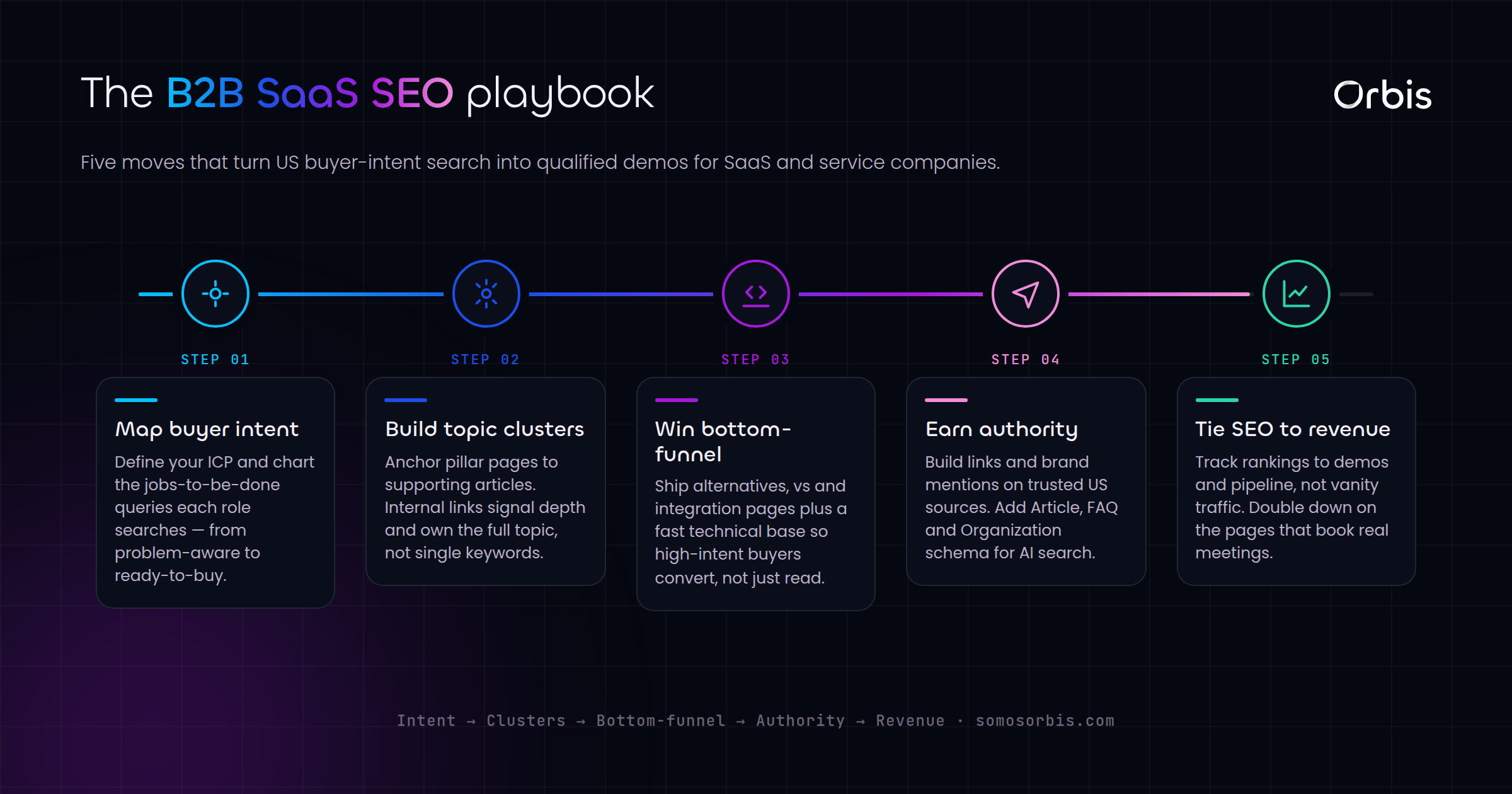
A B2B SEO strategy is not a content calendar. It is a revenue engine: map buyer intent, build bottom-funnel pages that convert, own comparison search, capture existing demand, and back it all with authority and clean technical foundations. Do this consistently and organic search becomes your most predictable source of qualified pipeline.
If you want a partner who builds this system with documented processes and accountability, explore our B2B SEO services. We help US SaaS and service companies turn high-intent search into booked demos and closed revenue, without guesswork or vanity metrics. Let's build your content engine.