
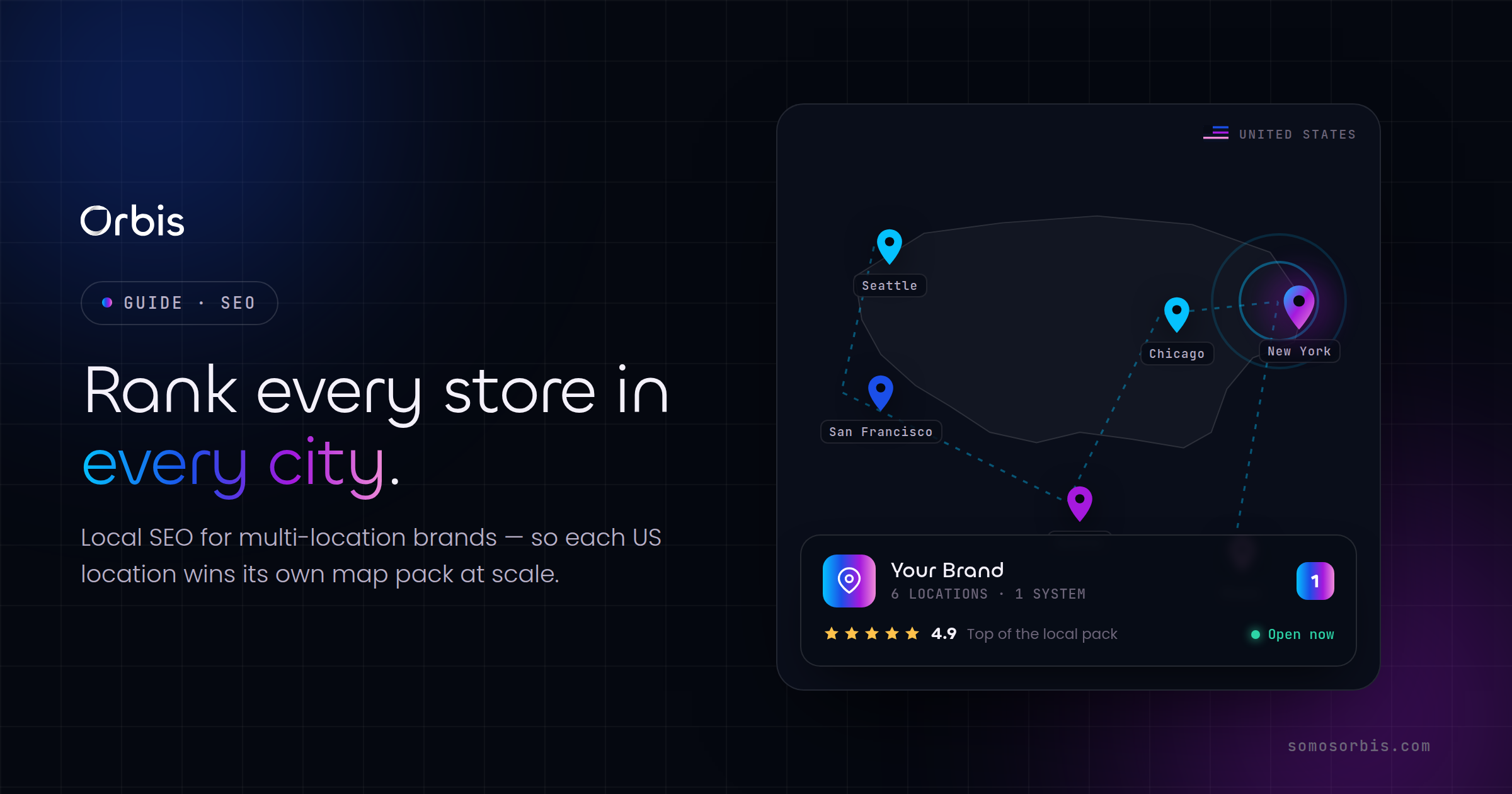
If your brand operates storefronts, clinics, dealerships, or service hubs in New York, Los Angeles, Chicago, Miami, Dallas, and Houston, you are not running one SEO campaign. You are running dozens of them at once. Every location competes in its own local pack, against its own neighborhood rivals, judged by its own pool of reviews. A national brand identity earns you trust, but it does not win the three-pack in Wynwood or River North. Local SEO does.
The hard truth for multi-location operators is that local search rewards specificity and consistency in equal measure. You need every location to feel distinctly local while the brand stays uniformly recognizable. That tension is where most multi-location programs break: either they centralize everything and locations read as generic, or they decentralize and the brand fragments into chaos. This guide lays out a practical, repeatable system to win local visibility at scale across US cities, built on Google Business Profiles, reviews, and city landing pages.
Why multi-location local SEO is a different game
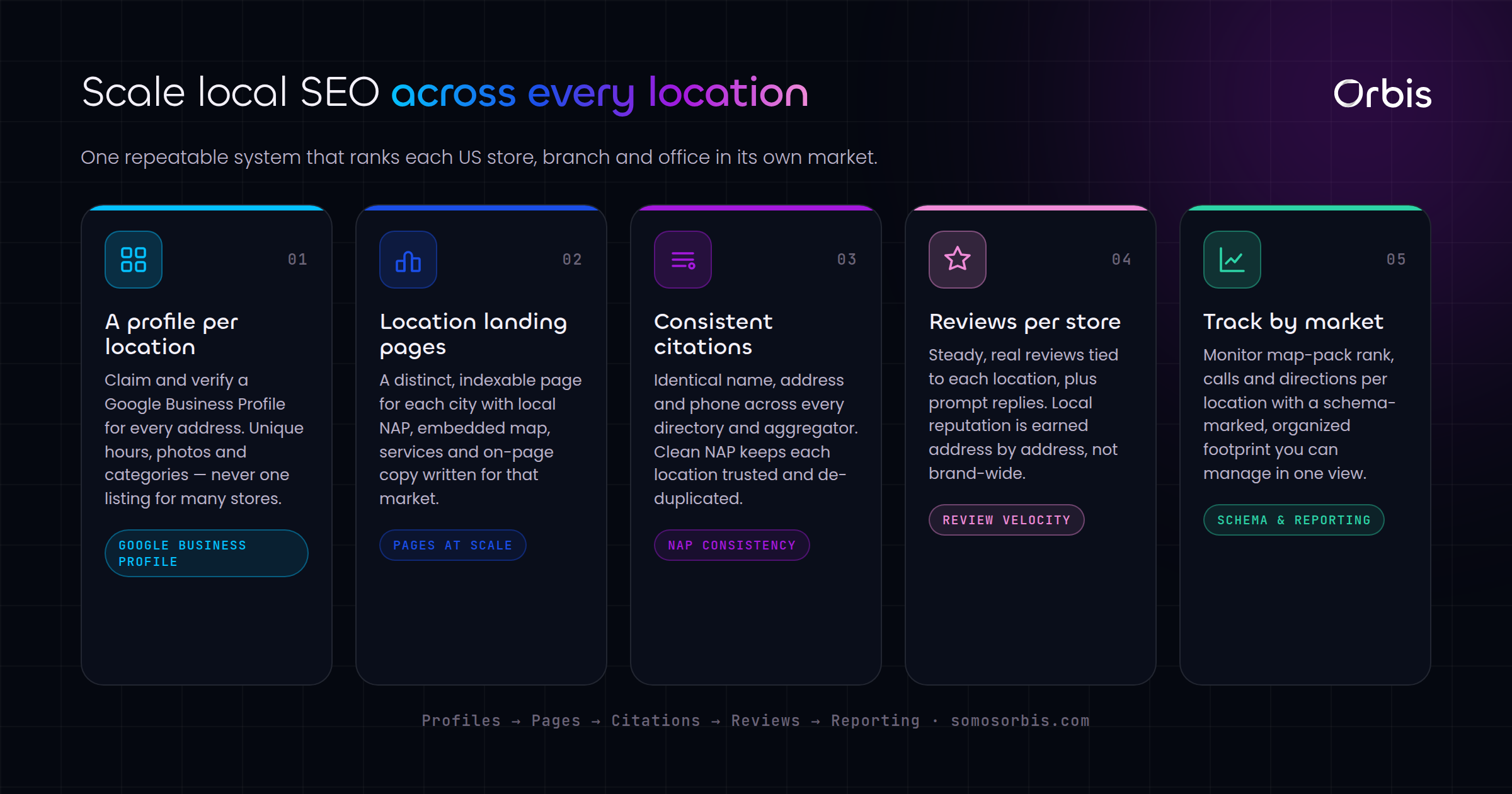
Single-location local SEO is mostly about getting one Google Business Profile right and earning steady reviews. Multi-location is an operations problem disguised as a marketing problem. You are managing data integrity across hundreds of listing fields, coordinating review responses across time zones from Miami to Los Angeles, and publishing landing pages that each have to rank for a different "[service] near me" query.
Three forces make this complex:
- Proximity dominates the local pack. Google heavily weights how close the searcher is to your physical location. A flawless profile in Houston does nothing for a searcher in Dallas. You have to win each market on its own merits.
- Duplicate and inconsistent data spreads fast. When you have 40 locations, a single misspelled street suffix or an old phone number gets syndicated across data aggregators and is painful to claw back.
- Local intent shifts with seasonality and geography. A retail brand sees "Black Friday hours near me" spikes the week of Thanksgiving, while a tax-prep service spikes in February and March, and a back-to-school retailer surges in late July. Each city behaves slightly differently.
The brands that win treat this as a documented, audited process rather than a series of one-off fixes. If you want the broader strategic context for how local fits into your full search program, start with our complete SEO guide for US businesses in 2026, then come back here for the location-by-location execution.
Get your NAP and listing data bulletproof first
NAP stands for Name, Address, Phone. It sounds trivial. It is the single most common reason multi-location brands underperform in local search. If your Chicago location is listed as "Suite 200" on Google, "Ste 200" on Apple Maps, and "#200" on a data aggregator, search engines lose confidence that these refer to the same real-world business.
Build a single source of truth
Before you touch a single profile, build one master spreadsheet or database that holds the canonical record for every location: exact legal name, standardized address format, local phone number, store hours, geo-coordinates, and category. Every downstream listing pulls from this record. No exceptions.
- Use local phone numbers, not a national 800 line. A New York location should show a number with a New York area code. This reinforces local relevance and earns customer trust.
- Standardize address formatting to match USPS conventions and apply it identically everywhere.
- Decide your naming convention up front. "Brand Name – Dallas Uptown" is fine; "Brand Name Dallas Uptown Best Deals" is keyword stuffing and risks suspension.
Audit your citations
Citations are mentions of your NAP across directories, aggregators, and local sites. For multi-location brands, audit the big data aggregators that feed the broader ecosystem, plus vertical directories relevant to your industry. Correct inconsistencies at the source so the fixes propagate. This is unglamorous work, but it is the foundation everything else sits on.
Optimize Google Business Profiles at scale
Your Google Business Profiles (GBP) are the heart of local pack visibility. Each location needs its own claimed, verified, and fully optimized profile. "Fully optimized" means more than filling in the address.
The per-location optimization checklist
- Primary and secondary categories. Choose the most specific primary category that matches the location's core service. Add relevant secondary categories without diluting focus.
- Services and products. Populate the services list with the offerings that location actually provides, described in plain language a customer would search.
- Photos that look local. Upload real photos of that specific storefront, team, and interior. A Miami location with Miami photos outperforms one using stock or headquarters imagery.
- Hours, including special hours. Set holiday hours ahead of time. For US retail, that means confirming Black Friday, Cyber Monday week, and the December holiday schedule for every location well in advance.
- Q&A and attributes. Seed common questions with accurate answers and set attributes (wheelchair accessible, free parking, identifies-as, language spoken) honestly.
Use Google Posts to signal freshness and seasonality
Google Posts let each location publish timely updates. Use them to localize seasonal moments: a Los Angeles location can post a back-to-school promotion in late July, a Dallas location can promote tax-season service availability in February, and every location can publish Amazon Prime Day or Black Friday hours and offers. Fresh, location-specific posts signal that the profile is actively managed, which correlates with stronger performance.
At scale, you will want to manage this through the GBP API or a trusted listings platform rather than logging into each profile by hand. The goal is consistent cadence without sacrificing the local voice. For the e-commerce side of seasonal peaks, our guide to e-commerce SEO for Black Friday and Cyber Monday covers how to align your online demand spikes with in-store local intent.
Build city landing pages that actually rank
City and location landing pages are where multi-location SEO scales beyond Google Business Profiles. Done well, they capture searchers who use branded plus geographic queries and "[service] in [neighborhood]" searches. Done poorly, they become thin, duplicated doorway pages that Google ignores or penalizes.
What separates a strong location page from a doorway page
- Genuinely unique content. Each page should reference the specific neighborhood, parking and transit details, the local team, and services unique to that location. A New York page mentioning subway access reads differently from a Houston page mentioning highway access, and that difference is the point.
- Embedded NAP and map. Show the exact address, local phone, hours, and an embedded map for that single location.
- Location-specific reviews and proof. Pull in reviews tied to that location, not a brand-wide average.
- LocalBusiness structured data. Implement schema markup for each location with the precise address, geo-coordinates, hours, and price range so search engines can parse the entity cleanly.
- A clear local CTA. "Get directions," "Call this store," and "Book at this location" beat a generic national contact form.
Structure your URLs and internal links logically
Use a clean, predictable URL hierarchy such as /locations/texas/dallas/uptown/. Link from a state hub to city hubs to individual locations, and link each location page back up the chain. This crawlable structure helps search engines understand your geographic footprint and distributes authority sensibly.
If a meaningful share of your customers in a given market speak Spanish, build bilingual location pages rather than English-only ones. Reaching the large US Hispanic market in both EN and ES is a real competitive edge in cities like Los Angeles, Houston, Miami, and Dallas. Our guide to bilingual SEO for the US Hispanic market walks through how to do this without creating duplicate-content problems.
Turn reviews into a local ranking and conversion engine
Reviews influence both your local pack ranking and the click decision once you appear. For multi-location brands, reviews are also a management challenge because volume, sentiment, and response speed vary wildly between a high-traffic Manhattan store and a quieter suburban Chicago location.
A review system that scales
- Make asking systematic, not random. Build review requests into the post-purchase or post-service moment at every location, triggered by your CRM or point-of-sale, so the ask is consistent across cities.
- Respond to every review, fast. Reply to both positive and negative reviews at the location level. A thoughtful response to a one-star review in Miami protects that location's reputation and signals active management to Google.
- Watch for review velocity by season. Volume naturally rises during peak periods like Black Friday and the holidays. A sudden drop-off afterward is normal; a sudden unexplained spike of similar reviews is a red flag worth investigating.
- Never gate or buy reviews. Filtering for only happy customers or purchasing reviews violates platform policy and puts your profiles at risk. Earn them honestly through quality processes.
The brands that win local at scale do not treat reviews as a vanity metric. They treat them as a documented feedback loop that improves both ranking and the actual customer experience at each location.
Respect privacy while you localize and personalize
Multi-location programs collect a lot of customer data to power review requests, local offers, and location-based personalization. As you scale across US states, build privacy into the system from the start. Honor opt-out and data-access requests, be transparent about what you collect, and align your consent and tracking practices with current US privacy norms. Doing this by design, rather than bolting it on later, protects the brand and keeps your local marketing durable as regulations evolve.
Measure what matters across locations
You cannot manage 40 locations by gut feel. Set up reporting that lets you compare performance market by market and spot the laggards.
- Local pack rankings by location and keyword, tracked from the searcher's likely geography, not your office.
- GBP insights: profile views, calls, direction requests, and website clicks per location.
- Conversions from local landing pages, segmented by city so you can see which markets convert and which need work.
- Review volume, average rating, and response time per location, reviewed monthly.
Roll these into a single dashboard so a regional manager in Chicago and a brand lead in New York are looking at the same numbers. When every location is measured the same way, underperformers become obvious and fixes become prioritized rather than reactive.
A 90-day rollout plan for multi-location brands
- Days 1–30: Foundation. Build the master NAP database, audit and correct citations, and claim or verify every Google Business Profile.
- Days 31–60: Optimization. Fully optimize each GBP, launch the systematic review-request program, and ship the first wave of unique city landing pages with LocalBusiness schema.
- Days 61–90: Scale and localize. Roll out bilingual pages where the market warrants, establish a Google Posts cadence tied to US seasonality, and stand up your cross-location reporting dashboard.
Treat this as a living program, not a project with an end date. Local search shifts constantly, and the brands that stay disciplined about data integrity, review cadence, and fresh local content keep their lead.
Related guides
- The Complete SEO Guide for US Businesses in 2026 — the pillar overview that frames where local SEO fits.
- E-commerce SEO for Black Friday and Cyber Monday in the US — aligning online demand spikes with in-store local intent.
- Bilingual SEO: Reaching the US Hispanic Market in EN and ES — capturing Spanish-speaking searchers across major US cities.
Ready to win local in every market you serve?
Multi-location local SEO is an operations discipline. It rewards brands that document their processes, audit their data, and execute consistently across every city. That is exactly how we work. Orbis is a Google Partner with a 4.9-star rating across 58 reviews, more than 500 clients, and over 15 years of experience helping brands turn complexity into measurable revenue.
If you operate locations across New York, Los Angeles, Chicago, Miami, Dallas, Houston, and beyond, our team can build and run the system that wins your local packs at scale. Explore our local SEO services and let's map out a plan tailored to every market you serve.