
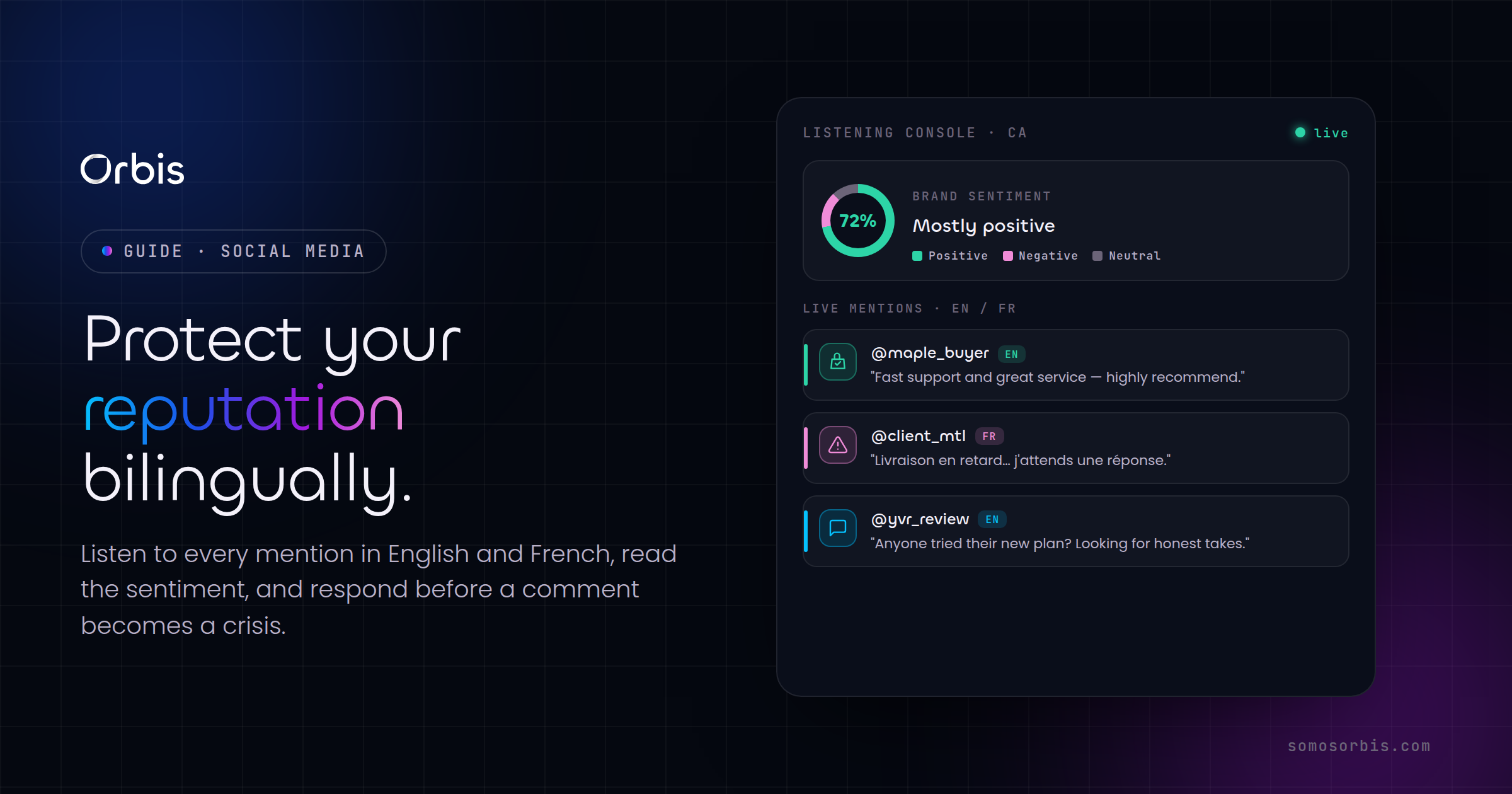
Every Canadian brand has two reputations: the one it broadcasts and the one its customers describe to each other. The second one lives in Google reviews, Reddit threads, French-language Facebook groups, X replies, app store ratings, and the comments under your own posts. Social listening is how you hear that second reputation in real time, and reputation management is how you respond before a single frustrated comment in Montreal or a slow-burning thread in Vancouver hardens into a story your prospects read before they ever reach your website. For companies operating across English and French Canada, the challenge is not just volume. It is doing this work credibly in two languages, across two cultural contexts, without sounding like a corporate template ran through a translation tool. This guide walks through how to set up listening that actually catches what matters, how to manage your reputation bilingually, and how to turn the signal into something your whole team can act on.
What Social Listening Actually Means (and What It Doesn't)
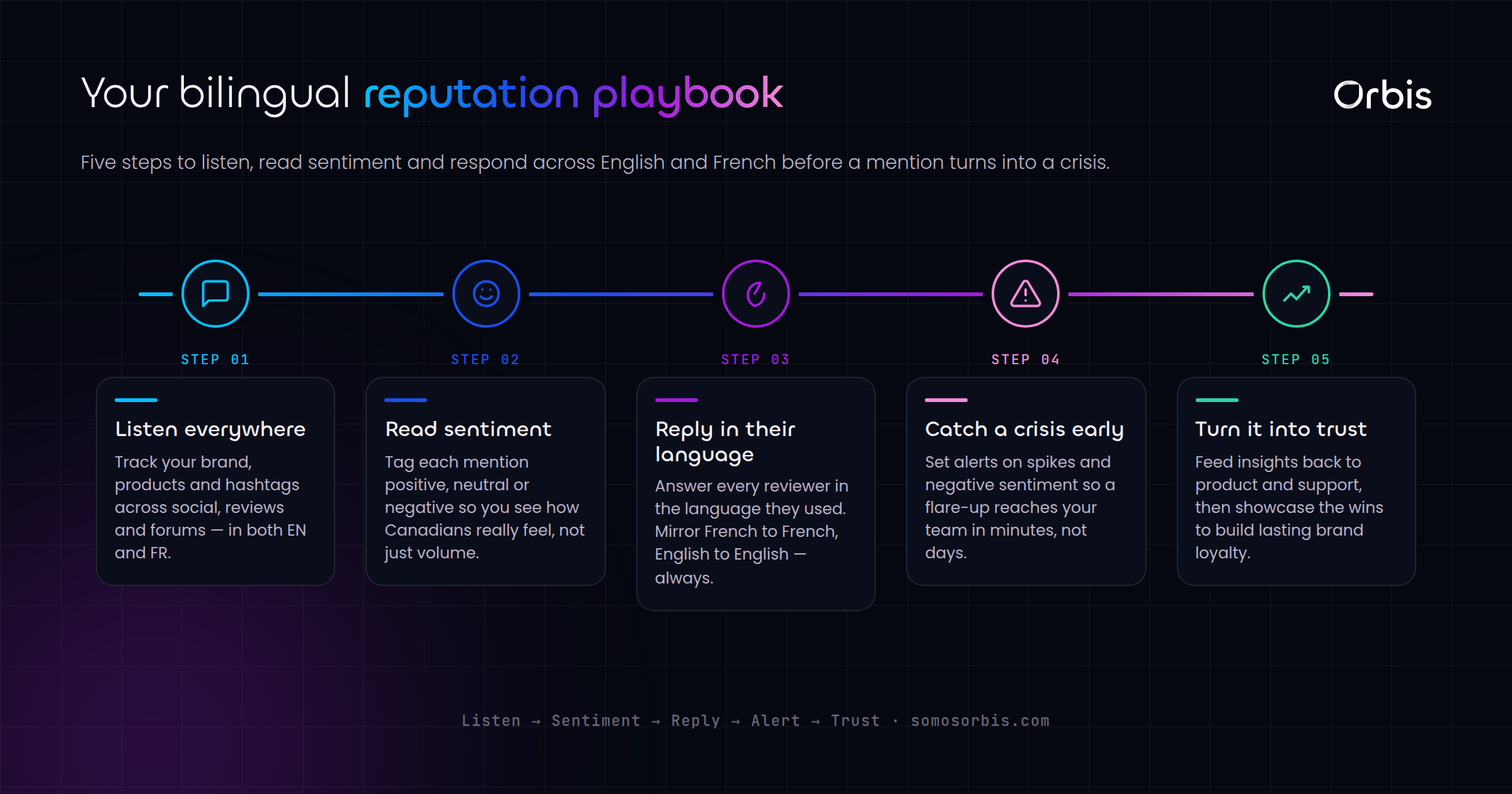
Social listening is often confused with social monitoring, and the difference matters for how you staff and budget the work. Monitoring is reactive: you watch your mentions, tags, and direct messages and respond to them. Listening is broader and more strategic. It tracks conversations that never tag you at all, the unbranded discussions where someone asks “has anyone in Calgary actually used a company like this?” or vents about a category problem your product solves. Most of the conversations that shape your reputation in Canada happen without your handle attached. If you only monitor mentions, you are hearing a fraction of what is being said.
A practical listening program tracks several distinct streams:
- Direct brand mentions — your company name, product names, executives, and common misspellings, in both languages.
- Unbranded category conversations — people discussing the problem you solve, asking for recommendations, or comparing options without naming anyone.
- Competitor mentions — what customers praise and complain about elsewhere, which tells you where to differentiate.
- Review platforms — Google Business Profile, the App Store and Google Play, industry-specific review sites, and sector directories.
- Sentiment and tone — not just what is said, but whether it trends positive, negative, or neutral over time.
Listening is the diagnostic layer that sits underneath your whole social presence. It is closely tied to the broader strategy work covered in our complete guide to social media management in Canada, which is the pillar this article sits within. If you are building a social program from scratch, start there for the strategic frame, then come back here to operationalize the listening and reputation side.
Why Bilingual Listening Is Non-Negotiable in Canada
Roughly one in five Canadians speaks French at home, and in Quebec the proportion flips entirely. A brand that listens only in English is deaf to a market of millions and, worse, blind to the moments when its reputation is being shaped in French. The risks are not symmetrical. A complaint that goes unanswered in English is a missed opportunity. A complaint that goes unanswered in French can read as cultural indifference, which carries a heavier reputational cost in Quebec, where language is tied to identity and where consumer-protection expectations are high.
Bilingual listening means more than running your monitoring tool with French keywords added. It requires:
- Native-quality French comprehension — Quebec French uses distinct expressions, slang, and product terminology that European French dictionaries and generic translation tools routinely miss. “Magasiner” means to shop; a tool trained on France French may not flag it.
- Separate sentiment baselines per language — tone, sarcasm, and politeness norms differ. What reads as neutral in English Canada can read as curt in Quebec, and vice versa.
- Keyword sets built in both languages from scratch — not translated. Your French keyword list should be authored by someone who lives in the market, capturing how real customers phrase complaints and recommendations.
- Routing rules that send French conversations to French-capable responders — a delayed, machine-translated reply is often worse than a slightly slower human one.
Compliance adds another layer. Quebec's language regulations shape how brands are expected to communicate, and operating with documented, language-aware processes is part of doing business credibly there. We treat this as a Business Assurance question rather than a marketing afterthought: the listening and response workflow should be designed so that French-language obligations are met by default, not patched in after a complaint surfaces.
Building Your Listening Stack
You do not need the most expensive enterprise suite to listen well. You need the right combination of tools and, more importantly, the right keyword architecture and routing. Here is how to assemble it.
1. Define Your Keyword Architecture
Start with three concentric rings. The inner ring is exact brand terms: company name, product names, key people, handles, and misspellings, in English and French. The middle ring is category and intent terms: phrases people use when they are shopping for what you sell or complaining about the category. The outer ring is competitor and adjacent terms. Build each ring twice, once per language, with native input on the French side. Review the lists monthly, because the way people talk shifts with seasons, campaigns, and news cycles.
2. Map Your Channels to the Canadian Reality
Canadian conversation does not distribute evenly across platforms. Reddit communities tied to Canadian cities are unusually active and influential for recommendations. Facebook Groups remain central for local and French-language community discussion. Google reviews carry heavy weight for any business with a local footprint. Industry-specific forums and review sites matter more in B2B. Prioritize the channels where your customers actually gather rather than spreading attention thin across every platform.
3. Set Sentiment and Alert Thresholds
Configure alerts so that a sudden spike in negative mentions, a review below a certain rating, or any mention of safety, legal, or compliance terms escalates immediately to a human. Routine positive mentions can batch into a weekly digest. The goal is to separate signal from noise so your team responds fast to what matters and is not buried under what doesn't.
4. Establish Response SLAs by Channel and Language
Decide, in advance, how quickly you respond on each channel in each language, and who owns it. A public complaint on X has a different clock than a Google review, which has a different clock than a DM. Document these service levels so response time is a process, not a personality trait of whoever happens to be online.
From Listening to Reputation Management
Listening tells you what is being said. Reputation management is what you do about it. The two functions are continuous, and the handoff between them is where most brands fail. A glowing comment that no one acknowledges is a missed relationship. A complaint that sits for two days is a reputation event. The discipline of responding consistently and well is squarely a community management function, which we cover in depth in our guide to community management for Canadian brands. Listening feeds the queue; community management works it.
A Tiered Response Framework
Not every mention deserves the same treatment. Sort incoming conversation into tiers so your team knows how to act:
- Praise and advocacy — acknowledge, thank, and where appropriate amplify. These are your most underused asset. A customer who recommends you unprompted in a Toronto subreddit is worth more than any ad.
- Questions and confusion — answer helpfully and publicly so the next person searching finds the answer. Every public answer is reusable content.
- Routine complaints — acknowledge fast, take the detail offline if it requires account information, and close the loop publicly once resolved.
- Escalations and crises — anything touching safety, legal exposure, discrimination, or a viral negative thread goes to a named owner with a documented playbook.
How to Respond to Negative Reviews
Negative reviews are not a problem to be hidden; they are a public audition. Prospects read how you handle criticism far more closely than they read the criticism itself. A strong response follows a consistent shape:
- Respond in the language the reviewer used. If they wrote in French, reply in French, fully and correctly.
- Acknowledge the specific issue rather than pasting a generic apology. Specificity signals you actually read it.
- Take responsibility where it is warranted, without defensiveness or legal hedging that reads as cold.
- Offer a concrete next step and a direct channel to resolve it.
- Keep it brief. Long public replies look like litigation; short, human ones look like care.
One genuine, well-handled negative review can build more trust than a wall of five-star ratings, because it proves the positive reviews are real and that you stand behind your service.
Crisis Readiness for the Canadian Context
Most reputation crises are slow before they are fast. A single complaint gets a poor reply, the reply gets screenshotted, and a thread builds momentum over hours. Listening buys you those hours. The brands that come through well are the ones that prepared before the storm, not the ones that improvised during it.
A workable crisis kit includes:
- A monitoring trigger — the volume or sentiment threshold that flips you from routine response to crisis mode.
- A named decision-maker — one person who can approve public statements quickly, with a backup.
- Pre-approved holding statements in both languages — drafted, reviewed, and ready, so the first response is minutes away, not hours.
- A clear escalation path — who gets pulled in, in what order, and how the team communicates internally during the event.
- A post-event review — a documented debrief that turns every incident into an improvement to the process.
The bilingual requirement is sharpest in a crisis. An English-only statement during an incident that affects French-speaking customers reads as exclusion at exactly the moment goodwill is most fragile. Holding statements must exist in both languages before you need them, drafted by people who write naturally in each.
Turning Listening Into Strategy
The highest return on a listening program is not faster complaint handling, valuable as that is. It is the intelligence. Aggregated over weeks, your listening data tells you which features customers actually praise, which objections recur, which competitor weaknesses you can address, and which seasonal moments — back-to-school, the holidays, Boxing Day — spike both demand and scrutiny. That intelligence should flow into your content calendar, your product roadmap, and your sales talking points.
This is also where listening connects to measurement. Sentiment trend, share of voice against competitors, response time, and resolution rate are reputation metrics that belong in your reporting alongside reach and engagement. We lay out how to structure that measurement in our guide to social media reporting and ROI, so that the reputation work you do is visible, defensible, and tied to business outcomes rather than treated as an unmeasurable cost centre.
Practically, build a monthly listening report that answers four questions: What did people say about us? How did sentiment move, by language? What did we learn about the market and our competitors? And what are we changing as a result? When that report lands on the desk of someone who can act on it, listening stops being a defensive chore and becomes a source of advantage.
Putting It Together: A 30-Day Start
If you are starting from nothing, you do not need to boil the ocean. A focused first month gets you to a working program:
- Week 1 — build your bilingual keyword architecture and connect your core channels and review platforms.
- Week 2 — set alert thresholds, define response SLAs by channel and language, and assign owners.
- Week 3 — draft your tiered response framework and pre-approved holding statements in English and French.
- Week 4 — run your first monthly listening report and hold a short debrief to refine the keywords and routing.
From there, the program compounds. Each month the keyword lists get sharper, the response templates get better, and your team's instinct for what matters gets faster.
Protect Your Brand in Both Languages
Reputation in Canada is bilingual whether you manage it that way or not. Customers are already talking about your brand in English and in French, on platforms you may not be watching, in moments you cannot afford to miss. A documented, bilingual listening and response program turns that exposure into an advantage: faster resolution, stronger trust, and a steady stream of market intelligence your competitors are ignoring.
Orbis builds and runs bilingual social listening and reputation programs for Canadian companies, with documented processes designed to meet French-language expectations by default and turn every conversation into something your team can act on. Explore our social listening and reputation management service to see how we protect your brand across English and French Canada — and talk to us about putting a real listening system in place before the next conversation about you starts without you.