
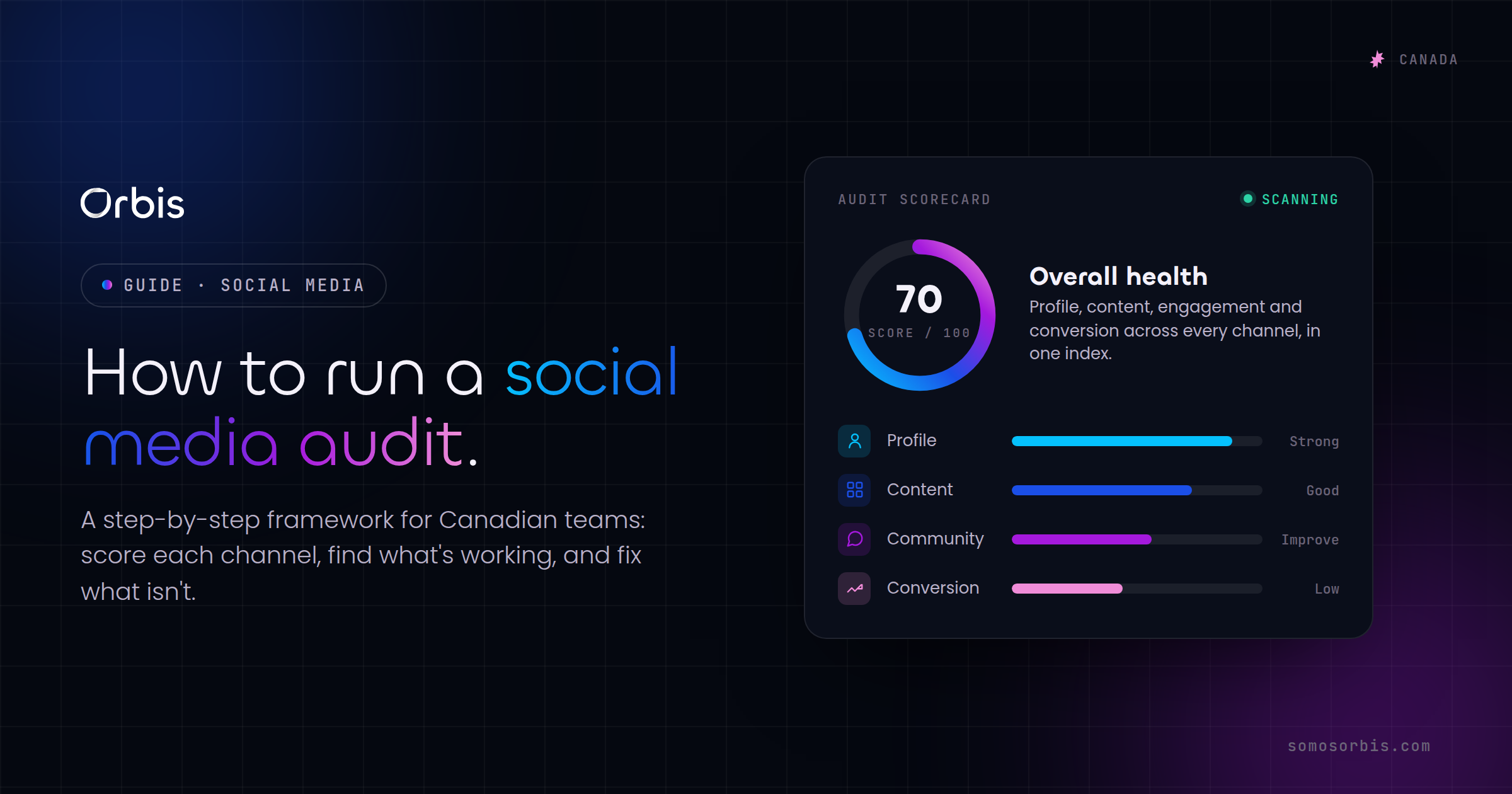
Most Canadian marketing teams run their social channels for years without ever stepping back to ask a simple question: are these accounts actually pulling their weight? A social media audit answers that question with evidence instead of opinion. It is the disciplined, once-or-twice-a-year exercise where you inventory every channel, measure what is working, document what is broken, and benchmark yourself against the competitors your customers are already comparing you to. Done well, it gives you a clean baseline before you replan your strategy, reallocate budget, or brief a new content calendar. Done poorly — or skipped entirely — you end up posting on autopilot into channels that quietly stopped earning their place months ago.
This guide lays out a step-by-step framework built for Canadian teams: bilingual EN/FR considerations, CAD-denominated budgets, and the seasonal rhythms (Boxing Day, back-to-school, the long holiday run-up) that shape engagement north of the border. It pairs naturally with our broader guide to social media management in Canada, which covers the day-to-day operating model an audit ultimately feeds into.
What a social media audit actually is (and isn't)
An audit is not a vanity report. It is not screenshotting your follower count and calling it a day. A real audit is a structured review of three things at once: your channels (do you own them, are they secured, are they on-brand), your content and performance (what formats and topics earn attention and action), and your competitive context (how you stack up against the brands fighting for the same Canadian feed). The output is a prioritized list of decisions — keep, fix, double down, or kill — plus a clean set of baseline numbers you can measure future work against.
Think of it as the diagnostic step that comes before any replanning. You would not rebuild a content calendar without knowing which posts already convert, and you would not ask for more budget without knowing your current cost per result. The audit produces exactly those inputs.
When to run an audit
- Quarterly light-touch, annual deep-dive. A full audit once a year, with a lighter performance check each quarter, keeps you honest without becoming a burden.
- Before a replan or budget cycle. If you are about to set next year's CAD social budget, audit first so the numbers are grounded in reality.
- Ahead of peak season. Run it in early autumn so your findings are actionable before the back-to-school and holiday-into-Boxing-Day surge, when Canadian retail and ecommerce engagement peaks.
- After a team or agency change. New ownership of the channels is the right moment to inventory access, passwords, and brand consistency.
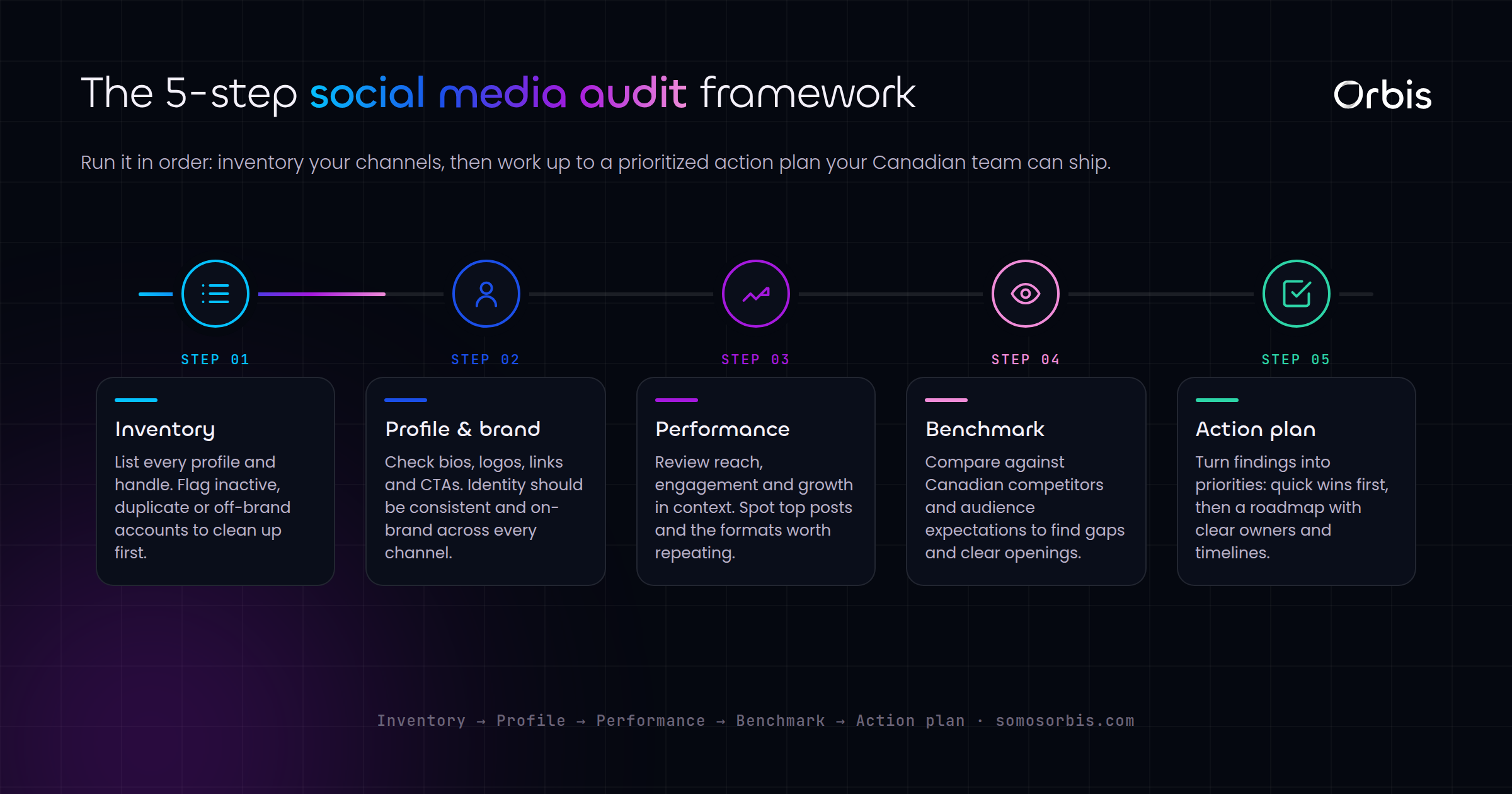
Step 1 — Inventory every channel you own (and the ones you forgot)
Start by listing every profile that carries your brand name: Instagram, Facebook, LinkedIn, TikTok, Pinterest, YouTube, X, and any regional or French-language variants. Canadian brands frequently accumulate orphaned accounts — an old @brand-FR page, a campaign-specific handle, a duplicate Facebook page created by a well-meaning franchise location. Each one dilutes your presence and can confuse customers.
For every channel, record:
- The exact handle and URL.
- Who has admin access (and whether anyone who left still does — a real security gap).
- Whether the profile is verified, complete, and on-brand (logo, bio, link, pinned content).
- Follower count and the date you recorded it, so you have a baseline.
- Whether it is bilingual-ready. If you serve Quebec or market federally, a profile that ignores French is leaving reach and trust on the table.
Flag duplicates and dormant accounts for consolidation or closure. A tidy channel list is the foundation everything else sits on.
Step 2 — Confirm your goals and the metrics that prove them
You cannot judge performance without knowing what each channel is supposed to do. Tie every active profile to one primary objective — awareness, community, lead generation, or direct sales — and choose the metrics that actually reflect that objective rather than the ones that are easiest to screenshot.
Map metrics to the funnel
- Awareness: reach, impressions, follower growth rate, share of voice.
- Engagement: engagement rate per reach (not per follower), saves, shares, comment quality.
- Traffic: link clicks, click-through rate, sessions from social in your analytics.
- Conversion: leads, sign-ups, sales, and cost per result in CAD.
Vanity metrics like raw follower count tell you almost nothing on their own. A 40,000-follower account with a 0.3% engagement rate is weaker than a 6,000-follower account at 4%. If you want a deeper treatment of which numbers to report and how to tie them to revenue, our piece on social media reporting and ROI walks through building a dashboard executives will actually trust.
Step 3 — Audit your content and performance
This is the heart of the exercise. Pull the last 90 to 180 days of posts per channel and analyze them as a set, not one at a time. You are hunting for patterns.
Group your content by type and topic
Tag every post by format (carousel, short video, single image, story, live) and by theme (product, educational, behind-the-scenes, user-generated, promotional, seasonal). Then sort by your primary metric. Within an hour you will usually see the truth: one or two formats and a couple of themes are doing most of the heavy lifting, and a long tail of posts is earning almost nothing.
Questions to answer
- Which formats consistently outperform? Short-form video almost always over-indexes — is your mix reflecting that?
- What is your real posting cadence versus your intended one? Gaps and bursts both hurt.
- How did seasonal content perform? Look specifically at your back-to-school, holiday, and Boxing Day posts — these are your highest-stakes Canadian moments and deserve their own line in the analysis.
- Are bilingual posts performing differently from English-only ones in the markets where you run both?
- What is your best-ever post in the window, and can you articulate why it worked? That insight is worth more than any single number.
The goal of the content audit is not to grade individual posts. It is to find the repeatable patterns you can scale and the dead weight you can stop producing.
Build a content calendar from the evidence
Your audit findings should flow directly into your forward plan. Once you know which formats, themes, and posting rhythms work, codify them. Our walkthrough on building a social content calendar for Canadian brands shows how to turn these patterns into a repeatable schedule that accounts for Canadian holidays and bilingual production timelines.
Step 4 — Benchmark against your competitors
Your performance numbers only mean something in context. A 2% engagement rate might be excellent in your category or mediocre — you cannot know until you look outside your own walls. Pick three to five direct competitors and a couple of aspirational brands in your space, ideally ones competing for the same Canadian audience.
For each, record the publicly visible signals:
- Which channels they are active on, and where they have clearly given up.
- Posting frequency and dominant content formats.
- Rough engagement levels on their top posts versus their average.
- How they handle French-language content and Canadian seasonal moments.
- Tone, positioning, and the offers or CTAs they push hardest.
You are not trying to copy them. You are looking for white space — formats they ignore, audiences they underserve, seasonal moments they fumble — that you can own. Competitive benchmarking also gives leadership a defensible reference point when you ask for budget or headcount.
Step 5 — Check the technical and compliance layer
The least glamorous part of an audit is often where the real risk hides. Take the time to confirm:
- Access and security: two-factor authentication on every account, a documented list of who holds admin rights, and no lingering access from former staff or agencies.
- Link integrity: every bio link, UTM-tagged campaign link, and pinned CTA actually resolves and points where it should.
- Tracking: pixels, conversion tags, and analytics are firing correctly so the numbers you are auditing are trustworthy in the first place.
- Advertising and disclosure practices: sponsored content, contests, and influencer partnerships should follow current Canadian regulations and platform rules — clear disclosure, accurate claims, and compliant contest terms. Building this into your documented process protects the brand long before a complaint ever lands.
This compliance-by-design mindset — bake the quality processes into how you operate rather than scrambling after the fact — is what separates a social program that scales cleanly from one that accumulates risk.
Step 6 — Synthesize findings and prioritize actions
An audit that ends in a spreadsheet nobody reads is wasted effort. Translate your findings into a short, prioritized decision list. For every channel and major content theme, assign one of four verdicts:
- Double down — it works; give it more resources.
- Fix — it has potential but something is broken (cadence, format, targeting, bilingual gap).
- Maintain — it is fine as-is; do not over-invest.
- Kill or consolidate — it is not earning its place; redirect that energy.
Rank the actions by impact and effort so the team knows what to tackle first. Pair each decision with the baseline number you captured, so the next audit can measure whether the change actually moved anything. That before-and-after discipline is what turns a one-time audit into a compounding advantage.
A simple audit checklist to keep handy
- Every branded channel inventoried, with access and security confirmed.
- Duplicate and dormant accounts flagged for consolidation.
- Each active channel mapped to one clear objective and the right metrics.
- 90–180 days of content analyzed by format and theme.
- Seasonal performance (back-to-school, holidays, Boxing Day) reviewed explicitly.
- Bilingual EN/FR performance compared where relevant.
- Three to five competitors benchmarked for white space.
- Links, tracking, and compliance verified.
- Findings turned into a ranked keep/fix/maintain/kill decision list.
- Baseline numbers recorded for the next audit.
Turn your audit into a plan
A social media audit is only valuable if it changes what you do next. Once you have your baseline, your competitive picture, and your prioritized decisions, you are ready to replan with confidence instead of guesswork. If you would rather have an experienced team run the diagnostic for you — inventory, benchmarking, compliance check, and a clear action plan delivered in plain language — explore our social media audit service for Canadian teams. We will hand you the evidence and the roadmap, so your next quarter of content is built on what actually works rather than what you have always done.