
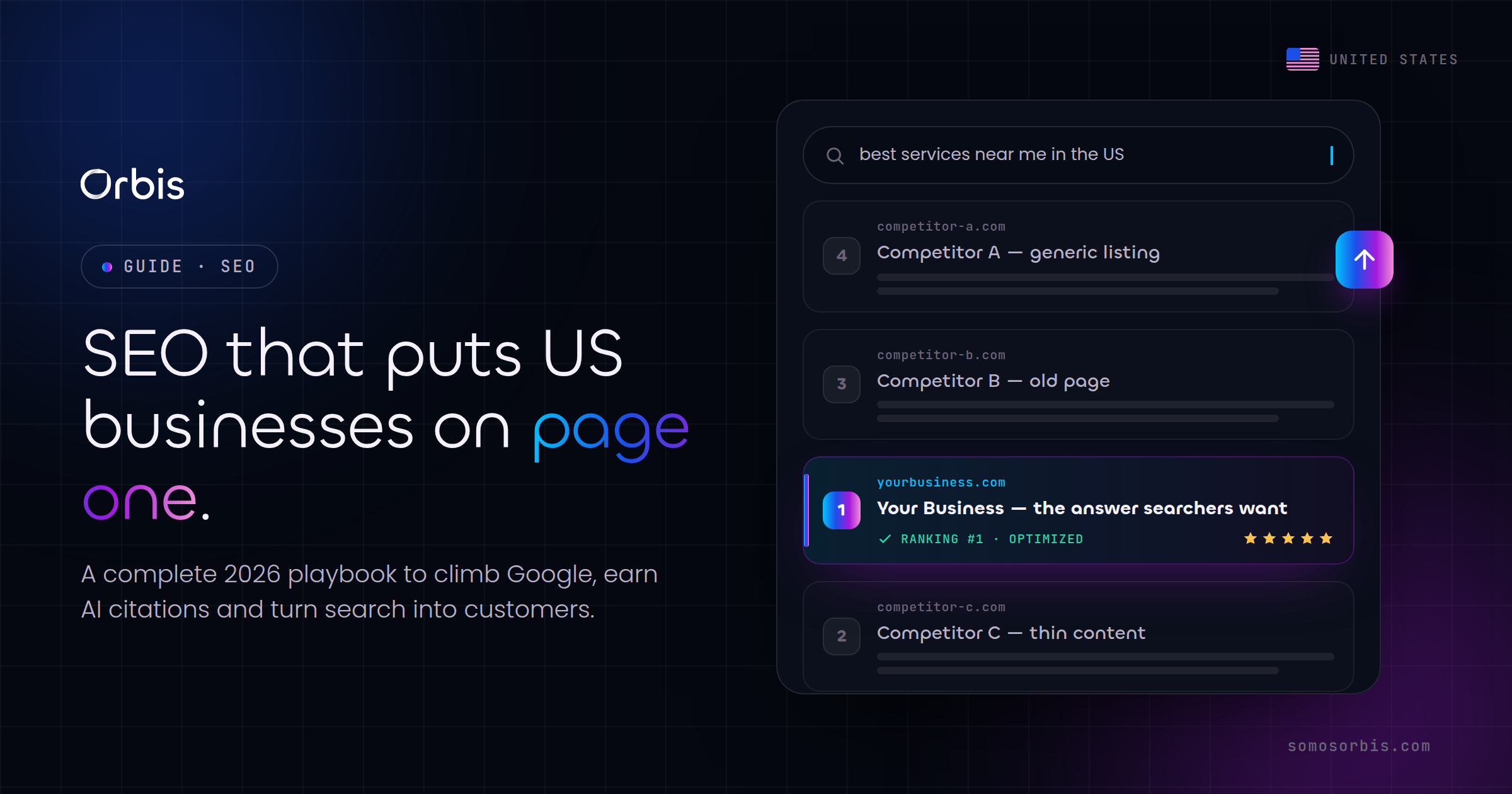
If you run a business that competes for attention in markets like New York, Los Angeles, Chicago, Miami, Dallas, or Houston, search is no longer a side channel. It is the front door. The way Americans discover plumbers, law firms, SaaS platforms, restaurants, and online stores has fundamentally shifted, and 2026 is the year the rules changed for good. Classic blue links now share the page with AI Overviews, local map packs, shopping carousels, and answer boxes that resolve a query before a single click happens. Winning here is not about chasing one trick. It is about building a durable system.
This guide is the pillar. It is the map of the whole territory: local search, e-commerce, B2B and SaaS, link building, international expansion, AI answer engines, and bilingual reach into the large US Hispanic market. Each of those areas is deep enough to deserve its own playbook, and we link to those deeper guides throughout. Read this top to bottom to understand how the pieces fit, then dive into the specific guide that matches your next priority.
At Orbis, we have spent more than fifteen years building revenue engines for over five hundred clients, and the pattern is always the same: SEO that lasts is engineered, documented, and measured, not improvised. As a Google Partner with a 4.9-star rating across 58 reviews, we treat search as an operating system, not a campaign. Let's build yours.
What SEO Actually Means for a US Business in 2026
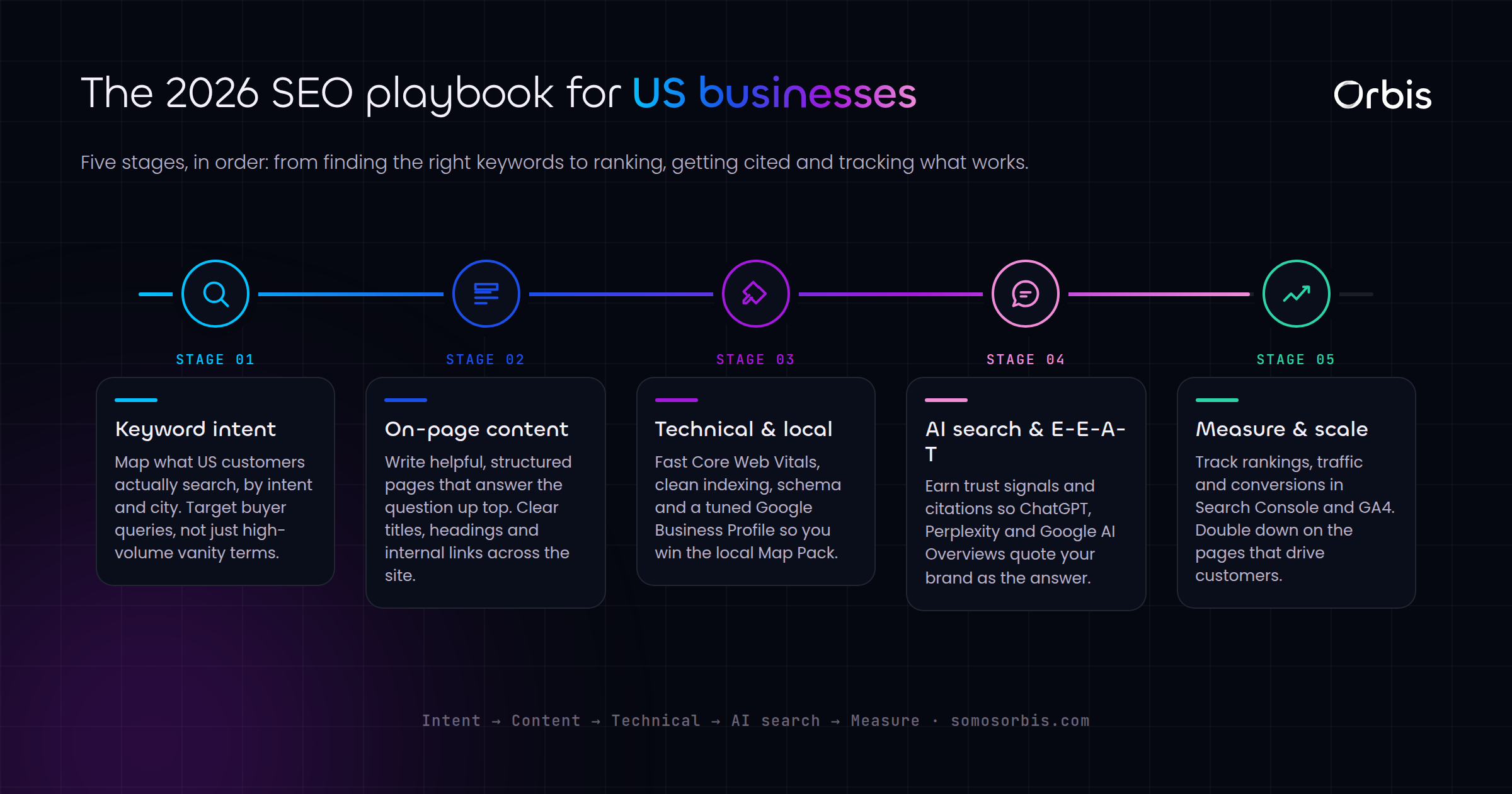
Search engine optimization used to be a fairly contained discipline: pick keywords, write pages, earn links, watch rankings. That definition is now dangerously incomplete. In 2026, organic visibility is fragmented across surfaces that each have their own logic. A single user researching "tax software for small business" in Dallas might see an AI Overview summarizing options, a sponsored carousel, a local pack of accountants, a featured snippet, and only then the traditional results. Your job is to be present, credible, and clickable across as many of those surfaces as your category allows.
The good news is that the underlying fundamentals have not been thrown out. They have been raised. Google and the AI answer engines reward the same things they always have, only with less tolerance for thin or unverifiable content:
- Genuine expertise and trust. The signals around experience, expertise, authoritativeness, and trustworthiness now decide which sources AI systems are willing to cite. A page that reads like it was written by someone who has actually done the work outranks a page that merely describes the work.
- Technical health. Core Web Vitals, crawlability, structured data, and mobile performance are table stakes. If a search engine cannot render or understand your page quickly, nothing else you do matters.
- Intent alignment. The page that best resolves what the searcher actually wants wins, whether that intent is informational, commercial, navigational, or transactional.
- Distribution and authority. Links and brand mentions across the web still tell search engines who is a real player in a category and who is not.
What changed is the cost of getting any of these wrong. With AI answer engines compressing results, the gap between the businesses that get cited and the ones that get ignored has widened. There is far less room in the middle. This is why a documented, repeatable process beats sporadic effort every time. If you want a partner who builds that process end to end, our SEO services for US businesses are designed exactly around this reality.
The four pillars of a modern SEO system
Every effective program we run rests on four load-bearing pillars. Think of them as the structural beams of the house. Skip one and the whole thing sags.
- Technical foundation. Crawl, index, render, and speed. The machinery that lets search engines access your content at all.
- Content and intent. The pages, clusters, and answers that satisfy real user questions across every stage of the buying journey.
- Authority and links. The off-site signals that establish you as a credible source in your market.
- Measurement and iteration. The analytics, attribution, and review cadence that turn results into decisions.
The rest of this guide walks through how those pillars apply to specific business types and markets, because SEO for a multi-location restaurant group in Miami looks nothing like SEO for a B2B SaaS company selling into enterprise buyers in Chicago.
Technical SEO: The Foundation Nobody Sees but Everyone Feels
Technical SEO is the plumbing. When it works, no one notices. When it breaks, rankings quietly evaporate and no one can explain why. In 2026, three technical areas deserve disproportionate attention from US businesses.
Core Web Vitals and real-world speed
American users are impatient and overwhelmingly mobile. A retail site that loads in four seconds on a phone in a Houston parking lot is losing money on every visit, and search engines know it. Core Web Vitals measure loading, interactivity, and visual stability, and they are a direct ranking factor. Prioritize Largest Contentful Paint under 2.5 seconds, minimal layout shift, and fast interaction response. Compress images to modern formats, defer non-critical scripts, and lean on a CDN that serves your East Coast and West Coast traffic from nearby edges.
Crawlability, indexation, and structured data
Search engines can only rank what they can find and understand. Maintain a clean XML sitemap, a sensible internal linking structure, and a robots configuration that does not accidentally block important sections. Structured data, implemented with schema markup, is increasingly the difference between being a candidate for rich results and being invisible. Product schema, FAQ schema, LocalBusiness schema, and Article schema all help search engines and AI systems parse your content with confidence. For multi-surface visibility, structured data is no longer optional.
Site architecture that scales
A flat, logical architecture where important pages are a few clicks from the homepage helps both users and crawlers. Group related content into topic clusters: one comprehensive pillar page linking out to focused supporting pages, each of which links back. That structure concentrates authority and signals topical depth. This very guide is a pillar, and the deeper guides it links to are its cluster. We follow quality processes here because a sloppy architecture is the single most common reason a content investment underperforms.
Local SEO: Winning the Map in Your City
For any business that serves customers in a physical place or a defined service area, local search is the highest-ROI channel in SEO. When someone in Los Angeles searches "emergency electrician near me," the local pack of three map results captures the overwhelming majority of clicks and calls. If you are not in that pack, you are effectively invisible for the most commercially valuable searches in your category.
The fundamentals of local visibility
Local SEO rewards consistency, proximity, and reputation. The core moves are well established but constantly under-executed:
- Claim and fully optimize your business profile on Google and the other major platforms. Complete every field, choose precise categories, and keep hours accurate, especially around US holidays and seasonal surges.
- Maintain NAP consistency. Your name, address, and phone number must match exactly across your website, your profile, and every directory and citation. Inconsistency confuses search engines and erodes trust.
- Earn reviews continuously. Volume, recency, and rating all matter. A steady flow of genuine reviews with thoughtful responses is one of the strongest local ranking signals there is.
- Build location-specific pages. A page for each city or neighborhood you serve, with genuinely local content rather than spun templates, helps you rank for the searches that convert.
The multi-location challenge
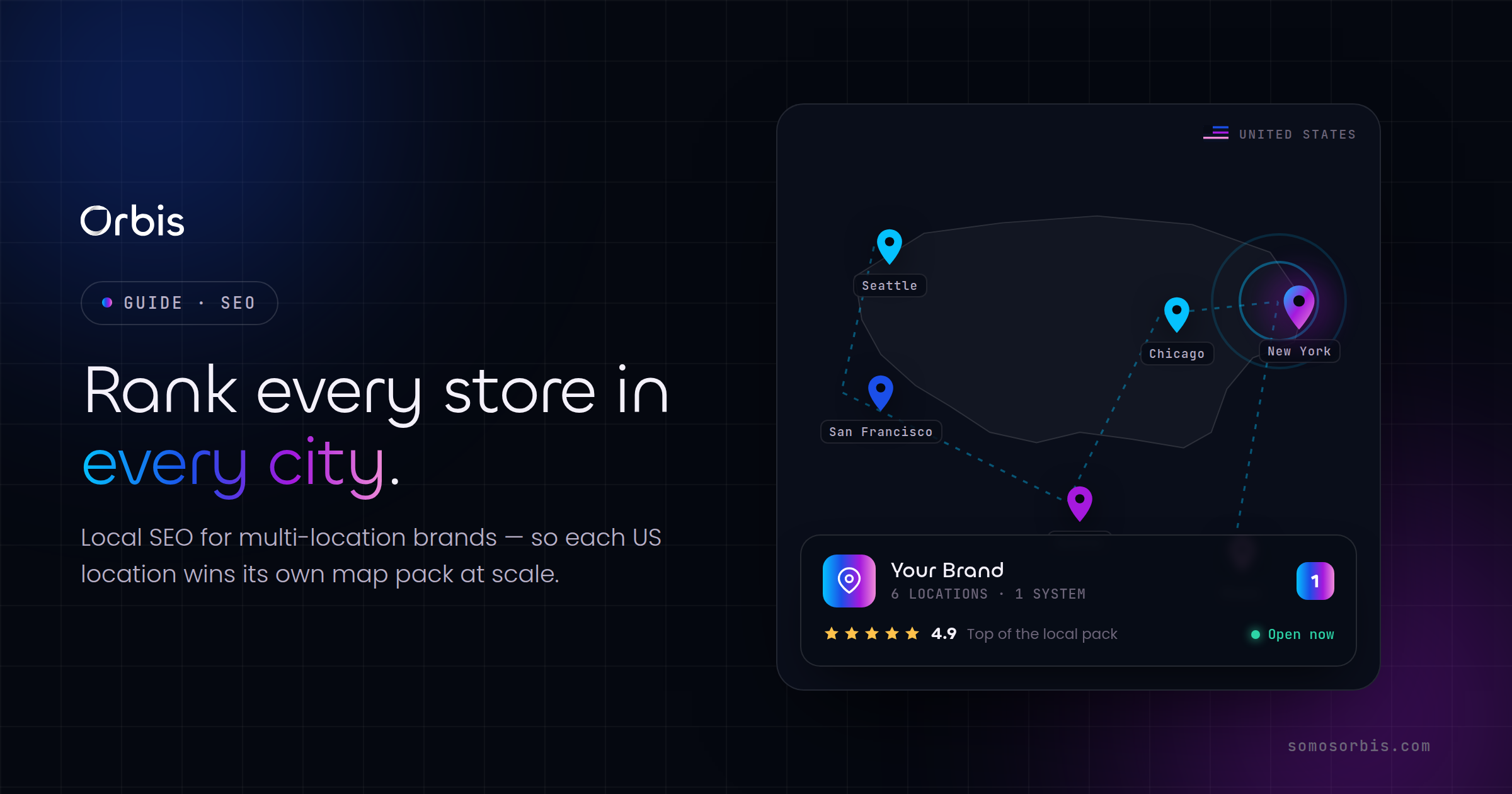
Brands with locations across several US cities face a harder problem: how to rank each location individually without creating duplicate, thin content that drags the whole domain down. The answer is a disciplined system of location pages, localized profiles, and consistent citations at scale. This is its own discipline, and we cover it in depth in our guide to local SEO for multi-location brands in the US. If you operate ten storefronts across Texas or fifty franchises nationwide, that guide is your next stop.
When local search is the engine of your business, a specialized approach pays for itself fast. Our local SEO services are built to put US businesses in the map pack and keep them there.
E-commerce SEO: Built for US Shopping Seasons
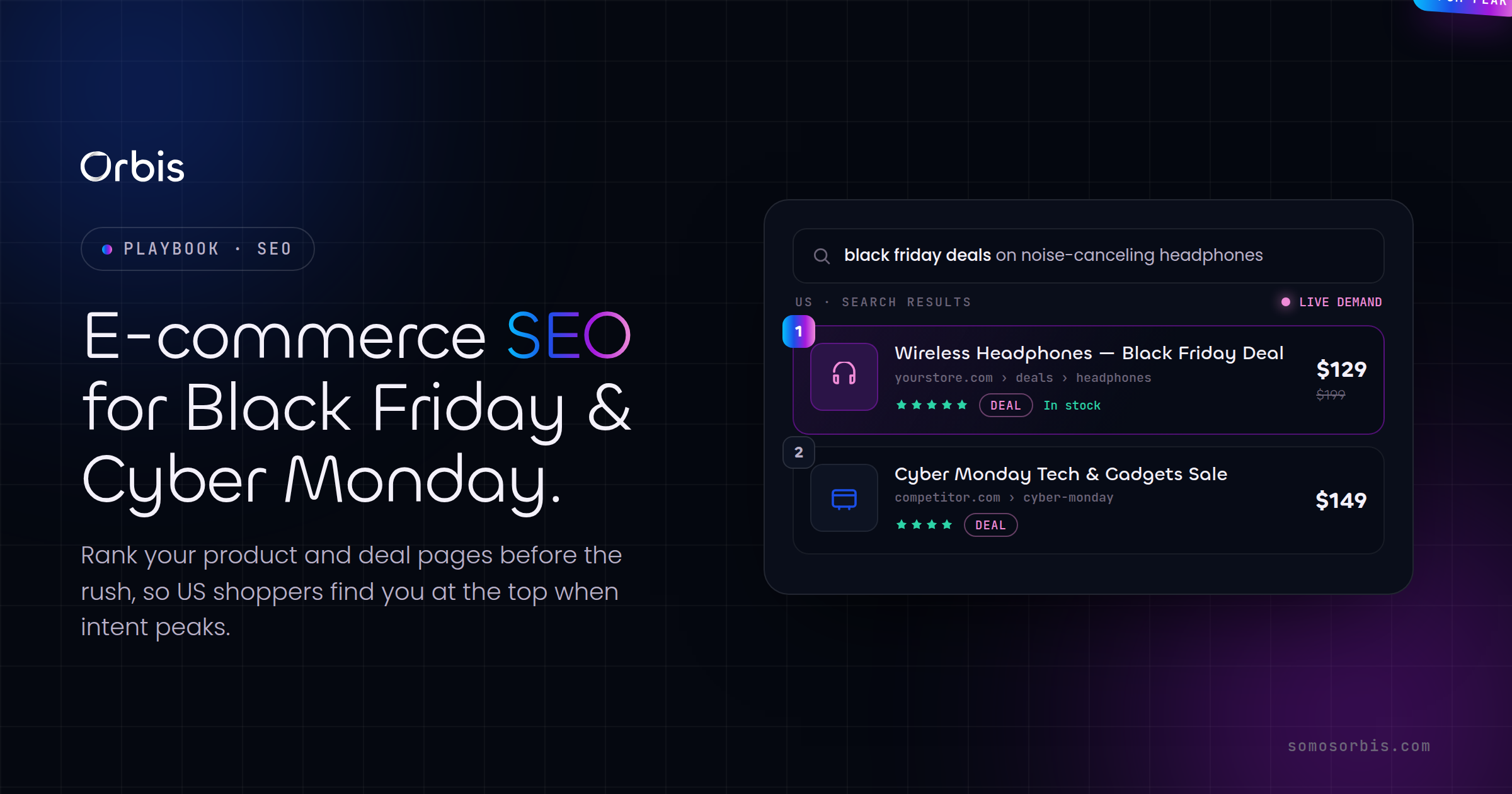
Online retail in the United States runs on a calendar, and that calendar is brutal. Black Friday and Cyber Monday, Amazon Prime Day, back-to-school, and the tax-season refund spending window each create enormous spikes in commercial intent. The stores that win those windows did the SEO work months in advance. You cannot rank a category page into the top results in November if you start optimizing it in late October.
The structural moves that drive organic e-commerce revenue
- Category pages are your money pages. For most stores, category and collection pages capture far more commercial search volume than individual product pages. Treat them as landing pages with real descriptive content, internal links, and clean faceted navigation that does not spawn thousands of crawlable duplicate URLs.
- Product schema and rich results. Price, availability, and review markup help your listings stand out in results and feed shopping surfaces. During peak season, a rich result with visible stars and price is a meaningful click-through advantage.
- Evergreen seasonal hubs. Rather than building and deleting a Black Friday page every year, maintain a permanent hub URL that you refresh annually. It accumulates authority and links year over year instead of starting from zero.
- Inventory and crawl management. Out-of-stock handling, pagination, and internal search pages all need deliberate technical treatment so crawl budget flows to pages that actually convert.
The interplay between seasonality and SEO is where a lot of US stores leave money on the table. We break down the full playbook, including the prep timeline, in our guide to e-commerce SEO for Black Friday and Cyber Monday. If retail seasonality drives your revenue, read it before your next planning cycle.
B2B and SaaS SEO: Selling to a Committee
B2B search behaves nothing like consumer search. Buying cycles stretch across months. Multiple stakeholders research independently. The keywords have lower volume but enormous value per conversion. A single qualified lead for an enterprise platform sold into a Chicago financial services firm can be worth more than thousands of consumer clicks.
What changes when your buyer is a business
For B2B and SaaS companies, the SEO playbook shifts in several important ways:
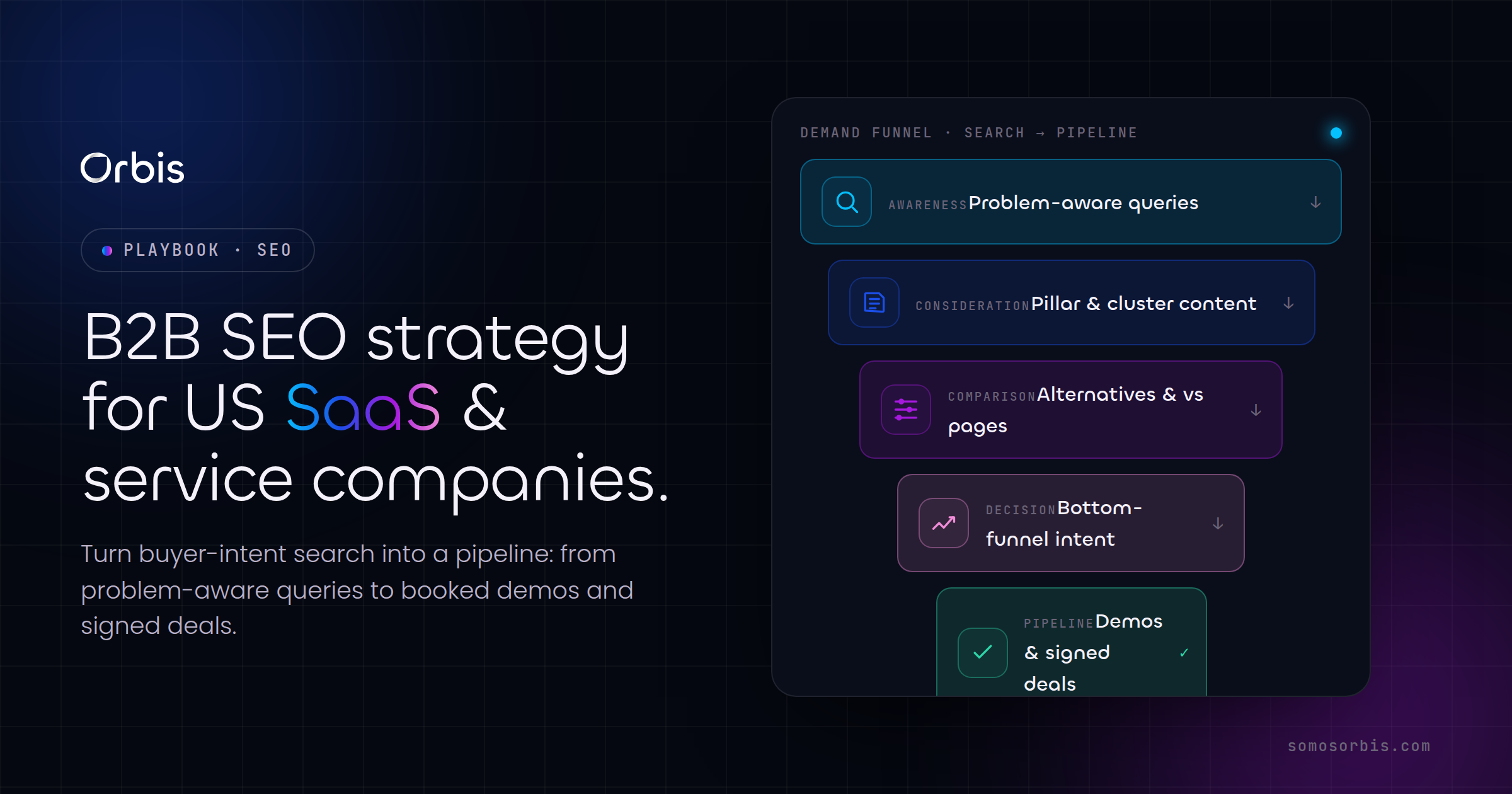
- Map content to the full buying journey. Top-of-funnel educational content earns trust and visibility, middle-of-funnel comparison and solution content captures active evaluation, and bottom-of-funnel pages convert ready buyers. You need credible content at every stage, not just the bottom.
- Bottom-funnel pages are the revenue drivers. Alternatives pages, comparison pages, integration pages, and use-case pages capture searchers who are close to a decision. These are often the most overlooked and most valuable pages a SaaS company can build.
- Demonstrate expertise relentlessly. Enterprise buyers are skeptical. Original research, detailed documentation, and content that clearly comes from practitioners build the trust that closes deals and earns AI citations.
- Optimize for product-led signals. Free tools, calculators, and templates attract links and qualified traffic while showcasing your product's value directly.
The full B2B framework, including how to structure a content engine that feeds a long sales cycle, lives in our guide to B2B SEO strategy for US SaaS companies. If you sell software or services to other businesses, that is your blueprint.
Link Building and Authority: Earning the Right to Rank
Content gets you into the race. Authority decides whether you finish. Links remain one of the strongest signals search engines use to judge whether a site deserves to rank, and in the AI era, the brand mentions and citations that surround those links matter even more. The catch is that the link-building tactics that worked a decade ago now actively harm you. Buying links, mass guest posting on irrelevant sites, and private networks are liabilities, not assets.
What actually works in the US market
- Digital PR and original data. Publishing genuinely newsworthy research or surveys earns coverage from real US publications, which produces the kind of authoritative links no outreach campaign can manufacture.
- Linkable assets. Free tools, comprehensive guides, and reference resources naturally attract links because other people find them useful enough to cite.
- Strategic partnerships and co-marketing. Joint content and integrations with complementary brands produce relevant, lasting links.
- Local and industry citations. For local and niche businesses, being listed in the directories and associations that matter in your category builds both authority and relevance.
Authority building is slow, compounding, and absolutely worth it. The tactics that are safe and effective in the US market right now are laid out in our guide to link building strategies that work in the US. Read it before you spend a dollar on links.
International SEO: Expanding Beyond US Borders
Many successful US businesses reach a point where domestic growth slows and international markets beckon. Expanding into Canada, the United Kingdom, Latin America, or Europe is a significant SEO undertaking, and the mistakes are expensive. Serving the wrong language version of a page to the wrong audience, or splitting your authority across poorly structured regional sites, can stall growth before it starts.
The core decisions of international SEO
- Domain structure. Country-code domains, subdirectories, or subdomains each carry different trade-offs for authority, maintenance, and geo-targeting. The right choice depends on your scale and resources.
- Hreflang implementation. Correct hreflang tags tell search engines which language and regional version to serve. Done wrong, they create duplicate-content confusion and lost rankings.
- True localization. Translating words is not localizing. Currency, examples, cultural references, and search behavior all differ by market and must be adapted.
- Local authority. Authority does not automatically transfer across borders. Each market often needs its own links and citations to compete.
If global expansion is on your roadmap, our guide to international SEO for US brands expanding abroad walks through the architecture and pitfalls in detail.
AEO and AI Answer Engines: The New Front Door
This is the biggest shift in search since mobile. AI Overviews, ChatGPT, Perplexity, Gemini, and other answer engines increasingly resolve queries directly, citing a handful of sources rather than sending users to a list of links. Answer Engine Optimization, or AEO, is the practice of becoming one of those cited sources. For US businesses, the brands that get cited by AI systems in 2026 are building the recognition and trust that will compound for years.
How to earn AI citations
- Answer questions directly and early. AI systems favor content that gives a clear, concise answer up front, then supports it with depth. Lead with the answer, then explain.
- Structure for extraction. Clear headings, lists, definitions, and tables make it easy for AI to parse and quote your content accurately.
- Establish unmistakable expertise and trust. AI systems cite sources they consider authoritative. Author credentials, original data, consistent brand presence, and verifiable claims all increase your odds of being cited.
- Cover topics comprehensively. Thin content rarely gets cited. Depth, accuracy, and freshness win.
AEO deserves a dedicated strategy, not an afterthought. We go deep on tactics and measurement in our guide to AEO and optimizing for AI Overviews and ChatGPT. And because this is where the next decade of search is heading, we built a dedicated practice around it. Explore our AEO and AI SEO services to position your brand inside the answers, not just the links.
Bilingual SEO: Reaching the US Hispanic Market
The US Hispanic population represents tens of millions of consumers and enormous purchasing power, much of it underserved by businesses that publish only in English. For brands in markets like Los Angeles, Miami, Houston, and Chicago, a thoughtful bilingual SEO strategy is not a nice-to-have. It is a competitive advantage that most of your rivals are ignoring.
Doing bilingual SEO right
- Serve genuine Spanish content, not machine translation. Spanish-speaking searchers can tell the difference instantly, and so can search engines. Quality, culturally aware Spanish content builds trust.
- Research keywords in Spanish independently. Search behavior in Spanish is not a direct translation of English queries. Regional vocabulary varies, and intent can differ.
- Implement hreflang correctly so the right language version reaches the right user, and so you do not cannibalize your own English rankings.
- Respect cultural context. Imagery, examples, and tone that resonate with US Hispanic audiences outperform generic translations every time.
The full approach, including technical setup and content strategy, is in our guide to bilingual SEO for reaching the US Hispanic market. If a meaningful share of your customers speak Spanish, this is one of the highest-leverage moves you can make.
Measurement: If You Can't Measure It, You Can't Improve It
None of the work above matters if you cannot tie it to outcomes. The businesses that win at SEO over the long run are the ones that measure rigorously and review consistently. A few principles separate serious programs from hopeful ones.
- Measure revenue, not just rankings. Rankings are a means, not an end. Track organic traffic, conversions, qualified leads, and revenue attributed to organic search. A number-one ranking that drives no business is a vanity metric.
- Respect US privacy norms. Build your measurement to honor current privacy expectations and consumer protection rules. Clean, compliant data collection protects your brand and your customers while still giving you what you need to optimize.
- Establish a review cadence. Monthly performance reviews and quarterly strategy resets keep the program adaptive. Search changes constantly, and a static plan decays.
- Document everything. A documented process means results are repeatable and not dependent on one person's memory. This is the difference between a marketing activity and a revenue engine.
This is the discipline at the heart of how we work. We call it Business Assurance: documented processes, revenue engineering, and compliance by design. It is why our SEO programs hold up under scrutiny and keep producing results long after the initial push.
Putting It All Together: Your 2026 SEO Roadmap
SEO in 2026 is not a checklist you complete once. It is a system you operate continuously. The businesses pulling ahead in markets like New York, Dallas, and Miami are the ones that treat search as core infrastructure: technically sound, content-rich, authoritative, measured, and present across every surface where their customers look for answers.
Here is how to sequence the work:
- Start with the foundation. Fix technical issues, nail Core Web Vitals, and implement structured data. Nothing else compounds until the foundation is solid.
- Match your priority to your model. Local businesses lead with the map pack. Retailers prepare for seasonal peaks well in advance. B2B and SaaS companies build journey-spanning content. Reach into the Hispanic market if your customers do.
- Build authority deliberately through digital PR, linkable assets, and real partnerships.
- Get into the answers. Treat AEO as a first-class priority, because that is where discovery is heading.
- Measure, review, and iterate against revenue, not vanity metrics.
Related guides to go deeper
This pillar gives you the map. Each of these guides is the detailed terrain for a specific part of the journey:
- Local SEO for multi-location brands in the US
- E-commerce SEO for Black Friday and Cyber Monday
- B2B SEO strategy for US SaaS companies
- Link building strategies that work in the US
- International SEO for US brands expanding abroad
- AEO and optimizing for AI Overviews and ChatGPT
- Bilingual SEO for reaching the US Hispanic market
SEO that lasts is engineered, documented, and measured. The brands that win in 2026 are not chasing tricks. They are building systems that compound month after month, across search, maps, shopping, and the AI answers that now sit in front of all of them.
Ready to Build a Search Engine That Drives Revenue?
You now have the full map. The next step is execution, and execution is where most SEO programs fall apart. Building and operating a system across technical health, content, local search, authority, AEO, and measurement is a lot to run in-house, especially while you are also running a business.
That is what we do. Orbis brings more than fifteen years of experience, over five hundred clients served, a 4.9-star rating across 58 reviews, and Google Partner status to every engagement. We do not sell rankings. We build documented, measurable revenue engines designed to perform across every surface where your US customers search. If you are ready to stop guessing and start compounding, explore our SEO services for US businesses and let's map out your roadmap together.