
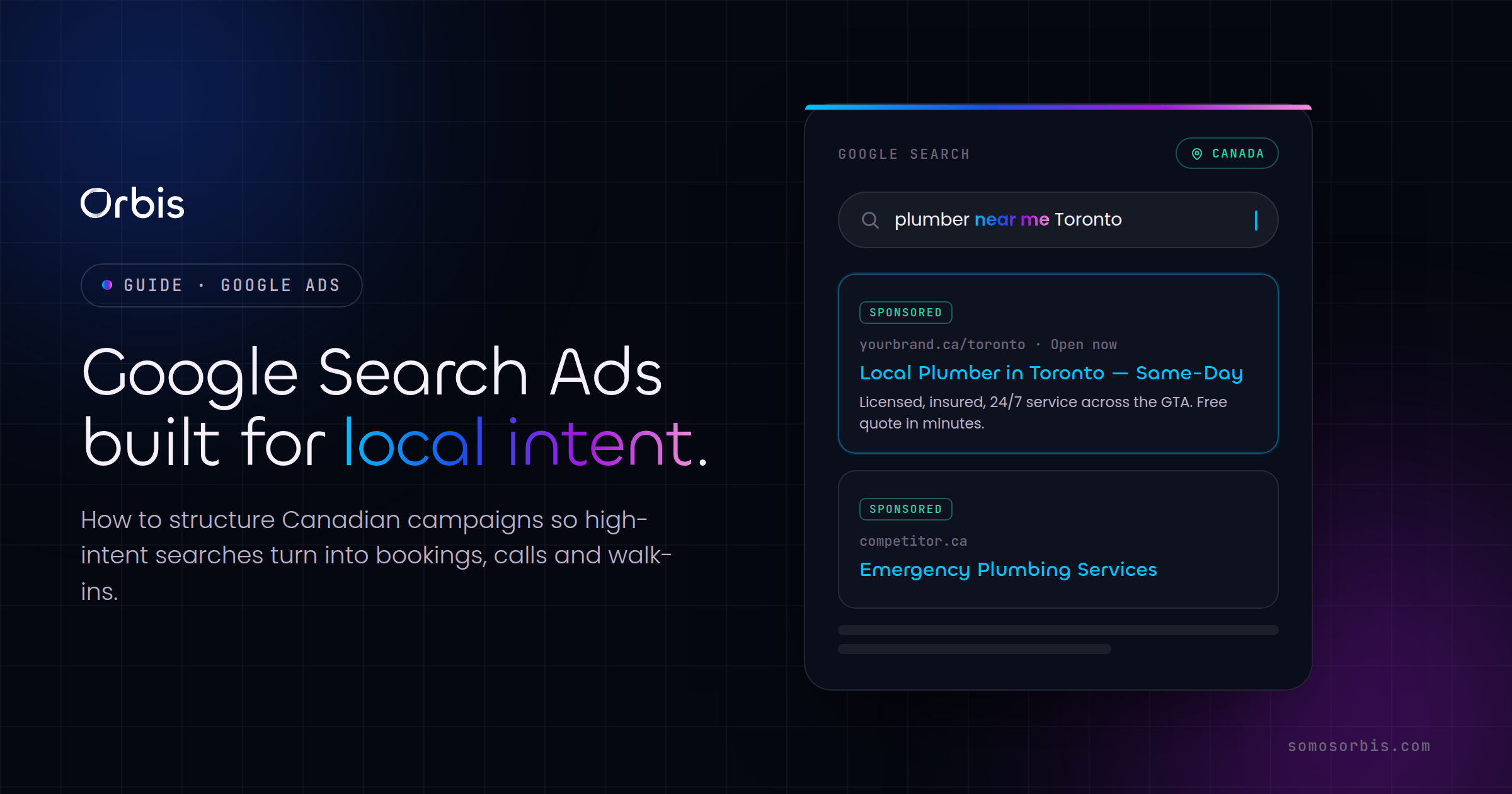
Search Ads are where high-intent demand meets your business at the exact moment someone is ready to act. When a homeowner in Mississauga types "emergency furnace repair near me" or a procurement manager in Calgary searches "commercial HVAC supplier Alberta," they are not browsing — they are buying. The question is whether your campaign is structured to capture that demand profitably, or whether you are bleeding budget on broad clicks that never convert. This guide walks through how to structure Google Search campaigns for the Canadian market, with practical decisions around keywords, geo-targeting, and bidding that reflect how buyers actually behave across Toronto, Calgary, Vancouver, Montreal, and the regions in between.
If you are building your paid search program from the ground up, start with our complete guide to running Google Ads in Canada, which covers account architecture, conversion tracking, and the platform fundamentals. This post goes one level deeper on Search specifically — the campaign type that converts high-intent local demand into pipeline and revenue.
Why Search Ads Reward Structure Over Spend
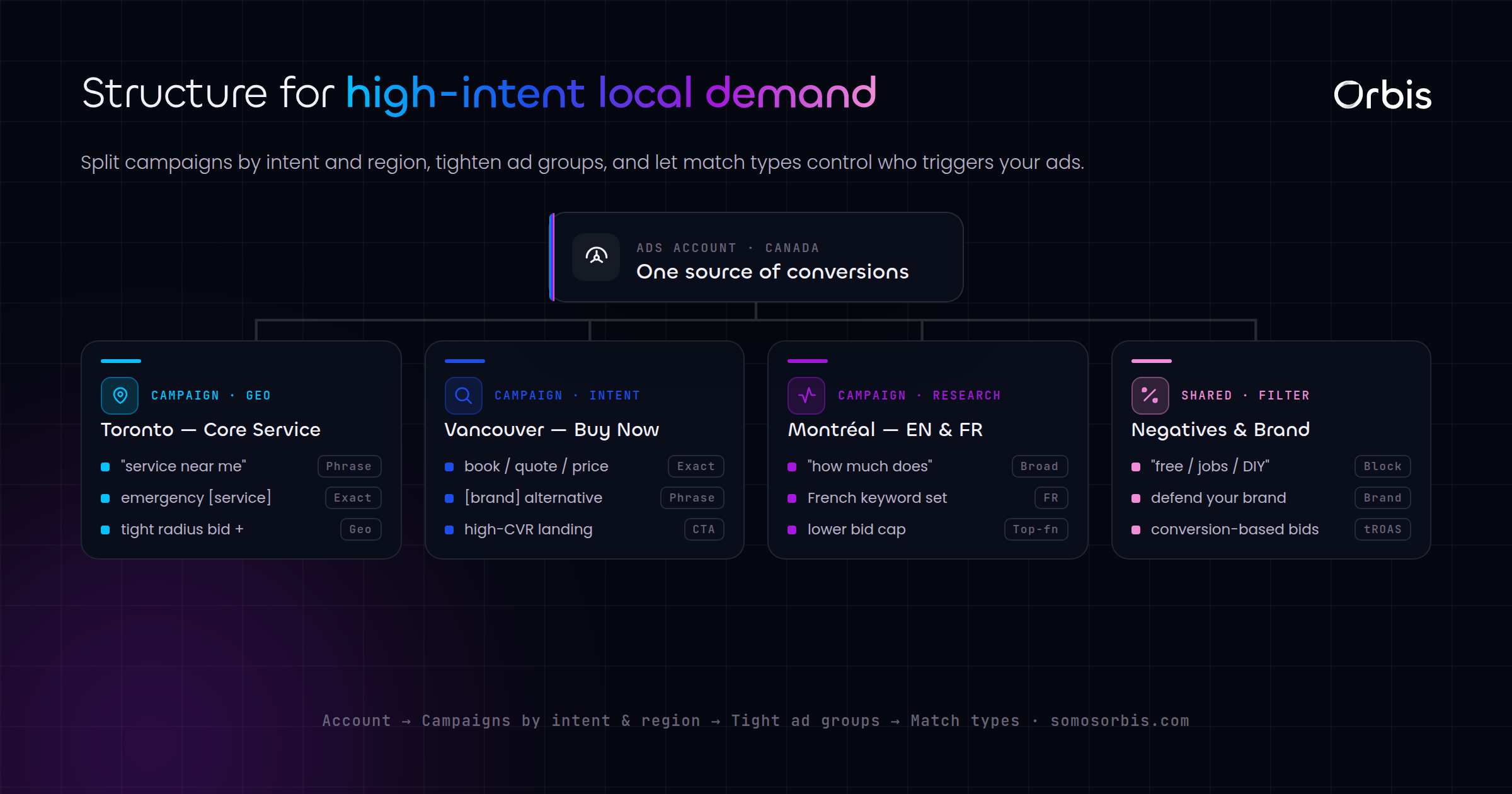
Google Search is an auction, but it is not a simple bidding war. Your cost per click and your ad position are determined by a combination of your bid and your Quality Score — Google's assessment of how relevant your keyword, ad, and landing page are to the searcher's query. A well-structured account with tight keyword themes and matching ad copy consistently pays less per click than a sloppy one, even when bidding lower.
For Canadian advertisers, this matters because clicks are not cheap. In competitive categories — legal services, home renovation, financial services, B2B software — cost per click in major metros like Toronto and Vancouver can run several dollars or more. Structure is the difference between a campaign that returns three or four dollars for every dollar spent and one that quietly drains your monthly budget. The goal is simple to state and harder to execute: show the right ad to the right searcher in the right city, and send them to a page that delivers exactly what they searched for.
Keyword Strategy: Match Intent, Not Just Topic
The biggest mistake we see in Canadian Search accounts is treating keywords as topics rather than as signals of intent. Two people can search around the same subject with completely different readiness to buy. Your keyword strategy should separate the buyer from the browser.
Map Keywords to Intent Tiers
Organize your keyword research into three tiers before you ever build a campaign:
- High-intent transactional — phrases that signal a ready buyer: "hire," "near me," "quote," "cost," "best," "[service] in [city]." Example: "commercial cleaning company Toronto" or "book HVAC tune-up Calgary." These deserve your highest bids and your sharpest ad copy.
- Commercial investigation — comparison and research phrases: "[product] vs [competitor]," "[service] reviews," "is [service] worth it." The buyer is close but still evaluating. These warrant their own ad groups and landing pages that address objections.
- Informational — "how to," "what is," "DIY [task]." These rarely convert on Search and usually belong in your content and SEO strategy, not your paid budget — unless you are running a deliberate top-of-funnel play.
By tiering your keywords this way, you can allocate budget where return is highest and avoid paying premium prices for clicks from people who are not ready to buy.
Choose Match Types Deliberately
Google has steadily pushed advertisers toward broad match paired with Smart Bidding, and in some accounts that works well once you have conversion data. But for a new or mid-sized Canadian campaign, control matters. We recommend starting with this approach:
- Phrase match for your core high-intent terms, so you capture relevant variations without opening the floodgates.
- Exact match for your proven money keywords — the handful of terms you know convert — so you can bid aggressively with confidence.
- Broad match only when you have solid conversion tracking and Smart Bidding in place, and even then, paired with a disciplined negative keyword routine.
Build a Negative Keyword Routine
Negatives are where profitability is won. Without them, a Canadian plumbing company can end up paying for clicks on "plumbing apprenticeship Ontario," "plumbing supplies wholesale," or "plumbing jobs Toronto" — none of which are customers. Review your search terms report weekly in the first month, then monthly, and add negatives aggressively. Build shared negative lists for obvious categories: "free," "jobs," "salary," "DIY," "course," and competitor brand terms you do not want to pay for. A maintained negative list quietly improves Quality Score and lowers cost per acquisition over time.
Geo-Targeting for a Country This Big
Canada is the second-largest country in the world by area, and ignoring geography in your campaign structure is leaving money on the table. A national flat campaign treats a downtown Toronto searcher the same as one in rural Saskatchewan, even though their value, competition, and conversion rate differ enormously.
Segment by Metro and Value
For most service businesses, the right move is to separate your highest-value metros into their own campaigns or use location bid adjustments. The major markets — the Greater Toronto Area, Metro Vancouver, Calgary, Edmonton, Ottawa, and Montreal — each have distinct competition levels and click costs. Splitting them lets you:
- Set budgets that reflect where your best customers are, rather than letting one expensive metro consume the national budget.
- Adjust bids up in cities where you convert well and down where you do not.
- Write location-specific ad copy that mentions the city, which lifts click-through rate and Quality Score.
Mind the Bilingual Reality
Quebec — and Montreal in particular — requires deliberate language handling. French-speaking searchers expect French ads and French landing pages, and serving them English creates friction that kills conversion. Run separate ad groups or campaigns targeting French keywords with French creative for Quebec, and ensure the landing experience matches. Even outside Quebec, bilingual searchers in Ottawa and parts of New Brunswick may search in either language. Treating French as a first-class audience rather than an afterthought is both a compliance-minded and a conversion-minded decision.
Use Radius and Location Intent Settings
For businesses that serve a physical catchment — clinics, dealerships, contractors, restaurants — radius targeting around your service area outperforms broad provincial targeting. Pair this with the correct location intent setting: target "presence" (people in or regularly in your area) rather than "presence or interest," so you do not pay for someone in Florida idly searching about Toronto. This single setting prevents a surprising amount of wasted spend.
Bidding: Let the Data Decide, but Give It Guardrails
Smart Bidding strategies like Target CPA and Target ROAS can genuinely outperform manual bidding — but only once Google's algorithm has enough conversion data to learn from. Sequencing your bid strategy correctly is one of the highest-leverage decisions in a Search campaign.
- Launch phase — start with Maximize Clicks with a max CPC cap, or manual CPC, while you gather conversion data. Resist the urge to switch to automated bidding before you have meaningful conversion volume.
- Learning phase — once you have a steady flow of conversions (generally 15 to 30 per month per campaign as a rough floor), move to Maximize Conversions or Target CPA.
- Optimization phase — when conversion data is reliable and you are tracking revenue or lead value, graduate to Target ROAS so the algorithm optimizes for dollars, not just lead count.
Layer in Bid Adjustments
Even with Smart Bidding, you retain levers worth using. Device adjustments matter in Canada, where mobile dominates local "near me" searches but desktop often drives higher-value B2B conversions. Schedule (dayparting) adjustments let you lean into the hours your phones actually get answered — there is little point bidding aggressively for "emergency" terms at 3 a.m. if no one is there to respond. And audience layering — bidding up on past site visitors or cart abandoners — squeezes more value from people already familiar with your brand.
Account for Canadian Seasonality
Demand in Canada is deeply seasonal, and your bids and budgets should breathe with it. Boxing Day, back-to-school in late summer, the holiday run-up, and trade-specific seasons (furnace demand in October, AC in June, tax services in spring) all shift both search volume and competition. Plan budget pacing around these peaks rather than spreading spend evenly across the year. For a deeper framework on pacing CAD budgets against the Canadian calendar, see our companion post on managing Google Ads budgets and seasonality in CAD.
Ads and Landing Pages: Close the Loop
Structure gets the right person to click; the ad and landing page convert them. Responsive Search Ads now dominate the platform, so give Google strong raw material: distinct headlines that lead with the city, the offer, and a clear differentiator, plus descriptions that name your proof points — a Google Partner badge, years in business, or review rating — without overpromising.
Pin your most important headline (usually the one naming the service and city) when message consistency matters, but otherwise let Google test combinations. Then make sure every ad sends traffic to a page that matches the search. If someone searches "commercial roofing Calgary," they should not land on your generic homepage — they should hit a page about commercial roofing that mentions Calgary. This message match is the single biggest driver of landing page conversion rate and Quality Score alike.
The campaigns that win in Canada are not the ones with the biggest budgets — they are the ones where keyword, geo, bid, ad, and landing page all point at the same buyer.
How Search Fits the Wider Paid Media Picture
Search captures existing demand — people already looking for what you sell. It pairs powerfully with channels that create demand and recover lost intent. Retailers, in particular, should run Search alongside Shopping campaigns so product-specific queries surface your inventory with pricing and images; our guide to Google Shopping for Canadian retailers covers that build in detail. The point is that Search is the high-intent core of a coordinated program, not a standalone tactic.
Getting It Right Without the Trial and Error
Structuring a Search account well is methodical work: tier the keywords, segment the geography, sequence the bid strategy, maintain the negatives, and match every ad to a purpose-built page. Done right, it turns Google's highest-intent inventory into a predictable source of qualified leads and revenue. Done carelessly, it burns budget on clicks that never had a chance to convert.
At Orbis, we build and manage Search campaigns for Canadian businesses with a Business Assurance approach — documented processes, revenue-focused engineering, and compliance built in from the start. As a Google Partner with more than fifteen years of experience and a 4.9-star rating across our client reviews, we structure paid search to capture the buyers who are searching for you right now. If you want a campaign built for profitable, high-intent local demand, explore our Google Search Ads services in Canada and let's map your highest-value markets together.