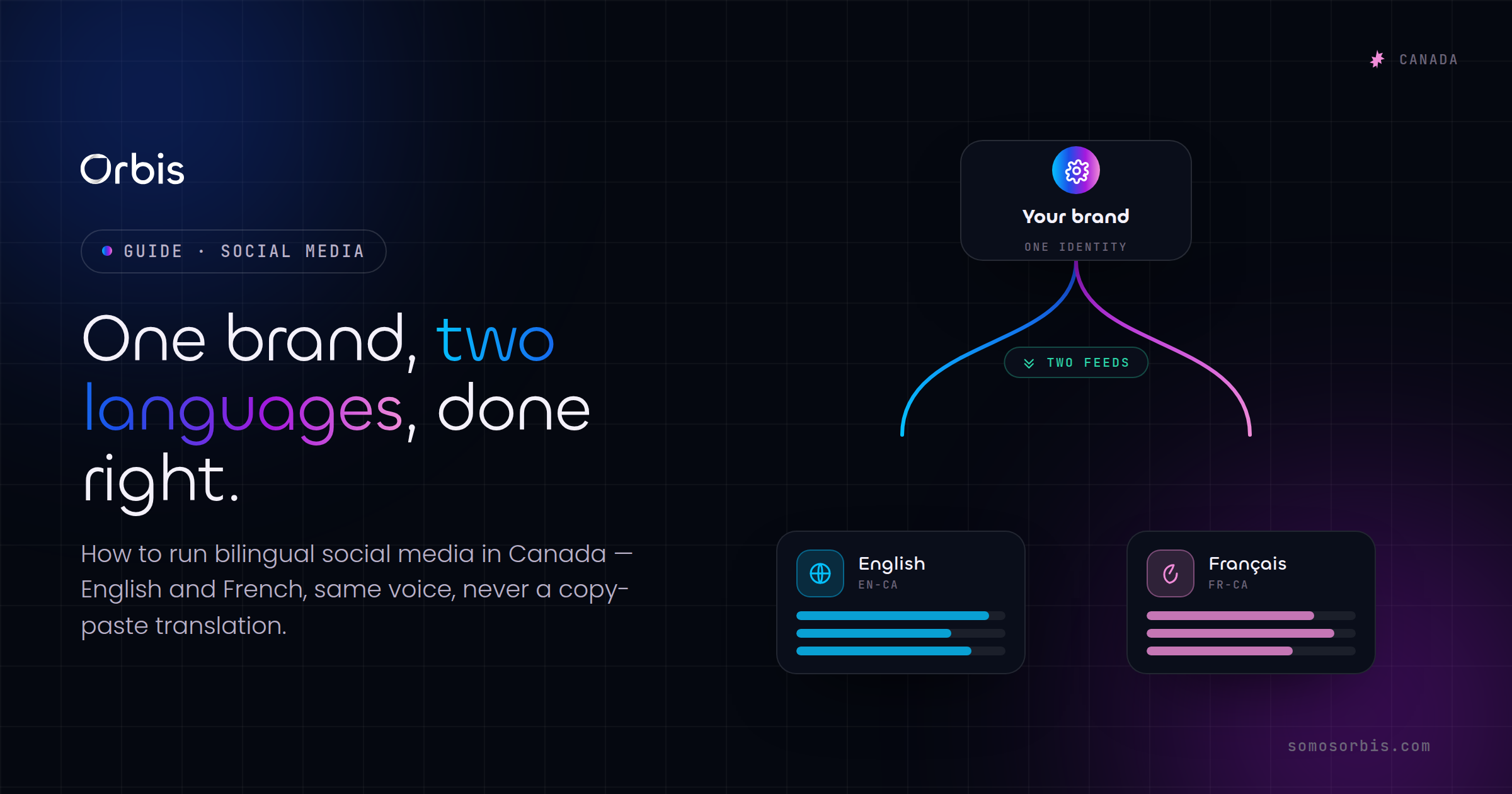
Running social media in Canada means writing for a country that lives in two languages at once. English and French aren't a "nice to have" or a checkbox for federal compliance — they're the difference between a Montréal customer feeling spoken to and a Montréal customer scrolling past. Yet most brands treat French as an afterthought: they write everything in English, run it through a translation tool the night before a campaign, and wonder why engagement in Quebec lags the rest of the country. Bilingual social done right isn't translation. It's two native conversations that happen to come from one brand. This guide lays out the workflows, creative decisions, and operational habits that let a single team produce English and French content that both feel like they were written by someone who lives there.
If you're building out the broader machine first, start with our complete guide to social media management in Canada — it's the pillar this article hangs off. This piece zooms in on the bilingual layer specifically.
Why "just translate it" fails in Canada
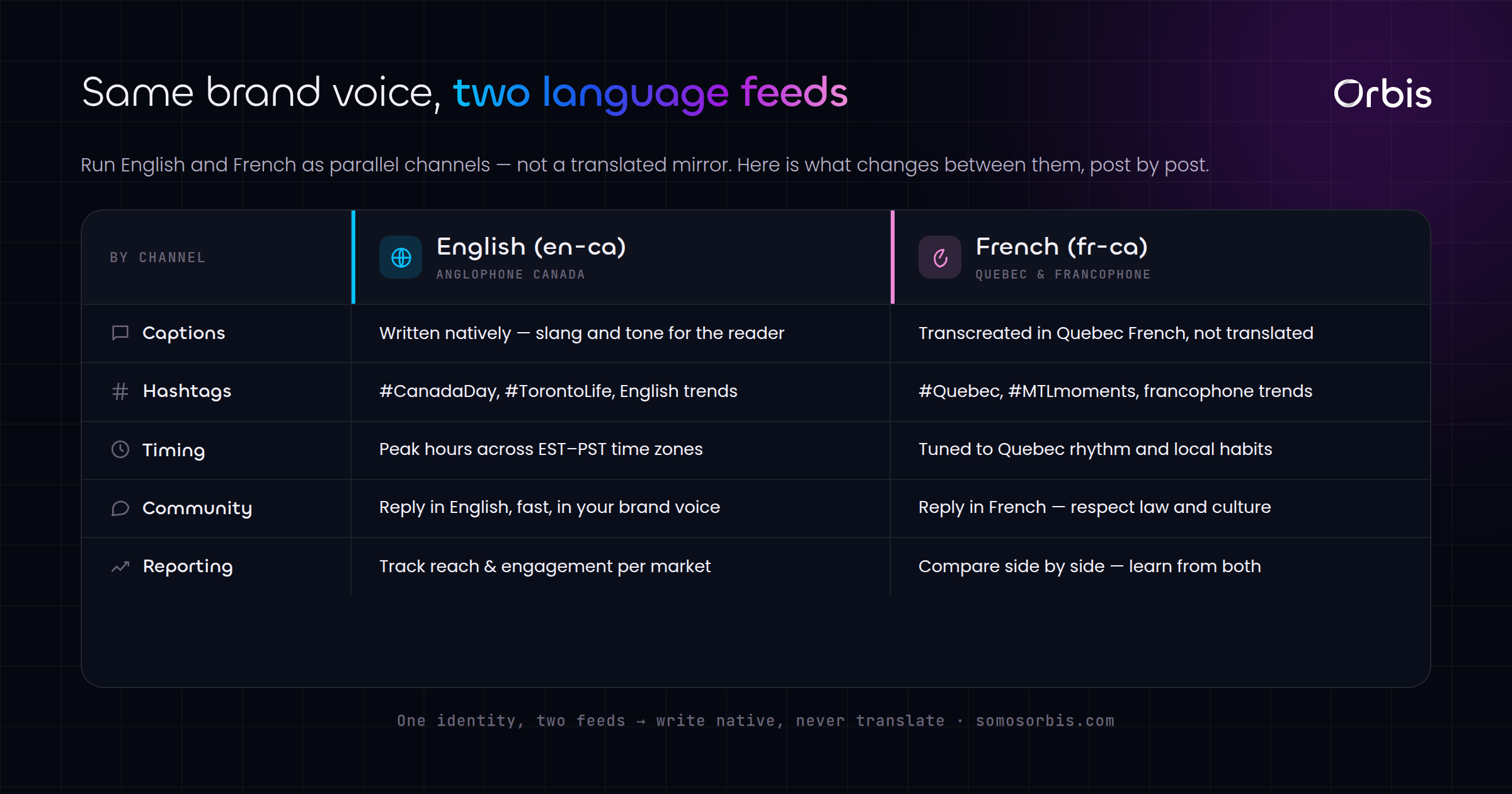
Canadian French is not a dialect you can approximate with European French settings on a translation engine. The vocabulary, idioms, and cultural references differ enough that a Parisian phrasing reads as foreign — sometimes comically so — to a Quebecer. A direct translation of an English caption almost always produces French that is grammatically correct and emotionally dead. Worse, it often breaks in three predictable ways:
- Length mismatch. French runs roughly 15–20% longer than English. A punchy English headline that fits a square graphic becomes a cramped two-liner in French, and your carefully designed template breaks.
- Tone drift. English social copy leans casual and verb-forward. Literal French translations tend to slide into a stiff, formal register that feels like a press release, not a friend.
- Lost wordplay. Puns, idioms, and culturally loaded references ("Boxing Day doorbusters," "back-to-school chaos") rarely survive translation. The joke dies, and so does the reason someone would share the post.
The fix isn't a better translation tool. It's a workflow built on transcreation — recreating the intent, tone, and impact of a message in each language rather than mapping words one-to-one.
Pick your bilingual content model
Before you touch a calendar, decide how the two languages relate to each other operationally. There are three workable models in Canada, and choosing the wrong one quietly sabotages everything downstream.
1. Mirrored accounts (separate EN and FR handles)
You run, for example, @BrandCanada and @BrandCanadaFR. Each audience sees only their language. This is the gold standard for brands with meaningful Quebec presence — a retailer with stores in Montréal and Québec City, or a service business with a francophone customer base. It lets each feed breathe in its own voice, run language-specific promotions, and respond to comments natively. The cost is double the publishing volume and a need for genuine French fluency on the team or through a partner.
2. Single bilingual feed
One account, posts in both languages — either alternating, or stacking EN and FR in the same caption. This is the most common starting point for smaller Canadian brands and the default for federally regulated organizations. It's efficient, but it asks every follower to scroll past content in a language they don't read. Keep captions tight, lead with the language matching the visual, and never let one language dominate the feed.
3. Geo-targeted single account
One handle, but you use platform tools (Meta's audience targeting, language-specific story content, regional ad sets) to serve French creative to Quebec and English elsewhere. This gives you native-feeling delivery without doubling your public-facing accounts. It demands more sophisticated paid and organic targeting, but it's often the sweet spot for national brands that want one brand presence with localized delivery.
There's no universally correct answer — it depends on how concentrated your francophone audience is and how much production capacity you have. What matters is committing to one model and building your calendar around it rather than improvising per campaign.
Build one calendar, two creative tracks
The single biggest operational mistake is maintaining two disconnected calendars that drift apart. Instead, run one master content calendar with parallel EN and FR tracks, planned together from the start. Every campaign brief should specify the intent and the emotional beat, then let each language hit that beat in its own way. This is exactly the discipline our content strategy and calendar service is built to install — planning both languages in the same sprint so neither is ever the rushed afterthought.
A practical structure looks like this:
- Concept in the dominant planning language (usually English) — but write a brief, not finished copy. Capture the goal, the offer, the feeling, the CTA, and any non-negotiable claims.
- Transcreate each language from the brief, not from the finished English post. This forces both versions to be native to their language instead of one being a shadow of the other.
- Adapt the visual, not just the text. Swap on-image copy, check that French text fits the layout, and confirm the reference lands. A graphic referencing "la rentrée" (the Quebec back-to-school moment) may need different art than the English "back-to-school" version.
- Schedule with timing in mind. Quebec's media and cultural rhythm isn't identical to anglophone Canada — local holidays like Saint-Jean-Baptiste (June 24) matter in French content in a way they don't elsewhere.
If you want a deeper, week-by-week build of this kind of dual-track calendar, our companion piece on building a Canadian social content calendar walks through the seasonal scaffolding — including how to slot bilingual moments around Boxing Day, holidays, and back-to-school.
The seasonal and cultural calendar matters more in French
Canada's shared retail moments — Boxing Day, Black Friday, holiday gifting, back-to-school — show up in both languages, but Quebec layers its own cultural calendar on top, and ignoring it reads as tone-deaf. A few that should be on every bilingual planner's radar:
- Saint-Jean-Baptiste (June 24) — Quebec's national holiday and a major francophone cultural moment. English-Canada brands often miss it entirely; for your French audience, acknowledging it builds real affinity.
- La rentrée — the back-to-school / back-to-routine season carries strong cultural weight in Quebec and often warrants its own creative angle rather than a translated "back-to-school" post.
- Les Fêtes — the holiday season has its own francophone traditions and vocabulary; "Joyeuses Fêtes" and "Joyeux Noël" aren't interchangeable depending on your brand's tone and inclusivity stance.
- Boxing Day / Lendemain de Noël — the shopping moment is shared, but the framing and even the name shift across languages.
Treating the French calendar as a first-class input — not a copy of the English one with dates swapped — is what separates brands that francophone audiences trust from those they tolerate.
Staffing and quality control
Native-feeling French content requires a native French voice somewhere in the chain. There's no shortcut around this. Your options, roughly in order of quality:
- A bilingual creator on the team who writes French natively — ideal, but rare and expensive to hire for solely.
- A Quebec-based French copywriter or partner who transcreates from briefs — the most reliable model for brands without in-house fluency.
- AI-assisted drafting with mandatory native review — acceptable for speed on low-stakes posts, but never publish AI French without a fluent human editing pass. The failure modes (formal register, European phrasing, lost nuance) are exactly the ones AI is worst at catching in itself.
Whatever the model, build a two-eyes rule into your workflow: no French post goes live without a native speaker signing off. Bake this into your calendar's approval column so it's a structural step, not a favour someone does under deadline pressure.
The cheapest way to lose a Quebec audience is to publish French that's "good enough." Francophone Canadians notice translated French instantly, and it signals that the brand sees them as an afterthought.
Community management in two languages
Publishing bilingually is only half the job. The moment someone comments or sends a DM in French, your response has to match — and it has to be fast and native. A flawless French campaign post followed by an English-only reply to a French comment undoes all the goodwill you just built.
Practical guardrails for bilingual community management:
- Respond in the language the customer used. Always. If someone comments in French, reply in French, even on a primarily English post.
- Prepare bilingual response templates for common questions (shipping, returns, hours, pricing) so your team isn't translating on the fly during a busy launch.
- Set coverage for Quebec time and rhythm. Response-time expectations are the same in both languages — make sure someone fluent is available during peak francophone engagement windows.
- Watch tone, not just accuracy. French community replies should carry the same warmth and personality as your English ones; a correct-but-cold reply still misses.
This is its own discipline, and we go deep on it in our guide to community management for Canadian brands — including how to staff and template bilingual responses without burning out your team.
Measuring bilingual performance separately
If you only look at blended metrics, you'll never know whether your French content is working — strong English numbers can mask a French feed that's quietly underperforming. Segment your reporting by language from day one:
- Track engagement rate, reach, and conversion per language, not just account-wide.
- Compare like-for-like: a French post and its English counterpart from the same campaign tell you whether the transcreation landed.
- Watch comment sentiment and language mix — if French content earns proportionally fewer comments, the voice may be reading as translated.
- Use the data to reallocate. If Quebec engagement is strong, that's a signal to invest more in native French creative, not less.
Measuring separately also protects you internally: it gives you the evidence to justify the extra production cost of doing French properly, instead of having it cut as "duplicate work."
A quick bilingual readiness checklist
- Have you chosen a content model (mirrored, single feed, or geo-targeted) and committed to it?
- Is your calendar planning both languages in the same sprint, from briefs rather than finished English copy?
- Does a native French speaker review every French post before it publishes?
- Are your templates designed to handle French text running 15–20% longer?
- Is the Quebec cultural calendar built into your planning, not just the shared retail dates?
- Can your team respond to French comments and DMs natively and quickly?
- Are you reporting performance per language so you can actually see what's working?
If you answered "no" to more than two of those, your French presence is probably costing you trust you can't see in a blended dashboard.
Make bilingual a system, not a scramble
Doing bilingual social media right in Canada isn't about translating harder — it's about building a repeatable system where both languages are planned together, written natively, reviewed by the right people, and measured on their own terms. The brands that win in Quebec and across anglophone Canada aren't the ones with the biggest budgets; they're the ones that treat French as a real conversation rather than a compliance task.
If you want both languages built into one disciplined workflow — shared calendar, transcreation briefs, native review, and seasonal planning that respects the Quebec calendar — that's exactly what we do. Start with our social media content strategy and calendar service and let's build a bilingual engine that feels native in both languages, every single post.