
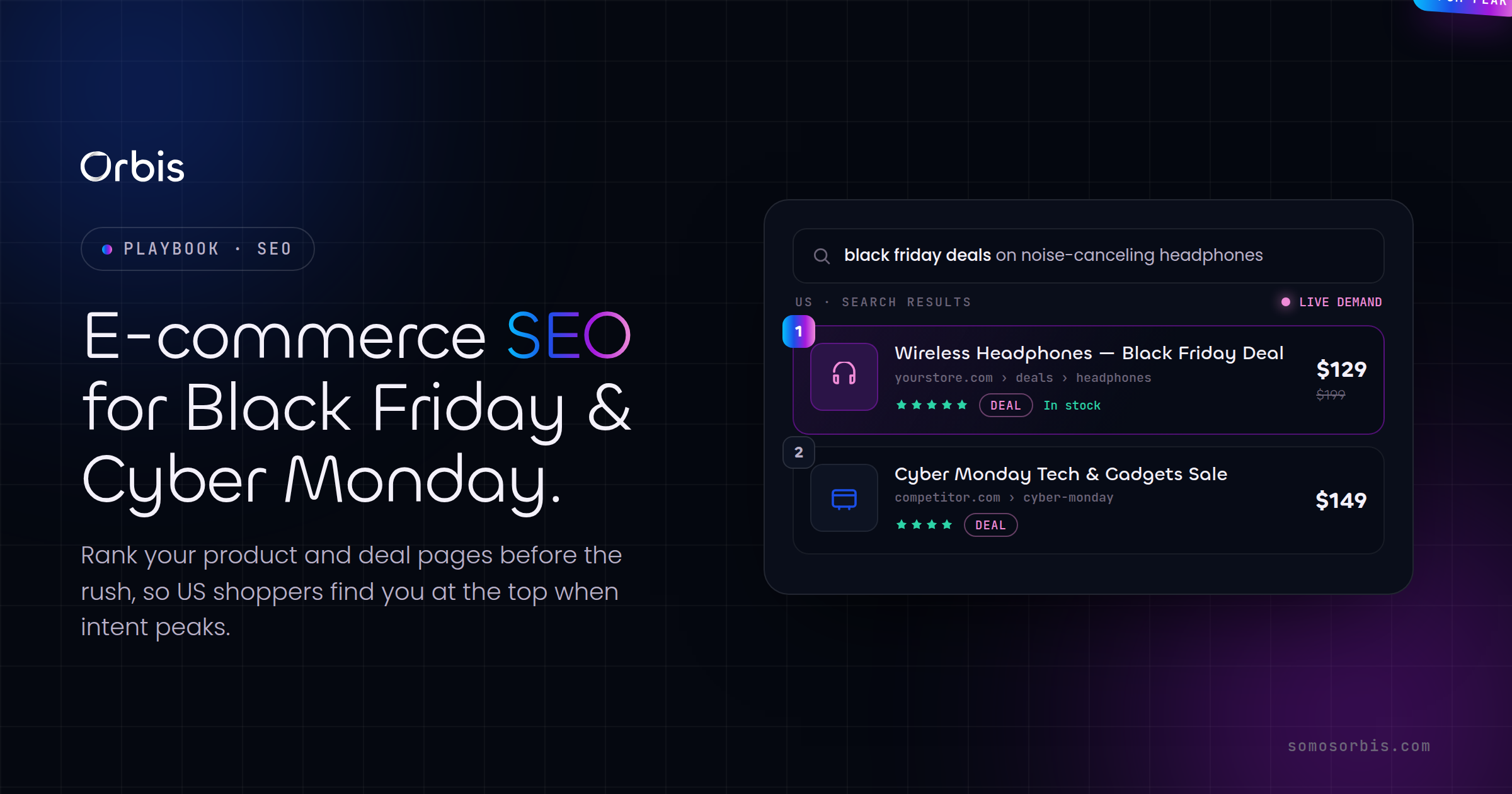
If your e-commerce store waits until November to think about Black Friday and Cyber Monday, you have already lost the most valuable real estate of the year: the search results page. In the United States, the path to a record-breaking holiday season is paved in the spring and summer. By the time shoppers in New York, Los Angeles, Chicago, Miami, Dallas, and Houston start typing "best deals on [your product]" into Google, the algorithm has already decided which pages it trusts. The winners did the technical and content work months ahead.
This guide is the operator's playbook for e-commerce SEO built specifically around US seasonality, from Amazon Prime Day in July to the Black Friday and Cyber Monday weekend, through back-to-school and into the new year. It is direct, actionable, and free of fluff. Every recommendation here is something you can hand to a developer, a content lead, or your agency this week.
Why Black Friday SEO is a year-round project, not a campaign
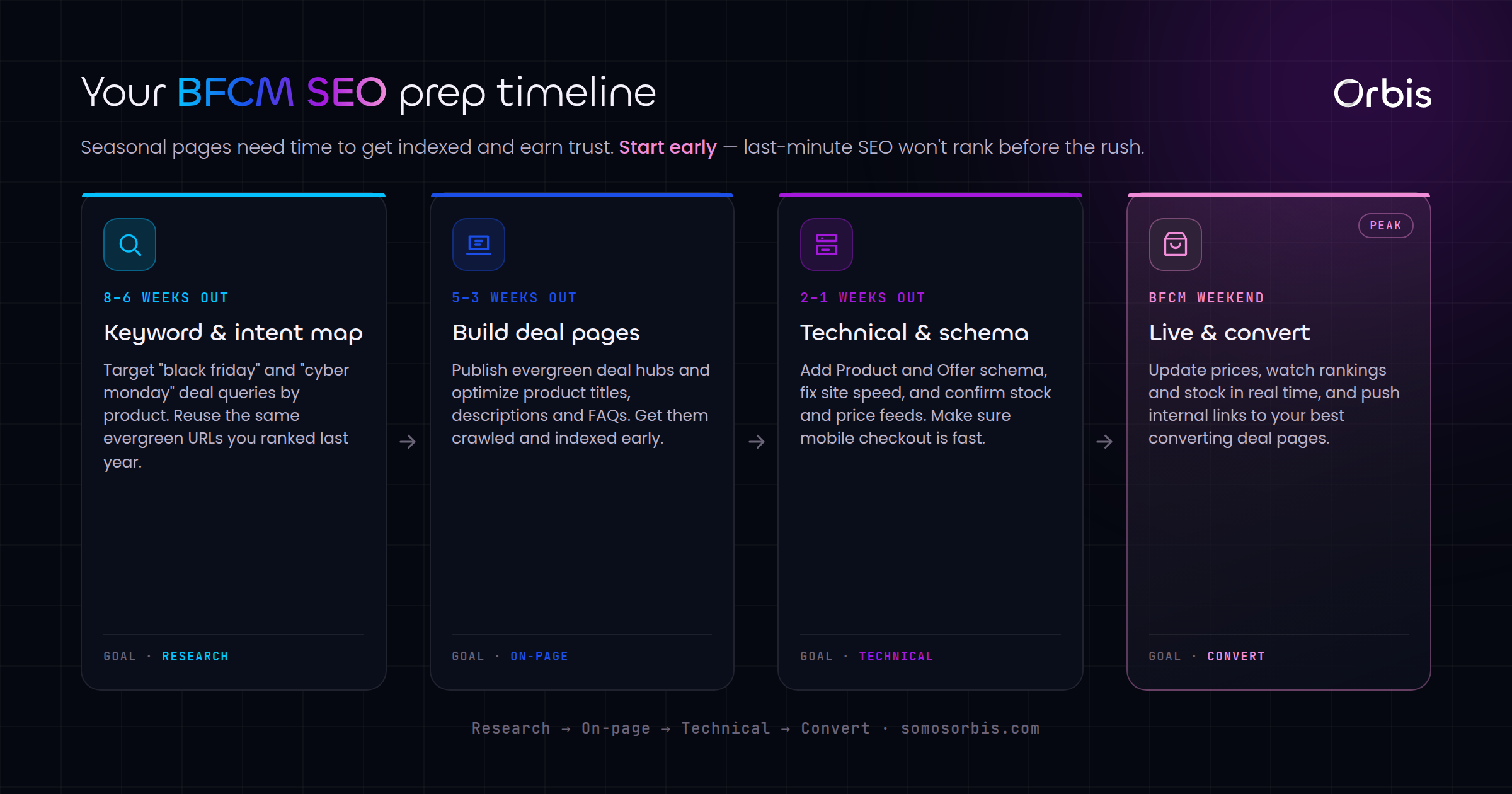
Google rewards consistency and authority, and both take time to accumulate. A category page that has been live, indexed, internally linked, and earning traffic since June will dramatically outrank a "Black Friday Deals 2026" page you publish on November 20th. The single biggest mistake US retailers make is treating seasonal SEO as a sprint instead of a standing asset.
Here is the practical reality of the US calendar and how it should shape your SEO roadmap:
- Q1 (January to March): Tax season drives discretionary spending. Audit your site, fix technical debt, and review last year's seasonal page performance while you have breathing room.
- Q2 (April to June): Build and refine evergreen category pages. This is when you do the heavy lifting that pays off in Q4.
- Q3 (July to September): Amazon Prime Day in July is a dress rehearsal for the holidays. Back-to-school demand peaks in August. Use both to test page templates, schema, and offer messaging.
- Q4 (October to December): Black Friday, Cyber Monday, and the December gifting rush. By now, your pages should already rank. This quarter is about merchandising and conversion, not foundational SEO.
The brands that show up on page one during the busiest shopping weekend in the US are the ones that treated their holiday landing pages as permanent URLs, not disposable ones. Keep the same URL year after year (for example, yourstore.com/black-friday/) and refresh the content annually instead of creating a new page each season.
Keyword strategy: capture intent before the rush
Seasonal shoppers in the US search in predictable waves. Months before the event, they research. Days before, they hunt for deals. Your keyword map needs to serve both.
Map the three layers of holiday intent
- Research intent (60-90 days out): "best [product] for the money," "[product] reviews 2026," "[product] vs [alternative]." These long-tail queries are where you build trust early.
- Deal intent (the Black Friday and Cyber Monday window): "[product] Black Friday deals," "[brand] Cyber Monday sale," "best [category] deals 2026." High volume, high competition, short window.
- Transactional intent (always on): "buy [product] online," "[product] free shipping," "[product] under $50." These convert all year and spike during sales.
For US retailers serving diverse markets, do not overlook bilingual search behavior. The US Hispanic market is enormous and increasingly searches in Spanish even when shopping from English-language storefronts. A query like "ofertas Black Friday [producto]" represents real, motivated demand. If your audience includes Spanish-speaking shoppers in Miami, Houston, or Los Angeles, consider bilingual EN/ES landing pages or at minimum Spanish-language meta descriptions and FAQ content. This is not about translating your whole site overnight; it is about meeting demand you are currently ignoring.
Use Prime Day as a free keyword laboratory
Amazon Prime Day in July gives you a low-stakes window to see which deal-related keywords your audience actually uses before the high-stakes Q4 season. Run a small Prime Day promotion, track which queries drove clicks in Search Console, and feed those learnings directly into your Black Friday content plan.
Technical SEO: the foundation that survives traffic spikes
On Black Friday, your site will take more traffic in a few hours than it normally sees in a week. If your technical foundation is weak, Google will see slow load times, crawl errors, and a poor experience exactly when stakes are highest. Lock these down well before November.
Page speed and Core Web Vitals
- Compress and lazy-load images. Product photography is the heaviest asset on most stores. Serve modern formats and defer off-screen images.
- Cache aggressively. Static category and landing pages should be served from cache, not rebuilt on every request.
- Stress-test before the spike. Simulate traffic at 5x to 10x your normal peak. A page that loads in two seconds at noon on a Tuesday may crawl to ten seconds under Black Friday load.
Crawlability and indexation
Make sure Google can find and prioritize your most important pages. Submit an updated XML sitemap, keep your robots.txt clean, and ensure seasonal landing pages are linked from your main navigation or homepage during the relevant window. Pages that are orphaned (linked from nowhere) rarely rank, no matter how good the content is.
USD pricing and structured data
This is where many US stores leave easy wins on the table. Implement Product schema and Offer schema so Google can display price, currency, and availability directly in search results. For US shoppers, always specify USD explicitly in your structured data so rich results show "$" pricing correctly.
During sale periods, your Offer schema should reflect:
- The current sale price in USD and the original price, so Google can render a strikethrough or discount badge where eligible.
- Accurate availability status (in stock, limited stock, out of stock). Nothing erodes trust faster than a shopper clicking an "in stock" result that turns out to be sold out.
- Valid priceValidUntil dates that match your actual Cyber Monday cutoff.
Add Review and AggregateRating schema to product pages too. Star ratings in search results lift click-through rates noticeably, and that extra traffic compounds during high-competition sale weekends.
On-page optimization for category and product pages
Your category pages are the workhorses of e-commerce SEO. They target high-volume, high-intent keywords and funnel shoppers to products. Treat them as landing pages, not afterthoughts.
Category page checklist
- Keyword-targeted H1 and title tag that match deal intent during the season ("Headphone Deals" rather than just "Headphones" when the sale is live).
- Unique, useful intro copy above or below the product grid. Thin category pages with no text rarely rank against competitors.
- An FAQ section answering shopper questions: "When does the sale end?", "Do you offer free shipping?", "What is the return policy?" This content earns featured snippets and serves real buyers.
- Internal links to related categories and your best-converting products.
Product page essentials
- Descriptive, keyword-rich product titles that include attributes shoppers search for (size, color, model year).
- Original product descriptions. Manufacturer-supplied copy duplicated across hundreds of retailers is a ranking liability.
- Visible USD pricing, shipping cost, and delivery estimate. Shoppers comparing deals across tabs will bounce from any page that hides the total cost.
- Genuine customer reviews, which feed your AggregateRating schema and build the trust that converts a browser into a buyer.
Privacy, trust, and the US shopper
US shoppers are increasingly privacy-aware, and evolving privacy norms in states like California shape how you collect and use data. Build trust by being transparent: a clear privacy policy, honest cookie consent, and respectful retargeting practices all signal a legitimate store. This matters for SEO indirectly, because trust signals reduce bounce rates and increase return visits, and it matters directly for conversion. A shopper who feels respected is a shopper who checks out.
Keep your data practices aligned with current privacy expectations and quality processes rather than treating compliance as an afterthought you bolt on in December. Doing it right is part of running a serious operation, the same way documented, repeatable processes underpin everything else in a healthy e-commerce business.
A realistic Black Friday SEO timeline
Here is a condensed, month-by-month plan you can adapt to your store:
- June to July: Audit technical health, build evergreen category pages, implement Product and Offer schema with USD pricing.
- July (Prime Day): Test deal keywords and page templates with a small promotion. Capture Search Console data.
- August to September: Refresh permanent holiday landing page URLs with this year's messaging. Earn backlinks and internal links to them early.
- October: Stress-test page speed under simulated load. Finalize FAQ content and bilingual EN/ES pages where relevant.
- November: Activate sale schema, update availability daily, and merchandise. Monitor Search Console for new query opportunities.
- December: Pivot messaging to gifting and shipping deadlines. Keep landing pages live for next year.
How this connects to your broader SEO strategy
Black Friday SEO does not exist in isolation. It is one seasonal expression of the same fundamentals that drive organic growth all year. If you want the full framework, start with our pillar resource, The Complete SEO Guide for US Businesses in 2026, which covers the technical, on-page, and content foundations every US store needs.
And if your business operates across several markets, whether that is multiple storefronts or physical locations in different cities, pair your seasonal strategy with strong local visibility. Our guide to Local SEO for Multi-Location Brands Across US Cities shows how to capture searchers in New York, Dallas, Miami, and beyond, so your Black Friday demand turns into both online sales and in-store foot traffic.
Make this your best holiday season yet
The retailers who dominate Black Friday and Cyber Monday in the United States are not the ones with the deepest discounts. They are the ones whose category and product pages were built, indexed, and trusted by Google long before the first deal went live. Solid technical foundations, USD-aware structured data, intent-driven keyword targeting, and respect for shopper privacy are what separate the stores that capture seasonal demand from the ones that watch it go to competitors.
The work you do in June decides where you rank in November. There is no shortcut, but there is a clear path.
At Orbis, we engineer this kind of revenue-driving SEO with documented processes and proven results, backed by 15+ years, 500+ clients, and a 4.9-star rating across 58 reviews. If you are ready to turn the US holiday season into your strongest revenue quarter, explore our e-commerce SEO services and let us build the foundation that ranks before the rush.