The US Hispanic market is not a niche. It is roughly one in five people in the country, with buying power measured in the trillions of dollars, concentrated in markets like Miami, Houston, Los Angeles, Dallas, Chicago, and New York. If your social content speaks only English, or worse, runs machine-translated Spanish that reads like a manual, you are leaving reach, trust, and revenue on the table. Bilingual social content done right is not about posting the same caption twice. It is about meeting a culturally fluent, mobile-first audience where they already are, in the language and register they actually use.
This guide breaks down how to build EN/ES social content that resonates with the US Hispanic audience without diluting your brand voice. We cover audience segmentation, language strategy (including the question of Spanglish), production workflow, platform nuances, seasonality, measurement, and the privacy guardrails US brands need to respect. Everything here is built to plug into a documented process so it scales past a single bilingual marketer's good intentions.
Why bilingual social content is a growth lever, not a checkbox
Brands often treat Spanish content as a translation afterthought. That framing costs you. The US Hispanic audience over-indexes on platforms like Instagram, TikTok, YouTube, and WhatsApp, spends more time on mobile video, and is highly responsive to creators and community signals. When content is built for them rather than translated at them, engagement and save rates climb, and the cost of reaching a high-intent buyer drops.
The strategic point is simple: bilingual content expands your addressable audience inside the same campaigns, the same calendar, and often the same creative shoots. You are not running a separate company. You are extending one brand voice across two languages and several cultural contexts. That extension only works when it is engineered as part of your overall plan rather than bolted on. If you have not yet defined that plan, start with our complete social media strategy guide for US brands in 2026, then layer the bilingual approach on top.
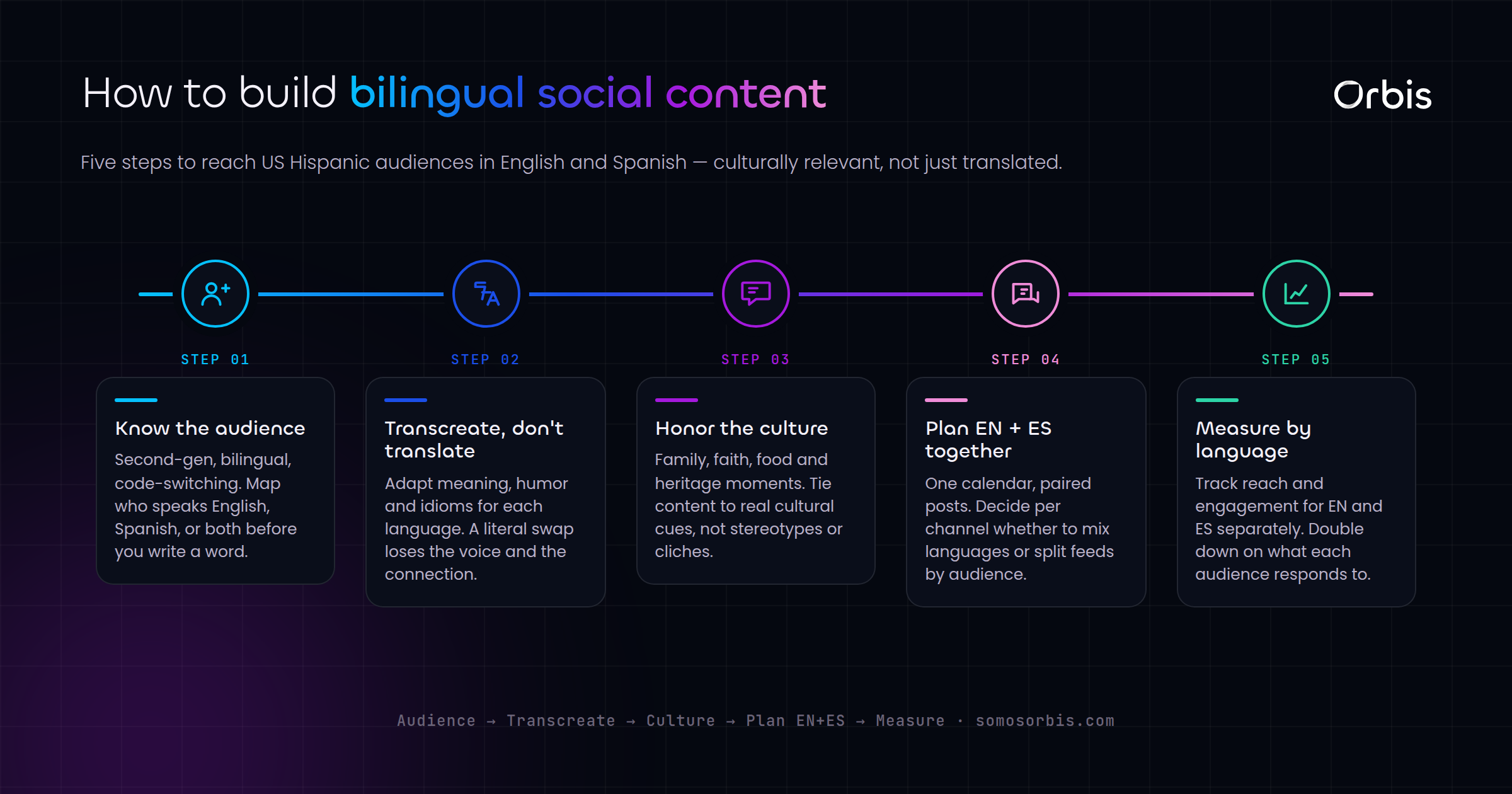
Segment the audience before you write a single caption
The biggest mistake is treating "Hispanic" as one homogeneous group. It is not. A second-generation Mexican American in Los Angeles, a recent arrival from Venezuela in Miami, and a bilingual professional in Chicago consume content differently. Before you draft copy, segment along a few practical axes.
- Language dominance: Spanish-dominant, English-dominant, or fully bilingual. This single variable drives most of your language decisions.
- Generation and acculturation: First generation often prefers Spanish for emotional and family topics; later generations frequently default to English but respond to cultural cues and code-switching.
- Country of origin and region: Vocabulary, humor, and references differ between Mexican, Caribbean, Central American, and South American communities. Miami skews Caribbean and South American; Houston and Dallas skew Mexican and Central American; New York is a broad mix.
- Platform and format preference: Short-form video, audio, and messaging apps behave differently across these segments.
You do not need a separate post for every cell in that grid. You need to know which two or three segments matter most for your business and let that drive language ratio, references, and creator choices.
The language decision: English, Spanish, or Spanglish
There is no single correct answer. There is a correct answer for each piece of content and each segment. Use a clear rule set instead of guessing.
When to lead in Spanish
Lead in Spanish when the segment is Spanish-dominant, when the topic is emotional, family-centered, or community-oriented, and when you are reaching first-generation audiences in markets like Miami or the Texas border metros. Spanish-led content signals respect and belonging, not just accessibility.
When to lead in English
Lead in English when targeting English-dominant later generations, when the content is product-feature or tech-heavy, or when the platform context (LinkedIn, professional B2B) skews English. Many bilingual US Hispanics consume aspirational and professional content in English by default.
When Spanglish wins
Spanglish and natural code-switching can be the most authentic register for bilingual, younger audiences, especially in short-form video and meme-driven content. The catch: it has to sound like a real person, not a brand cosplaying. Use it when a native bilingual creator or team member writes it. Do not engineer it from a template.
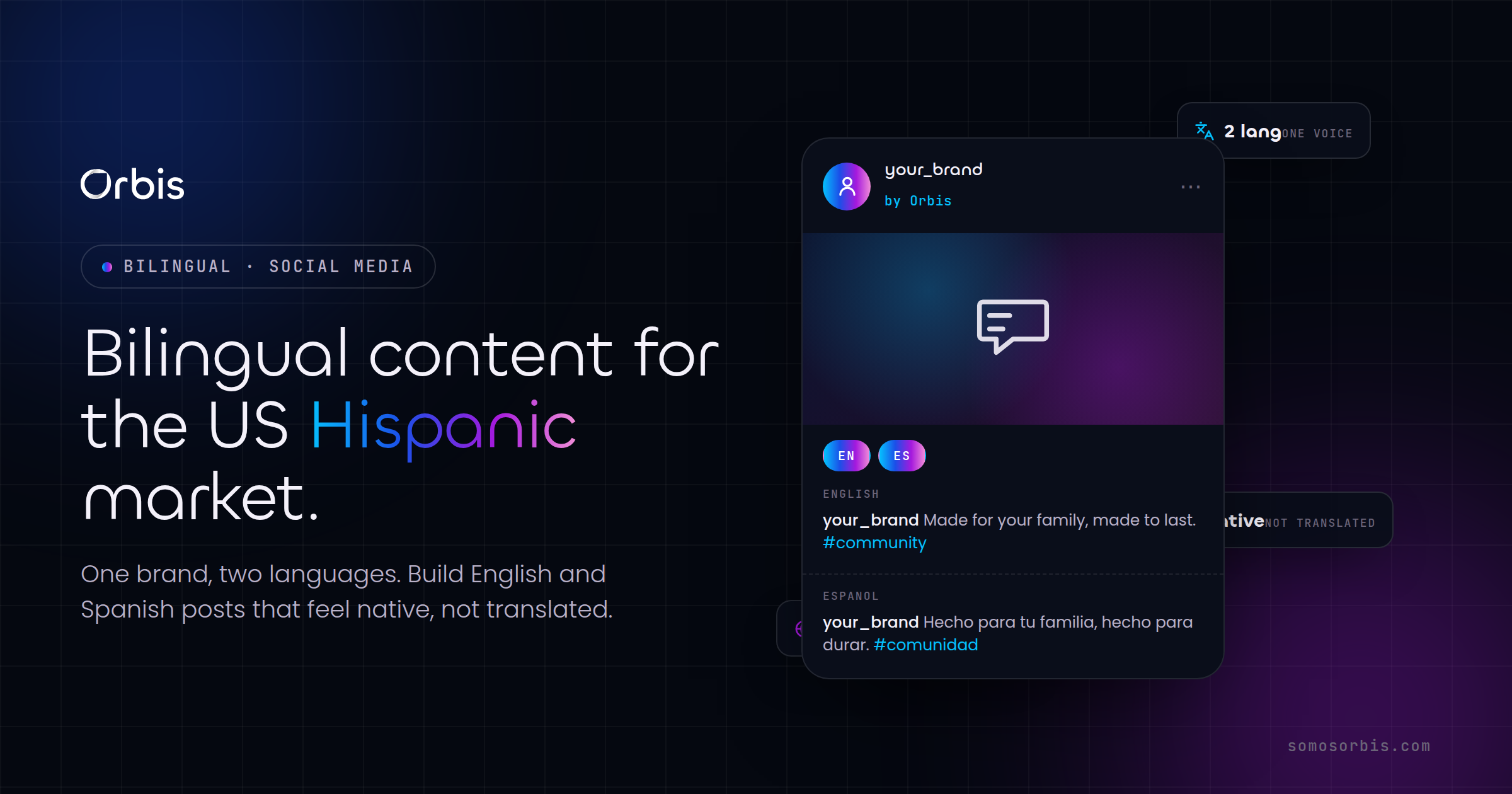
The rule of thumb: never machine-translate and ship. A literal Spanish translation of an English idiom reads as foreign and erodes trust faster than posting in English alone. Always have a native speaker transcreate, not translate.
Transcreation over translation
Transcreation means recreating the intent, emotion, and call to action in the target language rather than swapping words. A Black Friday / Cyber Monday promo headline that lands in English may need an entirely different hook in Spanish to carry the same urgency. The discount, the product, and the brand promise stay constant; the phrasing, references, and rhythm change.
Build a short bilingual style guide so transcreation is consistent and not personality-dependent. Include:
- Tone words: the three or four adjectives your brand voice should hit in both languages (for example: direct, expert, warm, no fluff).
- Formality: tú vs. usted by segment and platform. Younger social audiences usually take tú; formal financial or healthcare topics may take usted.
- Do-not-translate list: product names, taglines, and any English terms your audience already uses untranslated.
- Region-safe vocabulary: words that are neutral across Mexican, Caribbean, and South American Spanish, plus a list of region-specific terms to avoid or localize.
Build the workflow into your content calendar
Bilingual content fails when it is improvised. It scales when it lives inside one documented calendar with language as a built-in attribute of every slot, not a separate track. The practical move is to extend your existing planning system rather than create a parallel one. Our guide to building a content calendar around US seasonality walks through the calendar mechanics; here is how to make it bilingual.
- Tag every slot with a language plan: EN-only, ES-only, EN+ES adapted, or Spanglish. Decide this at planning time, not at publish time.
- Brief once, produce for both languages: write a single creative brief that includes the transcreated angle for each language so the shoot or design covers both.
- Route to native review: every Spanish and Spanglish asset passes a native speaker check before scheduling. Bake this step into the workflow so it never gets skipped under deadline.
- Localize captions and on-screen text: the same video can carry bilingual subtitles or two caption versions for two audience cuts.
This is where a documented, repeatable process pays off. When the steps live in a shared system, output quality stops depending on which person happens to be on shift. That is the operating principle behind everything we ship: quality processes that make good results the default. If you want this engineered end to end, our content strategy and calendar service builds the bilingual system, brief templates, and review gates for you.
Platform nuances for the US Hispanic audience
Instagram and TikTok
Short-form video is the heart of bilingual reach. Use bilingual subtitles, sound-on hooks in the first second, and creators who code-switch naturally. Trends move fast and often originate in Spanish-language or bilingual creator communities before crossing over, so monitor those communities directly rather than waiting for English trend lists.
YouTube
Long-form and how-to content performs well with Spanish-dominant viewers. Spanish-language captions and a dubbed or Spanish-voiced version of key videos extend shelf life. YouTube's multi-language audio features make a single video reachable in both languages.
WhatsApp and messaging
For many US Hispanic households, WhatsApp is the primary channel for family and trusted-brand communication. Use it for support, order updates, and opt-in promotions, always with explicit consent. This is a relationship channel, not a broadcast megaphone.
Still strong for community groups, events, and first-generation audiences. Spanish-language community management and timely replies matter more here than polished feed posts.
Tie content to US seasonality and cultural moments
Bilingual content gets its biggest lifts when it rides moments your audience already cares about. Map both mainstream US retail seasons and culturally specific dates.
- Black Friday and Cyber Monday: run parallel EN/ES promo creative with transcreated urgency hooks, not literal translations.
- Amazon Prime Day: a high-intent shopping window where bilingual product content can capture demand most brands address only in English.
- Back-to-school: family-centered and highly resonant with first- and second-generation households; lead emotional creative in Spanish where the segment supports it.
- Tax season: relevant for financial and services brands; clarity and trust matter, so favor precise transcreation over clever wordplay.
- Cultural dates: Hispanic Heritage Month, Día de los Muertos, Las Posadas, Three Kings Day, and country independence dates. Participate with substance and genuine community involvement, never as a one-day logo gesture.
Work with creators and community, not just media buys
Native bilingual creators are the fastest path to credibility. They already hold the trust, the register, and the cultural fluency you are trying to build. Brief them on the message and the boundaries, then let them write in their own voice, including Spanglish where it fits. Community managers who reply in the user's language, in real time, turn reach into relationship. This human layer is what makes bilingual content feel native instead of corporate.
Measure what matters, and respect privacy
Split your reporting by language and segment so you can see what actually works. Track engagement rate, save and share rate, video retention, and conversion by language variant. If your ES-led creative quietly outperforms your EN creative for a given segment, your calendar should shift accordingly. Aggregate numbers hide that signal.
As you collect data, follow current US privacy norms. Honor opt-in consent on messaging channels, provide clear language on how data is used, respect do-not-sell and data-deletion requests, and make privacy notices available in Spanish as well as English. Treating privacy as a design requirement, not an afterthought, is both the compliant move and the trust-building one. Build these guardrails into your process so every campaign inherits them by default rather than relying on someone to remember.
A practical starting checklist
- Identify your two or three priority US Hispanic segments by language dominance, generation, and region.
- Write a short bilingual style guide: tone words, tú vs. usted, do-not-translate list, region-safe vocabulary.
- Add a language-plan tag to every slot in your existing content calendar.
- Replace translation with transcreation and a mandatory native-speaker review gate.
- Partner with native bilingual creators and staff Spanish-language community management.
- Map both retail seasons and cultural dates, with transcreated creative for each.
- Report by language variant and bake privacy and consent into the workflow.
Turn bilingual content into a system
Bilingual social content is not a translation task. It is an audience-engineering task: segment the audience, choose the right language register for each moment, transcreate instead of translate, and run it all through a documented calendar with native review and privacy baked in. Do that, and you reach a large, high-intent US audience inside the campaigns you already run, without ever losing your brand voice.
If you want this built as a repeatable system instead of a scramble, let our team engineer it with you. Start with our content strategy and calendar service to get a bilingual editorial system, brief templates, transcreation standards, and review gates that make on-brand EN/ES content the default. For the broader picture, revisit the 2026 social media strategy guide for US brands and the companion guide to content calendars built around US seasonality.