
Social media in the United States is not a side project anymore. For a brand selling in New York, Los Angeles, Chicago, Miami, Dallas, or Houston, your feeds are where buying decisions start, where customer service plays out in public, and where your reputation gets written in real time. The problem is that most US brands still run social like a hobby: post when someone remembers, boost when sales dip, and report on likes nobody can spend. That gap between activity and outcomes is exactly what this guide closes.
This is a complete, end-to-end playbook for building a US social media program in 2026, from the foundational audit to the content calendar, from community management to reporting that a CFO will actually respect. We built it around how Orbis runs social media as a managed service for brands across the country: documented processes, revenue engineering, and compliance by design. No vanity metrics, no hype, no invented case studies. Just the system that turns a US audience into pipeline and retention.
Whether you are a regional retailer planning for Black Friday and Cyber Monday, a DTC brand timing launches to Amazon Prime Day, or a service business that needs to reach the large US Hispanic market in both English and Spanish, the structure here scales. Read it top to bottom the first time, then use it as a reference you return to every quarter.
Why a Strategy Beats a Posting Schedule
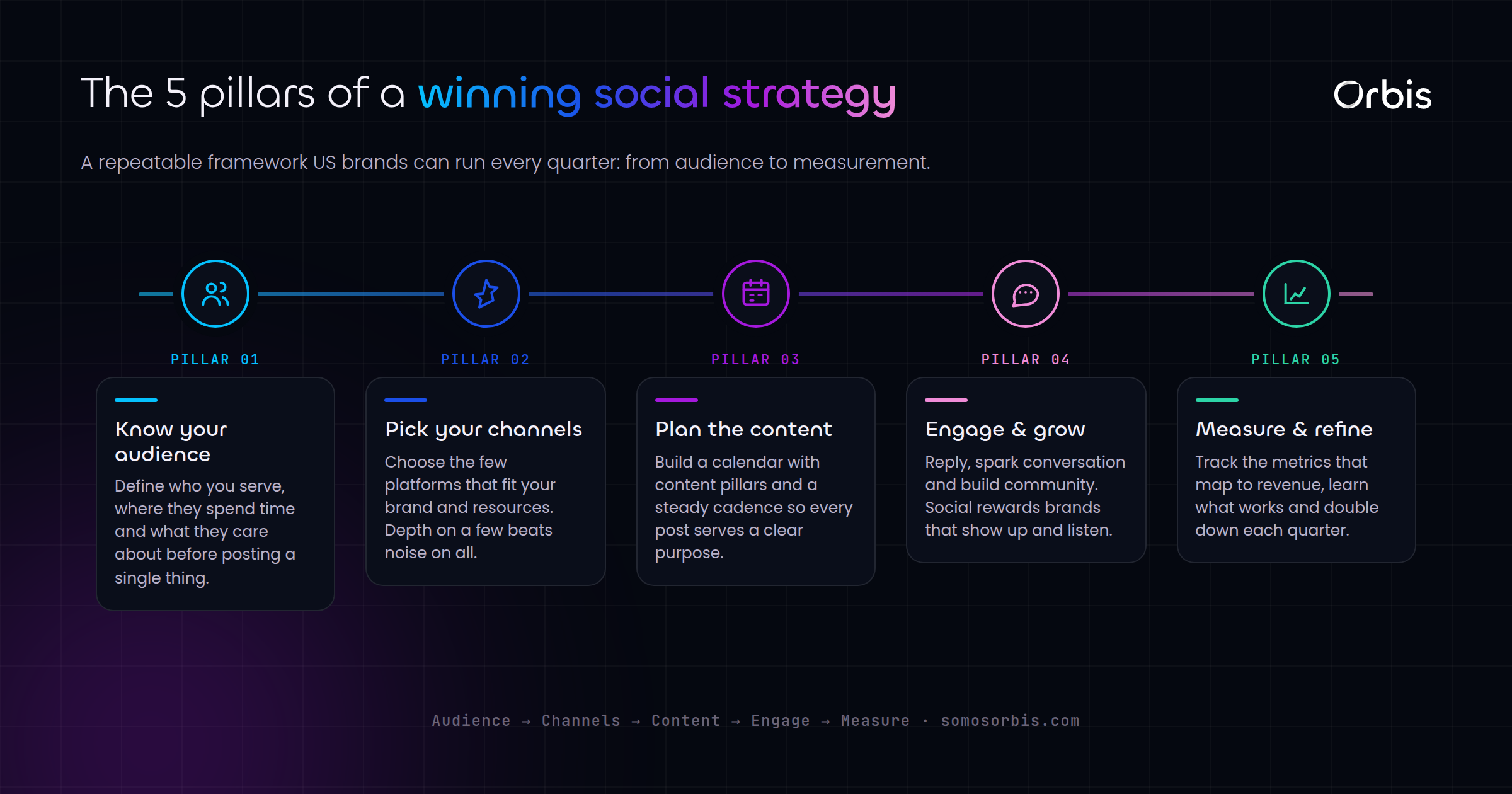
Most brands confuse a posting schedule with a strategy. A posting schedule answers "what do we publish on Tuesday?" A strategy answers "why does this channel exist, who is it for, what business result does it drive, and how will we know it worked?" The first is a calendar. The second is an operating system.
The difference shows up in the numbers. When you post without a strategy, every quarter feels like starting over: new themes, new tone, new metrics, no compounding. When you operate from a documented strategy, each month builds on the last. Audience data informs content, content performance informs the calendar, the calendar informs paid amplification, and reporting feeds back into the strategy. That loop is the whole point.
For US brands specifically, strategy matters even more because the market is fragmented. A customer in Miami behaves differently from one in Chicago. The Hispanic market in Los Angeles, Houston, and the Southwest expects bilingual, culturally fluent content, not machine-translated captions. US retail seasonality, from back-to-school in late summer to tax season in early spring, creates predictable demand spikes you can plan around a year in advance. A posting schedule ignores all of this. A strategy is built on it.
The Five Layers of a Modern Social Program
Every effective US social media program has five layers that work together. Skip one and the whole thing wobbles.
- Foundation: a current audit of every profile, audience, and competitor so you know your real starting point.
- Content: a calendar tied to US seasonality and your business goals, not random inspiration.
- Community: active management of comments, DMs, mentions, and reviews so engagement becomes relationship.
- Listening: monitoring of brand sentiment and reputation so you catch problems before they spread.
- Measurement: reporting on the KPIs that connect social activity to revenue and retention.
The rest of this guide walks each layer in order, because that is the order you should build them. You cannot plan a calendar before you have audited what you have. You cannot manage a community you have not staffed. And you cannot report on results you never defined.
Start With a Social Media Audit
You would not launch a paid campaign without knowing your conversion rate. Yet brands relaunch their social presence every January without ever auditing what they already have. The audit is the single highest-leverage hour you will spend, because it replaces opinion with evidence.
A proper audit covers four areas. First, your profiles: are they complete, consistent, and on-brand across Instagram, TikTok, Facebook, LinkedIn, YouTube, and Pinterest? Mismatched bios, outdated links, and inconsistent handles quietly cost trust. Second, your audience: who actually follows you, where are they, what language do they speak, and when are they online? US brands are frequently surprised to find a large Spanish-speaking segment they have never spoken to directly. Third, your content: which formats and topics earn engagement and saves, and which quietly die? Fourth, your competitors: what are the three brands you lose customers to actually doing, and where are the gaps you can own?
The output of an audit is not a report you file away. It is a prioritized list of fixes and opportunities ranked by impact. Fix the broken link in the bio today. Plan the bilingual content stream this quarter. Reposition against the competitor who owns a topic you should own. If you want a repeatable framework you can run yourself every quarter, follow our social media audit checklist for US brands, which breaks the whole process into a checklist you can hand to anyone on your team.
Setting Goals That Map to Revenue
Audits tell you where you are. Goals tell you where you are going, and they must connect to money. "Grow followers" is not a goal; it is a wish. "Generate 200 qualified leads per quarter from social at a cost below our paid benchmark" is a goal. So is "reduce response time on customer complaints to under one hour to protect retention" or "drive 15% of Black Friday revenue through organic and paid social combined."
Anchor every goal to one of three business outcomes: acquisition, retention, or reputation. Acquisition goals drive new customers and leads. Retention goals keep existing customers buying and reduce churn through service and community. Reputation goals protect the brand so that growth is not undone by a public crisis. When every piece of content and every team decision ladders up to one of those three, you have a strategy. When it does not, you have a feed.
Choose the Right Platforms for the US Market
You do not need to be everywhere. You need to be where your customers are, with the right content for each environment. Spreading a small team across six platforms produces six mediocre presences. Concentrating on the two or three that matter produces leadership.
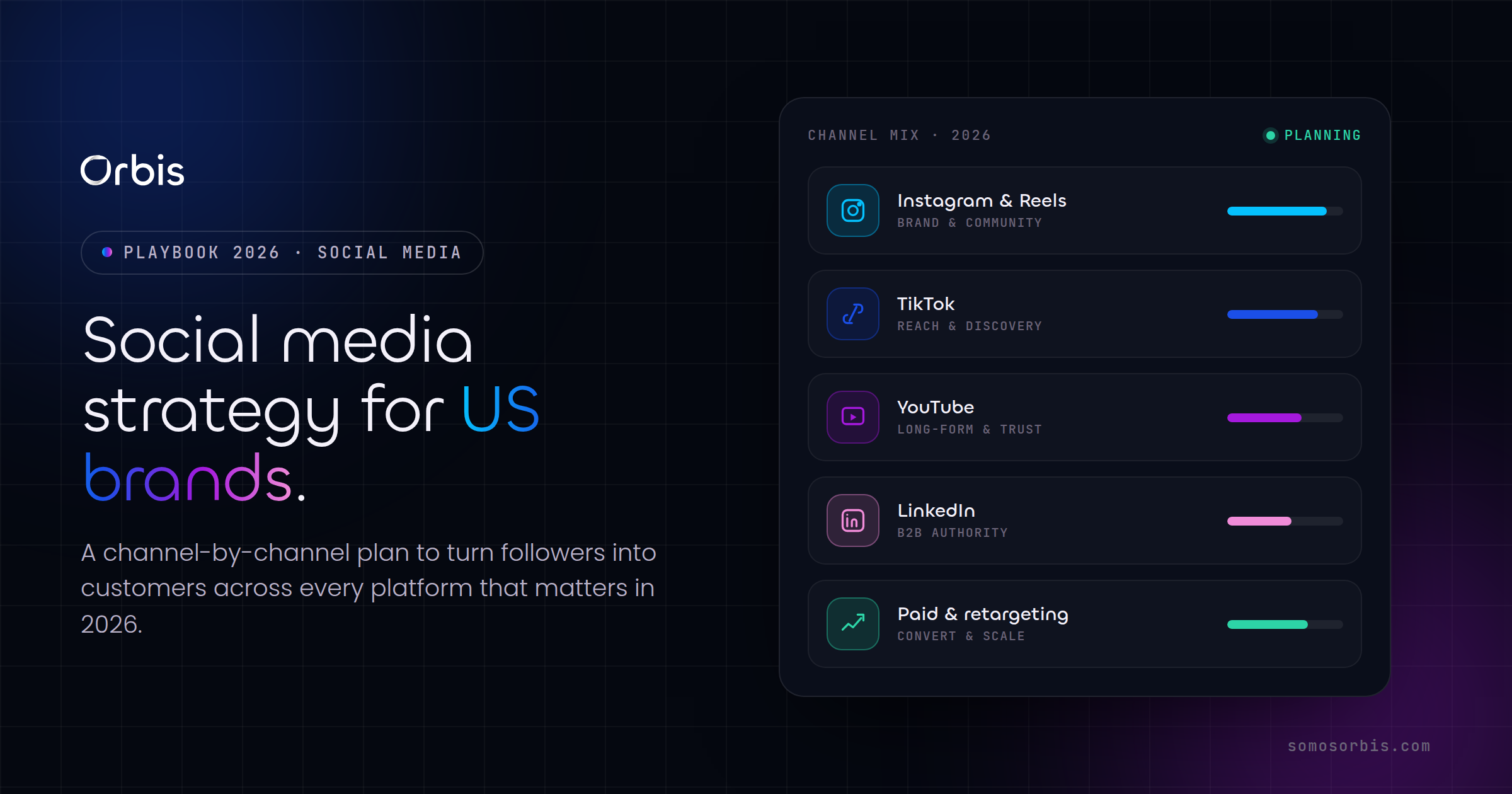
Here is how the major platforms break down for US brands in 2026:
- Instagram remains the default for visual brands, lifestyle, retail, food, and DTC. Reels drive reach, the grid builds brand, and Stories drive daily engagement and direct response. Strong across all US markets and essential for reaching younger and Hispanic audiences.
- TikTok is where discovery and culture live, especially for brands targeting Gen Z and younger Millennials in cities like Los Angeles, Miami, and New York. Native, fast, authentic content wins; polished ads lose.
- Facebook still owns reach among adults 30 and up, local community groups, and event promotion. It remains a workhorse for paid and for reaching Hispanic households across the Southwest and Florida.
- LinkedIn is non-negotiable for B2B, professional services, and recruiting. If you sell to businesses in Chicago, Dallas, or Houston, this is your primary channel.
- YouTube is the long-form engine for education, demos, and evergreen search-driven content. Underused by most brands and a major SEO asset.
- Pinterest drives high-intent discovery for retail, home, wedding, food, and seasonal planning, with a US audience that plans purchases weeks ahead, perfect for back-to-school and holiday.
The right mix depends on who you sell to and what you sell. A Houston B2B firm leads with LinkedIn and YouTube. A Miami fashion brand leads with Instagram and TikTok and uses Pinterest for seasonal planning. Pick your two primary platforms where you will win, add one secondary where you will maintain a presence, and ignore the rest until you have earned the capacity to expand.
Build a Content Calendar Around US Seasonality
Content without a calendar is improvisation, and improvisation does not scale. A content calendar turns your strategy into a repeatable production system: themes, formats, publishing cadence, and the people responsible for each piece. For US brands, the calendar's superpower is seasonality.
The US retail and cultural year has a rhythm you can plan around twelve months out. January brings New Year resolutions and post-holiday recovery. Tax season runs from January through April and drives spending intent in finance, home, and big-ticket categories. Spring brings graduation and Mother's Day and Father's Day. Summer brings travel and the back-to-school ramp that starts in July. Fall is the run-up to the biggest moment of all: Black Friday, Cyber Monday, and the holiday season that can make or break a retail year. Layer in Amazon Prime Day in the summer and again in the fall, plus cultural moments like Hispanic Heritage Month, and you have a calendar that practically writes itself.
The mistake brands make is planning these moments two weeks out. Black Friday content should be in production by September. Back-to-school creative should be approved by June. A content calendar built on US seasonality lets you batch production, secure budget early, and show up prepared when your competitors are scrambling. We go deep on how to map each of these moments into a publishing plan in our guide to building a content calendar for US seasonality.
The Content Mix That Actually Performs
A healthy calendar balances four content types so you are never all-sell or all-fluff:
- Educational content teaches your audience something useful and builds authority. This is your AEO and SEO workhorse, the content AI assistants and search engines love to surface.
- Entertaining content earns reach and shares. It is how you get discovered by people who have never heard of you.
- Inspirational content connects your brand to the customer's aspirations and reinforces why they chose you.
- Promotional content drives the direct response: launches, offers, and seasonal pushes. Keep this to roughly one in five posts so your feed never feels like a sales flyer.
The ratio matters more than the perfection of any single post. Brands that post only promotions train their audience to ignore them. Brands that never sell leave money on the table. A documented mix, planned in the calendar, keeps the balance right week after week. If you would rather hand the entire production system to a team that runs it as a documented process, that is exactly what our content strategy and calendar service delivers, from theme planning through scheduling and approvals.
Community Management Is Where Brands Are Won or Lost
Posting is broadcasting. Community management is conversation, and conversation is where loyalty is built. Every comment you answer, every DM you respond to, and every review you address in public is a signal to thousands of silent observers about how your brand treats people. In the US market, where customers expect fast, human, and bilingual service, community management is not optional. It is the difference between a brand people trust and one they scroll past.
The fundamentals are simple to state and hard to sustain. Respond fast: a complaint left for a day on a public feed becomes a story. Respond human: scripted corporate replies make things worse. Respond in the customer's language: if a Spanish-speaking customer in Houston writes to you in Spanish, answering in English tells them they do not belong. And respond consistently, because a community manager who is brilliant on Monday and absent on Thursday creates a worse impression than one who is reliably good every day.
This is also where social becomes a retention engine. A customer whose problem you solved publicly and graciously is more loyal than one who never had a problem at all. The brands that treat community management as customer service plus relationship building, rather than as moderation, are the ones that turn followers into repeat buyers. We lay out the playbooks, response frameworks, and escalation paths in our deep dive on community management best practices for US brands.
Staffing and Scaling Community Management
The hardest part of community management is not knowing what to say. It is being there, consistently, across every platform, in every relevant language, during the hours your audience is active. That is an operational problem, not a creative one, and it is where most in-house teams break down. One person cannot cover six platforms, two languages, and weekend spikes around a Black Friday launch.
The solution is a documented system: response time targets, tone guidelines, an FAQ library, an escalation matrix for complaints that need a manager or legal review, and clear coverage windows. With those in place, community management becomes a process you can staff and scale rather than a heroic effort that depends on one tired person. For brands that want coverage without building the team, our community management service provides bilingual, always-on coverage with documented response standards and escalation built in.
Reach the US Hispanic Market With Bilingual Content
The US Hispanic market is one of the largest and fastest-growing consumer segments in the country, concentrated heavily in the very cities where most brands compete: Los Angeles, Houston, Miami, Dallas, Chicago, and New York. Brands that speak to this audience authentically, in both English and Spanish, unlock growth that English-only competitors cannot reach. Brands that ignore it, or that bolt on machine-translated captions, leave that growth on the table and sometimes do real damage to their reputation.
Authentic bilingual content is not translation. It is cultural fluency. A campaign that works in English may fall flat or even offend when rendered word-for-word into Spanish. The right approach treats Spanish content as its own creative stream, with native writers, culturally relevant references, and an understanding of the distinct Hispanic communities across US regions, which are not monolithic. A message that resonates with Cuban-American audiences in Miami may differ from one that lands with Mexican-American audiences in Houston or Los Angeles.
The payoff is significant: deeper engagement, stronger trust, and access to households that drive enormous purchasing power, especially around family-centered moments and US seasonal peaks. We cover the strategy, workflow, and pitfalls in detail in our guide to bilingual social content for the US Hispanic market, including how to build a sustainable EN/ES production process rather than a one-off translation scramble.
Listen Before You Get Blindsided
Social listening is the difference between managing your reputation and reacting to it. Listening means monitoring not just the comments on your own posts, but every mention of your brand, your competitors, and your category across the web, so you understand sentiment in real time and catch issues while they are still small.
For US brands, listening surfaces three kinds of intelligence. First, reputation signals: a rising wave of complaints, a viral negative post, or a review pattern that points to a product or service problem. Catching these early, before they trend, is the entire game in reputation management. Second, opportunity signals: customers asking for something you offer, praising a competitor's weakness you can exploit, or creating content about your brand you can amplify. Third, market intelligence: what your category is talking about, which trends are rising, and where the conversation is heading so your content stays relevant.
Reputation management is where listening becomes urgent. A single mishandled incident, a slow response to a public complaint, or a tone-deaf reply during a sensitive moment can undo months of brand building. The brands that weather these moments are the ones that saw them coming, had a response plan ready, and acted with speed and humanity. We detail the monitoring setup, alert thresholds, and crisis-response frameworks in our guide to social listening and reputation management for US brands.
Compliance and Privacy by Design
Running social at scale in the US means handling customer data, user-generated content, and direct messages responsibly. Privacy expectations have risen sharply, and customers increasingly notice how brands handle their information. The principle to operate by is compliance by design: build your data handling, consent practices, and content workflows to respect privacy norms and current regulations from the start, rather than retrofitting after a problem.
In practice this means clear consent when you collect or repost user content, careful handling of any personal data shared in DMs, transparent practices around contests and data capture, and documented processes your whole team follows. You do not need to turn every caption into a legal disclaimer. You need quality processes that keep you on the right side of current regulations while keeping the customer experience smooth. Treating compliance as a design principle rather than an afterthought is part of how serious US brands protect both their customers and themselves.
Measure What Matters: Reporting That Connects to Revenue
If your social media report leads with follower count and total likes, it is measuring activity, not outcomes. The CFO does not care how many people liked a post. They care whether social drove revenue, reduced cost, or protected the brand. The job of reporting is to translate social activity into the language of the business.
The KPIs that matter fall into the same three buckets as your goals. For acquisition, track reach to the right audience, qualified traffic to your site, leads generated, and the cost per lead compared to your paid benchmarks. For retention, track engagement rate among existing customers, response time on service interactions, and the share of community issues resolved. For reputation, track sentiment trend, share of voice against competitors, and how quickly you respond to negative mentions.
Vanity metrics like raw follower count and total impressions belong in the appendix, if anywhere. What earns a seat at the table is a report that says: "Social drove this much qualified traffic, generated this many leads at this cost, resolved this many service issues protecting this much retention, and held sentiment steady through a difficult month." That is reporting a leadership team acts on. We break down exactly which metrics to track, how to benchmark them, and how to build a dashboard executives trust in our guide to social media reporting and the KPIs that matter for US brands.
Turning Reporting Into a Feedback Loop
Reporting is not the end of the process; it is the start of the next cycle. The best social programs treat every report as input to the strategy. Did educational content outperform promotional content? Shift the mix. Did bilingual posts earn double the engagement? Invest more in the Spanish stream. Did response time slip during a launch? Add coverage for the next peak. Did a competitor gain share of voice on a topic you should own? Reposition.
This is revenue engineering applied to social media: a documented loop where audit informs strategy, strategy informs content and community, performance informs reporting, and reporting informs the next audit. Run that loop every month and every quarter, and your social program compounds instead of resetting. That compounding is the real return on a strategy, and it is invisible to brands that only ever look at this week's numbers.
Putting It All Together: Your 90-Day Rollout
A strategy you do not execute is a document. Here is how to turn everything above into action over your first 90 days.
- Days 1 to 15: Run the full audit. Inventory profiles, analyze audience and language mix, review your top and bottom content, and study three competitors. Set goals tied to acquisition, retention, and reputation.
- Days 16 to 30: Choose your two primary platforms and one secondary. Build the first 90 days of your content calendar around upcoming US seasonal moments. Stand up your community management system with response targets and an escalation matrix.
- Days 31 to 60: Produce and publish on cadence. Launch your bilingual content stream if you serve the Hispanic market. Turn on social listening with alerts for brand mentions and sentiment shifts.
- Days 61 to 90: Build your reporting dashboard around the KPIs that matter. Run your first monthly review, feed the learnings back into the strategy, and lock in the production rhythm.
By day 90 you no longer have a posting schedule. You have an operating system: a documented, measurable, compounding social program built for the realities of the US market. That is the difference between brands that post and brands that grow.
Related Guides for US Brands
This pillar connects to a full library of in-depth guides. Use them to go deeper on each layer of your program:
- Community Management Best Practices for US Brands — response frameworks, escalation, and turning engagement into loyalty.
- Content Calendar for US Seasonality — mapping Black Friday, Prime Day, back-to-school, and tax season into a publishing plan.
- Social Media Audit Checklist for US Brands — the quarterly checklist to know exactly where you stand.
- Social Media Reporting and KPIs That Matter — building reports leadership acts on.
- Social Listening and Reputation Management — monitoring, alerts, and crisis-ready response.
- Bilingual Social Content for the US Hispanic Market — reaching EN/ES audiences with cultural fluency.
Ready to Build a Social Program That Drives Revenue?
You now have the complete blueprint: audit, goals, platform selection, a seasonal content calendar, community management, bilingual reach, listening, compliance by design, and reporting that connects to the bottom line. The strategy is clear. The only question is whether you build and run it in-house or partner with a team that does this every day, with documented processes, revenue engineering, and compliance built in.
Orbis has spent more than 15 years helping over 500 brands turn marketing into measurable growth, with a 4.9-star rating across 58 reviews and partnerships with Meta, Shopify, Pinterest, and more. If you want a US social media program built and managed as a documented, accountable system rather than a guessing game, explore our social media services and let's turn your feeds into a revenue engine.