
Most social calendars in the United States fall apart for the same reason: they are built around the brand's internal roadmap instead of the customer's year. Product launches, webinar dates, and "we should post more" sprints feel productive, but they ignore the rhythm your audience actually lives by. In the US, that rhythm is loud and predictable. Tax season squeezes household budgets in the spring. Back-to-school turns July and August into a buying window. Black Friday, Cyber Monday, and Amazon Prime Day compress most retail demand into a handful of weeks. Build your content calendar around that seasonality and your posts stop fighting for attention; they start arriving exactly when intent is already high.
This guide walks through how to build a US seasonal content calendar that holds up across a full year, the platforms it should run on, and the planning cadence that keeps it from collapsing in Q4. It is the practical companion to our broader playbook on social media strategy for US brands, and it pairs closely with our guide to bilingual social content for the US Hispanic market, because seasonality and language are the two levers that most often get ignored at the same time.
Why US seasonality should anchor your calendar
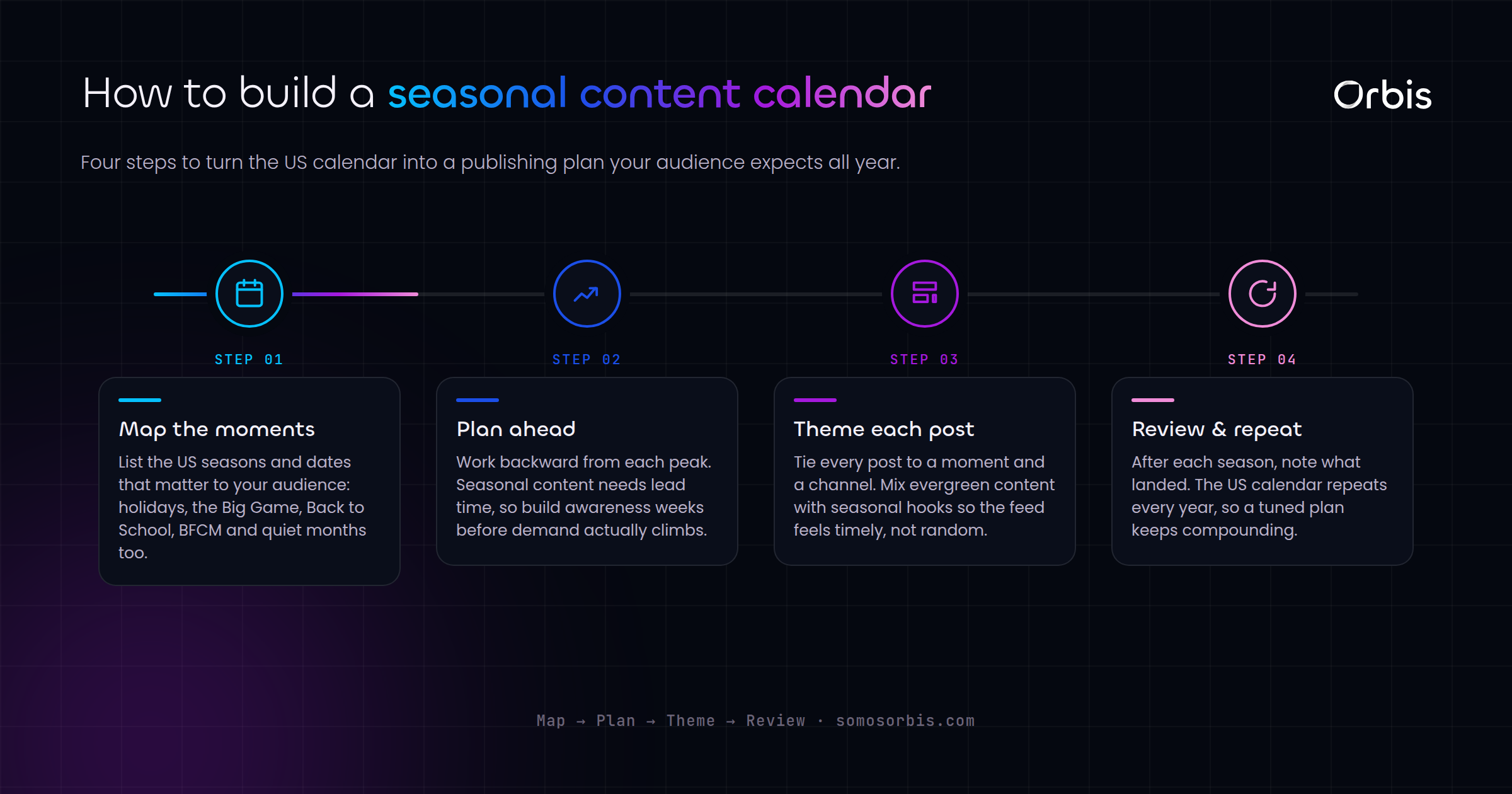
A content calendar built on seasonality wins for one structural reason: demand is not evenly distributed across the year, so your effort should not be either. A New York DTC apparel brand, a Dallas home-services company, and a Miami SaaS startup all have radically different products, but they share the same national calendar of spending moments. When you align content with those moments, you ride momentum that already exists instead of manufacturing it from scratch.
The US calendar has a few characteristics worth naming directly:
- It is front-loaded and back-loaded. Tax season (January through mid-April) and the holiday peak (November through December) bookend the year with the heaviest commercial intent.
- It rewards preparation, not reaction. Black Friday content that goes live on Black Friday is already late. The planning, creative, and audience warming should start weeks earlier.
- It is bilingual in many markets. In cities like Los Angeles, Houston, Chicago, and Miami, a large US Hispanic audience experiences these same seasons, often with distinct cultural overlays. A single English calendar leaves reach on the table.
- It varies by industry. Retail peaks in Q4; B2B software often peaks around budget cycles in Q1 and Q4; real estate moves with spring and early summer. Your seasonality is the US calendar filtered through your category.
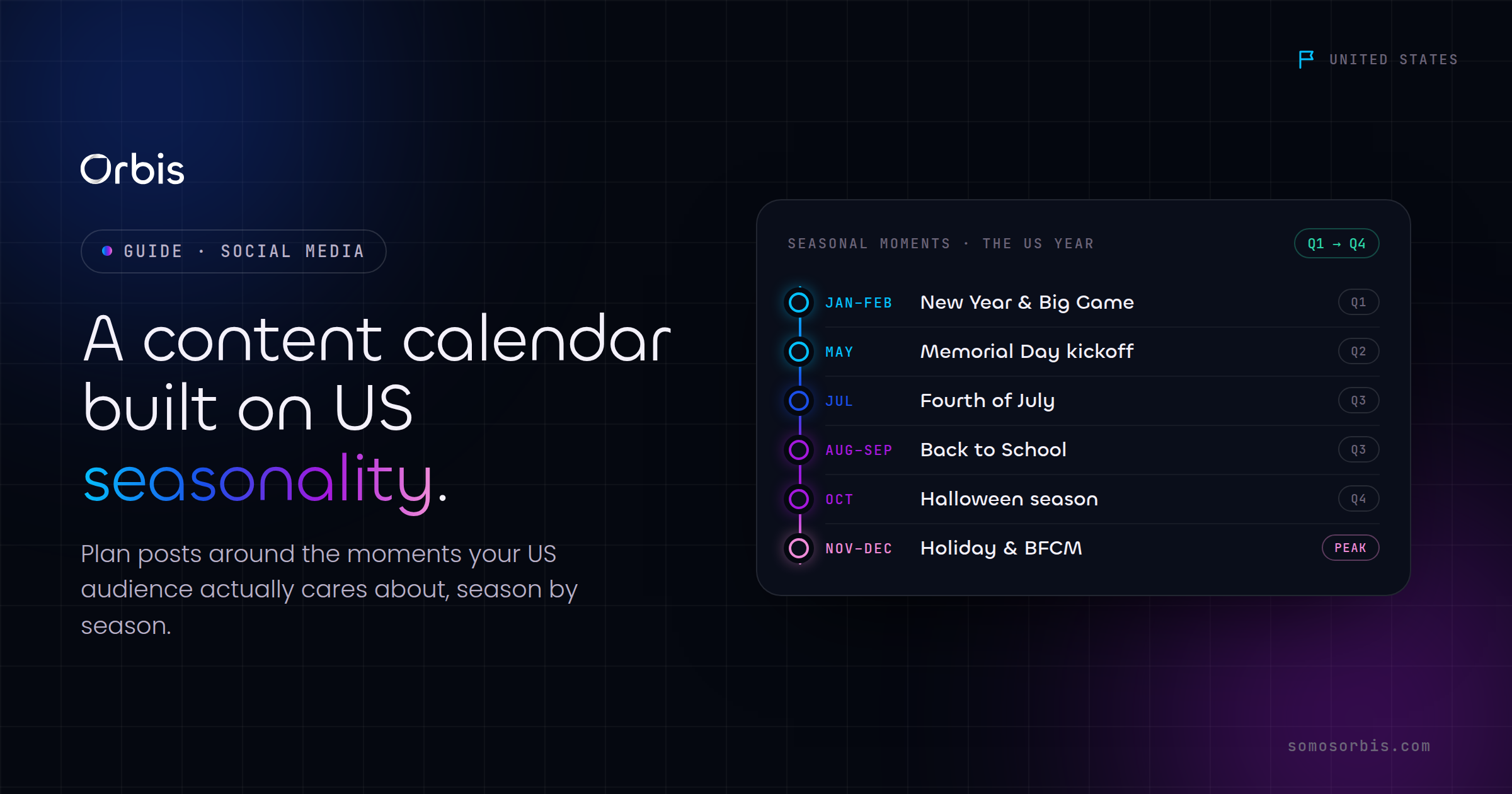
Mapping the US seasonal calendar, quarter by quarter
Before you schedule a single post, map the year. The goal is a one-page view of the spending and attention moments that matter to your audience, so you can see where to concentrate creative and budget.
Q1 (January to March): tax season and the fresh-start window
January opens with "new year, new me" intent, strong for fitness, finance, productivity, and education. February brings Valentine's Day and the Super Bowl, the largest single advertising moment in the US. March moves into tax season urgency. For finance, accounting, and any service that helps people save or organize money, this quarter is prime. For retail, lean into the fresh-start angle rather than discounts.
Q2 (April to June): tax deadline, Mother's and Father's Day, summer ramp
Mid-April closes tax season with a hard deadline that creates a genuine spike in attention. May brings Mother's Day, Memorial Day, and the start of summer travel and outdoor spending. June adds Father's Day, graduations, and Pride, which matters in markets like Los Angeles, New York, and Chicago. This is also when smart brands begin planning Q4, not posting about it yet, but building the assets.
Q3 (July to September): Prime Day, back-to-school, and Q4 pre-production
Amazon Prime Day in July kicks off the second half of the year and pulls forward a wave of deal-seeking behavior that benefits far more than Amazon sellers. Back-to-school spending runs from mid-July through early September and is one of the largest US retail seasons after the winter holidays, relevant to apparel, electronics, software, and home organization. By September, your Q4 creative, offers, and landing pages should be in production.
Q4 (October to December): the holiday peak
This is the quarter the whole calendar bends toward. Halloween opens it, then the demand stack builds through Black Friday and Cyber Monday into the December gifting window and year-end. Most retail brands earn a disproportionate share of annual revenue here, and most paid and organic content should be planned by late summer so execution in Q4 is calm rather than chaotic.
From calendar to content: building the actual posting plan
A list of seasons is not a content calendar. The next step is turning each moment into a sequence of posts with a clear job. The mistake we see most often in the US market is treating a season as a single "campaign day" instead of a build. Black Friday is not a post; it is a three-to-four-week arc.
For each major seasonal moment, plan content across three phases:
- Warm-up (2 to 4 weeks out): Teasers, value content, and early-access signups. You are building audience and intent, not selling yet. Think gift guides before Black Friday, or "get organized before tax season" content in early January.
- Peak (the moment itself): The offer, the launch, the strongest calls to action, and the highest posting frequency. Stories, reels, and time-sensitive formats carry urgency here.
- Cool-down (the days after): Last-chance reminders, social proof, and a soft transition to the next moment. Cyber Monday extensions and "the sale ends tonight" posts live here.
Lay this out so that the cool-down of one season overlaps the warm-up of the next. Done well, your calendar becomes a continuous chain rather than a series of disconnected spikes with dead air between them.
Match formats and platforms to the moment
Seasonality also dictates format. Different moments reward different content types and channels:
- Instagram and TikTok carry the visual, fast-moving energy of Black Friday, back-to-school, and holiday gifting. Short video and carousels work hard during peaks.
- Pinterest indexes for planning-heavy seasons; people plan holidays, weddings, and back-to-school there weeks ahead, so publish earlier than you would elsewhere.
- LinkedIn aligns with B2B budget cycles, end-of-quarter pushes, and year-end planning content rather than consumer holidays.
- Email and SMS are the workhorses of the peak itself, when timing and urgency matter most.
You do not need to be everywhere for every season. Pick the two or three channels where your audience already shows seasonal intent and commit to depth there.
Don't forget the US Hispanic audience
In many of the largest US metros, a single-language calendar quietly caps your reach. The US Hispanic market experiences Black Friday, back-to-school, and tax season alongside everyone else, and adds culturally significant moments such as Hispanic Heritage Month (mid-September to mid-October), Día de los Muertos, and the Three Kings Day gifting window in early January.
A few practical principles for bilingual seasonal planning:
- Translate intent, not just words. A Spanish-language back-to-school post should reflect how families actually talk about and plan for the season, not a literal English-to-Spanish swap.
- Add culturally specific moments to the calendar rather than treating bilingual content as a translation layer bolted onto an English plan.
- Decide your language strategy per channel. Some brands run parallel EN/ES feeds; others weave bilingual content into one feed. Both work; inconsistency does not.
We go deep on this in our companion guide to bilingual social content for the US Hispanic market, which fits directly into the seasonal framework here.
The planning cadence that keeps the calendar alive
The hardest part of a seasonal calendar is not building it once; it is keeping it current as the year unfolds. The teams that succeed run a simple, repeatable cadence rather than relying on heroics every quarter.
- Annual: Build the full-year seasonal map. Mark every relevant US moment, your industry peaks, and the cultural dates that matter to your audience. This is your skeleton.
- Quarterly: Detail the next quarter into a real posting plan with themes, formats, and offers. Lock the assets that need lead time, especially anything for Q4.
- Monthly: Finalize copy, creative, and schedule for the coming weeks. Confirm any time-sensitive promotions and approvals.
- Weekly: Review performance, adjust the live week, and respond to anything moving in real time. Engagement and community management live here.
This cadence is what separates a calendar that survives Q4 from one that gets abandoned in October when the team is underwater. It also gives you the lead time to coordinate seasonal content with paid campaigns, landing pages, and email, so every channel hits the same beat at the same time.
Build in measurement from day one
Seasonality is one of the few areas of marketing where you get a clean year-over-year comparison. The same moments come back, so the data compounds if you capture it. For every major season, note what you posted, what performed, and what you would change. Next year, that record turns guesswork into a starting point. Track engagement and conversion by moment, not just by month, so you can see which seasons genuinely drive your business and where you are over-investing out of habit.
Common mistakes to avoid
A few patterns sink US seasonal calendars more than any others:
- Starting too late. Q4 content planned in October is already behind. The brands that win in November did the work in August.
- Treating every season as a discount. Not every moment is a sale. Tax season is about relief and organization; back-to-school is about readiness. Match the emotion to the season.
- Ignoring the cool-down. The days after a peak still convert. Last-chance and social-proof content captures the procrastinators, who are a meaningful share of US shoppers.
- One language in a bilingual market. In Miami, Houston, or Los Angeles, an English-only calendar leaves a large, ready audience untouched.
- No documented process. Calendars that live in one person's head break when that person is on vacation during the busiest week of the year.
That last point is the quiet difference between agencies and teams that scale and those that scramble. A seasonal calendar should be a documented process, not a memory, so it runs the same whether the founder is in the room or not. That is the discipline behind durable revenue: clear processes, planned ahead, executed consistently.
Turn the US calendar into your unfair advantage
Your competitors all share the same US calendar. The advantage goes to whoever plans against it earliest, executes most consistently, and speaks to the full audience, including the bilingual one. A seasonal content calendar is not a nice-to-have organizational tool; it is the operating system for a year of social content that arrives when intent is already high.
If you want a calendar that is built around your category, your cities, and your audience, our team can help you design and run it. Explore our content strategy and calendar service to put a documented, seasonally aligned plan behind your social channels, so your content shows up at the right moment, in the right language, every quarter of the year.