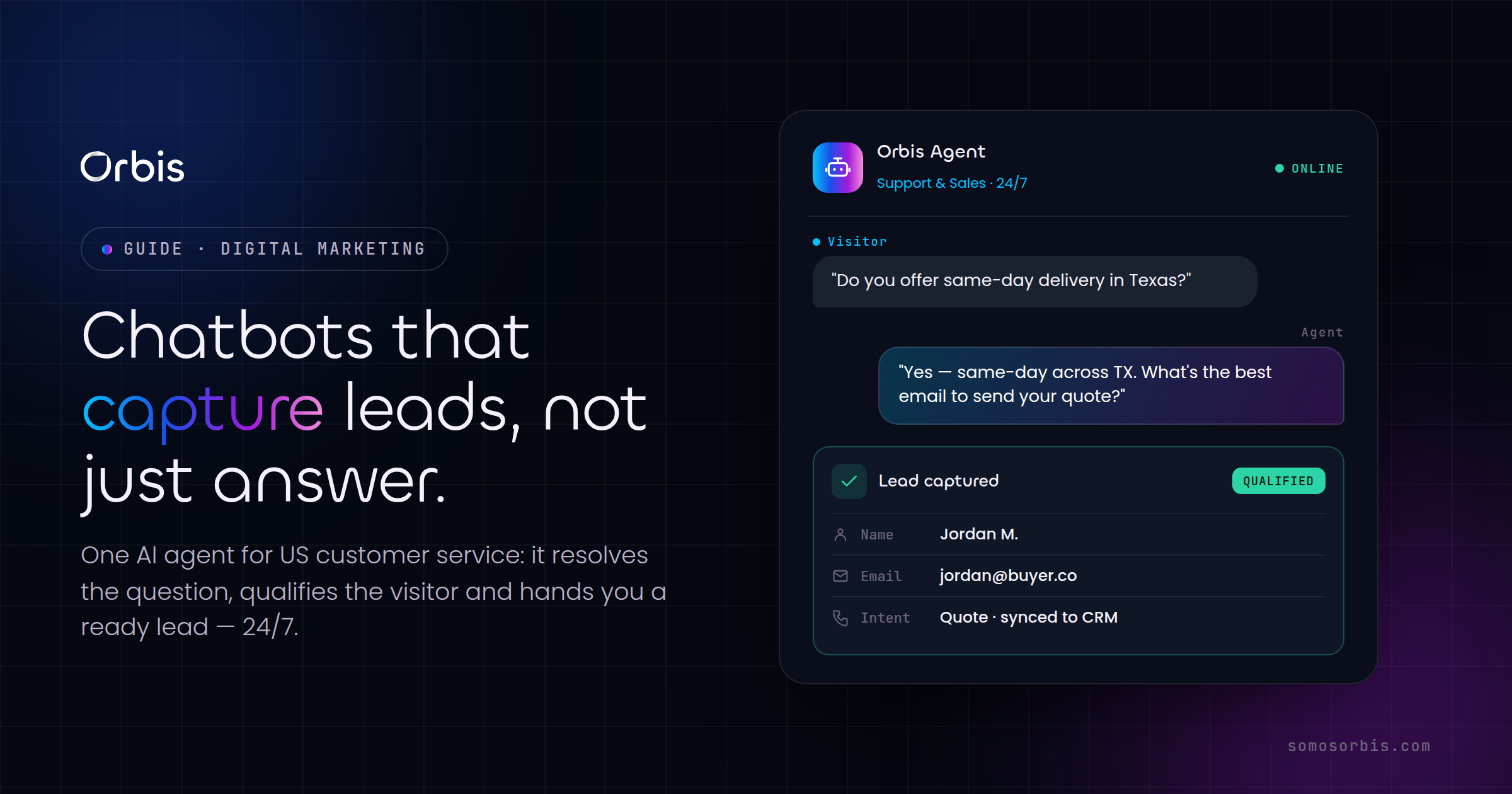
Your best lead doesn't fill out a form at 2 p.m. on a Tuesday. They land on your pricing page at 11:47 p.m., have one question standing between them and a purchase, and there's no one to answer it. By morning they've found a competitor who replied faster. Across a country that spans four mainland time zones plus Alaska and Hawaii, "business hours" is a fiction. A customer in Miami is winding down while a shopper in Los Angeles is just getting started, and neither one wants to wait until tomorrow.
This is the gap a well-built chatbot closes. Not a clunky scripted menu that frustrates people into leaving, but a bilingual EN/ES assistant that qualifies leads, answers real questions, and hands off cleanly to a human when it should. Done right, a chatbot is one of the highest-leverage pieces of marketing technology a US business can deploy: it works 24/7, it never has an off day, and it captures intent at the exact moment it's hottest. This guide walks through how to plan, build, and operate chatbots that actually move revenue, not just deflect tickets.
Why chatbots matter more in the US market
Three realities make chatbots disproportionately valuable for businesses selling in the United States.
The clock never stops. A brand operating nationally is effectively always "open" somewhere. If your team is in Dallas working 9-to-5 Central, you're offline before the New York evening rush of after-work shoppers and well before the West Coast prime browsing window. A chatbot covers the hours your team can't, and it does so consistently whether it's a quiet Wednesday or the chaos of Black Friday and Cyber Monday.
Demand spikes are brutal and predictable. US seasonality concentrates enormous traffic into narrow windows: Black Friday/Cyber Monday, Amazon Prime Day, back-to-school in late summer, and tax season in the first quarter. During these spikes, human support queues overflow and response times balloon exactly when a slow reply costs the most. A chatbot absorbs the first wave of repetitive questions ("Is this in stock?" "When does the sale end?" "What's your return window?") so your humans handle the conversations that need judgment.
The Hispanic market is too big to serve in one language. The US Hispanic population represents tens of millions of consumers with significant and growing purchasing power, concentrated heavily in markets like Los Angeles, Houston, Miami, Chicago, and Dallas. A customer who starts a conversation in Spanish and is forced into an English-only flow feels the friction immediately. A bilingual EN/ES chatbot that detects language and responds natively isn't a nice-to-have in these markets, it's table stakes.
Two jobs: customer service and lead capture
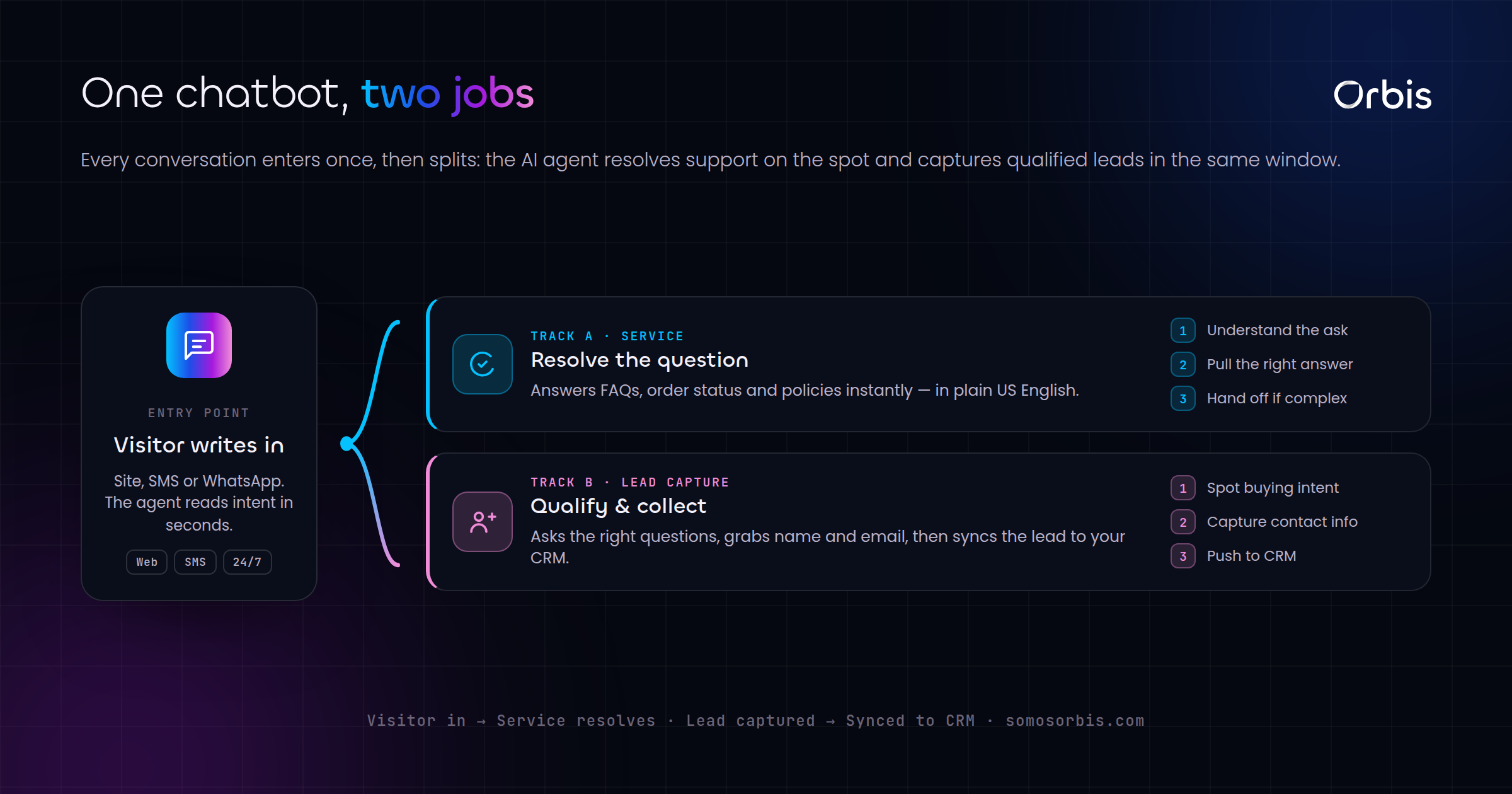
The biggest mistake teams make is treating a chatbot as a single tool with a single goal. In practice a chatbot does two distinct jobs, and the design for each is different.
Job one: lead capture and qualification
On your marketing pages, the chatbot is a sales development rep that never sleeps. Its goal is to identify whether the visitor is a fit, capture the right information, and route hot leads to your team fast. A strong qualification flow does a few things in sequence:
- Opens with intent, not a wall. "Looking for a quote, a demo, or just have a quick question?" beats "How can I help you today?" because it sorts visitors immediately.
- Asks qualifying questions conversationally. Company size, budget range, timeline, and use case, gathered one at a time so it feels like a conversation rather than a form.
- Captures contact details at the moment of intent. Email and phone, ideally with a reason ("So we can send your custom quote, what's the best email?").
- Routes by priority. A qualified, high-budget lead in a target city should trigger an instant alert to a salesperson, while a low-intent visitor gets a helpful resource and a nurture sequence.
Job two: customer service and deflection
On your support and account pages, the chatbot is a tier-zero support agent. Its goal is to resolve common issues instantly and escalate the rest. The highest-value flows here are order status, returns and exchanges, billing questions, password and login help, and "where do I find X." Every one of these resolved by the bot is a ticket your humans never have to touch, and a customer who got an answer in seconds instead of hours.
The art is knowing when to stop trying. A chatbot that loops a frustrated customer through the same three options is worse than no chatbot. Build a clear, fast escape hatch to a human, and make the handoff carry full context so the customer never repeats themselves.
Building a bilingual EN/ES chatbot that feels native
Bilingual support is where most chatbots quietly fail. Bolting machine translation onto an English script produces stilted, sometimes embarrassing Spanish that damages trust with exactly the audience you're trying to win. A chatbot that genuinely serves the US Hispanic market follows a few principles:
- Detect and offer, don't assume. Detect the visitor's browser language or let them pick with a clear "English / Español" toggle in the opening message. Respect the choice for the whole session.
- Write each language natively. Spanish flows should be written by people who speak it, tuned for US Hispanic audiences, not literally translated from English. Tone, idioms, and formality all matter.
- Localize the details that break trust. Dates, currency in USD, and culturally relevant references should read naturally in both languages.
- Route to bilingual humans. A Spanish conversation that escalates should reach someone who can continue in Spanish. Nothing kills the experience faster than switching the customer back to English at the handoff.
For a deeper look at building the rest of your bilingual approach across content and campaigns, our broader work on reaching Spanish-speaking US audiences connects directly to how your chatbot should sound.
The build: rules, AI, or a hybrid
There are three broad ways to build a chatbot, and the right answer is almost always a blend.
Rule-based flows
Decision-tree bots follow predefined paths. They're predictable, cheap to run, and easy to control, which makes them excellent for structured tasks like lead qualification and order-status lookups. The downside is rigidity: anything off-script breaks the experience.
AI and natural language
Modern AI assistants understand free-text questions and can answer from your knowledge base in natural language, in both English and Spanish. They handle the long tail of "I just have a quick question" beautifully. The risk is control: an unconstrained AI can give wrong answers or wander off-topic, which is dangerous when it's representing your brand and touching customer data.
The hybrid that wins
The most reliable production chatbots use rules for the high-stakes structured paths (qualification, checkout help, account actions) and AI for the open-ended conversational layer, with guardrails that keep the AI grounded in your approved content. This gives you the predictability of rules where you need it and the flexibility of AI where it helps, all wired into your CRM so every conversation becomes a record you can act on.
Getting this architecture right is exactly the kind of work covered in our chatbot implementation services, where the flows, the AI guardrails, and the CRM connections are built as one system rather than three disconnected pieces.
Connecting the chatbot to your revenue engine
A chatbot that captures a lead and then drops it into a void is a wasted investment. The value compounds only when the chatbot is wired into the rest of your stack. That means three connections at minimum:
- CRM sync. Every qualified lead and every meaningful conversation should land in your CRM automatically, tagged with source, language, and intent, so sales has full context and nothing slips through.
- Automation triggers. A captured lead should kick off the right follow-up instantly, an alert to a rep for hot leads, a nurture sequence for warmer-but-not-ready prospects, a welcome flow for new customers.
- Analytics. Conversation volume, resolution rate, qualified leads, and handoff rate should flow into your reporting so you can see what the chatbot is actually contributing.
The chatbot is one node in a larger system. To see how lead capture connects to the follow-up that turns conversations into closed deals, read our guide to marketing and sales automation for US revenue, which picks up exactly where the chatbot hands off.
Designing flows that convert: practical patterns
Here are patterns that consistently outperform, drawn from real US deployments across e-commerce and B2B.
The proactive trigger, used sparingly
A chatbot that pops up the instant a page loads is annoying. One that appears after a visitor has lingered on a pricing page for 40 seconds, or has scrolled to the bottom of a product description, catches genuine intent. Trigger on behavior, not on arrival.
The abandoned-cart rescue
During Cyber Monday traffic spikes, a chatbot that engages a shopper hesitating at checkout ("Questions about shipping or returns before you complete your order?") recovers sales that would otherwise vanish. Pair it with a clear, honest answer about delivery timing, the number-one checkout anxiety during the holidays.
The qualification short-circuit
For B2B lead capture, let highly qualified visitors skip the line. If someone says they're a 200-person company with a Q3 timeline, don't make them wait, offer to book a call with a rep right there in the conversation. Speed-to-lead is one of the strongest predictors of conversion.
The graceful failure
When the bot can't help, it should say so clearly, capture the question, grab a contact method, and promise a real follow-up with a timeframe. "I'm not sure on that one, let me get a specialist to email you within the hour, what's the best address?" preserves trust far better than a robotic dead end.
Privacy and trust: handling conversations responsibly
Chatbots collect personal information, names, emails, phone numbers, sometimes account details, which puts them squarely inside US privacy expectations. You don't need to lecture visitors about regulations, but you do need to operate by them. A few practical commitments:
- Be transparent. Make it clear what you collect and why, with an accessible link to your privacy policy from the chat window.
- Honor consumer rights. Visitors in states with strong privacy laws can ask what data you hold and request deletion. Your chatbot data needs to live in systems that can answer those requests.
- Minimize and secure. Collect only what the conversation actually needs, and store it under the same quality processes and current regulations that govern the rest of your customer data.
This isn't just compliance hygiene, it's trust. A customer who sees you handling their information carefully is a customer more likely to convert and stay. We treat this as Cumplimiento por Diseño, privacy built into the system from the first flow rather than patched on afterward.
Measuring what matters
Vanity metrics like "number of conversations" tell you almost nothing. The numbers that matter map to the chatbot's two jobs:
- For lead capture: qualified leads generated, qualification rate, speed-to-handoff, and downstream conversion of chatbot-sourced leads.
- For customer service: resolution rate (how many issues the bot closes without a human), deflection rate, average handle time saved, and post-conversation satisfaction.
- For both: escalation rate, abandonment within the chat, and language split, so you can see whether your Spanish experience is performing as well as your English one.
Review these monthly, watch how they move during seasonal spikes like Prime Day and Black Friday, and use the patterns to refine flows. A chatbot is never "done", the best ones improve every quarter as you learn what your customers actually ask.
Where the chatbot fits in your bigger tech stack
A chatbot is one implementation among several that, working together, form a coherent revenue system, CRM, automation, integrations, and the chatbot itself all connected. Deployed in isolation, it's a clever widget. Deployed as part of a planned stack, it's a 24/7 sales and service layer that pays for itself.
If you're mapping out the full picture, our pillar guide to marketing tech implementations for US businesses in 2026 lays out how the chatbot connects to CRM, automation, and the rest of the stack, so you build the system in the right order instead of bolting tools together one at a time.
Get your bilingual chatbot built right
A chatbot that works around the clock, qualifies leads while your team sleeps, supports customers in English and Spanish, and feeds clean data into your CRM isn't a futuristic luxury. It's a practical, proven layer that US businesses are using today to capture demand they were previously losing after hours and during every seasonal spike.
The difference between a chatbot that frustrates and one that converts is in the build: the flows, the bilingual writing, the AI guardrails, and the CRM connections, engineered as one system. That's the work we do. Explore our chatbot implementation services and let's build an assistant that turns your busiest, after-hours, and Spanish-speaking traffic into qualified leads and loyal customers, every hour of every time zone.