
Product imagery is the closest thing your online store has to a physical shelf. When a shopper in New York, Los Angeles, or Miami lands on a product page, they cannot pick up the item, feel the fabric, or check the build quality. The photograph does all of that work. For US e-commerce brands competing on Amazon, Shopify, and their own DTC sites, commercial photography is not a cosmetic line item. It is one of the highest-leverage conversion assets you control.
This guide breaks down how to plan, brief, and produce commercial photography that actually moves revenue for US online stores. We will cover product versus lifestyle shots, marketplace requirements, shot lists tuned to US seasonal moments like Black Friday and Amazon Prime Day, bilingual considerations for the large US Hispanic market, and the production workflow that keeps quality consistent at scale.
Why Commercial Photography Is a Conversion Lever, Not a Cost
Most product pages lose buyers in the first few seconds. The visitor scans the main image, the price, and maybe two thumbnails before deciding whether to keep reading. If the imagery looks cheap, inconsistent, or fails to answer an obvious question (How big is it? What does it look like in a real kitchen? Does that blue match the swatch?), the shopper bounces to a competitor or back to search.
Strong commercial photography does three jobs at once:
- It builds trust. Clean, professional images signal that a real business stands behind the product. This matters even more for newer DTC brands without decades of name recognition.
- It answers objections silently. A scale shot, a texture close-up, and a lifestyle context shot can remove three reasons a person might hesitate, without adding a single word of copy.
- It reduces returns. When the photo accurately represents color, size, and finish, fewer customers are surprised on delivery. In a US market where return logistics eat margin, accurate imagery protects profit.
Treat photography as part of your revenue engine. The cost of a proper shoot is small next to the lifetime impact of a product page that converts a few percentage points higher across thousands of sessions.
Product Photography vs. Lifestyle Photography: Use Both Deliberately
The two main categories of commercial e-commerce imagery serve different jobs, and the best product pages use them in sequence.
Product (Studio) Photography
These are the clean, controlled shots, usually on a white or neutral background, that show the item itself with no distractions. Studio photography is where you prove the details:
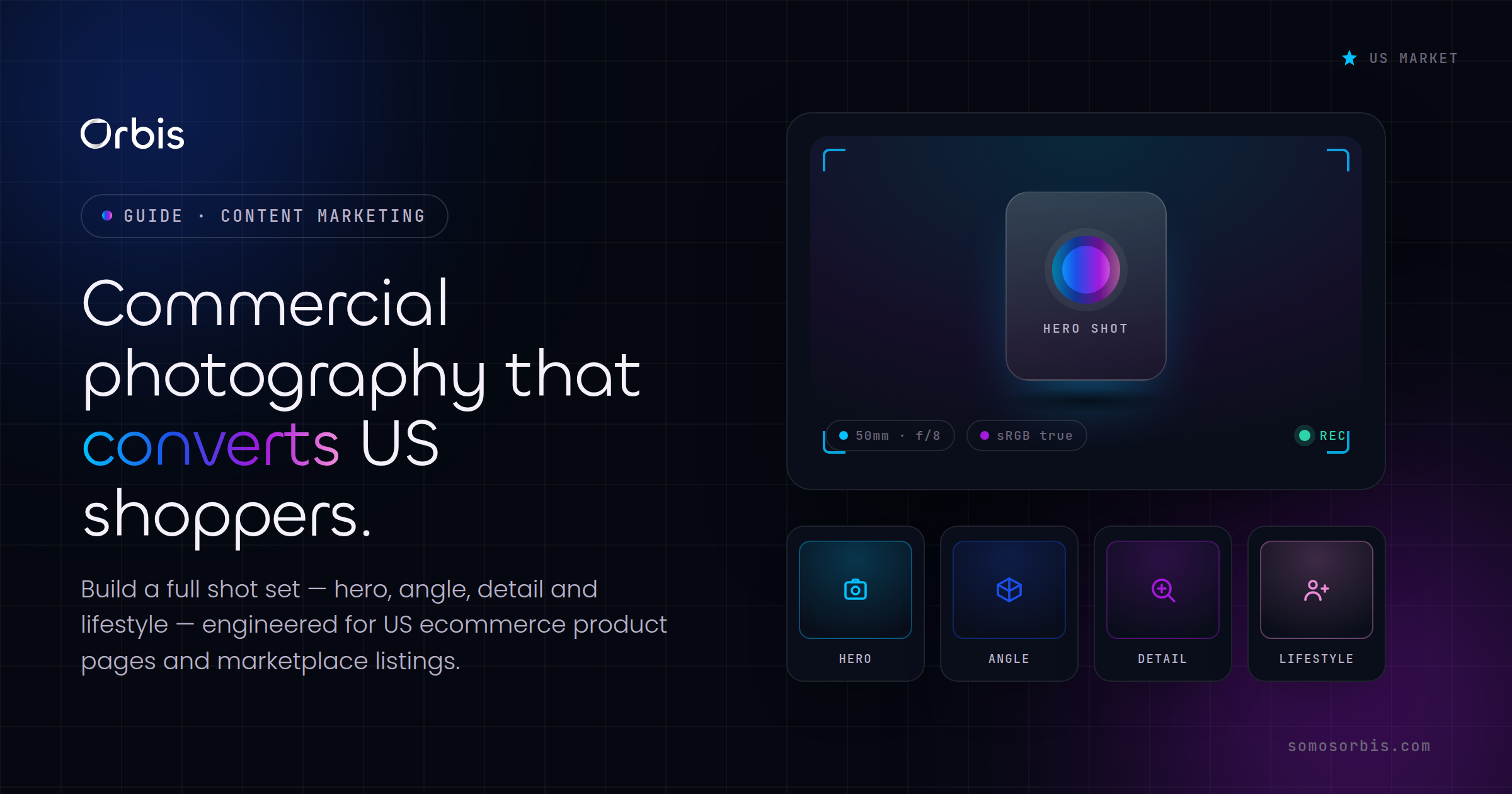
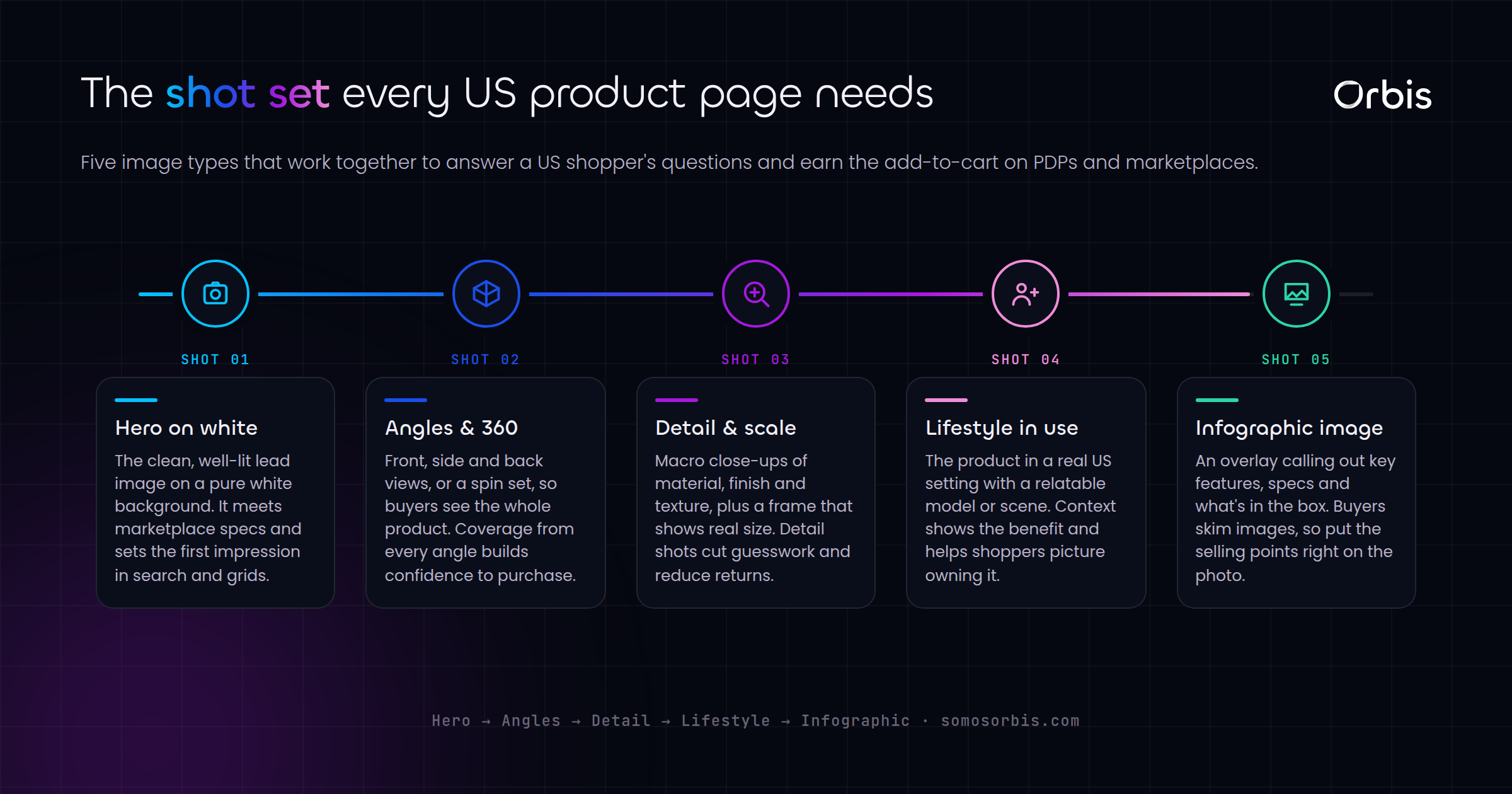
- The hero shot: the single most flattering, recognizable view that becomes your main marketplace image.
- Angles: front, back, side, top, and any functional view (an open lid, a folded state, a port or seam).
- Macro detail: stitching, material grain, logo placement, finish quality.
- Scale references: the product next to a common object, or with on-image dimension callouts.
Lifestyle Photography
Lifestyle imagery places the product in a believable real-world context with people or environments. This is where you sell the feeling and the use case. A coffee maker on a bright Chicago apartment counter, a backpack on a commuter in Dallas, a skincare bottle on a sunlit Miami bathroom shelf. Lifestyle shots help the shopper picture the product in their own life, which is what actually triggers desire.
A practical rule: lead your marketplace listing with clean studio hero images (many platforms require it), then use lifestyle imagery to carry the emotional weight on your own DTC product pages, social ads, and email campaigns.
Marketplace Requirements You Cannot Ignore
If you sell on US marketplaces, your photography has to satisfy their technical rules before it can win the sale. Plan for this at the shoot, not in a panic afterward.
- Main image standards. Major US marketplaces typically require the primary image to show the product alone on a pure white background, filling most of the frame, with no text, logos, watermarks, or props. Shoot a compliant white-background hero for every SKU as a baseline.
- Resolution and zoom. High enough resolution to support zoom (a common threshold is at least 1000 pixels on the longest side, and more is better) so customers can inspect detail.
- Multiple supporting images. Use the additional image slots for angles, scale, detail, and lifestyle context. Brands that fill every available slot consistently outperform those that use only one or two.
- Aspect ratio and square crops. Many marketplaces and ad placements favor square (1:1) crops. Shoot with enough headroom so a square crop never amputates the product.
Build a compliance checklist per platform and verify against it before assets ship. A single non-compliant main image can get a listing suppressed during your most important sales window.
Build a Shot List Before Anyone Touches a Camera
The shot list is where good commercial photography is won or lost. It turns a vague creative idea into a repeatable production plan, and it prevents the expensive scenario where you discover a missing angle after the set is struck and the product is back in the warehouse.
A solid e-commerce shot list specifies, for each SKU:
- Every required marketplace image (white-background hero plus angle set).
- Detail and macro shots tied to specific selling points.
- Scale and dimension shots.
- Lifestyle scenarios with location, talent, and props defined.
- Variant coverage (every color, size, or finish you actually sell).
- Crop and aspect-ratio targets for each destination (PDP, square ad, vertical story, email banner).
Group SKUs that share a setup so the crew shoots all white-background heroes in one block, then all lifestyle scenes in another. This batching is what keeps per-image cost down when you scale to a full catalog.
Tune Your Shot List to US Seasonal Campaigns
US e-commerce runs on a calendar of major demand spikes, and your imagery should be produced ahead of each one rather than scrambled together in the final week. The mistake most brands make is shooting generic photography all year and then realizing in October that they have nothing seasonal for the biggest weekend of the year.
Black Friday and Cyber Monday
This is the peak of US retail. You need promo-ready imagery weeks in advance: hero shots that work with discount overlays, bundle and gift-set compositions, and a clean, uncluttered look that reads instantly on a crowded deals page. Shoot in summer or early fall so assets are edited, approved, and loaded long before traffic arrives.
Amazon Prime Day
For brands selling on the platform, this mid-year event is effectively a second holiday season. Plan a dedicated batch of compliant, deal-optimized images, including lifestyle shots that justify a premium product even at a promotional price.
Back-to-School
Late summer demand for anything tied to students, dorms, classrooms, and family routines. Lifestyle imagery here should feel practical and aspirational at once, picture a college apartment in a US city or a busy family kitchen.
Tax Season
The early-year window when many US households have refund money to spend. Higher-consideration purchases (furniture, electronics, tools, upgrades) benefit from richer detail and lifestyle photography that supports a confident, larger spend.
Mapping your shot list to these moments means one well-planned production day can feed multiple campaigns, which lowers cost per asset and keeps your visual identity consistent across the year.
Photography for the US Hispanic Market
The US Hispanic audience is one of the largest and fastest-growing consumer segments in the country, and it is too often treated as an afterthought in commercial imagery. Reaching it well is both a revenue opportunity and a brand-trust signal.
- Authentic representation. Casting, settings, and styling should reflect real Hispanic households and lifestyles in cities like Los Angeles, Houston, Miami, and Chicago, not a generic stock-photo gloss.
- Bilingual-ready compositions. If your campaign runs bilingual EN/ES creative, leave clean negative space in lifestyle shots so the same image can carry English or Spanish copy without a reshoot. One photo set, two language versions, consistent look.
- Culturally relevant context. Seasonal and family moments that resonate with Hispanic consumers can guide lifestyle scenarios, expanding your seasonal calendar beyond the default US retail dates.
Done with care, inclusive imagery widens your addressable market while reinforcing the trust that drives repeat purchases.
Respect Privacy When You Shoot With People
Lifestyle photography involves real models and, sometimes, real customers. Under current US privacy norms, handle their information responsibly: secure written model releases, store personal data only as long as you need it, and be transparent about how images and any associated data will be used. Building these quality processes into your production workflow protects both the people in your photos and your brand. It is compliance by design, handled quietly and correctly rather than as an afterthought.
The Production Workflow That Keeps Quality Consistent
Great one-off photos are easy. Consistent photography across hundreds of SKUs, multiple campaigns, and a full year is a process problem. A documented workflow is what separates brands that look premium everywhere from those whose product pages feel stitched together.
- Brief and shot list. Lock objectives, channels, SKUs, and crop targets before booking the studio.
- Pre-production. Sample collection, prop and location sourcing, casting, and scheduling. Confirm every variant is physically on set.
- Capture. Shoot in batched setups against the shot list, with on-set review so gaps are caught immediately.
- Post-production. Color-accurate retouching, background cleanup, consistent lighting treatment, and export in every required size and crop.
- QA and delivery. Check each asset against marketplace and brand specs, then deliver organized, clearly named files mapped to SKUs and channels.
The payoff of this discipline is repeatability: the next catalog drop or seasonal refresh slots into the same machine, so quality holds even as volume grows.
How This Fits Your Wider Content Strategy
Photography rarely works in isolation. It is one pillar of a broader content program that includes video, social, and written assets all reinforcing the same brand. For the full picture of how imagery, motion, and messaging fit together for US brands, start with our complete content creation guide for US brands in 2026, which maps the entire content engine.
Photography and video are natural partners on a product page and in paid social: a still hero earns the click, and motion carries the story. If you are planning both, pair this guide with our breakdown of video production for US social channels so your stills and your video share one consistent look, casting, and seasonal calendar.
Common Mistakes That Quietly Kill Conversion
- One angle only. Empty image slots leave money on the table. Fill them.
- Inconsistent lighting and color. A catalog where every product looks shot in a different studio erodes trust. Standardize your treatment.
- Inaccurate color. Mismatched color drives returns and bad reviews. Calibrate and proof.
- No scale reference. Shoppers consistently misjudge size without one, leading to disappointment and returns.
- Skipping lifestyle entirely. Pure studio shots inform but rarely inspire. You need both.
- Last-minute seasonal scrambles. Generic photography cannot stand in for a planned Black Friday or Prime Day set. Plan ahead.
Bringing It Together
Commercial photography is one of the most direct, measurable levers an US e-commerce brand can pull. Clean studio imagery that meets marketplace rules, lifestyle photography that makes the product feel essential, a shot list mapped to Black Friday, Prime Day, back-to-school, and tax season, authentic representation for the US Hispanic market, and a documented workflow that holds quality at scale. Get these right and your product pages do more selling with less friction, all year long.
Imagery is the silent salesperson on every product page. Make it work as hard as the rest of your funnel.
Ready to turn your product pages into conversion machines? Explore our commercial photography services for US e-commerce brands and let us build a shot list, shoot, and delivery pipeline tuned to your catalog and your seasonal calendar, with documented processes and consistent quality from the first SKU to the last.