
Content is no longer the thing you do after the strategy is set. In 2026, for US brands competing across crowded feeds in New York, Los Angeles, Chicago, Miami, Dallas, and Houston, content is the strategy. The brands winning attention and revenue are the ones treating video, photography, influencer collaboration, user-generated content (UGC), and even drone footage as a coordinated production system, not a pile of one-off posts. This guide gives you the full operating model: how to plan, produce, distribute, and measure content that performs across US channels and genuinely resonates with diverse American audiences, including the large and fast-growing US Hispanic market.
At Orbis we have spent more than 15 years helping over 500 clients turn content into a predictable revenue engine. We are a Google Partner with a 4.9-star rating across 58 reviews, and we work hands-on with the platforms that matter for content distribution: Meta, Shopify, Pinterest, Spotify, Kommo, and Zapier. This is the playbook we use, written so your in-house team can run it. No fluff, no vanity metrics, just the system.
Why content production is a system, not a series of posts
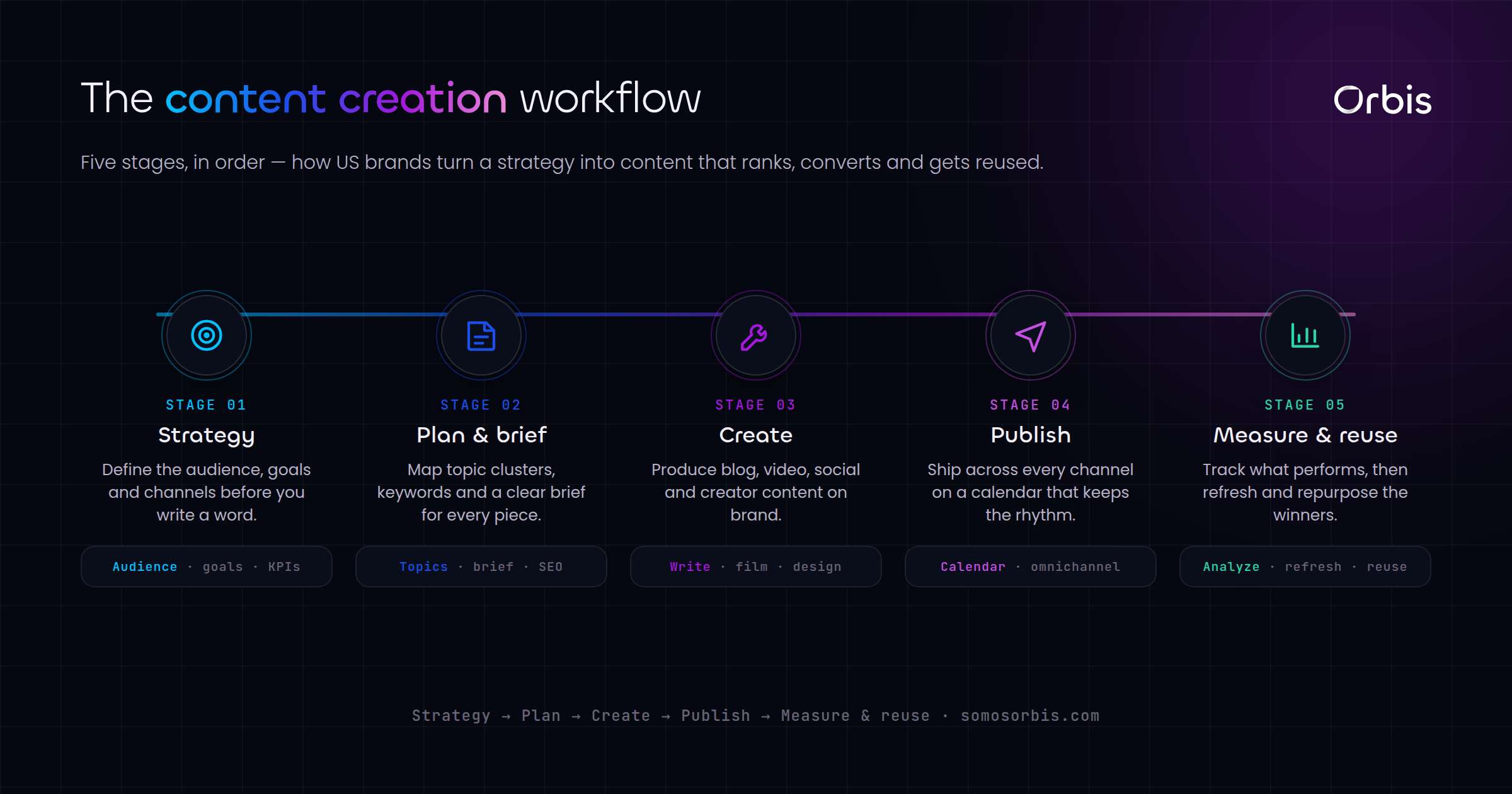
Most US brands hit the same wall. They produce content reactively: a product launch needs photos, a holiday needs a video, a campaign needs "some influencer stuff." Each asset is briefed from scratch, shot in isolation, and used once. The result is high cost per asset, inconsistent brand look, and content that never compounds.
The brands that pull ahead think in terms of production systems. A single, well-planned shoot day yields dozens of assets across formats and aspect ratios. One product can generate a hero video, fifteen-second cutdowns for Reels and TikTok, vertical stills for Stories, square images for the feed, lifestyle photography for the product detail page, and raw clips handed to creators for remix. The marginal cost of the tenth asset from a shoot is a fraction of the first.
This is the core of what we call content creation as a managed service: documented processes that turn creative work into repeatable output, so quality and volume both go up while cost per asset goes down. When content production runs on a documented process instead of heroics, three things happen: your brand looks consistent everywhere, your team stops reinventing briefs, and your calendar stays full even during your busiest US retail moments.
The content production flywheel
- Plan once, shoot in batches. Group shoots by season or campaign so you capture months of assets in a few production days.
- Cut many formats from one capture. Always shoot for vertical, square, and horizontal simultaneously.
- Distribute everywhere, natively. Reformat and re-caption per channel instead of cross-posting identical assets.
- Measure, then feed the winners back in. Let performance data dictate the next shoot list.
Mapping content to US channels in 2026
Every channel rewards a different content shape. Producing one master asset and dumping it everywhere is the fastest way to underperform. Here is how to think about the major US channels.
Short-form vertical video: TikTok, Reels, Shorts
Short-form vertical is the highest-leverage format in the US right now. It is where discovery happens for younger audiences and where your reach is least dependent on existing followers. The mechanics that matter: hook in the first second, native captions burned in (most US viewers watch with sound off in public), fast pacing, and a clear payoff. Polished does not win here; relevant and fast wins. This is exactly why a tight video production process matters more than expensive gear. The brands that win short-form are the ones who can produce 20 variations of a hook, not one perfect film.
YouTube and long-form
YouTube remains the US workhorse for consideration-stage content: tutorials, comparisons, founder stories, and product deep-dives. It is also the second-largest search engine in the country, which makes long-form video a durable SEO and AEO asset. A single strong YouTube video can drive traffic for years, unlike a Reel that peaks in 48 hours.
Instagram feed and Stories
Instagram is still where US brand aesthetics live. The feed is your storefront window; Stories are your daily conversation. Use the feed for your highest-quality photography and brand films, and Stories for behind-the-scenes, polls, and time-sensitive offers tied to moments like Black Friday or a back-to-school push.
Underused by most US brands, Pinterest is a planning and intent engine, especially for ecommerce, home, beauty, food, and apparel. As a Pinterest partner, we see it drive qualified, high-intent traffic at a lower cost than paid social, particularly in the run-up to seasonal events when US shoppers are actively saving ideas for the holidays, weddings, and home projects.
Spotify and audio
Audio is a content channel most brands ignore. Branded playlists, podcast presence, and audio ads on Spotify reach US commuters in cities like LA and Houston and listeners during work hours. Audio content extends your brand into moments where video cannot follow.
Video production: the backbone of US content
If you only systematize one format, make it video. Video is the most demanded and most reusable content type across every US channel. A disciplined video production workflow is what separates brands that publish weekly from brands that publish "when we get around to it."
Pre-production is where the money is saved
Amateur productions improvise on set and pay for it in wasted hours and reshoots. A documented pre-production process locks the shot list, the formats, the talent, the locations, and the deliverables before anyone picks up a camera. Build a shot list that explicitly captures vertical, square, and horizontal framing in the same setups so one shoot day feeds every channel.
- Creative brief: one page, with the single message each asset must land and the channel it serves.
- Shot list: every setup mapped to its deliverables and aspect ratios.
- Format matrix: which cuts you owe (15s, 30s, 6s bumper, hero) and for which platform.
- Reuse plan: which raw clips go to creators for UGC remixing afterward.
Production: shoot for the edit, shoot for the year
On set, the discipline is to capture more than today's brief needs. B-roll, detail shots, and varied framing are cheap to capture in the moment and expensive to go back for. A single product or seasonal shoot, planned well, should yield enough raw material to keep your calendar fed for a quarter.
Post-production and the cutdown engine
This is where systematized teams pull away. From one master edit you generate the full ladder of cutdowns, each captioned and formatted natively. A US apparel brand we model this for can take a single shoot and produce a 30-second hero for YouTube, three 15-second Reels, a square feed teaser, five vertical Story frames, and a 6-second bumper for retargeting, all on-brand, all from one production day. For the deep dive on platform-specific specs and pacing, see our guide on video production for US social channels.
Photography that sells on US ecommerce
Photography is not decoration; on a US product detail page it is the single biggest driver of conversion after price. Shoppers on Amazon, Shopify storefronts, and marketplaces buy with their eyes. Weak photography taxes every dollar you spend driving traffic to the page.
The ecommerce photography stack
- Clean catalog shots: consistent lighting, true color, multiple angles, on a neutral background. These are non-negotiable for marketplace compliance and trust.
- Lifestyle and in-context shots: the product in a real US home, on a real person, in a believable setting. This is what builds desire.
- Scale and detail shots: close-ups of texture, stitching, and finish; objects that communicate size.
- Infographic-style images: stills with overlaid callouts for features, dimensions, and use cases, which perform especially well on Amazon.
The same shoot-once, use-everywhere discipline applies. A product photographed properly should feed your PDP, your social feed, your Pinterest boards, and your paid ads. For the complete workflow, including lighting, retouching standards, and marketplace specs, read our companion guide on commercial photography for US ecommerce.
Influencer marketing in the US: from gut feel to engineered ROI
Influencer marketing in the US has matured past celebrity endorsements and one-off posts. The brands getting real return treat it as a managed channel with documented selection criteria, briefing, usage rights, and measurement, not a series of favors and freebies.
Micro and nano beat mega for most US brands
Unless you are a national brand buying awareness, your best returns usually come from micro-influencers (10K to 100K followers) and nano-influencers (under 10K) with high engagement in a tight niche. A Miami fitness micro-creator or a Chicago home-cooking nano-creator will often out-convert a celebrity at a fraction of the cost, because their audience trusts them and shares their context.
Build a repeatable influencer process
- Selection: screen for genuine engagement, audience location and demographics, and brand fit, not just follower count.
- Briefing: give creative freedom inside clear guardrails. Specify the message and the must-haves; let the creator own the execution.
- Usage rights: negotiate the right to reuse content in paid ads up front. This is the single most overlooked value lever.
- Measurement: track with unique codes and links, and judge on revenue and content output, not likes.
Influencer content also feeds your other channels: the best creator videos become your highest-performing paid social ads. For the full framework on tiers, rates, contracts, and bilingual creator strategy, see our deep dive on influencer marketing in the US market.
UGC: the most cost-effective content you are not producing enough of
User-generated content is the highest-trust, lowest-cost content format available to US brands, and most are leaving it on the table. UGC, real content from real customers, converts because it is credible. American shoppers trust other shoppers far more than they trust brand-produced ads.
The two flavors of UGC
- Organic UGC: content your customers create unprompted. Your job is to make it easy (branded hashtags, packaging that invites unboxing) and to capture rights to reuse it.
- Commissioned UGC: content you pay creators to produce in an authentic, non-polished style for use in your own ads and channels. This is the engine room of high-performing paid social in 2026.
Commissioned UGC is now a core production line, not an afterthought. It is what lets you run dozens of ad variations cheaply and find winners fast. A systematized UGC content operation can generate more testable creative in a month than a traditional studio produces in a quarter, at a fraction of the cost per asset.
Building a UGC engine
- Source a roster of vetted US creators across demographics and regions.
- Standardize the brief so creators know the hook, the message, and the format.
- Always secure paid usage rights, so UGC can move straight into your ad account.
- Test relentlessly: ship many variations, kill losers fast, scale winners.
For the operational detail, including creator sourcing, briefs, rights, and the test-and-scale loop, read our full guide on UGC content strategy for US brands.
Drone and aerial: the differentiator for real estate, hospitality, and events
Aerial footage used to be a luxury. Now it is an expectation in several US categories, real estate above all. A property listing with professional drone video and stills consistently outperforms one with ground-level photos alone, because it communicates scale, location, and context in a way nothing else can.
Beyond real estate, drone content elevates hospitality (resorts, venues), large-scale retail and commercial spaces, events, and any brand whose physical footprint is part of the story. The key is integration: aerial shots should slot into your existing video and photo edits, not live as standalone novelty clips. For the regulatory considerations, shot planning, and listing-conversion data, see our guide on drone video for US real estate marketing.
Content for the US Hispanic market: not translation, transcreation
The US Hispanic market is one of the largest and fastest-growing consumer segments in the country, with significant buying power concentrated in markets like Los Angeles, Houston, Miami, Dallas, and Chicago. Brands that treat this audience as an afterthought, by running machine-translated captions on the same creative, leave enormous value on the table and often get the culture wrong.
The principles that actually work
- Transcreate, do not translate. Adapt the message, references, and humor to resonate, rather than swapping words one-for-one.
- Cast and create authentically. Use bilingual creators and talent who genuinely belong to the community you are speaking to.
- Respect the bilingual reality. Many US Hispanic consumers move fluidly between English and Spanish. Content that lives naturally in both, sometimes in the same asset, often outperforms strictly monolingual content.
- Localize the moment. Tie content to the cultural calendar your audience lives by, not only the general-market one.
Bilingual content is a growth lever, not a compliance checkbox. Done right, it expands your reachable market dramatically without doubling your production budget, because much of the visual capture is shared. For the complete approach, including creator casting and channel nuances, read our guide on bilingual content for US Hispanic audiences.
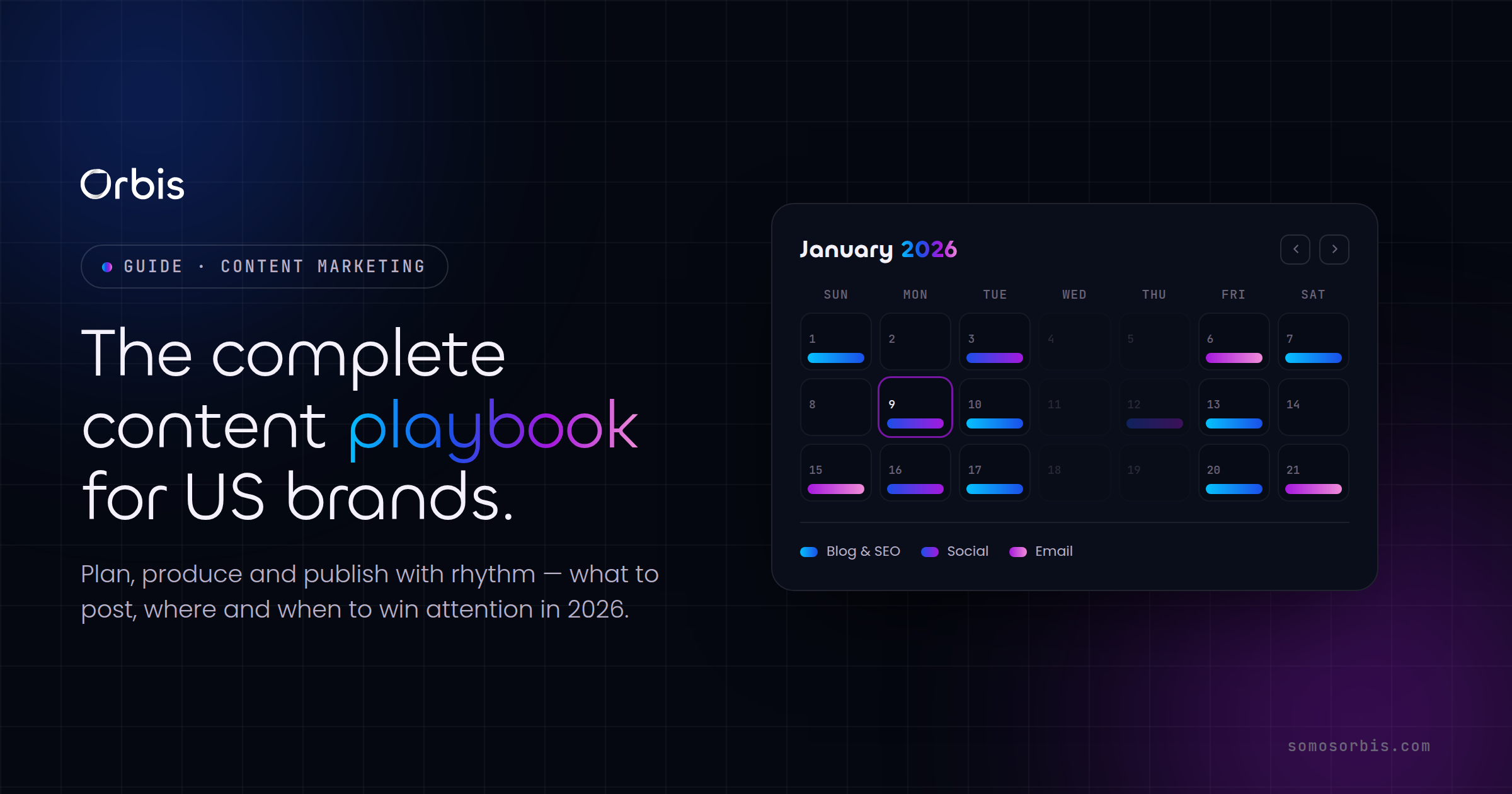
Building your US content calendar around the retail year
Content production should be planned backward from the US commercial calendar. Producing seasonal content in-season is too late; the brands that win plan shoots months ahead so assets are ready when audiences are.
The anchor moments to plan around
- Black Friday and Cyber Monday: the single biggest US retail moment. Creative should be shot by early fall, with ad variations ready to test before the rush.
- Amazon Prime Day: a mid-year spike that rewards brands with ready-to-deploy product video and UGC.
- Back-to-school: a late-summer surge across apparel, tech, and home, with strong relevance to family and Hispanic audiences.
- Tax season: a distinctly US window when discretionary spending rises for many households; valuable for higher-ticket categories.
- Cultural and seasonal moments: from summer to the winter holidays, plus the cultural calendar relevant to your specific audiences.
A documented content calendar maps each of these to a shoot date, a deliverables list, and a distribution plan, so production capacity is reserved before the crunch hits. This is where treating content as a system pays off most: you are never scrambling for assets at the moment you most need to be in market.
Staffing and tooling your content engine
A production system needs the right people and the right tools, but probably fewer of both than you think. The common mistake is over-investing in gear and under-investing in process. A modern smartphone, good lighting, and a tight workflow will out-produce an expensive camera in the hands of a team without a documented process.
The roles that matter
- A content lead who owns the calendar and ties production to the commercial plan.
- A producer who runs shoot days, manages talent and creators, and protects the deliverables list.
- An editor who runs the cutdown engine and keeps every asset on-brand.
- A creator network manager for UGC and influencer relationships at scale.
For most US brands, the smart move is a hybrid model: a small in-house core that owns strategy and the calendar, plus an external partner that brings production capacity, a vetted creator roster, and the documented processes that keep quality consistent as volume scales. That is exactly the gap a managed content partner fills, you keep control of the brand and the plan, and you borrow the machine that turns it into output.
Repurposing: the multiplier most teams skip
Before you brief a single new asset, audit what you already have. A long-form YouTube video contains a dozen short-form clips. A podcast episode becomes audiograms, quote cards, and a blog post. A photo shoot feeds Pinterest, the PDP, and paid ads. Repurposing is not lazy; it is leverage. The brands that publish the most are rarely the brands that produce the most from scratch. They are the brands that extract the most from every capture.
Measuring content performance without vanity metrics
Content that cannot be measured cannot be improved. The discipline is to tie content to outcomes, not applause. Likes and views are inputs; the metrics that matter are downstream.
- Engagement rate by format and channel, to learn what your audience actually responds to.
- Watch time and completion for video, which predict reach far better than views alone.
- Click-through and conversion from content to product, tracked with proper attribution.
- Cost per asset and cost per winning asset, so you know your true production efficiency.
- Content velocity: how many testable assets you can ship per month, which increasingly determines paid-social success.
All of this should respect current US privacy norms and consumer expectations around data and consent. Measure rigorously, but do it within the bounds of responsible, consent-based tracking and the privacy regulations that apply in your markets. Good measurement and good data practice are not in tension; both come from documented processes applied consistently.
Putting it together: the Orbis content operating model
Everything above rolls up into a single operating model. Plan content backward from the US retail calendar. Shoot in batches, capturing every format at once. Cut many assets from each capture. Distribute natively per channel. Commission UGC and influencer content to multiply your creative volume. Adapt authentically for bilingual and Hispanic audiences. Measure on revenue and velocity, not vanity. Then feed the winners back into the next shoot list.
This is Business Assurance applied to content: documented processes that make output predictable, revenue engineering that ties creative to outcomes, and quality built in by design rather than inspected in at the end. It is how a content function stops being a cost center and becomes a growth engine.
Related guides in this series
This pillar is the map; the guides below are the territory. Each one goes deep on a single discipline so your team can execute.
- Video production for US social channels — platform specs, pacing, and the cutdown engine.
- Commercial photography for US ecommerce — the photography stack that converts on US product pages.
- Influencer marketing in the US market — tiers, rates, contracts, and creator selection.
- UGC content strategy for US brands — sourcing creators, securing rights, and the test-and-scale loop.
- Drone video for US real estate marketing — aerial shot planning and listing conversion.
- Bilingual content for US Hispanic audiences — transcreation, casting, and channel nuance.
Ready to build a content engine that performs?
You do not have to build this system alone. Orbis has spent more than 15 years helping over 500 US and US-facing brands turn content into a predictable, measurable growth engine, backed by a 4.9-star rating across 58 reviews and partnerships with the platforms where your audience lives. If you want a documented production system that ships on-brand content at volume and ties it to revenue, explore our content creation services and let's plan your next quarter of content together.