
Video is no longer a nice-to-have for US brands; it is the format the algorithms reward and the one your audience actually finishes. On every major platform, watch time and completion rate now decide who gets distribution. Yet most brands still produce one expensive "hero" film a quarter and wonder why their reach is flat. The brands winning in New York, Los Angeles, Miami, and Dallas are the ones treating video as a production system: a repeatable engine that turns one shoot into dozens of platform-native assets.
This guide breaks down how to produce short-form and long-form video tuned to US platforms and audiences, from Reels and Shorts to YouTube, with realistic USD budget tiers. It is part of our broader playbook in The Complete Content Creation Guide for US Brands in 2026, and it pairs closely with how you source UGC content for US brands. Read both and you will have the full picture of paid-grade and creator-grade video working together.
Start With the Platform, Not the Camera
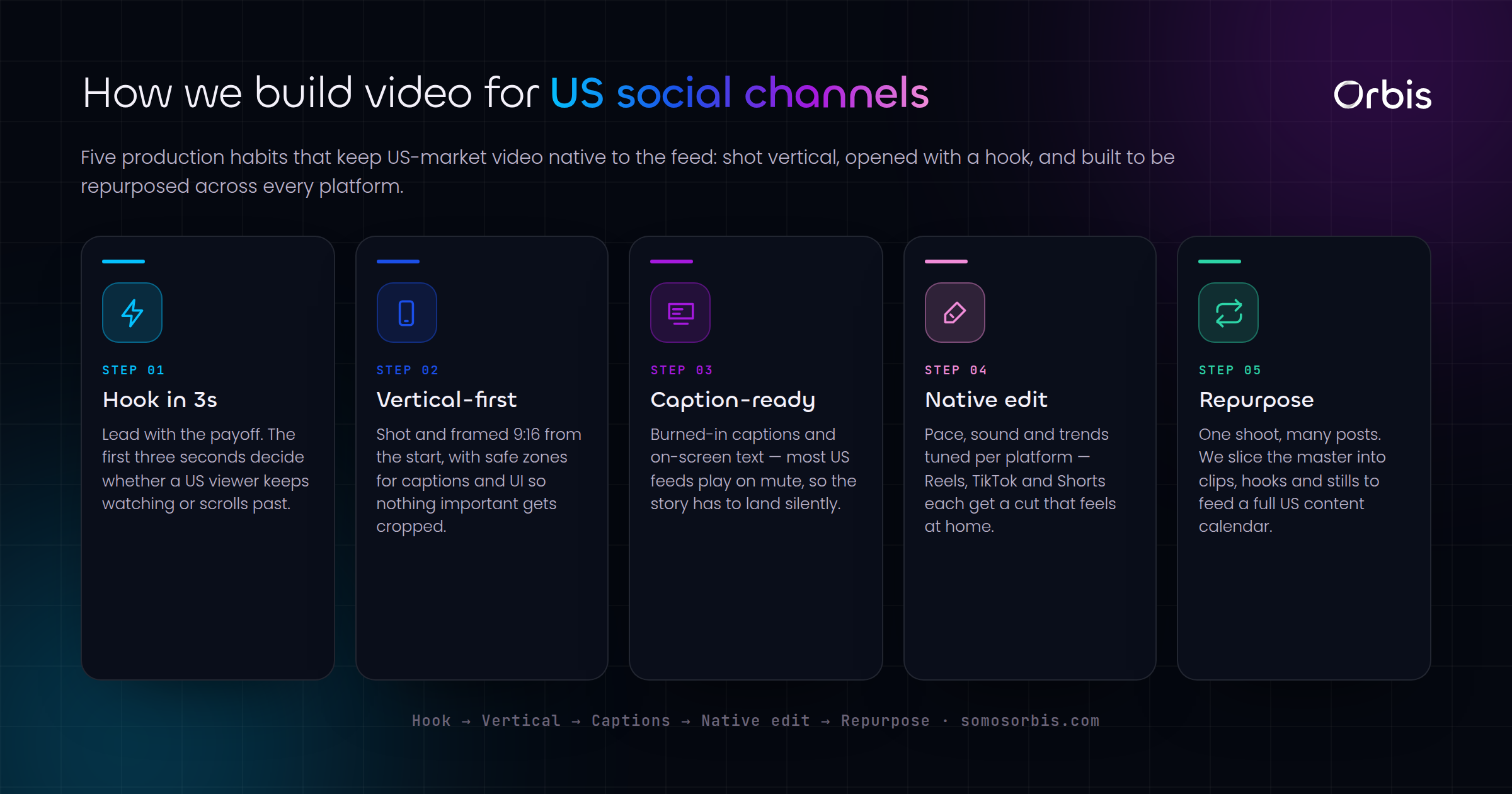
The single biggest mistake we see is shooting a beautiful 16:9 video and then cropping it for everywhere else. Each US social channel has its own native shape, length sweet spot, and viewing context. Produce for the platform first and you stop fighting the algorithm.
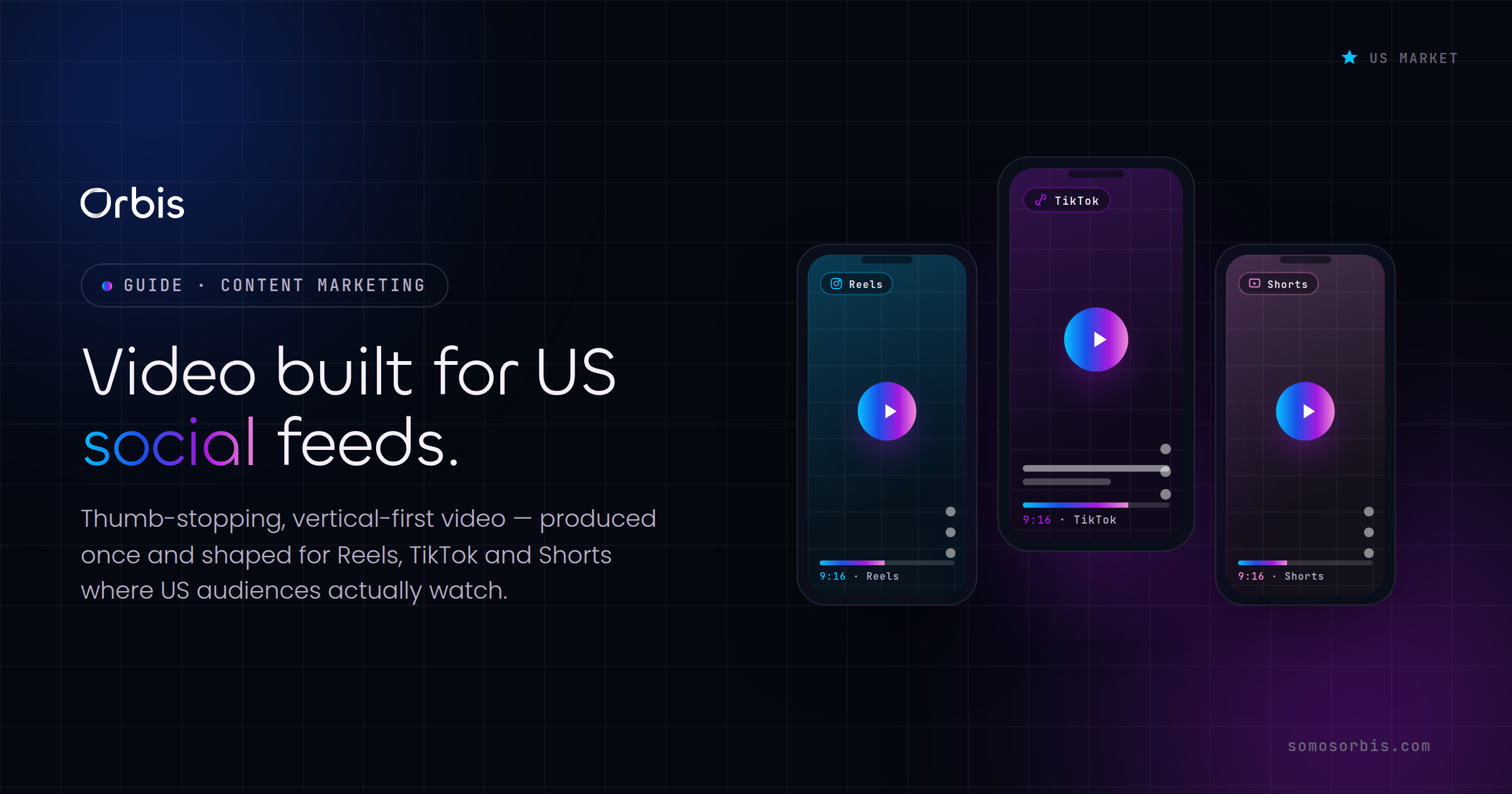
- Instagram Reels & TikTok: 9:16 vertical, 7 to 30 seconds for top performers, with a hook in the first 1.5 seconds. Captions baked in, because most US viewers watch on mute in line at Starbucks or on the subway.
- YouTube Shorts: 9:16, up to 60 seconds, but treated as a discovery funnel into your long-form library.
- YouTube long-form: 16:9, 6 to 12 minutes for most consideration content, longer for tutorials and webinars. This is where you build the durable, searchable library.
- Facebook & LinkedIn: 1:1 square or 4:5 vertical still outperforms widescreen in feed; LinkedIn skews B2B and rewards captioned talking-head clips.
- Pinterest: 9:16 or 2:3, strong for how-to, home, beauty, and seasonal US retail moments.
A practical rule: design your shoot so a single setup yields a vertical cut, a square cut, and a long-form anchor. That is the difference between paying for one asset and paying for fifteen.
The Two Video Tracks Every US Brand Needs
High-performing brands run two parallel tracks, not one. Confusing them is why budgets balloon and output stalls.
Track 1: Short-Form Volume
This is your reach engine: Reels, Shorts, and TikToks produced in batches. The goal is frequency and testing, not polish. Three to five posts per week per platform is a realistic cadence for a brand serious about organic growth. You are testing hooks, formats, and offers cheaply so you know what to put paid dollars behind.
Track 2: Long-Form Anchors
This is your authority engine: YouTube tutorials, founder interviews, product deep-dives, and case studies. One strong long-form video per month can be sliced into eight to twelve short clips, feeding Track 1 for weeks. This is the most cost-efficient content move available to a US brand right now, and it is wildly underused.
One monthly long-form shoot, intelligently chopped, can supply a full month of short-form posts. Production becomes a multiplier, not a line item.
USD Budget Tiers: What Video Actually Costs
Founders constantly ask what to budget. There is no single number, but there are honest tiers. These are realistic US market ranges, not aspirational ones, and they assume a documented, repeatable process rather than one-off chaos.
Starter Tier (roughly $1,500 to $4,000 per month)
- One half-day shoot per month, single location, natural or simple lighting.
- 8 to 12 short-form vertical edits plus one long-form anchor.
- Captioning, basic motion graphics, brand-kit lower thirds.
- Best for early-stage DTC brands, local service businesses in cities like Chicago or Houston, and founders building a personal brand.
Growth Tier (roughly $4,000 to $12,000 per month)
- Two shoot days per month, including a creator or talent day for UGC-style content.
- 20 to 30 short-form edits, two long-form anchors, paid-ad cutdowns built for Meta and YouTube.
- A/B hook variants so your paid team can test creative, not just audiences.
- Best for scaling ecommerce brands and B2B companies running consistent paid media.
Premium Tier ($12,000+ per month)
- Dedicated crew, multi-location, studio days, advanced post-production and color.
- Seasonal campaign films for Black Friday and Cyber Monday, Amazon Prime Day, back-to-school, and tax season pushes.
- Bilingual EN/ES variants to reach the large US Hispanic market without re-shooting.
- Best for established brands defending category leadership.
Whatever tier you choose, the budget should buy a system, not a single video. If a vendor quotes you one hero film and no distribution plan, you are overpaying for reach you will never see.
Plan Your Production Calendar Around US Seasonality
US retail and demand cycles are predictable, and your video calendar should be locked months ahead. Reactive production is expensive production.
- Q1: New Year intent and tax season. Educational and "get organized" content performs; financial, productivity, and home brands lean in.
- Q2 to Q3: Amazon Prime Day and back-to-school. Product demos, comparison videos, and creator hauls drive consideration.
- Q4: Black Friday and Cyber Monday. This is the heaviest paid-video window of the year. Your cutdowns, offer overlays, and urgency creative should be shot by early October, not improvised in November.
Plan the shoots that feed these windows a full quarter in advance. The brands that win Cyber Monday filmed in September.
Produce for the US Hispanic Audience From the Start
The US Hispanic market represents enormous, fast-growing buying power, and most brands address it as an afterthought, if at all. The smart move is to design bilingual EN/ES video into the production plan rather than translating later.
- Shoot talent who can deliver lines in both English and Spanish, or capture B-roll-heavy edits where voiceover and captions carry the language.
- Produce parallel caption tracks and ES voiceover from the same footage; this roughly doubles your addressable audience at a fraction of a second shoot's cost.
- Respect cultural nuance: this is not word-for-word translation but resonance. Test ES-first hooks in markets like Miami, Los Angeles, and Dallas where Hispanic audiences are large and engaged.
Done well, bilingual video is not a separate project. It is two audiences served by one well-planned shoot.
The Production Workflow That Keeps Output Consistent
Volume without process leads to burnout and inconsistent quality. A documented workflow is what lets a brand publish reliably without depending on a single heroic editor. Ours runs in five repeatable stages.
- 1. Strategy & scripting: Hooks and concepts mapped to platform and funnel stage before anyone touches a camera.
- 2. Pre-production: Shot lists, talent, locations, and a single shoot day engineered to yield multiple asset types.
- 3. Production: Efficient capture, multiple framings recorded simultaneously, B-roll banked for future edits.
- 4. Post-production: Editing, captioning, motion graphics, brand-kit consistency, and platform-specific exports.
- 5. Distribution & analysis: Native uploads, paid cutdowns, and a feedback loop reading retention and completion data to brief the next shoot.
That last stage matters most. Watch the audience retention graph on every video. The exact second viewers drop tells you what to fix in the next script. This is revenue engineering applied to content: every shoot informed by the data from the last one.
Measure What Actually Predicts Growth
Vanity metrics like raw view counts mislead. The numbers that correlate with growth are tighter and more honest.
- Hook retention (first 3 seconds): Are viewers staying past the open? If not, nothing else matters.
- Average watch time and completion rate: The primary signals platforms use to decide distribution.
- Saves and shares: Stronger intent signals than likes, and a leading indicator of reach.
- Cost per result on paid cutdowns: The bridge between organic video and revenue.
Track these per platform and per format. Over a quarter, patterns emerge that make every future shoot cheaper and more effective. We handle US privacy norms responsibly throughout measurement, respecting consent and current privacy regulations rather than over-collecting.
Common Mistakes That Waste Video Budget
- One asset per shoot. If you walk away from a shoot day with a single video, you overpaid by an order of magnitude.
- Ignoring captions. Most US social video is watched on mute. No captions means no completion.
- Cropping widescreen for vertical. Native vertical framing always outperforms a cropped 16:9.
- No distribution plan. A great video nobody is paid or planned to distribute is a sunk cost.
- Skipping the data loop. Producing without reading retention is guessing with a budget.
Bring It Together
Video production for US social channels works when it is a system: platform-native formats, two parallel tracks of short-form volume and long-form anchors, USD budgets that buy repeatable output, a calendar built around US seasonality, bilingual EN/ES reach designed in from the start, and a measurement loop that makes every shoot smarter than the last. That is how brands in New York, Miami, and Los Angeles turn a fixed budget into compounding reach.
If you want a partner that treats video as documented process and revenue engineering rather than a one-off expense, explore our video production services and let us build the engine with you. And to see how video fits into your wider content strategy, start with our complete content creation guide for US brands and our breakdown of UGC content strategy.