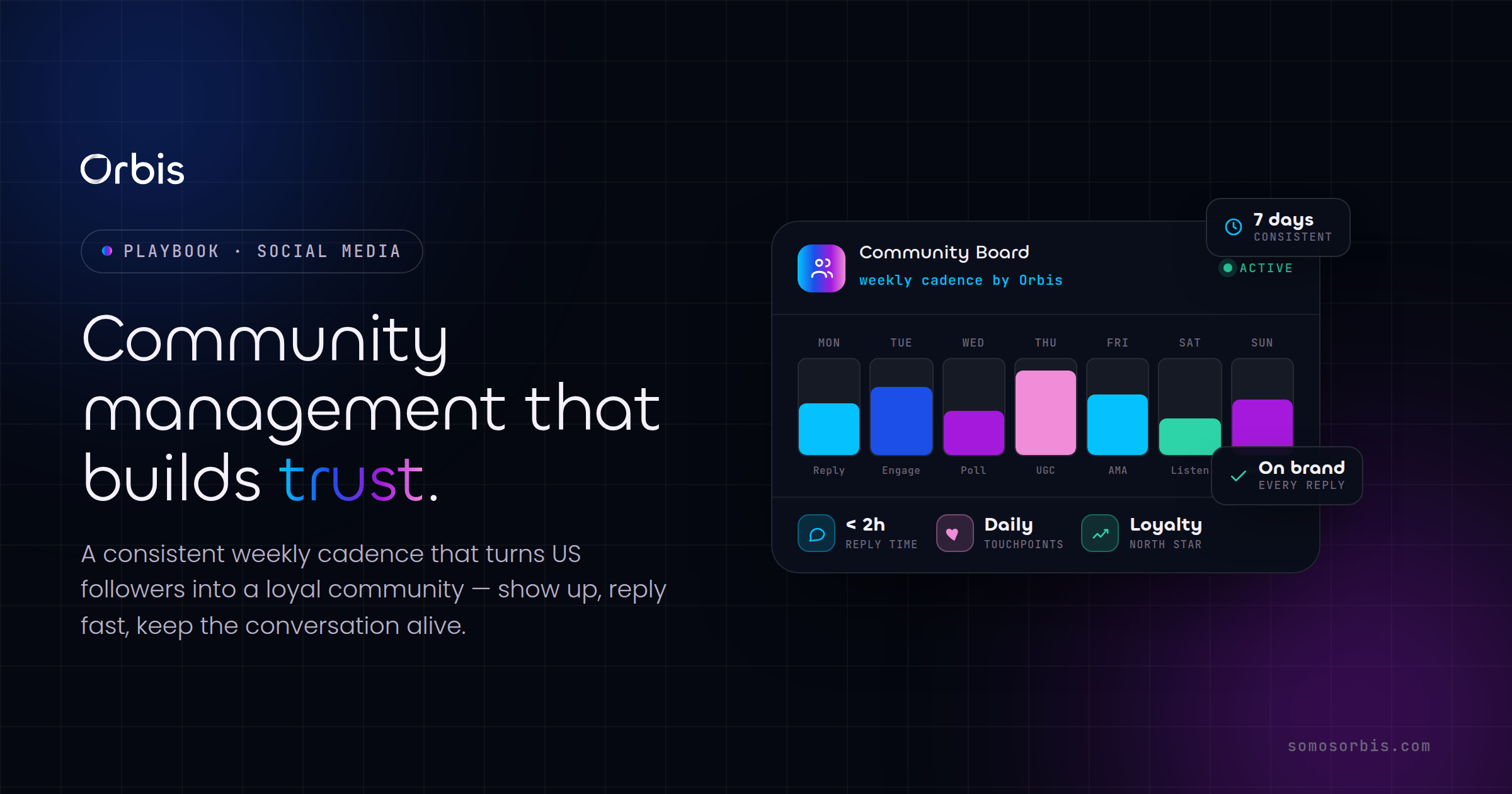
Community management is the unglamorous work that decides whether your social media actually builds a brand or just rents attention. Posting is the easy part. The hard part starts the moment a customer in Miami asks a question at 11 p.m. Eastern, a frustrated buyer in Los Angeles leaves a one-star comment during your West Coast lunch hour, and a Spanish-speaking follower in Houston drops a question your team can't read. Across the United States, your community never sleeps in a single time zone, and the brands that win are the ones with documented standards instead of improvisation.
At Orbis, we treat community management as a revenue function, not a courtesy. A reply is a touchpoint, a complaint is a save opportunity, and a well-handled crisis is brand equity you didn't have to buy. This guide lays out the response-time standards, tone rules, and escalation playbooks US brands need to manage communities at scale, from New York to LA, in both English and Spanish.
Why community management is a US-scale problem
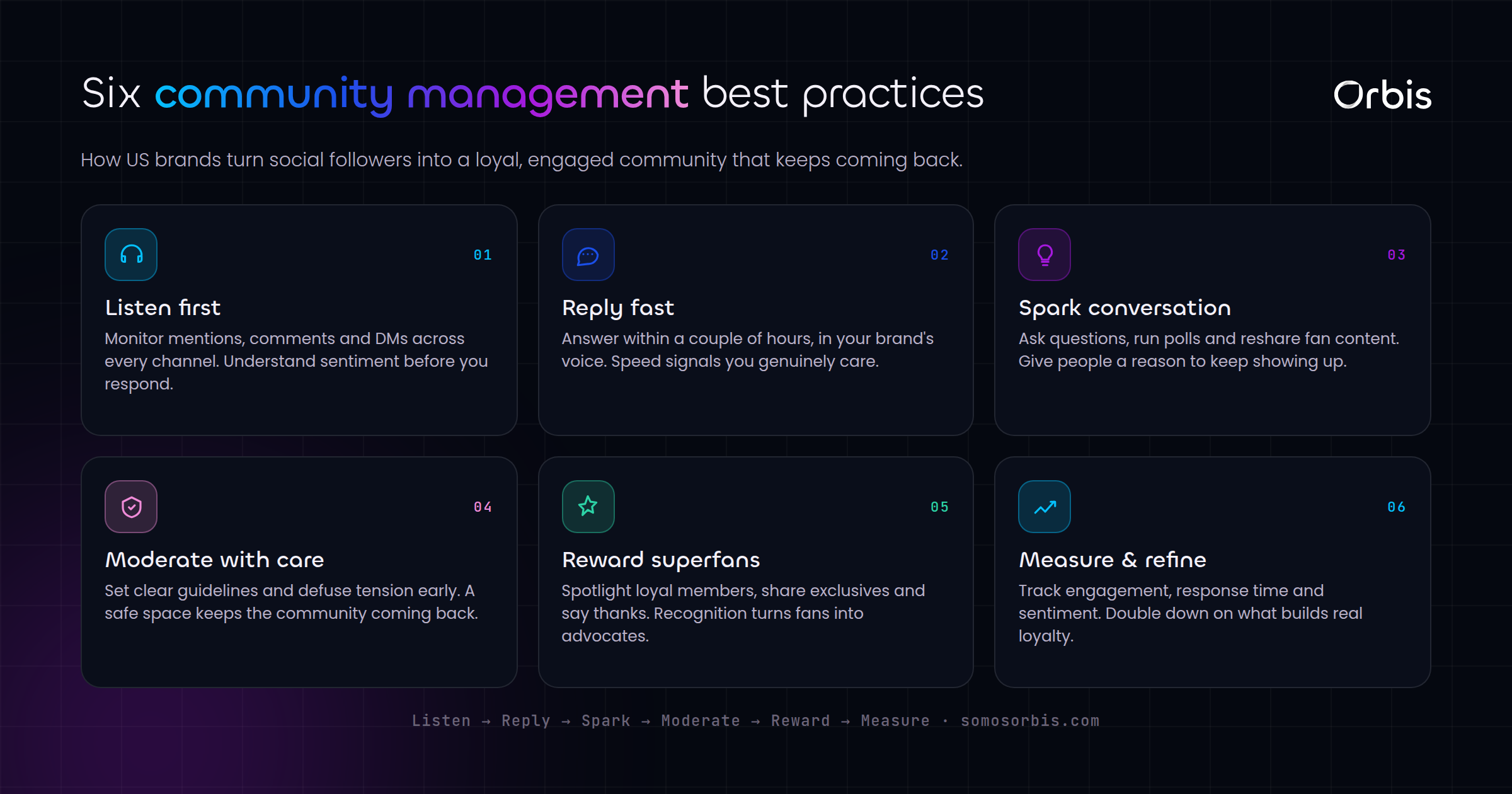
The continental United States spans four primary time zones, which means a single national brand is effectively open from roughly 8 a.m. in New York until well past midnight Eastern, when the West Coast is still awake. A "9-to-5" coverage model leaves Pacific-time customers unanswered for three of their most active hours, and weekend gaps are where reputation quietly erodes.
Layer on US seasonality and the load is anything but flat. Black Friday and Cyber Monday compress a month of customer questions into 96 hours. Amazon Prime Day spikes "where is my order" volume mid-summer. Back-to-school floods comment sections with sizing and availability questions in August, and tax season changes the tone of every financial brand's inbox. If your community team is sized for a Tuesday in February, it will collapse on Cyber Monday.
And the United States is bilingual in practice. Tens of millions of US consumers prefer Spanish, and the US Hispanic market is one of the fastest-growing buyer segments in the country. A community that only answers in English is ignoring a meaningful slice of its own audience. Bilingual EN/ES coverage isn't a nice-to-have in markets like Miami, Houston, Dallas, and Los Angeles; it's table stakes.
Set response-time standards (and actually hit them)
You can't manage what you don't define. The first artifact every brand needs is a written response-time standard, sometimes called an SLA, broken down by channel and by message type. Vague goals like "respond quickly" produce inconsistent results. Specific targets produce accountability.
Here is a practical baseline we recommend for US brands. Adjust the numbers to your team size, but publish them internally and report against them weekly.
- Direct messages (DMs): first response within 1 hour during staffed hours, within 4 hours otherwise.
- Public comments and mentions: within 2 hours during staffed hours.
- Complaints or service failures: within 30 minutes; these are escalation candidates, not routine replies.
- Reviews (Google, Facebook, Yelp): within 24 hours, every single one, positive included.
- Peak periods (BFCM, Prime Day, product launches): tighten DM targets to 30 minutes and add staffing.
Standards only matter if you measure them. Track first-response time, full-resolution time, and the percentage of conversations that hit your SLA. If you're hitting 95% in February but 60% on Cyber Monday, your staffing model is the problem, not your team.
Match staffing to the US clock and calendar
Build coverage around when your audience is actually active, not around your office hours. For most consumer brands that means staggering shifts so someone is monitoring until at least 9 p.m. Pacific (midnight Eastern), plus weekend coverage. Use scheduling tools to queue proactive content, but never automate the listening side: a queued post going out during a crisis while no human is watching is how small problems become screenshots.
For seasonal spikes, plan staffing six to eight weeks ahead. Map your community calendar to US retail moments: Black Friday and Cyber Monday, Prime Day, back-to-school, the December holiday rush, and tax season for relevant verticals. Surge capacity is cheaper than a reputation repair.
Define your brand voice and a clear tone matrix
Consistency is what makes a community feel like a brand and not a rotating cast of strangers. Every person who touches the inbox should sound like the same company. That requires a documented voice guide and, more importantly, a tone matrix that tells responders how to flex that voice by situation.
Orbis voice principles translate well to community work: be direct, be genuinely helpful, skip the fluff, and never over-promise. A tone matrix maps emotional context to the right register:
- Happy customer / praise: warm, brief, specific. Name what they liked. Don't bury a thank-you in a sales pitch.
- Simple question: clear, fast, complete. Answer the actual question first, then add the helpful extra.
- Frustrated customer: acknowledge, take ownership, move to a private channel. Never debate in public.
- Angry / public complaint: empathetic, calm, accountable. Apologize for the experience without admitting fault you can't verify.
- Trolls / bad-faith actors: respond once, factually, then disengage. Don't feed it.
Bilingual EN/ES tone, done right
Reaching the US Hispanic market well means more than running English replies through a translator. Spanish-language community management has its own register: many US Hispanic audiences expect a slightly warmer, more personal tone, and code-switching between English and Spanish is normal in markets like Miami and LA. Staff at least one native or fluent Spanish speaker on your community team, and build a Spanish version of your canned responses that reads naturally, not machine-translated. Mirror the language the customer used: if they wrote in Spanish, answer in Spanish.
Build escalation playbooks before you need them
The middle of a crisis is the worst time to invent a process. Every community team needs a written escalation playbook that answers three questions: what counts as an escalation, who owns it, and how fast it has to move. Document it, drill it, and keep it one click away from the people in the inbox.
Define your escalation tiers clearly:
- Tier 1 — Routine: handled by the community manager using approved responses. Questions, light complaints, praise.
- Tier 2 — Service recovery: a genuine product or service failure (wrong order, billing error, broken promise). Move to DM, log the case, resolve within your SLA, and loop in customer service if a refund or replacement is involved.
- Tier 3 — Reputational risk: viral negative posts, accusations, safety or legal claims, or a complaint from a public figure. Notify the brand lead and, if needed, legal and leadership immediately. Do not freelance a response.
- Tier 4 — Crisis: coordinated backlash, a trending negative hashtag, or a story being picked up by press. Activate the crisis comms plan, pause scheduled content, and designate a single approver for every external word.
For each tier, your playbook should name the owner, the response window, the approval chain, and a few pre-approved holding statements. A holding statement like "We hear you and we're looking into this right now — we'll follow up shortly" buys you the minutes you need to get the facts straight without going silent.
Privacy and compliance in public replies
US privacy expectations are real, and they show up in community management more than people expect. Never ask a customer to post an order number, account email, phone number, or any personal detail in a public comment. Always move those conversations to a DM or a secure support channel. Be mindful of the data you collect and how you store it, in line with current US privacy norms and your own quality processes. The simple rule: public for acknowledgment, private for resolution.
Turn community signals into business intelligence
A well-run community is the cheapest research department you have. Every complaint is a product note, every repeated question is a content gap, and every spike in sentiment is an early warning. Tag and categorize conversations so you can spot patterns: if forty people in one week ask about international shipping, that's a roadmap item, not forty isolated tickets.
Close the loop with the rest of the business. Share a weekly digest of community themes with product, marketing, and customer service. The questions your Dallas and Chicago customers keep asking should feed your content calendar and your FAQ. Community management isn't a silo at the end of the funnel; it's a sensor wired into the whole company.
A practical weekly community management routine
Standards and playbooks only work if they live inside a repeatable routine. Here's a lightweight cadence we deploy with US brands:
- Daily: clear the inbox to zero twice a day, monitor mentions, flag escalations, and log any Tier 2+ cases.
- Weekly: review SLA performance, surface recurring themes, update canned responses, and report sentiment trends.
- Monthly: audit tone consistency across responders, refresh the escalation playbook, and brief the team on upcoming seasonal spikes.
- Quarterly: reassess staffing against growth and seasonality, and pressure-test the crisis plan with a tabletop drill.
This rhythm keeps community management proactive instead of reactive. The brands that treat it as a documented process, with clear owners and measurable standards, are the ones that turn a comment section into a competitive advantage.
Related guides
Community management is one pillar of a complete social program. For the full framework, start with our social media strategy guide for US brands, which ties channels, content, and community into one plan. To get ahead of issues before they hit your inbox, pair this with social listening and reputation management for US brands, so you're catching brand mentions and sentiment shifts across the conversation, not just the replies aimed directly at you.
Let Orbis run your community
Great community management is a system, not a personality. It takes documented standards, bilingual coverage, tested escalation playbooks, and people who show up across every US time zone and every seasonal spike. That's exactly what we build. With a Google Partner badge, a 4.9-star rating across 58 reviews, and more than 500 clients served over 15+ years, Orbis brings quality processes and real accountability to the messy, high-stakes work of talking to your customers in public.
If your comments are piling up, your response times are slipping, or you're leaving the US Hispanic market unanswered, let's fix it. Explore our community management services and we'll design a coverage model, tone system, and escalation playbook built for how your audience actually behaves, from New York to Los Angeles.