
Your reputation is being written right now, in real time, by people you have never met. A frustrated customer in Houston posts a one-star review at 11 p.m. A Miami micro-influencer tags your brand in a Story that disappears in 24 hours. A Reddit thread in r/Dallas quietly racks up 4,000 views before anyone on your team notices. In the United States, where a single screenshot can travel from a private group chat to a national feed in hours, brand reputation is no longer something you manage once a quarter. It is something you listen for every single day.
This guide is built for US brands that want a practical, accountable system for social listening and reputation management, not vague advice about "engaging your community." We will cover what to monitor, the tools and signals that matter, how to handle reviews across platforms, and a crisis-response playbook you can hand to your team before you need it. Everything here is designed to be documented, repeatable, and measurable, so reputation stops being a fire drill and becomes a process.
What Social Listening Actually Means (and What It Is Not)
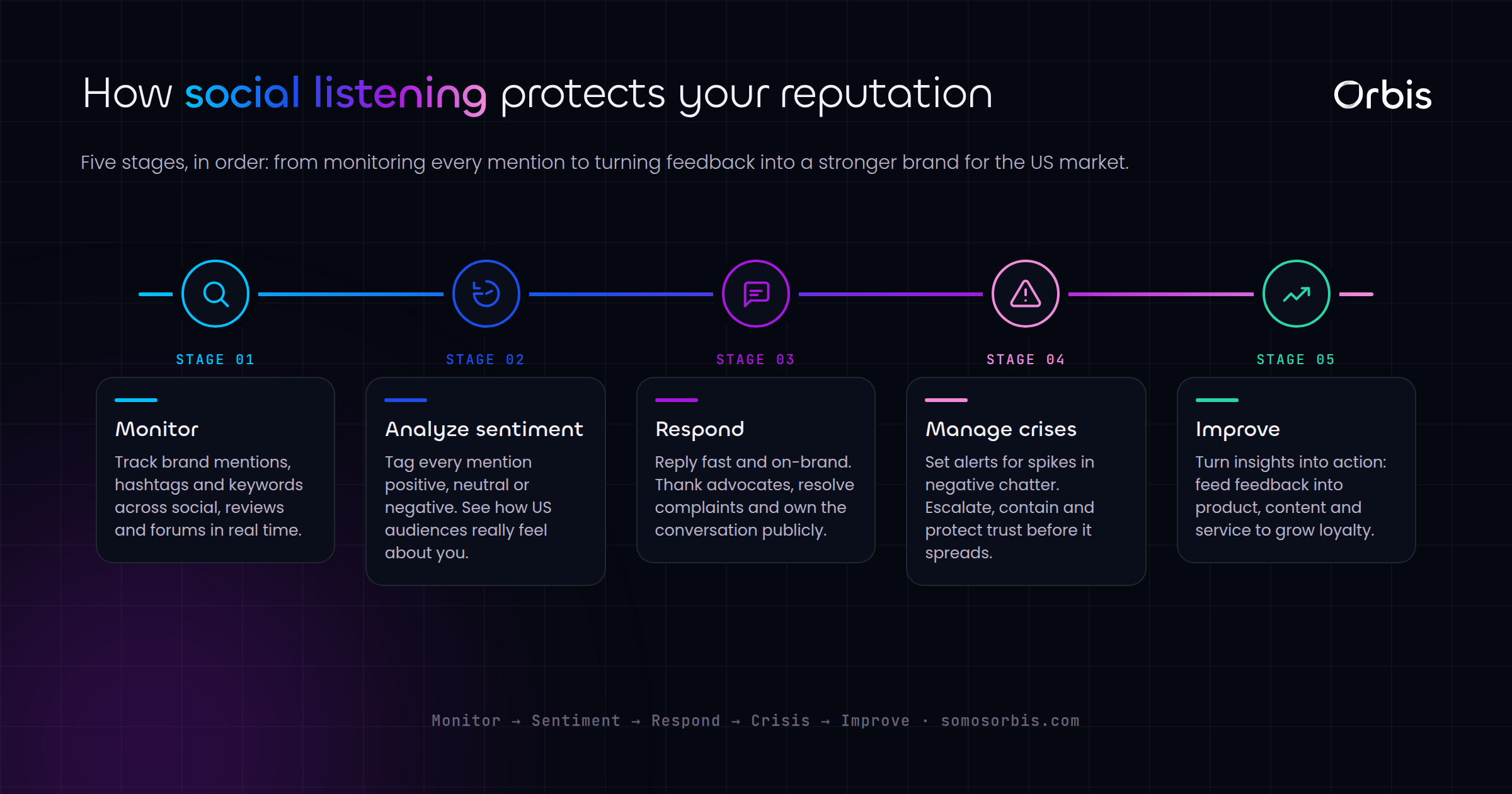
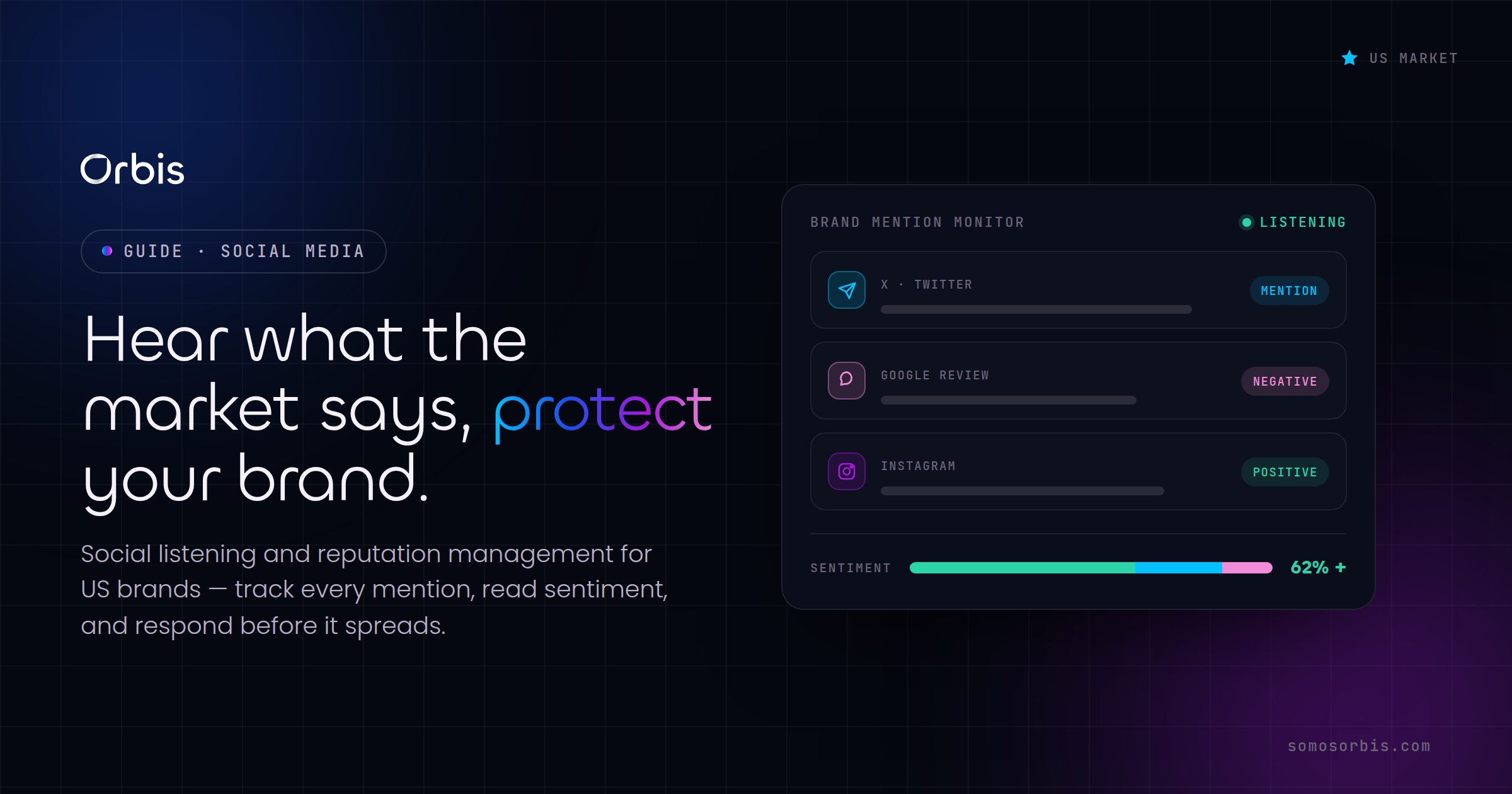
Social listening is the practice of systematically tracking what people say about your brand, your competitors, and your category across public channels, then turning those signals into decisions. It is broader than "social monitoring," which is just watching for direct @-mentions and tags. Listening includes the conversations where nobody tagged you at all, which in our experience is where the real risk and the real opportunity live.
Consider the difference. Monitoring catches the customer who writes "@yourbrand my order never arrived." Listening catches the customer who writes "ordered from a Dallas company two weeks ago, still waiting, never again" without naming you, in a local Facebook group with 30,000 members. The second post is invisible to a tagging-only setup, and it is often the more damaging one because it spreads inside a trusted community.
For US brands, listening needs to span several layers at once:
- Direct mentions and tags across Instagram, Facebook, X, TikTok, LinkedIn, and YouTube.
- Untagged brand and product name variations, including common misspellings and your founders' or executives' names.
- Review platforms: Google Business Profile, Yelp, Trustpilot, the App Store and Google Play if you ship software, and industry-specific sites like G2 or Capterra.
- Community spaces: Reddit, niche forums, Discord servers, and large regional or interest-based Facebook groups.
- Bilingual conversation. The US Hispanic market is enormous and active, and a meaningful share of brand chatter happens in Spanish. If you only listen in English, you are deaf to a large, high-intent audience in markets like Miami, Los Angeles, Houston, and Chicago.
Setting Up a Listening System That Holds Up
You do not need an enterprise budget to start, but you do need structure. The goal is a system where signals route to the right person with a defined response time, not an inbox where alerts go to die.
1. Define your keyword and query map
Start with a documented list of everything worth tracking. At minimum: exact brand name, brand name with common typos, product names, executive names, your main hashtags, and three to five competitor names. Then add category and intent phrases such as "best [your category] in [city]" or "[category] recommendations." Tag each query with a priority level so your team knows which alerts demand a same-hour response versus a same-day one.
2. Choose tools that match your stage
Free and low-cost foundations include Google Alerts, native platform search, and the notifications inside each social account. As you scale, dedicated platforms like Brandwatch, Sprout Social, Talkwalker, Mention, or Hootsuite add sentiment scoring, share-of-voice tracking, and historical search. The right tool is the one your team will actually check daily, integrated into the workflows you already run. We help clients connect these signals into their existing stack so listening feeds the same systems that drive the rest of the operation.
3. Assign ownership and SLAs
A signal with no owner is a signal that gets ignored. Document who handles reviews, who handles direct mentions, who escalates a potential crisis, and who has authority to approve a public statement. Define internal response-time targets: for example, acknowledge a negative public review within four business hours and resolve or escalate within 24. These are quality-of-process commitments, and they are what separate brands that look reliable from brands that look absent.
4. Track sentiment, not just volume
Mention volume tells you how loud the conversation is. Sentiment tells you whether it is helping or hurting. Track the ratio of positive to negative mentions over time, and watch for sudden swings. A spike in volume with flat sentiment might just be a viral moment. A spike in volume with collapsing sentiment is the early warning of a reputation problem you want to catch in hours, not days.
Reputation Management Across US Review Platforms
Reviews are where listening turns into revenue. The data is consistent across industries: most US consumers read reviews before buying, and a brand's average star rating and recency directly influence both conversion and local search ranking. Managing reviews is not optional maintenance; it is performance marketing.
Google Business Profile is your priority
For any brand with a physical or local presence, Google Business Profile reviews carry the most weight because they appear directly in search and Maps. Respond to every review, positive and negative. A thoughtful reply to a four-star review signals attentiveness to every future reader. For negative reviews, acknowledge the specific issue, avoid defensiveness, and move the detailed resolution to a private channel like email or phone. Never argue facts in public, even when you are right.
Yelp, Trustpilot, and the rest
Yelp remains influential for restaurants, services, and retail in major metros. Trustpilot carries weight for e-commerce and B2C software. Each platform has its own rules about soliciting reviews, so document the do's and don'ts per platform and train your team accordingly. The unifying principle: make it easy for happy customers to leave reviews, and make it just as easy for unhappy customers to reach you privately before they post.
Build a review-response template library
Speed and consistency come from preparation. Build a documented library of response frameworks, not copy-paste robotic replies, for the most common scenarios: shipping delays, product defects, billing confusion, great experiences, and ambiguous one-star reviews with no comment. Each template should leave room for personalization. The structure handles the speed; the human handles the empathy.
Listening to the US Hispanic Market in Both Languages
This deserves its own section because too many brands treat it as an afterthought. Tens of millions of US consumers engage with brands primarily or comfortably in Spanish, and they are concentrated in exactly the high-value markets where competition is fiercest: Miami, Los Angeles, Houston, Dallas, Chicago, and New York.
Practical steps for bilingual listening and reputation:
- Add Spanish-language queries to your keyword map, including how your brand and category are naturally discussed in Spanish, not just direct translations.
- Respond in the language the customer used. A Spanish-language review answered in Spanish signals respect and belonging; the same review answered in English can feel dismissive.
- Watch bilingual code-switching. Real conversation mixes English and Spanish in the same sentence, so your listening setup should not assume one language per post.
- Staff for it. Have at least one fluent, culturally fluent reviewer in the loop, not machine translation alone, for anything customer-facing or crisis-related.
Done well, bilingual listening is not just defense. It surfaces an entire layer of advocacy and demand that monolingual competitors never even see.
The Crisis-Response Playbook
Every brand will eventually face a moment of heightened scrutiny: a product failure, a viral complaint, an employee misstep, or a sensitive cultural moment where saying nothing and saying the wrong thing are both risks. The brands that come through intact are the ones that prepared the playbook before the crisis, not during it.
Tier your incidents
Not every negative post is a crisis. Document a simple severity scale:
- Tier 1, routine: isolated complaints handled by your normal review and support process.
- Tier 2, elevated: a post gaining unusual traction, a pattern of similar complaints, or a complaint touching a sensitive topic. Notify the team lead; monitor closely.
- Tier 3, crisis: rapidly spreading negative coverage, a safety or legal dimension, or sustained media or influencer attention. Activate the full response team and a single approval chain for public statements.
The first-hour checklist
When a Tier 3 moment hits, the first hour sets the tone for everything that follows. Document this sequence and rehearse it:
- Verify the facts before responding. Confirm what actually happened internally; a wrong public statement is far worse than a measured delay.
- Acknowledge quickly, even briefly. A short "We're aware and looking into this" buys time and signals you are present.
- Centralize the message. One approved voice, one approval chain. Conflicting statements from different team members compound the damage.
- Pause scheduled content. An automated promotional post during a crisis reads as tone-deaf. Have a fast way to freeze your queue.
- Document everything. Capture screenshots, timestamps, and decisions for the post-incident review and any compliance obligations.
Respect privacy in your response
When a complaint involves a specific customer, resist the urge to share account details publicly to "set the record straight." Beyond being bad optics, it can cross privacy lines that US consumers increasingly expect brands to honor. Move personal details to private channels, handle data responsibly, and let your public response stay about your commitment to making things right. Privacy-respecting behavior is itself a reputation asset.
Timing matters: plan around US seasonality
Reputation pressure spikes when volume spikes. Black Friday and Cyber Monday, Amazon Prime Day, back-to-school, and tax season all drive surges in transactions and therefore in complaints about shipping, billing, and support. Staff your listening and response team for these windows in advance. The worst time to be understaffed on reputation is the exact week your sales peak.
Turning Listening Into Strategy
The highest return on social listening is not damage control. It is intelligence. The same stream that surfaces complaints also surfaces what customers love, which features they wish you had, how they describe you in their own words, and where competitors are vulnerable. Feed that intelligence back into your roadmap, your messaging, and your campaigns.
This is where listening connects to the bigger picture. Reputation management is one pillar of a coherent presence, and it works best alongside a clear plan for how you show up and how you engage. If you are still defining the foundation, start with your social media strategy for US brands in 2026, then tighten the day-to-day execution with proven community management best practices. Listening, strategy, and community management are three views of the same goal: a brand people trust and talk about for the right reasons.
A Reputation System You Can Actually Run
Let's pull it together into something operational. A US brand with a working reputation system has, at minimum:
- A documented keyword and query map, including Spanish-language and competitor terms.
- Listening tools your team checks daily, with sentiment and share-of-voice tracking.
- Clear ownership and response-time commitments for reviews and mentions.
- A response-template library that keeps replies fast and human.
- A tiered crisis playbook with a rehearsed first-hour checklist.
- Seasonal staffing plans for high-volume US shopping windows.
- A monthly review that turns listening data into product and marketing decisions.
None of this is glamorous, and that is exactly the point. Reputation is not won with a single clever response. It is won through documented processes, consistent execution, and a team that knows precisely what to do when the conversation gets loud. That is the difference between a brand that reacts and a brand that is ready.
Reputation is the compound interest of every interaction your brand has ever had in public. You cannot fake it, and you cannot cram for it. You build it one well-handled moment at a time.
If you want a partner to design and run this system with you, from listening setup and bilingual coverage to crisis playbooks built for the US market, explore our social listening and reputation management services. With Google Partner credentials, a 4.9-star rating across 58 reviews, and more than 15 years protecting and growing over 500 brands, Orbis turns reputation from a risk you fear into an advantage you compound. Let's build the system before you need it.