
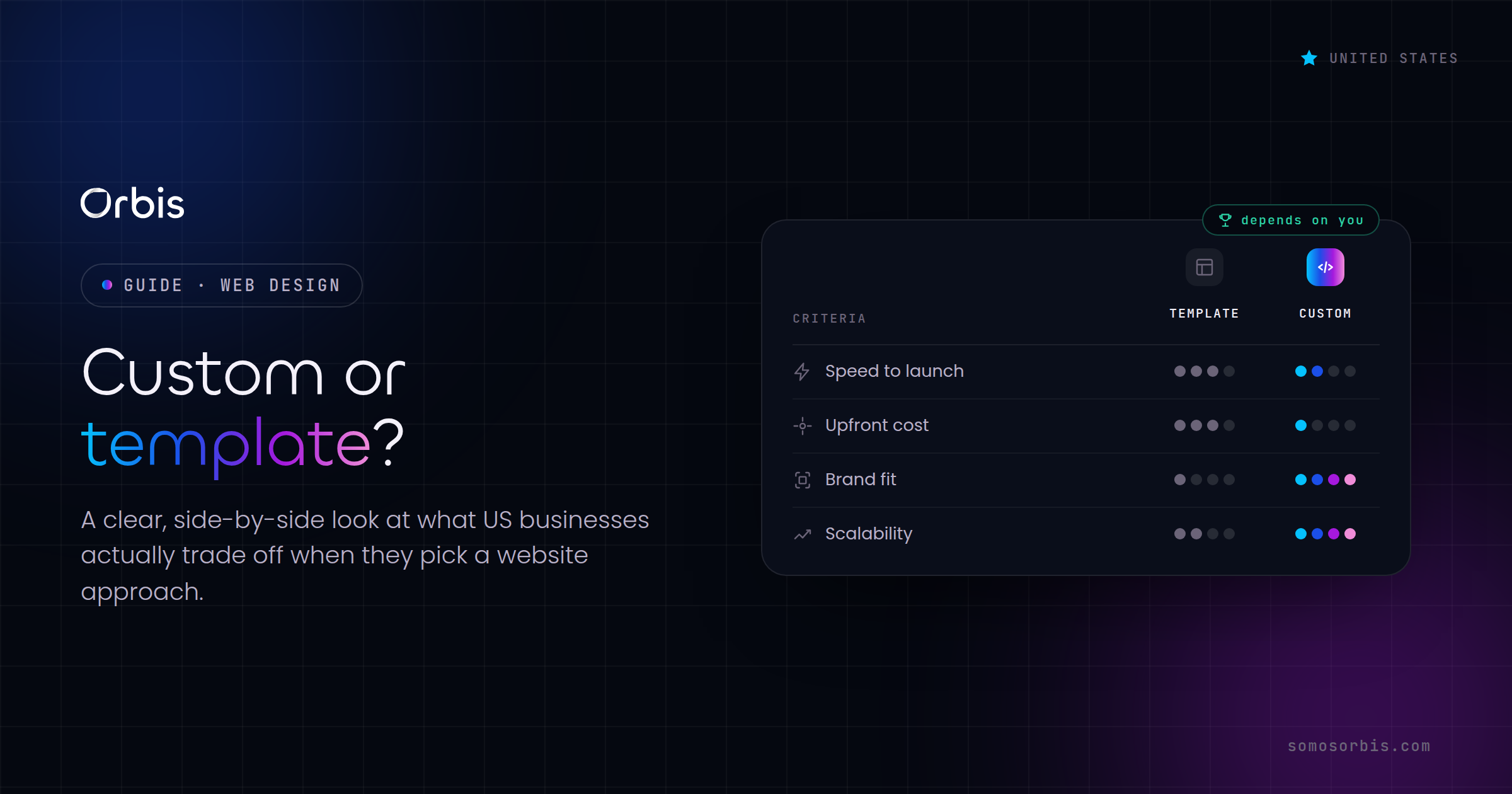
Every US business that needs a website eventually hits the same fork in the road: do you start from a template, or do you commission a custom build? It feels like a budget question, but it rarely is. The real question is whether your website is a brochure or a revenue engine. A bakery in Austin and a multi-location HVAC company in Dallas can both be "online," yet one needs a $40 theme and the other needs an architecture that survives Black Friday traffic, bilingual EN/ES content, and three years of growth without a painful rebuild.
At Orbis we have built and rebuilt hundreds of sites across the US market over more than 15 years, and the pattern is consistent: templates win on speed and price up front, custom wins on control, scalability, and long-term SEO value. The trick is knowing which side of the line your business actually sits on. This guide gives you a clear, no-fluff framework so you can choose with confidence instead of regret.
What "template" and "custom" actually mean
These two words get thrown around loosely, so let's anchor them before we compare costs in USD.
A template (or theme) is a pre-built design you buy or rent and then fill with your content. Think Shopify themes, WordPress themes from a marketplace, or a Wix/Squarespace layout. You're renting a design that thousands of other businesses also use, customizing colors, fonts, and images within the limits the theme allows.
A custom build is a website designed and developed specifically for your business, your data, and your workflows. The design system, the page structure, the integrations, and the performance budget are all decided by your goals rather than by what a marketplace author happened to ship. You can read more about how that process works on our custom web design service page, but the short version is: nothing on the page exists unless it earns its place.
There's also a middle ground worth naming: a heavily modified template. This is where a lot of US businesses think they're saving money but quietly inherit the worst of both worlds, which we'll cover below.
The honest cost comparison (in USD)
Price is the first thing every founder asks about, so let's be direct. Here is roughly how the two paths break down for a US small-to-midsize business.
- Template, do-it-yourself: $0–$500 for the theme plus your own time. Realistic timeline: a weekend to two weeks.
- Template, professionally configured: $2,000–$8,000 once you pay an agency or freelancer to set it up, migrate content, and connect tools. Two to four weeks.
- Custom build: $12,000–$60,000+ depending on scope, integrations, and number of templates. Six to twelve weeks for most projects.
Those numbers scare people into templates, but they only tell half the story. The real cost of a website is the total cost of ownership over three years, and that's where the math flips for a lot of businesses.
A template that can't support your seasonal promotions might cost you a custom landing page rebuild every Black Friday. A theme that loads slowly on mobile in Miami's spotty cellular zones quietly bleeds conversions every single day. And when you outgrow the theme in year two, you pay for the migration and the rebuild you were trying to avoid. Cheap up front frequently means expensive over time.
The most expensive website is the one you have to build twice. Choose for where your business will be in three years, not just where it is this quarter.
When a template is the right call
We are not anti-template. For a meaningful share of US businesses, a well-chosen theme is the smart, capital-efficient choice. Pick a template if most of these are true:
- You're pre-revenue or early-stage and need to validate demand before investing in infrastructure.
- Your business model is standard: a single-location restaurant in Chicago, a solo consultant, a portfolio site, a simple service business.
- Your content fits a conventional structure and you don't need custom workflows.
- You don't have heavy integrations beyond a payment processor, a booking tool, and an email platform.
- Speed to launch matters more than differentiation right now.
If that's you, choose a reputable theme on a stable platform, pay a professional a few hundred dollars to configure it properly, and put your energy into marketing instead. A template launched this month beats a custom build that's still in design review six months from now.
When a custom build pays for itself
Custom development stops being a luxury and starts being a requirement when your website has to do real work. Choose a custom build if several of these apply:
- You sell at scale or with complexity. Hundreds of SKUs, B2B pricing tiers, quote workflows, or marketplace-style listings push past what most themes handle gracefully.
- Seasonality is a revenue spike, not a footnote. If Black Friday and Cyber Monday, Amazon Prime Day, back-to-school, or tax season drive a large slice of your annual revenue, you need pages and infrastructure built to convert and to stay up under load.
- You need true bilingual EN/ES. Reaching the large US Hispanic market well means more than a translate button: it means parallel URL structures, hreflang done right, and culturally adapted content. Templates often bolt this on awkwardly.
- Performance is a competitive edge. Core Web Vitals, sub-second loads, and clean code directly influence both conversions and rankings. Custom code lets you hit a strict performance budget that bloated themes can't.
- Integrations are central. A custom build can connect cleanly to your CRM, ERP, inventory system, or in-house tools instead of forcing you into whatever plugins a theme tolerates.
- Privacy and consent are non-negotiable. If you handle customer data at any scale in states like California, you need consent management and data handling built in by design, not patched in after a compliance scare.
The common thread: when your website is part of how you make money rather than just where people find your phone number, the control a custom build gives you tends to pay for itself.
The hidden cost of templates: SEO and scalability
This is the part that doesn't show up in the price quote, and it's where the long game is won or lost.
SEO and Core Web Vitals
Popular templates are built to please everyone, which means they ship with code, sliders, and scripts you'll never use. That bloat slows your site down, and Google has been clear that page experience and speed influence rankings. A custom build lets you ship only the code your pages need, control your heading structure and schema markup precisely, and hit performance scores that templates routinely miss. Over a year, that difference can be the gap between page one and page three for a competitive term like "roof repair Houston."
Scalability and technical debt
Templates have ceilings. The moment you need a feature the theme author didn't anticipate, you start layering plugins and custom code on top of a structure that wasn't designed for it. Each addition increases the odds something breaks during an update. That accumulating fragility is technical debt, and it has a way of surfacing at the worst possible moment, like the morning of Cyber Monday. Custom builds are designed to grow with you, so adding a new product line or a new market is an extension rather than a fight.
Differentiation
If a customer in Los Angeles visits three competitors and they all run the same popular theme, your brand blurs into the background. Design is a trust signal. A site that looks and feels distinctly yours tells visitors you're established and serious, which matters enormously for higher-consideration purchases.
A practical decision framework
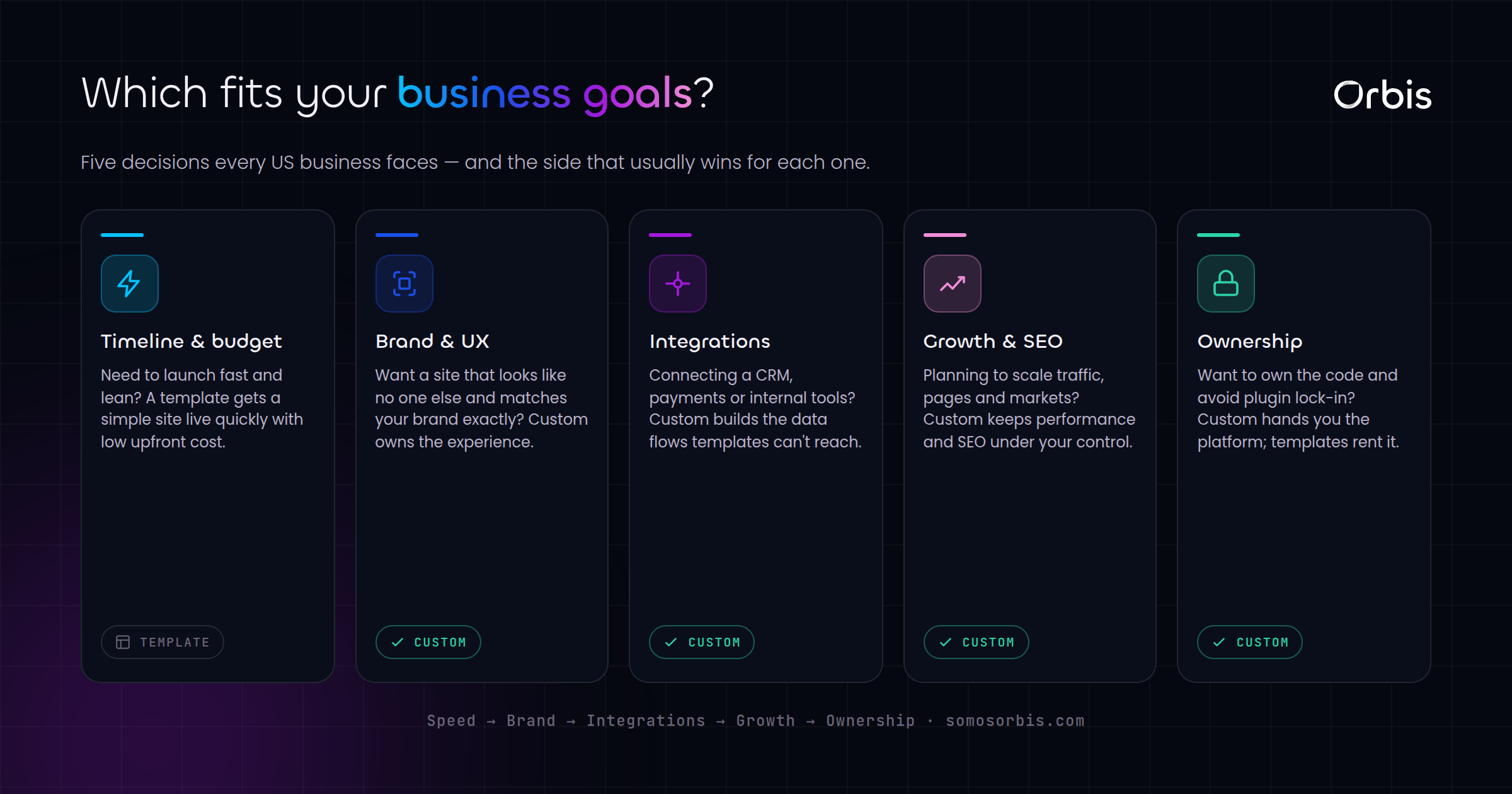
Run your business through these five questions. The more "custom" answers you get, the stronger the case for investing in a custom build.
- Revenue dependence: Is the website where revenue happens, or where you're simply listed? Direct revenue leans custom.
- Growth horizon: Where will the business be in three years? Aggressive growth or new markets lean custom.
- Complexity: Do you need workflows, integrations, or bilingual structure that go beyond standard pages? Complexity leans custom.
- Differentiation: Does your brand need to stand apart in a crowded local market? Differentiation leans custom.
- Budget reality: Can you fund a custom build without starving your marketing? If not, a strong template now plus a custom build later is a perfectly legitimate roadmap.
Notice that the smart answer is sometimes "template now, custom later." Launching on a theme to validate, then reinvesting revenue into a custom build once you understand your customers, is a disciplined way to sequence the spend. The mistake isn't choosing a template. The mistake is choosing a template and then trying to force it to do a custom build's job for years.
How we approach the decision at Orbis
We don't lead with a recommendation. We lead with your numbers. Before we ever talk about themes or code, we map how your site will make money, where your traffic spikes during the US calendar, what data you handle, and which markets and languages you need to serve. That's the difference between Business Assurance and guesswork: documented processes, revenue engineering, and compliance built in by design rather than bolted on later.
Sometimes that analysis points to a well-configured template, and we'll tell you so plainly. There's no honesty in selling a $40,000 build to a business that needs a $4,000 setup. But when the work calls for control, performance, and room to grow, a custom build is the foundation that won't need replacing the moment you succeed.
Related guides
If you're early in your research, start with our pillar overview: the web design guide for US businesses in 2026. And if your decision is really about which platform to build on, our breakdown of WordPress vs Shopify for US businesses compares the two most common starting points so you can match the platform to your model.
The bottom line
Templates are a great way to get online fast and cheap when your needs are standard and your priority is speed. Custom development is the right investment when your website carries real revenue, has to scale, needs genuine bilingual EN/ES support, or has to stand apart in a competitive US market. Decide based on the next three years and the total cost of ownership, not just the sticker price this quarter.
Not sure which side of the line your business is on? That's exactly the conversation we have every week. Talk to our custom web design team and we'll map your goals, your seasonality, and your growth horizon, then give you a straight recommendation, even if that recommendation is to start with a template. Either way, you'll leave the conversation knowing your website is built to make you money, not just to exist.