
If you run a business in the United States and you are about to invest in a new website, two names keep coming up in every conversation: WordPress and Shopify. Both are mature, well-supported platforms with millions of live sites. But they were built for different jobs, and choosing the wrong one can cost you months of rework, thousands of dollars in USD, and lost revenue during the seasons that matter most, from Black Friday and Cyber Monday to Amazon Prime Day and back-to-school.
This is a practical, no-fluff comparison written for owners, marketing leads, and operations teams in cities like New York, Los Angeles, Chicago, Miami, Dallas, and Houston. We will cover real cost in USD, SEO, scalability, maintenance, and the day-to-day reality of running each platform, so you can make the call with confidence and document the decision instead of guessing.
The short answer first
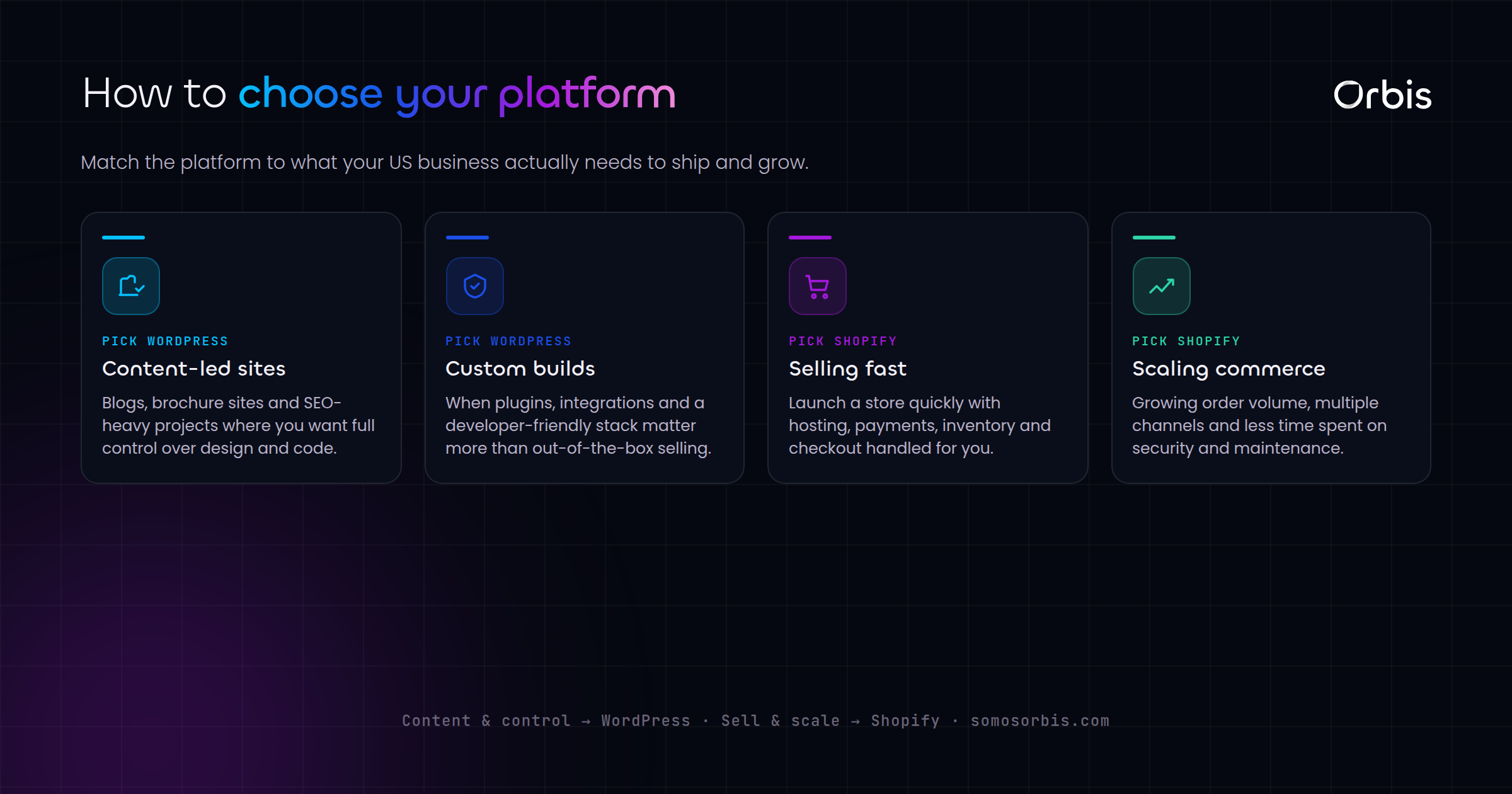
Here is the honest summary before the details:
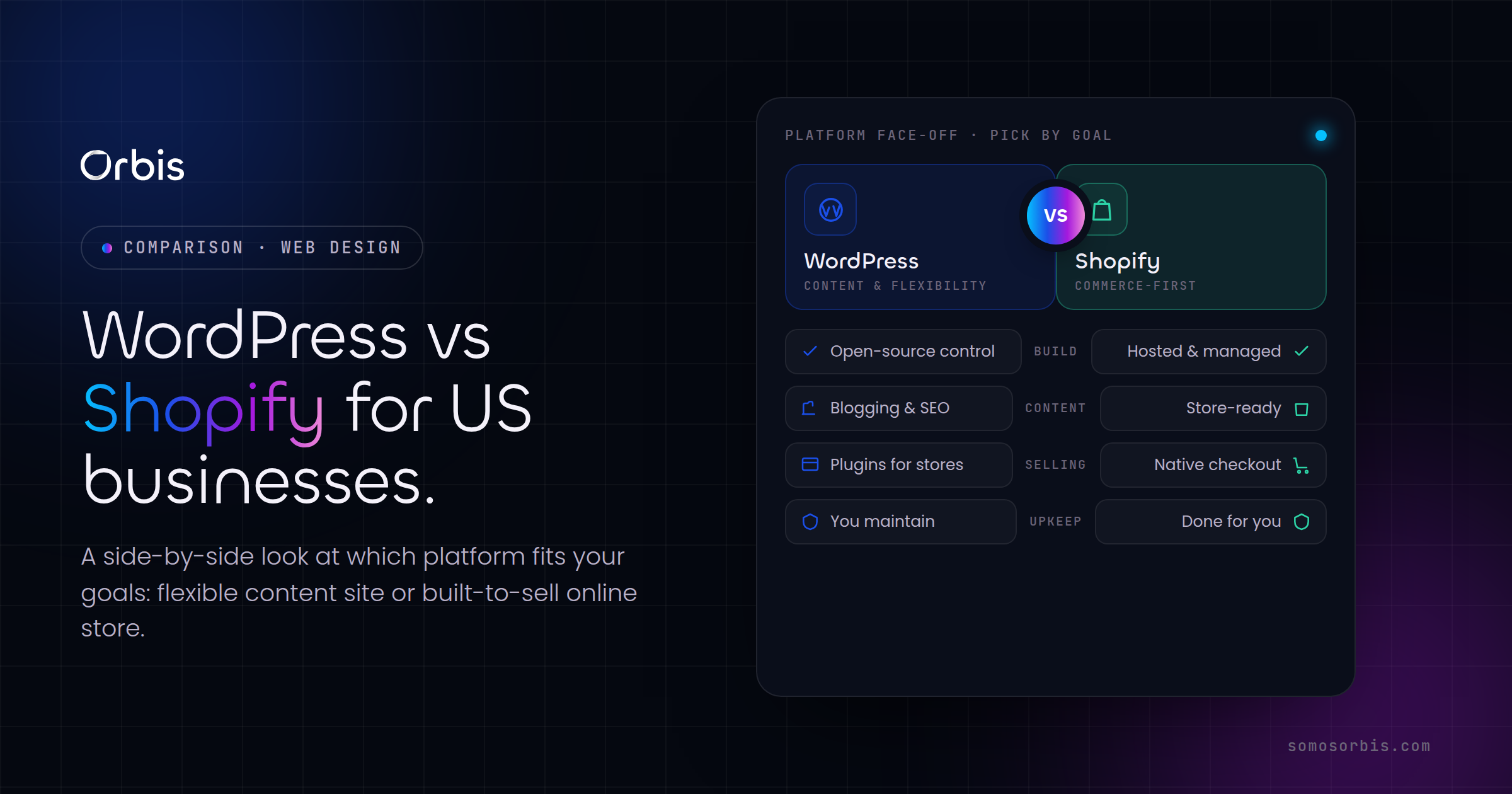
- Choose Shopify if your core business is selling physical or digital products online, you want predictable hosting and security handled for you, and you need to be transaction-ready for high-traffic events like Cyber Monday without babysitting servers.
- Choose WordPress if content, SEO, custom functionality, brand storytelling, or a mix of marketing site plus light commerce is your priority, and you want full ownership and flexibility over how everything works.
Most US businesses are not purely one or the other. A content-heavy brand that also sells a few products may lean WordPress with WooCommerce. A direct-to-consumer brand doing real volume almost always belongs on Shopify. The rest of this guide explains why, with numbers.
Cost in USD: what you actually pay
Sticker price is misleading. The real question is total cost of ownership over two to three years, because that is the window in which most US businesses recover their investment.
Shopify cost breakdown
- Subscription: roughly $39 to $399 per month for standard plans, billed in USD, with Shopify Plus for larger merchants priced higher and negotiated.
- Transaction fees: if you do not use Shopify Payments, you pay an extra percentage per sale. Using their payments avoids that surcharge but you still pay standard card processing.
- Apps: the average store runs several paid apps for reviews, email, subscriptions, or upsells. Budget $50 to $300 per month here, sometimes more.
- Theme and design: a premium theme is a one-time cost; custom design and development is where serious brands invest.
The advantage is predictability. Hosting, security, PCI compliance, and uptime during a Prime Day traffic spike are baked in. You are renting a managed, transaction-grade platform.
WordPress cost breakdown
- Software: the WordPress core is free and open source.
- Hosting: from a few dollars a month for shared hosting up to several hundred for managed hosting that can handle traffic surges.
- Theme and plugins: many are free, but premium plugins for SEO, forms, security, caching, and commerce add up to a few hundred dollars a year.
- Maintenance and updates: this is the cost people forget. Someone has to keep core, themes, and plugins updated and secure.
WordPress can be cheaper at the entry level and more expensive at the top end, because flexibility means you can build almost anything, and building costs money. The trade-off is ownership: you control the stack instead of renting it.
Rule of thumb for US budgets: Shopify trades a higher fixed monthly fee for fewer surprises. WordPress trades lower licensing for higher operational responsibility. Neither is "cheaper" in the abstract; it depends on who maintains it.
SEO: which platform ranks better?
Both platforms can rank. The difference is how much control you get and how much work it takes.
WordPress is, historically, the stronger SEO foundation for content-led strategies. You get granular control over URLs, metadata, schema, internal linking, and content structure. Combined with a serious SEO plugin, it is the platform of choice for brands that want to win organic search and AI answer engines through deep, well-structured content. If your growth plan depends on ranking for hundreds of informational and commercial queries across US markets, WordPress gives you the most room to maneuver.
Shopify has closed the gap considerably. Its SEO is solid for product and collection pages, page speed is generally fast out of the box, and it handles the technical fundamentals well. Its historical limitations were rigid URL structures and a blog that is functional but not built for heavy content marketing. For an ecommerce brand whose SEO priority is product discoverability, Shopify is more than capable.
A practical pattern many US brands use: run the store on Shopify and a content hub on WordPress under the same brand, getting the best of both. That requires clean architecture so the two do not compete or confuse search engines, which is exactly the kind of decision worth documenting up front.
SEO factors to weigh
- Do you need a large, fast-growing content library? Lean WordPress.
- Is product and collection SEO your main lever? Shopify is fine.
- Do you want bilingual EN/ES content to reach the large US Hispanic market? Both can do it, but plan the multilingual structure deliberately so you are not bolting it on later.
Scalability: handling your busiest day
For US retailers, the website is a stress test on a handful of days a year. Black Friday and Cyber Monday alone can deliver a year's worth of traffic in a weekend, with back-to-school and the post-holiday tax season adding their own spikes.
Shopify is built for exactly this. Infrastructure scaling, checkout reliability, and fraud handling are Shopify's problem, not yours. When a campaign goes viral or an influencer drives a flood of traffic at 9pm, you are not paging a developer to add server capacity. For high-volume direct-to-consumer commerce, this is a decisive advantage.
WordPress scales too, but you own the scaling. With managed hosting, a CDN, and proper caching, a WordPress site handles serious traffic. The difference is that responsibility sits with you and your hosting partner. For a content site or a store with moderate volume, this is very manageable. For unpredictable, high-spike commerce, it requires planning and budget.
Maintenance and security: the ongoing reality
This is where the long-term character of each platform shows.
Shopify handles updates, security patches, PCI compliance, and uptime for you. That is the core value of a hosted platform: your team focuses on merchandising, marketing, and customer experience rather than infrastructure. The trade-off is less control and a dependence on Shopify's roadmap and app ecosystem.
WordPress needs active maintenance. Core, theme, and plugin updates must be applied and tested; security must be monitored; backups must be reliable. Neglected WordPress sites are a common source of breaches, almost always through outdated plugins. Maintained properly, WordPress is secure and stable. The key word is maintained, which means either an in-house owner or a partner with documented processes who treats it as an ongoing commitment, not a one-time launch.
How to decide: a simple framework
Run your business through these questions, ideally with your team in the room so the answer is documented and not just one person's opinion.
- What is the primary job of the site? Selling products at volume points to Shopify. Content, lead generation, and brand storytelling point to WordPress.
- Who will maintain it? No dedicated technical owner favors Shopify's managed model. A capable in-house team or a reliable partner makes WordPress viable.
- How seasonal is your traffic? Heavy Black Friday, Cyber Monday, or Prime Day spikes favor Shopify's hands-off scaling.
- How custom does it need to be? Highly custom functionality or unusual workflows favor WordPress's flexibility.
- What is your real budget over three years? Include subscriptions, apps or plugins, design, and maintenance, all in USD, not just the launch quote.
- How do you handle customer data? Whichever you choose, configure privacy and consent in line with current US privacy norms and quality processes from day one, rather than retrofitting later.
Common scenarios for US businesses
The DTC brand scaling fast
A direct-to-consumer brand in Los Angeles or Miami selling physical products, running paid ads, and bracing for Cyber Monday should almost certainly be on Shopify. The managed checkout, scalability, and app ecosystem are worth the monthly fee.
The content-driven company
A professional services firm in Chicago or Dallas that wins clients through SEO, thought leadership, and bilingual EN/ES resources targeting the US Hispanic market is a natural fit for WordPress, where content and search are first-class citizens.
The hybrid
A New York or Houston brand that needs both a deep content marketing engine and a real store often runs WordPress for content and Shopify for commerce under one brand. This is powerful but demands clean architecture and disciplined execution so the two reinforce each other instead of competing.
Where expert execution makes the difference
The platform is only half the decision. A poorly built Shopify store loses sales, and a neglected WordPress site becomes a security liability. Execution, on-brand design, conversion-focused UX, and documented maintenance processes are what turn a platform choice into actual revenue.
At Orbis we are a Google Partner with a 4.9-star rating across 58 reviews, more than 500 clients served, and over 15 years of experience helping businesses build and grow online. As Shopify and Meta partners, we work with both platforms every week and recommend the one that fits your goals, not the one that is easiest for us. If you have decided on WordPress, our team can design and build a site that ranks and converts through our WordPress web design service. If Shopify is the right call, we build conversion-focused stores ready for your busiest season through our Shopify web design service.
Related guides
This article is part of a larger series on building effective websites for US businesses. For the full strategic picture, start with our pillar resource, The Complete Web Design Guide for US Businesses in 2026. And if your real question is whether to build custom or use a template, read the companion comparison, Custom Web Development vs Templates: What US Businesses Should Choose.
Make the call, then build it right
WordPress versus Shopify is not a battle with a single winner. It is a fit question. Match the platform to the primary job of your site, the team that will maintain it, and the seasons that drive your revenue, and you will choose well. Then invest in execution, because the platform sets the ceiling but the build determines whether you reach it.
Not sure which way to go for your specific business? Talk to our team. We will look at your goals, your team, and your USD budget, and give you a straight recommendation with no fluff. Start with our web design experts and let us help you build a site that actually grows your business.