
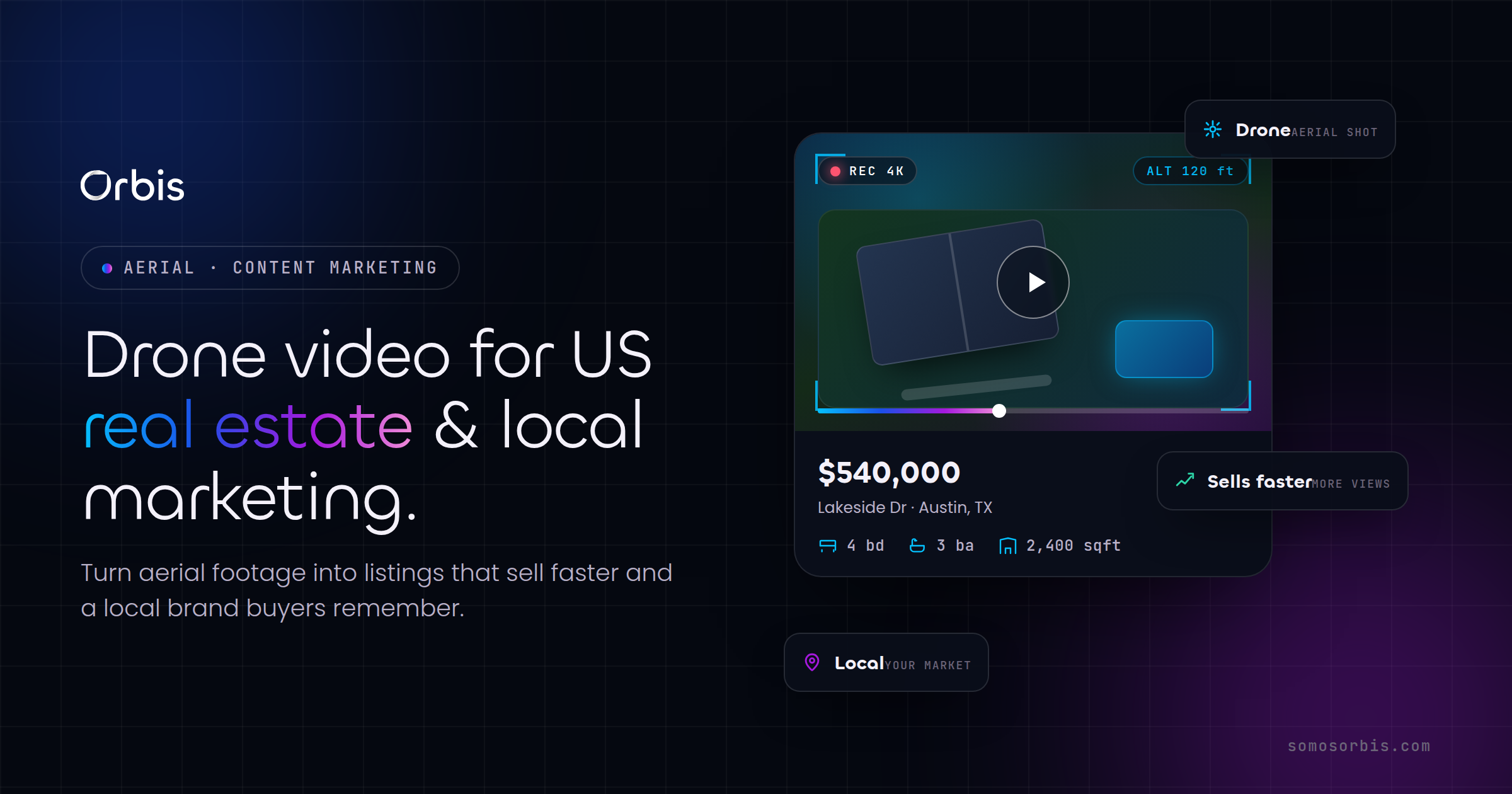
A listing photo stops the scroll. A drone shot makes a buyer feel the property. When a prospective owner in Miami sees a smooth aerial pull-back revealing a rooftop pool, the walk to the bay, and the skyline beyond, you have communicated location, scale, and lifestyle in eight seconds. No paragraph of MLS copy does that. Across US metros where inventory moves fast and attention moves faster, commercial drone video has shifted from a luxury flourish to a baseline expectation for serious real estate and local marketing.
This guide is the practical version: what drone footage actually does for US property and venue marketing, how FAA Part 107 rules shape what you can legally fly and film, what production costs in USD, and how to turn raw aerial clips into assets that close deals. It is written for agents, brokerages, property managers, restaurants, event venues, and local brands that want to look like the category leader in their market without guessing at the rules or the budget.
Why drone video wins in US real estate marketing
Aerial video answers the three questions every buyer and visitor asks before they ever pick up the phone: Where is it? How big is it? What is it near? A ground-level photo cannot show that a Dallas warehouse sits two minutes from a major freeway interchange, or that a Lake Michigan condo in Chicago has unobstructed water views from the upper floors. Drone footage shows it in a single continuous move.
The performance case is just as strong as the emotional one:
- Listings with aerial media get more engagement. On portals and social feeds, video that opens with motion holds attention longer than a static carousel, and longer watch time feeds the algorithm that decides who sees your listing next.
- Context sells the neighborhood, not just the box. A New York commercial space is only as valuable as its foot traffic and adjacency. Aerial framing puts the building inside its block, its transit, and its competition.
- It signals seriousness. A seller choosing between two agents reads drone video as proof you will invest in the listing. For venues and local businesses, it reads as proof you are established.
- It is reusable. One 20-minute flight produces hero video, vertical social cuts, website background loops, and still frames for print. The cost per asset drops fast when you plan the shoot around outputs.
Drone work rarely stands alone. It is the wide, cinematic layer on top of interior photography, twilight shots, and floor-level video. Treat it as one component of a coordinated capture, not a separate errand, and the whole package gets stronger.
FAA Part 107: what you can and cannot do
Here is the part most marketing guides skip, and the part that protects you from fines and liability. If you are flying a drone to produce footage that supports a business or generates revenue, including marketing a listing or a venue, the FAA treats that as commercial operation. Commercial flights in the United States require a remote pilot certificate under Part 107. Flying recreationally and then using the footage for business does not change the classification.
What this means in plain terms:
- The pilot must hold a Part 107 certificate. Not the brokerage, not the marketing manager. The person at the controls. If you hire a videographer, confirm their certificate is current before the shoot.
- The aircraft must be registered. Drones used commercially are registered with the FAA, and the registration number must be displayed on the aircraft.
- Airspace authorization is often required. Large portions of major metros sit in controlled airspace near airports. Flying near LAX in Los Angeles, O'Hare in Chicago, or the dense airspace around New York frequently requires authorization, which a certified pilot obtains through the FAA's LAANC system. A good operator checks this before quoting you, not after.
- Altitude and line-of-sight limits apply. Standard operations cap altitude and require the pilot to keep the drone within visual line of sight. Night flights and operations over people have their own conditions.
- Local rules layer on top. Some cities, parks, HOAs, and private venues add their own restrictions or require permits. The FAA governs the airspace; the property owner governs the takeoff and landing on their land.
None of this should scare you off. It should make you selective about who you hire. The right answer to "are we cleared to fly this listing?" is a confident yes backed by a certificate, a registration, and an airspace check, not a shrug. Building those checks into your process is exactly the kind of compliance-by-design discipline that keeps a marketing program out of trouble while it scales.
If a vendor cannot tell you their Part 107 certificate number and how they handle controlled airspace, they are not ready to shoot your commercial listing. Treat that conversation as a qualification step, not a formality.
What drone production actually costs in USD
Pricing varies by market, complexity, and deliverables, but here is a realistic framing so you can budget without sticker shock. Think in three tiers.
Tier 1: Single-property aerial package
A focused shoot for one residential listing, delivering a short edited aerial sequence plus a handful of still frames, typically runs in the low hundreds of dollars in most US metros. This is the workhorse package for active agents who want every premium listing to have an aerial layer. Turnaround is usually a day or two.
Tier 2: Full property film
A combined shoot that pairs drone footage with ground video, interior coverage, and a scripted edit, music, captions, and a vertical cut for social, lands in the mid-hundreds to low thousands depending on property size and how much editing the final film requires. This is the right tier for luxury listings, commercial spaces, and venues that need a polished brand piece.
Tier 3: Ongoing program
Brokerages, property managers, and multi-location venues that need consistent output every month are better served by a retainer than by one-off bookings. A program builds a repeatable shoot-to-publish pipeline, locks in pricing, and keeps your brand look consistent across every listing and city. The per-asset cost is lowest here because the workflow, templates, and approvals are already built.
What moves the number up or down:
- Airspace complexity. A listing in open suburban Houston is faster to clear and fly than one under controlled airspace near a Miami flight path.
- Edit depth. A clean 30-second cut costs less than a narrative film with motion graphics, color grading, and multiple deliverable formats.
- Number of outputs. Plan all the formats you need up front, vertical for Reels and Stories, square for feed, wide for the website, so you capture once and cut many.
- Seasonality and timing. Twilight and golden-hour shoots take more coordination and weather flexibility, which adds cost but lifts perceived value significantly.
Turning footage into assets that convert
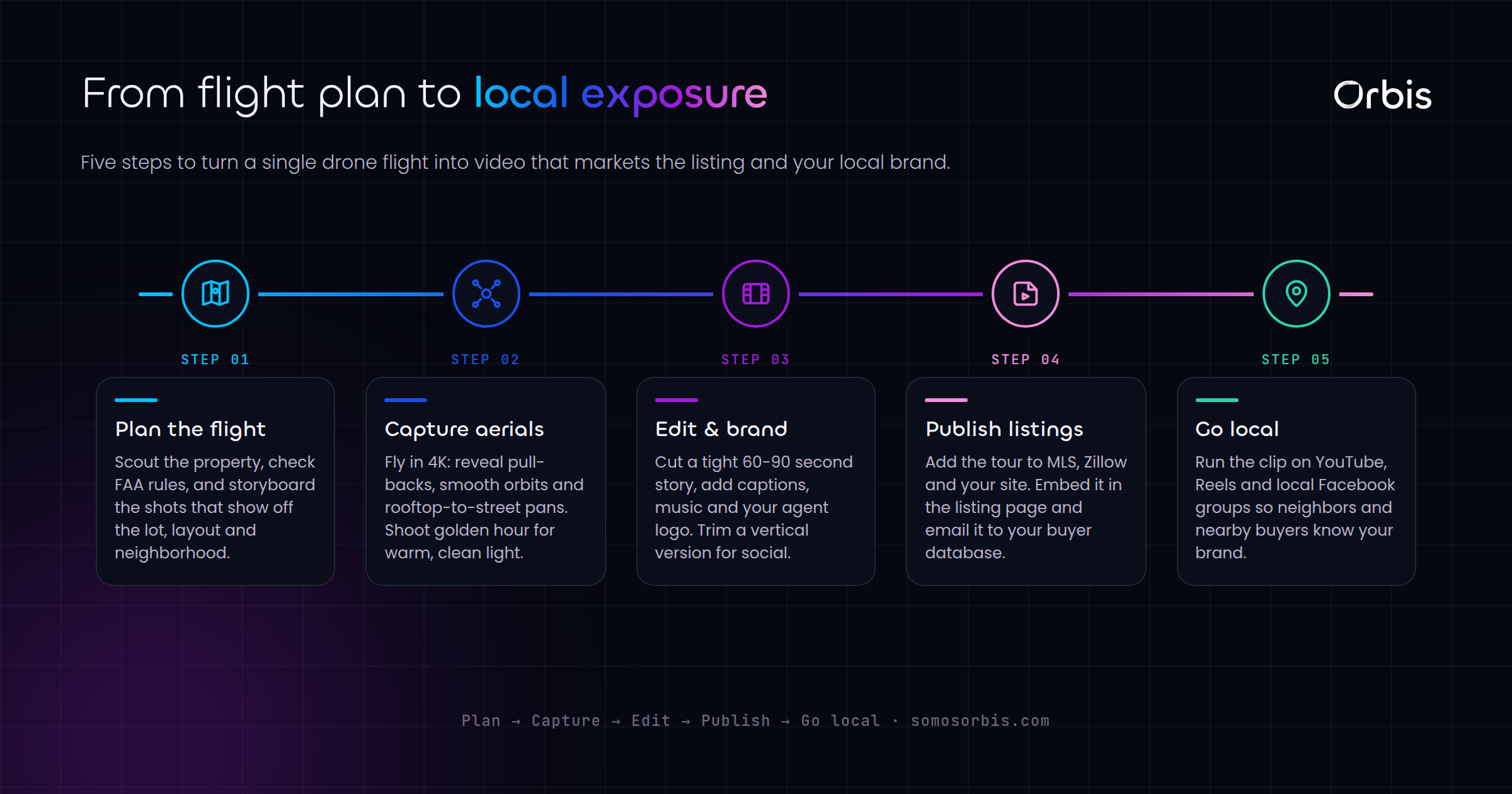
Raw drone clips are not marketing. The edit is where value is created. A disciplined post-production plan turns one flight into a library.
- The hero film (30 to 90 seconds). Open on the strongest aerial reveal, cut to the best ground and interior moments, close on the address and a clear call to action. This is your portal and website centerpiece.
- Vertical social cuts (15 to 30 seconds). Reframe for Reels, TikTok, and Stories with the most dramatic aerial move in the first two seconds. Motion in the opening frame is what stops the scroll.
- Looping website backgrounds. A silent, seamless aerial loop behind a hero headline makes a listing or venue page feel premium instantly.
- Still frames. Pull crisp stills from the footage for print flyers, email, and listing thumbnails. One flight feeds multiple channels.
Reaching the US Hispanic market with bilingual cuts
In markets like Miami, Los Angeles, Houston, and Dallas, a large and active US Hispanic audience is researching properties and venues in both English and Spanish. Drone video travels across language better than any other asset because the imagery carries most of the message. Produce bilingual EN/ES caption tracks and on-screen text from the same edit, and you double your reach with a fraction of the added cost. This is one of the highest-leverage moves a US local marketer can make, and it is trivial to plan when you script the edit with both audiences in mind from the start.
Timing drone content to US seasonality
Aerial content performs best when it matches how Americans buy and move. A few practical hooks:
- Spring and early summer listing surge. The bulk of US residential moves cluster in warmer months. Capture twilight aerials while evenings are long and landscaping looks its best.
- Back-to-school relocation. Families time moves around the school calendar. Aerial footage that shows proximity to schools and parks lands hard with this audience in late summer.
- Holiday venue marketing. Event spaces, restaurants, and rooftops marketing for the Black Friday and Cyber Monday through year-end season benefit from dramatic evening aerials shot before the rush.
- Tax-season commercial activity. Commercial leasing and investment decisions cluster in the first quarter. Have aerial assets of available spaces ready before that window opens.
A practical checklist before you book a shoot
Use this to qualify any vendor and brief any internal team:
- Confirm Part 107. Get the pilot's certificate and the aircraft registration on record.
- Check airspace early. Ask how they will handle controlled airspace and whether LAANC authorization is needed for your address.
- Secure ground permissions. Confirm takeoff, landing, and any HOA or venue permits.
- Define every deliverable up front. Hero film, vertical cuts, website loop, stills, and bilingual EN/ES versions if relevant to your market.
- Plan for weather. Build a backup date into the schedule; the best light and calm wind do not always cooperate.
- Set the timeline. Agree on shoot-to-delivery turnaround so the asset is live while the listing is hot.
Drone video is one piece of a complete capture strategy. If you want the full picture of how aerial, video, photography, and copy work together for US brands, our complete content creation guide for US brands in 2026 ties the whole system together. And because most property and venue marketing needs sharp ground-level imagery alongside the aerials, see how to build that layer in our guide to commercial photography for US e-commerce and product-led brands, where the same production discipline applies.
Make your next listing impossible to scroll past
The agents and venues winning their markets are not necessarily the ones with the best properties. They are the ones whose marketing makes every property feel like the best. Aerial video, shot legally under Part 107, edited into a full library of assets, and timed to how Americans actually buy, is one of the fastest ways to look like the leader in New York, Los Angeles, Chicago, Miami, Dallas, Houston, and every market in between.
If you want a partner that handles the certification, the airspace, the shoot, and the edit as one documented process, explore our commercial drone video production service. We will help you turn one flight into a month of marketing, and turn your next listing into the one buyers cannot stop watching.