You can spend thousands of dollars driving paid traffic from Google, Meta, or TikTok, and still walk away with almost nothing to show for it. The reason is rarely the campaign. More often, it is the page that traffic lands on. A high-converting landing page is the difference between a New York retailer profiting on Black Friday and a Dallas SaaS company quietly burning its budget. In the US market, where cost per click keeps climbing and attention spans keep shrinking, the landing page is where money is made or lost.
This guide breaks down how to build landing pages that turn US paid traffic into real leads and sales. We will cover message match, structure, social proof, mobile and speed, bilingual EN/ES variants for the large US Hispanic market, privacy expectations, and the testing discipline that separates winners from guesses. Every recommendation here is built on real campaign mechanics, not theory.
Why landing pages, not your homepage, win paid campaigns
A homepage is built to serve everyone: investors, job seekers, existing customers, and the occasional buyer. A landing page exists for one job, one audience, and one action. When you send a Los Angeles shopper who clicked a "20% off running shoes" ad to your homepage, you force them to re-find what the ad promised. That friction kills conversions.
Dedicated landing pages consistently outperform homepages for paid traffic because they eliminate distraction and reinforce the exact promise the visitor responded to. If you are running campaigns to your homepage today, building dedicated pages is usually the single highest-leverage change you can make.
The cost of a weak page in the US market
Consider the math. A Miami home services company pays an average of 6 to 9 USD per click on competitive Google Search terms. If 1,000 clicks cost roughly 7,000 USD and the landing page converts at 2 percent, that is 20 leads at 350 USD each. Lift the conversion rate to 5 percent through better message match and structure, and the same spend produces 50 leads at 140 USD each. Nothing about the campaign changed. The page did all the work.
Message match: the promise must carry through
Message match is the alignment between what your ad says and what your landing page delivers. When a Chicago B2B buyer clicks an ad headlined "Cut Payroll Errors by Half," the landing page headline should echo that exact promise. If the page instead leads with a generic brand slogan, the visitor feels a disconnect and bounces.
Strong message match operates on three levels:
- Headline match: The page H1 should restate the core benefit from the ad, ideally using similar words. Continuity reassures the visitor they are in the right place.
- Visual match: If the ad shows a product in a specific color or context, the page hero should show the same thing. A Cyber Monday ad featuring a discounted bundle should land on a page showing that bundle, not the catalog.
- Offer match: The discount, free trial, demo, or guarantee promised in the ad must be visible above the fold without scrolling or hunting.
Message match also feeds Google Ads Quality Score. Tight alignment between keyword, ad, and landing page improves ad relevance and lowers your cost per click, so the discipline pays off twice.
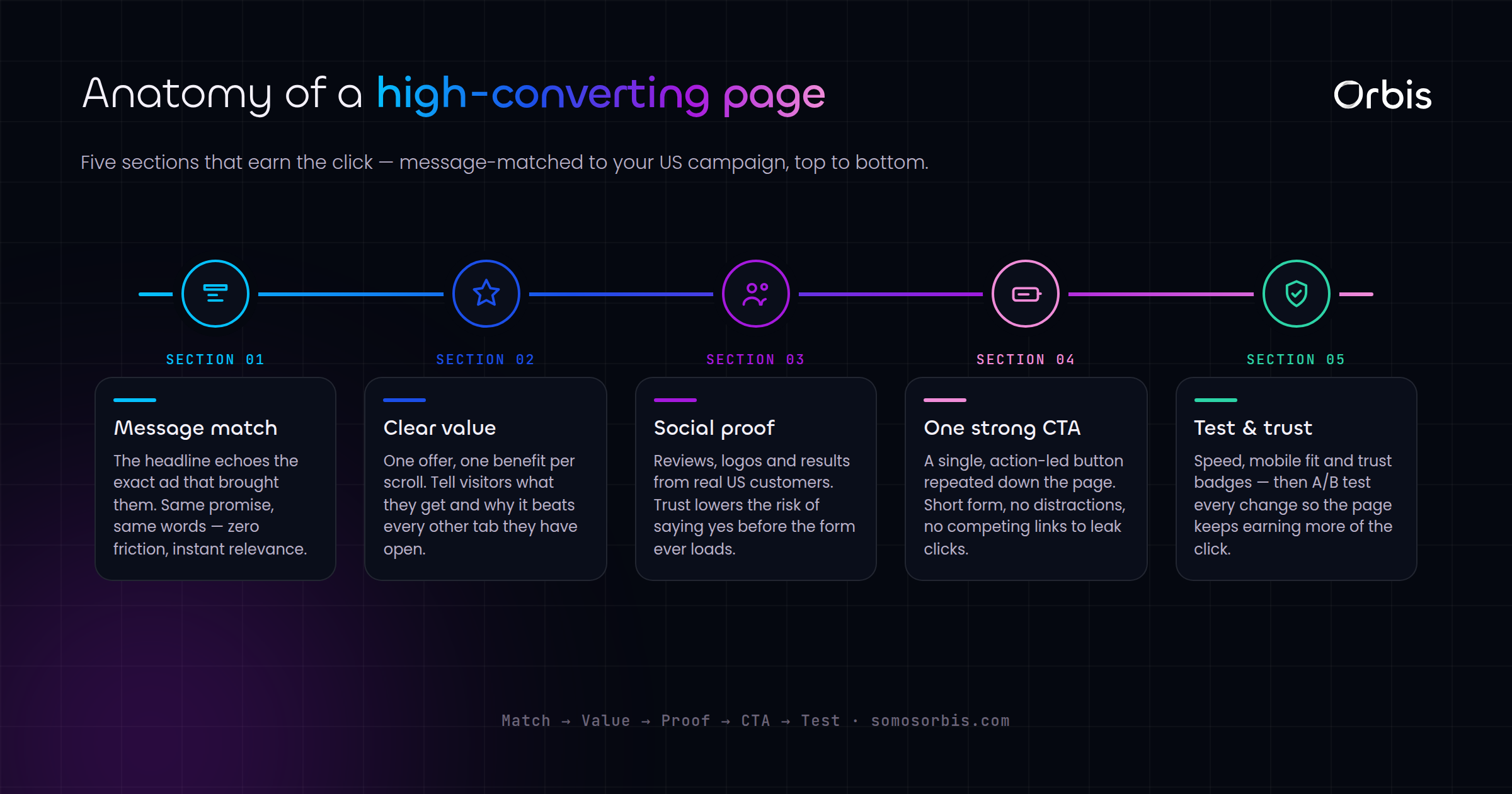
The anatomy of a high-converting landing page
Most pages that convert well share a recognizable skeleton. You do not need every element on every page, but you should make a deliberate choice about each one.
1. A focused above-the-fold zone
The first screen must answer three questions in seconds: What is this? Why should I care? What do I do next? That means a benefit-led headline, a one-line subhead clarifying the offer, a single primary call to action, and one supporting visual. Resist the urge to cram. The fold is for clarity, not completeness.
2. A single, repeated call to action
One page, one goal. If your objective is demo requests, every CTA button should say the same thing and lead to the same form. Mixing "Buy Now," "Learn More," and "Contact Sales" on a single page splits attention and dilutes results. Repeat the primary CTA at natural decision points: after the hero, after social proof, and at the end.
3. Benefit-driven body copy
Lead with outcomes, not features. A Houston logistics buyer cares that your software "gets trucks loaded 30 minutes faster," not that it has a "real-time dispatch module." Translate every feature into the result it produces for the visitor.
4. Social proof that fits the audience
US buyers are skeptical and comparison-driven. Proof lowers their risk. Use real, specific signals: customer logos, star ratings, review counts, certifications, and short testimonials with a name and role. Orbis, for example, can point to a Google Partner badge, a 4.9-star rating across 58 reviews, more than 500 clients served, and over 15 years in business. Concrete numbers beat vague claims like "trusted by many."
5. Objection handling and risk reversal
Every visitor has a reason not to act. Anticipate the top three and address them on the page: pricing transparency, a money-back or satisfaction guarantee, a short FAQ, and clear next steps after they convert. Reducing perceived risk is often worth more than another benefit bullet.
6. A frictionless form
Ask for the minimum you need to follow up. A name and email or phone is enough for most lead-gen offers. Every extra field costs you conversions. If you genuinely need more data, collect it after the visitor commits, not before.
Speed and mobile: non-negotiable for US paid traffic
A large share of US paid clicks now happen on phones, especially from Meta, Instagram, and TikTok. If your page takes more than a few seconds to load, a meaningful portion of visitors leave before it even renders, and you paid for every one of them.
Prioritize these technical fundamentals:
- Load speed: Compress images, defer non-critical scripts, and keep the hero lightweight. Slow pages bleed both conversions and ad rank.
- Thumb-friendly design: Large tap targets, a sticky CTA button on mobile, and forms that are easy to complete one-handed.
- Readable without zoom: Generous font sizes and short paragraphs. Walls of text die on small screens.
- Fast forms: Enable autofill, use the correct input types so the right keyboard appears, and never make mobile users pinch to find the submit button.
These same principles carry directly into commerce, where every fraction of a second affects revenue. If you are optimizing checkout-driven pages, our guide to e-commerce website design for higher US conversion goes deeper on speed, trust, and cart-stage friction.
Bilingual EN/ES landing pages for the US Hispanic market
The US Hispanic market is one of the largest and fastest-growing consumer segments in the country, with significant buying power in metros like Los Angeles, Miami, Houston, Dallas, and Chicago. Yet most advertisers route Spanish-speaking clicks to English-only pages, then wonder why those campaigns underperform.
If you serve bilingual audiences, build dedicated EN and ES landing page variants rather than relying on auto-translation. A few principles:
- Translate intent, not just words: Spanish copy should feel native, not machine-rendered. Idioms, tone, and the offer framing all matter.
- Match the ad language: A Spanish-language ad should land on a Spanish page. Mismatched language is the most jarring message-match failure of all.
- Localize proof: Where possible, show testimonials or signals that resonate with the specific community you are reaching.
- Give visitors control: A clear EN/ES toggle respects bilingual users who may prefer to switch.
Bilingual variants are not a nice-to-have for many US advertisers. They are how you capture demand competitors leave on the table.
US seasonality: build pages for the moments that matter
US buying behavior spikes around predictable moments, and your landing pages should be ready for each one. Generic evergreen pages underperform during peak windows because they fail to match seasonal intent.
- Black Friday and Cyber Monday: Dedicated pages with the specific offer, urgency, and countdown. Shoppers in this window decide fast; remove every obstacle.
- Amazon Prime Day: Even if you sell off-Amazon, the deal-hunting mindset spills over. Competitive offers framed around savings convert well.
- Back-to-school: Family and bulk-purchase framing for retail and services in late summer.
- Tax season: Financial, accounting, and high-ticket purchase pages benefit from refund-timed messaging early in the year.
Build these pages in advance and stage them. Scrambling to launch a Cyber Monday page on the morning of Cyber Monday is how budgets get wasted.
Privacy and trust in US campaigns
US consumers are increasingly aware of how their data is handled, and privacy norms shape conversion. A landing page that asks for personal information without visible reassurance raises hesitation, particularly for higher-consideration offers.
Make trust explicit. Link to a clear privacy policy, explain what happens after the form is submitted, and avoid asking for sensitive data you do not need. Respecting visitor choices around data collection is not only good practice under current US privacy expectations, it directly supports conversion by lowering perceived risk. This is part of building under quality processes and current regulations by design rather than as an afterthought.
Test, do not guess: the optimization loop
The best-performing US advertisers treat landing pages as living assets. They form hypotheses, run controlled tests, and let data decide. You do not need massive traffic to start; you need discipline.
What to test first
- Headline: Usually the highest-impact element. Test benefit angles against each other.
- Primary CTA: Button copy, color, and placement all move numbers.
- Hero visual: Product-in-use versus abstract, real photography versus illustration.
- Form length: Fewer fields almost always lifts completion; confirm it for your offer.
- Social proof placement: Above the fold versus mid-page.
How to run a clean test
Change one variable at a time so you know what caused the difference. Let tests run long enough to reach a reliable result rather than calling a winner after a handful of conversions. And tie the metric that matters, qualified leads or sales, not vanity clicks, to your decision. A page that lifts clicks but lowers sales is a loss.
The campaign gets the click. The landing page earns the customer. If you optimize only one of them, optimize the page, because that is where the decision happens.
A practical build checklist
Before you push paid traffic to any US landing page, confirm the following:
- The headline matches the ad promise word for word in spirit.
- The offer is visible above the fold without scrolling.
- There is one primary CTA, repeated, with no competing actions.
- Real social proof appears early: ratings, logos, certifications, numbers.
- The page loads fast and works flawlessly on mobile.
- The form asks only for what you genuinely need.
- Bilingual EN/ES variants exist where the audience warrants them.
- Privacy and trust signals are present and honest.
- A clear test is queued for the next iteration.
Tick every box and your paid traffic stops leaking. Skip a few and you are paying premium US click prices to underperform.
Where landing pages fit in your broader web strategy
Landing pages do not live in isolation. They share design language, trust signals, and technical standards with the rest of your site. The strongest results come when your campaign pages and your core site reinforce the same brand and the same conversion discipline. For the full picture of how modern US sites should be built, see our complete web design guide for US businesses in 2026, the pillar that connects this and our other web design guides.
Turn your paid traffic into real revenue
A great campaign deserves a page that converts. If you are spending on Google, Meta, TikTok, or any US channel and your landing pages are not pulling their weight, Orbis can help you fix that. With over 15 years of experience, more than 500 clients served, a 4.9-star rating across 58 reviews, and Google Partner status, we build pages around documented processes, revenue engineering, and compliance by design, so your spend produces leads and sales, not just clicks.
Ready to build pages that convert? Explore our landing page design service and let us turn your next campaign into measurable results.