
The US holiday season is not a single weekend. It is a ten-week revenue window that starts before Halloween and does not close until the last guaranteed-shipping deadline in mid-December. Advertisers who treat Black Friday and Cyber Monday as the only days that matter end up overspending on the most competitive auctions of the year while leaving cheaper, high-intent traffic on the table in October and early November. The brands that win do something less glamorous and far more profitable: they plan their USD budget across the entire calendar, week by week, channel by channel, and they defend their margins when CPCs spike.
This guide walks through how to build a holiday PPC budget for the US market, from Amazon Prime Day in the summer through Black Friday, Cyber Monday, and last-minute gifting. It is written for operators who want a documented, repeatable plan, not a scramble. If you want the full strategic context behind these tactics, start with our complete paid media guide for US advertisers in 2026 and treat this article as the seasonal playbook that sits inside it.
Why holiday budget planning is a margin decision, not a spend decision
During Q4, cost-per-click on retail keywords in the US can rise 30% to 80% above your baseline. Every advertiser in your category is bidding harder, Amazon is buying its own branded terms, and the auction gets crowded fast. If you walk in without a plan, two things happen: you either cap your budget too early and miss the days that actually convert, or you let an automated bid strategy chase volume at a return on ad spend that quietly destroys your margin.
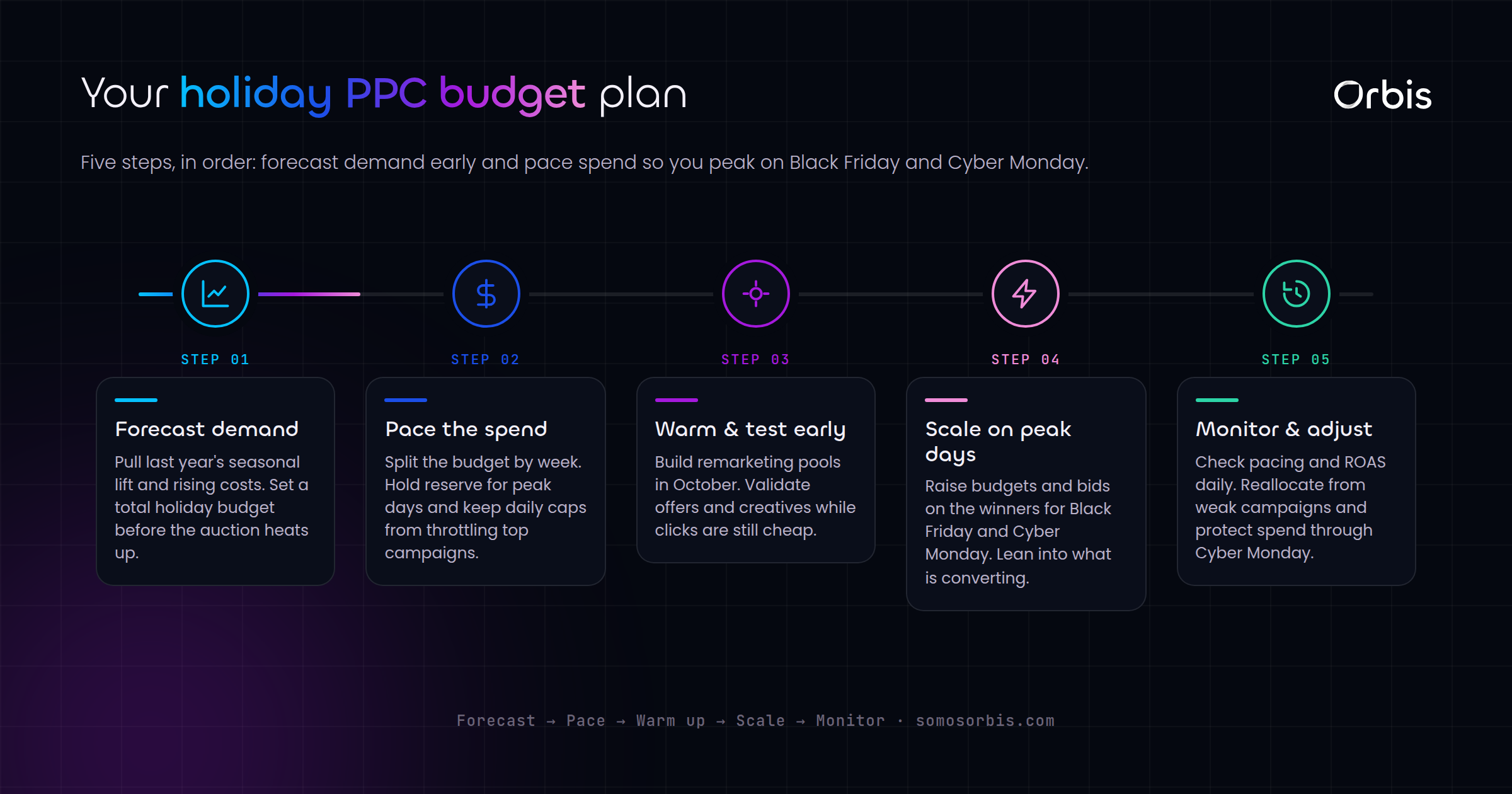
The fix is to plan backwards from contribution margin. Before you allocate a single dollar, you need three numbers:
- Your true break-even ROAS for the holiday period, accounting for higher return rates on gifts and any promotional discounting you plan to run.
- Your inventory ceiling by SKU, so you never pay to acquire demand you cannot fulfill before the shipping cutoff.
- Your last-click and assisted-conversion split, so you know which campaigns are prospecting and which are harvesting demand you already created.
When you know your break-even ROAS, the daily budget decisions stop being emotional. A campaign at 3.2x ROAS on Black Friday might look worse than your 4.5x October average, but if your break-even is 2.4x, you are still printing margin and you should push more budget into it, not less.
Map the full US holiday calendar before you build the budget
The single biggest mistake we see is treating the season as one event. The US calendar has at least five distinct demand phases, and each one deserves its own budget posture and creative.
Phase 1: Amazon Prime Day and the summer signal (July)
Prime Day in July is the unofficial start of US holiday behavior. Even if you do not sell on Amazon, deal-hunting intent spikes across the open web, and it is the cheapest moment of the year to test your holiday messaging. Use July to run small-budget experiments on offers, audiences, and landing pages so that by November you are scaling what already works instead of guessing.
Phase 2: Back-to-school and the fall ramp (August to early October)
Families in New York, Chicago, and Dallas are spending on back-to-school in August and September, and that purchasing momentum bleeds directly into early holiday research. This is the window to build your remarketing audiences cheaply. Every dollar of prospecting you spend here lowers the cost of the demand you harvest in November.
Phase 3: The pre-Black-Friday build (mid-October to mid-November)
CPCs are still reasonable, but intent is climbing. This is when you grow your retargeting pools, seed your Google Shopping feed with your strongest sellers, and capture the early researchers who are building gift lists. Shoppers in Miami and Los Angeles start browsing weeks before they buy, and the advertiser who shows up during research often wins the eventual purchase.
Phase 4: Cyber Week (Black Friday through Cyber Monday)
This is the auction peak. Budgets should be uncapped within your ROAS guardrails, not constrained by a flat daily limit. We will cover the mechanics below, because this is where most plans break.
Phase 5: Last-minute gifting and the post-holiday tail (December)
From December 1 through the shipping cutoff, intent stays high but the audience shifts to procrastinators who will pay full price for guaranteed delivery. After the cutoff, pivot creative to digital gift cards, e-delivery, and January gifting. Tax season research also begins quietly in late December, which matters if any of your offering touches financial or organizational services.
How to allocate the USD budget across the season
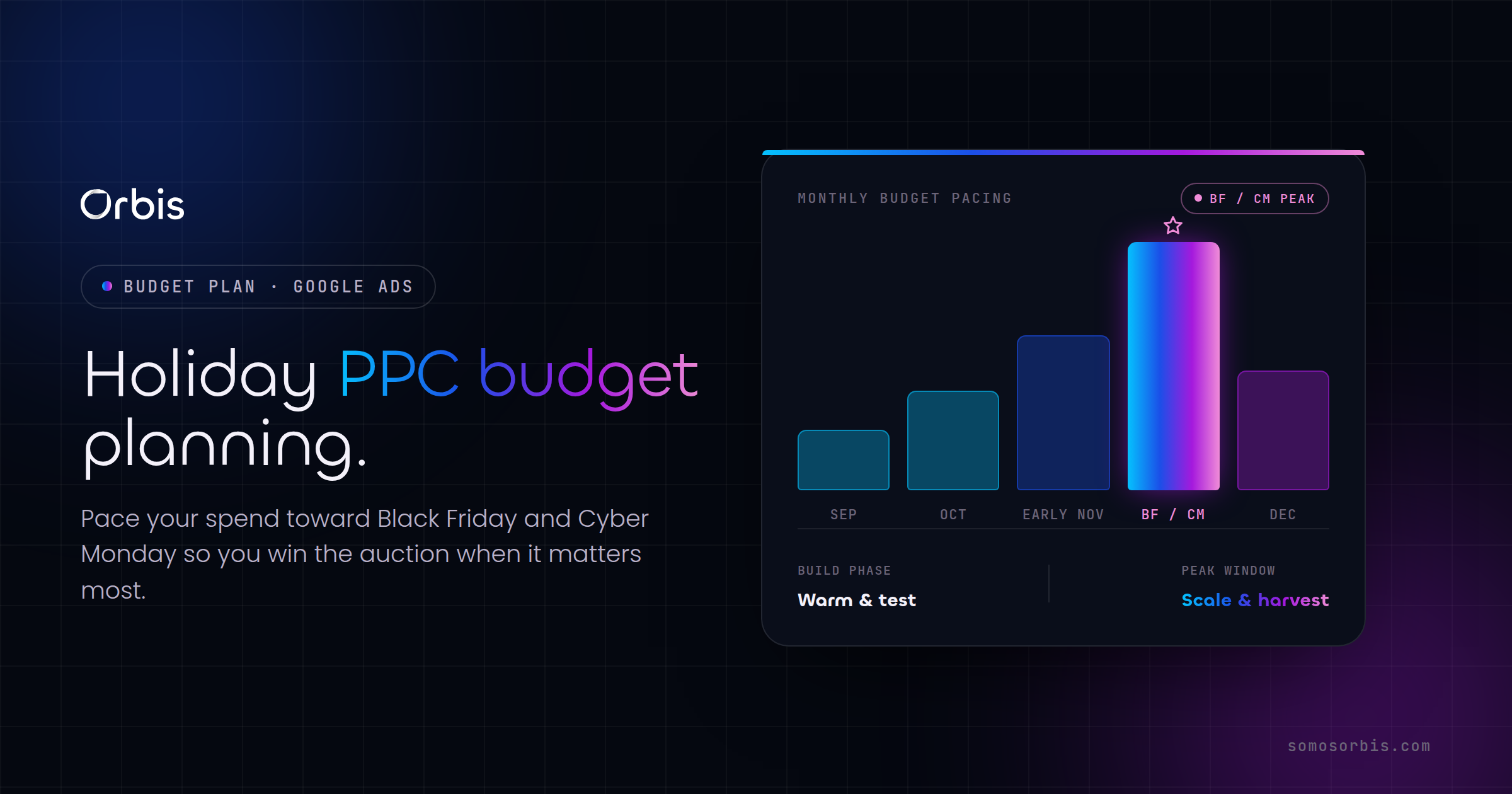
A common and costly error is to dump 70% of the Q4 budget into Cyber Week. That feels intuitive, but it ignores how demand is actually created. A more durable allocation looks like this for a typical US retail advertiser:
- 20% to 25% in the pre-Black-Friday build (mid-October to mid-November): this is your demand-generation and audience-building budget. It is the cheapest traffic you will buy all quarter.
- 35% to 40% during Cyber Week: concentrated, but not the whole budget. You are harvesting demand here, and harvesting is more efficient than creating, so the dollars stretch further than the raw competition suggests.
- 25% to 30% in the December gifting tail: margins are often best here because discounting eases and intent stays high.
- 10% to 15% held in reserve: a flexible pool you deploy where ROAS is strongest in real time. Do not pre-spend this.
Notice that this is not a peak-and-collapse curve. It is a build, a concentration, and a sustained tail. The reserve matters more than people expect, because the season never plays out exactly as forecast and the advertiser who can move budget on day three of Cyber Week to the campaigns that are overperforming captures outsized return.
Budget pacing inside Cyber Week
Within Black Friday and Cyber Monday themselves, intraday pacing decides whether you capture the high-converting windows. US shoppers convert in waves: a morning spike, a midday lull, and a strong evening surge after dinner across the Eastern and Central time zones. If your daily budget exhausts by 4 PM, you miss the most profitable hours. Use bid strategies that allow spend to follow conversion probability, and monitor budget burn hourly during the peak days rather than reviewing it the next morning when the money is already gone.
Channel mix: where each dollar works hardest
Holiday budgets fail when every channel is treated the same. Each one plays a different role in the season.
Google Search: harvest the high-intent buyer
Search is where you capture people who already know what they want. During the holidays, Google Search Ads deserve the largest share of your harvesting budget because the intent is explicit. Protect your branded terms aggressively in Q4, since competitors and resellers bid on them hardest when buying intent peaks. Expand your non-brand coverage on gift-oriented and deal-oriented queries, and make sure your ad copy reflects the actual offer and the shipping deadline, because urgency converts.
Google Shopping: win the visual comparison
For any retailer with physical products, Shopping is the workhorse of the season. Shoppers compare images, prices, and reviews side by side, and a clean, complete feed wins those comparisons. Before October, audit every title, image, and attribute. A well-optimized feed lowers your cost per click because relevance improves your placement. We cover the mechanics in depth in our guide to Google Shopping feed optimization for US retailers, and it is worth reading before you scale Shopping spend, because feed quality multiplies the return on every dollar you put behind it.
Paid social and remarketing: stay in front of the researcher
The early-November researcher who browsed but did not buy is your most valuable December audience. Use the build phase to grow those pools, then retarget them with the specific products they viewed once your promotions go live. Reaching the large US Hispanic market is often a missed opportunity here: bilingual EN/ES creative on social can dramatically lower acquisition cost in markets like Miami, Los Angeles, Houston, and Dallas, where a meaningful share of holiday shoppers respond more strongly to Spanish-language messaging. Test it early so you can scale it during Cyber Week.
Measurement and compliance without losing your nerve
Two operational realities will shape your results more than your creative does.
First, attribution gets noisy in Q4. The path from first touch to purchase lengthens, and last-click reporting will undercredit the prospecting you did in October. Before the season, agree internally on the attribution window you will judge campaigns by, and resist the urge to cut a prospecting campaign mid-season just because its last-click ROAS looks weak. It is doing the work you cannot see.
Second, US privacy norms now shape how you can target and measure. With CCPA and CPRA-style expectations in play across many states, lean on first-party data, server-side measurement, and consented audiences rather than fragile third-party signals. Treat compliance as a design constraint you build in from the start, not a cleanup task. A measurement setup that respects consent is also more durable, because it does not collapse when a browser or platform changes its rules mid-campaign.
The advertisers who keep their nerve in Q4 are the ones who decided their guardrails in September. When the auction heats up and CPCs spike, they already know their break-even ROAS, their inventory ceiling, and the attribution window they trust. They are not making decisions under pressure. They are executing a plan.
A practical pre-season checklist
Before the first cold front hits, work through this list. None of it is glamorous, and all of it compounds:
- Confirm your holiday break-even ROAS by product category, including expected return rates.
- Map inventory ceilings by SKU and exclude anything you cannot ship before the cutoff.
- Audit and clean your Shopping feed: titles, images, GTINs, and attributes.
- Build and segment your remarketing audiences from back-to-school traffic onward.
- Pre-write and pre-approve promotional ad copy and shipping-deadline messaging.
- Set bid strategies that allow intraday pacing to follow conversion probability.
- Define your attribution window and lock it so no one panics mid-season.
- Verify consent and server-side tracking are firing correctly before traffic scales.
- Reserve 10% to 15% of budget as a flexible pool for real-time reallocation.
- Prepare bilingual EN/ES creative for high-Hispanic-population markets.
Bring it together with a documented plan
Holiday PPC rewards preparation over reaction. The brands that grow margin in Q4 are not the ones with the biggest budgets. They are the ones who mapped the calendar, allocated USD across all five demand phases, defended their ROAS guardrails when CPCs spiked, and held a reserve to push into whatever overperformed. That is the difference between buying revenue and engineering it.
This is exactly the kind of work where documented processes and revenue engineering pay for themselves. If you want a holiday plan built and managed against your real margins, our team can help you structure and run your Google Search Ads program so your peak season is profitable by design, not by luck. Talk to Orbis about building your Q4 paid media plan before the auction heats up, and walk into Black Friday with a strategy instead of a scramble.